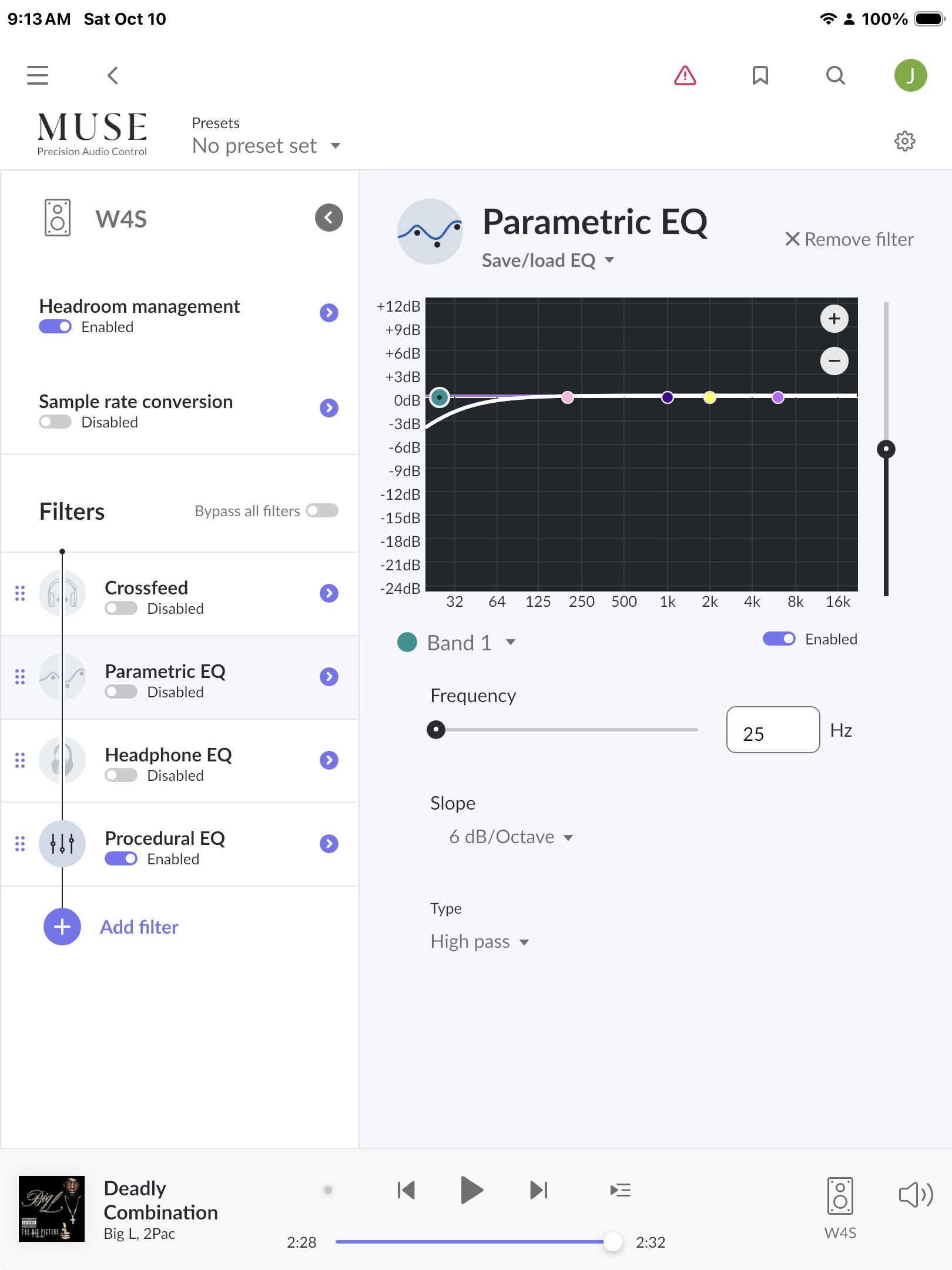
· this is what happened, and i want to know if the AI settings suggestion is correct. these speakers were new and I have been in contact with wyred4sound in regards to their equipment; first they have heard of any of damage to speakers like described has happened.
Tell us about your home network
· I have a wyred4sound system, st-500 amp, stp-se preamp, MS streamer, and DACv2 I happen to be streaming music off Roon and using my Tidal library i played a house tune, https://tidal.com/track/60853510/u Plat. Doug Cream; this track has a very low bass intro, and just at volume level 14 on the preamp, i blew the right channel woofers on the 896. I google'd AI and Grok AI and it seems to point to EQ settings on Roon. Has anybody had this issue? I never thought about damaging speakers at low-moderate volume. I have an order for replacement speakers but want to fully understand how this could happen. Google AI gave me instructions to do a trouble shoot on the amp speaker outputs, 2.4 mv, and with amp off ohm check, 59.9 and 60 ohms, I don't think it's was the amp and leaning towards the Roon EQ set up.
this is what AI gave me.
If you utilize the Wyred 4 Sound MS as your Roon Core Server, Roon’s ultra-powerful internal MUSE DSP engine can perfectly handle this task before the audio ever reaches your STP-SE preamp and ST-500 amplifier. [1]
Open your Roon Remote app on your phone, tablet, or computer. Tap on the Volume/Zone speaker icon in the bottom right corner. Click the Gear icon (DSP) to open the MUSE settings panel. Click Add Filter and select Procedural EQ. Click Add Rule and choose Parametric Equalizer. Set the filter type to High-Pass (sometimes called Low-Cut). Change the Frequency to 25Hz or 30Hz. Leave the "Q" or slope at its default smooth setting (usually 12dB or 24dB per octave). This will seamlessly shave off dangerous subsonic energy without affecting your audible bass.
What EQ settings did you use? If you just lower the volume in certain frequency bands, e.g. to reduce a bass boom, it can’t damage anything. This is the generally recommended approach with EQ.
However, it you have a room mode that creates a deep valley in a certain bass band because the sound waves cancel each other out at a certain point in the room, and you try to fill this valley by creating a large EQ amplification in this band, then there is potential of damage to amps and speakers. The same happens if you try to boost the bass below the range the speaker is physically capable of.
However, usually this occurs at high volumes that already started to approach the physical capabilities of amps and speakers, where an additional large bass boost takes it beyond. It seems unlikely at low-mid volumes. On the other hand, if you pump a bass band by 30 or 40 dBs or whatever, it may still happen at lower volumes depending on the gear. You would normally visually notice an extreme excursion of the speaker cone and audible distortion, though. (Though perhaps no audible distortion if you boost very low volumes below the speaker’s physical limit).
This occurs because if the sound waves cancel each other out in a certain bass band due to the room geometry, this cancellation will always occur, irrespective of how much energy you pump into this frequency band. Or if you boost below the physical limit, the speaker simply cannot reproduce these frequencies, at least not very well. If you continue to increase the EQ push in such a band, eventually the amp will give up (twice the volume requires 4 times the power, 4 times the volume requires 16 times the power) or the maximum physical excursion of the speaker cone will be exceeded. If the amp already started to distort, it increases the probability of damage caused by large physical excursions.
However, this would mean essentially the same apportion of blame as simply listening too loud and/or turning the bass dial of old-style amps too high for the capabilities of the gear.
Whatever your gear is set up and your settings besides roon’s EQ were done. For sure, you can blow up speakers in case you simply send too much energy to them. But, you have to know the limits for any setting in any gear or app. That’s your very own responsibility.
I don’t see how roon should be able to help you here.
Following AI advice more or less blindly is NEVER a good idea since LLM AIs are NOT confirmed knowledge bases or even experts as MANY believe.
And if mankind continues to believe so, our whole world will get blown up rather sooner than later. That’s the utter truth
Sorry to hear about the woofers, that is a rough way to break in new speakers.
We pulled logs from your Roon Server to check what Roon was doing on that zone. We found two plays of “Cream (Radio Mix)” by Platinum Doug on your W4S zone, on September 6 and on October 4. For both, the logs show:
No EQ was active. Parametric EQ was turned off, and the only DSP setting enabled was Headroom Management.
The Signal Path was the TIDAL stream at 16 bit / 44.1 kHz, converted to 32 bit / 44.1 kHz and sent to your Wyred 4 Sound DAC over USB, with no other processing.
Roon was not controlling volume on that zone, so the level was set only by your STP-SE.
The Parametric EQ with a 25 Hz high-pass filter was added on October 6, after that playback. That filter only reduces content below 25 Hz and does not boost anything.
Since Roon passed the track through without any boost, we would suggest following up with Wyred 4 Sound and the speaker manufacturer, as they are best placed to check the amplifier and the drivers.
the volume level was low, on 14 on preamp. i haven’t stressed the speakers, so i was looking at what could cause the issue. i know a lot response don’t seem to address the sub sonic bass tone that this particular track had, and there are settings on Roon to address this. i simply want to know it this makes sense. the amp is on its way to wyred4sound for a check up and i’ll find out more, but to be clear, the amp has levels of protection built in, so it shouldn’t happen. thanks for the reply.
ok, to be clear, i didn’t change any settings when i used roon, so the changes that i did were post speaker damage when i went online to find an answer. the volume was low to moderate, only 14 on preamp, so the question is with roon and no setting changes to a new install of this app, does it make sense to employ this changes to armor against this happening again? a subsonic bass being sent from tidal through roon app to my amp and through my speakers?
To be fair, the topic title together with the opening post made a bit difficult to understand what the question was. I took it as asking whether DSP can damage speakers.
Was it very low or subsonic? Because in your first post you wrote:
“Subsonic” usually means a frequency too low to be heard (below 20 Hz), but I can’t see anywhere what speakers you have, except you mentioned “the 896”. The only speakers I find with this designation are Canton Vento 896 DC. According to the very incomplete specs on the Canton site, they go down to 20 Hz but they don’t say what the attenuation is at this frequency. Given the size, I very much doubt that they go flat to 20 Hz.
Anyway, most likely they won’t reproduce “subsonic” bass in any meaningful way. So, creating a DSP in Roon that attenuates the very low frequencies won’t hurt and may serve as protection against truly subsonic bass. But I wouldn’t roll it off starting at 100 (!) Hz as your screenshot showed:
This is just crazy and will make the sound generally worse. No normal use of the volume knob will damage speakers between 30 and 100 Hz.
However, I have never heard of any track (that isn’t designed to do it) destroying anything (except if listening too loud into amp distortion territory). A speaker naturally rolls off at the deep end according to its physical capabilities.
But I remain confused because I have now listened to the Cream (Radio Mix) by Platinum Doug on TIDAL (both mixes) tracks and I can’t hear any very deep bass intro at all, certainly not “subsonic”, on my rather big speakers that are measured at -3 dB at 22 Hz and -6 db at 19 Hz. In fact, the start of the track has barely any bass at all, it comes in a little later and is not at all unusually deep or high volume. I also checked this with a frequency analyzer on the phone, but of course this may be limited by the built-in mic.
So, all in all I don’t really understand what you mean. Based on what I hear and see, there is nothing in this track that may be expected to do damage.
Thanks for clarifying. We understand now that none of the DSP changes were in place when the woofers failed, and that you want to know whether adding them now makes sense as protection.
Short answer: yes, a gentle subsonic (high-pass) filter is reasonable insurance, and it won’t do any harm if it’s set correctly.
A few notes:
Set it around 20–25 Hz, not 100 Hz. As @Suedkiez pointed out, rolling off from 100 Hz cuts real bass your 896s are built to play and will make everything sound thinner. A filter in the 20–25 Hz range only trims content below what the speakers can usefully reproduce.
Keep Headroom Management enabled. It’s already on, and it stops Roon’s DSP from clipping if you add EQ later.
Don’t expect too much from it. When you played that track, Roon passed TIDAL’s stream to your DAC unchanged and wasn’t controlling volume, and other listeners haven’t found anything unusual in that track’s low end. A subsonic filter guards against extreme low-frequency content, but it can’t prevent damage caused by an amplifier fault, a loose or shorted connection, or a defective driver.
Since the amp is already heading back to Wyred 4 Sound, their findings will be the most useful piece of this. If they report anything that points back to the signal coming from Roon, please share it here and we’ll look again.