Is McGowan Running for Office?

From what can see the mastering suite is optional if you want it. I haven’t tried it. Maybe poor recordings benefit. I listen to historical reordings. Maybe they benefit.

But isn’t RAAT the difference? In general it is Maestro that is passing an URL to the endpoint whilst the roon core is disassembling the stream with RAAT wrappers which must then be decoded and reassembled at a roon-ready end-point. That’s a lot of what roon ready is. Assuming the current version of Maestro does not really have a network control layer and that’s why in my tests (you can try for yourself) it seems so unresponsive then I cannot see how some kind of network control can be avoided. But it would have to separate control from the audio stream somehow to differentiate from roon.

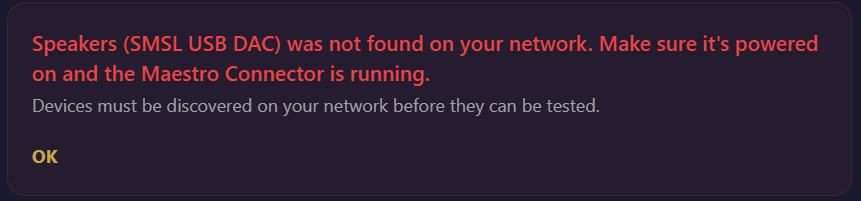
Not really. A USB DAC on an endpoint doesn’t expose any network protocol, it’s just a local device accessible through UAC. There has to be a local service on the endpoint that exposes some network protocol, and that’s Maestro Connector, as this message suggests:

So yes, audio will flow through Maestro when you use USB devices.

No Maestro spec. service on endpoint. It’s just UAC which provides access and format support.

Like any other app that makes use if USB Audio.

The Maestro Connector is obviously a part of the PC/Mac software responsible for connecting and using an endpoint in the background. It’s not running on an endpoint.

But I see it’s getting a bit more complicated Maestro is able to stream audio signals, at least with the “Mastering Suite” which can apply DSP in several ways.

Seems to be some kind of fallback in case UPnP/DLNA is not supported on an endpoint.

Anyway, their marketing is either heavily (wrong) suggestive in case of direct handoff or simply false in case of “Mastering Suite”.

The folks on Audiophile Style are trying to get to the bottom of it as well. This is a lengthy response from Paul McGowan to Chris Connaker. My takeaway is that the Maestro Connector currently supports at least UPnP and Openhome and will fallback to simple HTTPS URL exchange if the endpoint supports that. Those are explicitly mentioned. He also makes the point that the Maestro approach is to support the native protocols of the streamer like Audirvanna or JRiver rather than requiring an additional software layer like roon ready.

Chris —

The sentence you quoted is doing the work badly, so let me say it plainly. “The computer” in it means a Mac or PC in your house. Not a tablet, not my servers.

Maestro is two pieces. The interface is delivered from the web, which is the part RichardSF describes as cloud-based, and it’s why updates land without a reinstall. The other piece is a native program called the Connector that you install on a Mac or PC (and soon a iPad or Android). The Connector holds your Qobuz session, opens the HTTPS connection to Qobuz, and decrypts the stream there, on that machine. It then serves the audio to your streamer over your own LAN. Nothing about the music touches my cloud, and nothing leaves your network unencrypted. My servers do accounts, metadata, and the control channel; they never carry audio. So no contractual problem, and no proxy in a remote control.

Now the part you called ambiguous, because it’s the part I actually care about.

When a streamer talks to Qobuz directly, its own little CPU does everything: the TLS handshake, the decryption of every packet, the HTTPS fetch across the internet with its stalls and retries, the buffering to cover them, and only then the audio. Those are hard, bursty jobs, and inside the box the audio clock and DAC are sitting next to the processor doing them. My argument, which you’re welcome to test with your own ears, is that a streamer sounds best when it does as little as possible: read a plain file off a fast, quiet local link and play it.

So Maestro’s Connector takes all of that off the streamer. The computer does the internet side, decrypts the stream, and serves your streamer a plain file over the LAN through the streamer’s own native path, UPnP or OpenHome, in the format the box asks for. The streamer isn’t proxied through anything exotic; it’s reading a local file, the way it would from a NAS. Same for your local library, which the Connector serves the same way.

That is also the answer on Roon. Roon Core does the same internet work on a computer, but it then re-wraps the audio into its own transport, RAAT, and asks the endpoint to run Roon’s software stack to receive it. It’s a fine system, and it’s why Roon Ready exists. I’m doing the opposite: no protocol of my own, the streamer’s own path, nothing added on the box. Audirvanaand JRiver are closer to me than Roon is; the difference there is what the app around it does, which is the part I’m still building, as Richard fairly says.

The upcoming iPad and Android apps are the same idea with the Connector built into the app instead of installed on a computer. The tablet holds the Qobuz session, does the internet side and the decryption, and hands the streamer a plain file over the LAN by the same native path; or, plugged into a DAC over USB, it is the player, and there’s no other box in the chain at all. What a phone or tablet can’t do is stay awake all night as a server for every room, because the operating systems put apps to sleep. So for a whole-house setup you’ll still want something that never sleeps: a computer today, and later a small always-on box built for nothing else. The mobile apps get you out of the “PC required” business for the listening you do in front of them.

Where a streamer can fetch an HTTPS URL fine on its own, Maestro can simply hand it the direct Qobuz link and step aside. And yes, today it needs an internet connection and a computer. Not a PWA.

I’d rather you tried it than took my word for any of this.

Paul
I believe this to be wrong, or at best, misleading. The stream isn’t wrapped up, it’s PCM and not a file as it is with Maestro, which needs decoding. Moreover, Maestro is using a protocol–UPnP, OpenHome etc.

What RAAT does is promote honesty regarding audio. Can the same be said of Maestro?

1 Like

How do you know that? On both Windows machines I installed Maestro on, I can see these processes:

image

There’s a Maestro service running besides the UX. Also, as I said before, the ‘exclusive’ switch is a Maestro setting, so there has to be an app that knows about Maestro’s settings and opens the WASAPI device in exclusive mode. That’s enough evidence for me that a Maestro app is driving UAC devices.

1 Like

Endpoint meant to be the rendering device, i.e. external, DAC, streamer, etc., not any kind of controlling PC running the Maestro software which includes the “Connector” software :slightly_smiling_face:

And there is more to come. The optional “Remastering” DSP function seems to be completely cloud based.

But how can that work? The stream must be “wrapped” in some way. There is no such thing as raw, continuous PCM over a local network. Roon have been quite clear about this and taken it down a couple of layers in earlier forum posts when they were much more active. There appear to be two layers of this.

First, the raw PCM is chunked into dynamic RAAT frames in the application layer. Its a completely custom process I would characterise as Layer 7.

The protocol is completely custom, i.e. it is not an application or adaptation of a pre-existing system like RTP/RTSP.

Moreover, the chunking is dynamic so that produces a specific computational workload on the endpoint. Roon couldn’t be clearere on this:

RAAT uses a dynamically defined network protocol . . . Dynamically defined network protocols present a different workload than inflexible ‘baked-in’ protocols, and also a different workload than decoding media.

Second, the RAAT frames are packetised for transport over TCP/IP in the network layer. That must be Layer 4.

We use TCP to move the audio… allowing us to offload work associated with re-assembling the packetized audio stream from RAAT to the operating system kernel on the audio device

There isn’t much choice about a lot of this except the design decisions about how to distribute the processing. Or as Linn put it when discussing on the forum roon ready certification:

Roon Ready uses a protocol called RAAT which was created by Roon. Implementing RAAT requires running a substantial block of code from Roon on a streamer… RAAT makes assumptions about Operating System and available memory that match most of the market but are incompatible with earlier DSMs

All players are going to have to do similar things but there are design choices about where code is distributed and whether it makes a difference. As far as I can see Maestro, Audirvana, and JRiver choose to use the streamer’s native factory firmware (like standard UPnP/OpenHome) to read incoming data. Roon, takes a different approach requiring the endpoint to deploy some kind of roon ready process to unwrap its custom RAAT protocol. Otherwise, what is the purpose of RAAT, what is it doing?

It’s important to remember that Roon doesn’t always use RAAT. Roon tested devices don’t use it. And devices like the Meridian 218, (still a current device) which I use, are based on Sooloos architecture, from which Roon originally evolved.

2 Likes

The point is that Roon does not encapsulate the PCM. That is what is sent to the device (a device doesn’t need to do anything else once the stream is received from Roon Bridge or Roon Ready firmware.) RAAT is about audio distribution plus two-way signalling for a streamer or DAC to control volume, play, pause etc. So, yes, of course RAAT uses TCP/IP and its own protocols.

In contrast, Maestro requires the streamer to download the track and decode it before passing to the DAC. Yet McGowan implies that Roon RAAT impacts sound “quality” because Maestro doesn’t “touch” the stream. This is all a ruse since more processing is performed in the zone than with RAAT (and I’m not even going to get into the discussion about whether this really matters.)

However, this is all getting rather dull. It would be far better if McGowan spent some time explaining how Maestro works (for the different capabilities withing streamers) and provided something concrete regarding his claims. Instead, he has chosen to make this a head-to-head with other products without offering up anything tangible or consistent to support his claims.

6 Likes

If Maestro “Remastering Suite” really relies on a cloud based DSP service I’d rather doubt that this won’t lead to significant UX flaws.

Since each time a track is triggered to be played (instantly) the audio data has first to be transferred to the cloud service where it’s being processed before sending it back to the consumer to be played.

Even if you assume some buffer for a few pre-processed tracks, this won’t work seamlessly for the consumer. Because whenever the consumer triggers a skip or manually selects a track somewhere from the library, the cloud approach will fail UX wise, at least if it’s about local track files.

For internet streaming music this might work a bit differently, but the UX lag will be there. Cloud based DSP in total is not nearly without lag. It’s by far not in realtime.

I currently have no idea how this cloud approach could ever be satisfactory for a consumer. And for sure this cloud wouldn’t hold your whole library as pre-processed.

So… regarding their marketing…

  • As long as direct handoff is used they can easily say “we don’t touch the audio data, we don’t even see it”. Check.
  • Whenever they rely on something different they have to send the audio data itself. So, “don’t touch” gets a different meaning here, i.e. “we see and transmit it, but we don’t alter it”. Fine.
  • If “Remastering Suite” is invoked, they touch/see and actually change the audio data. Completely different situation. Well, nothing is actually untouched here. But… their fallback marketing argument is active here. The audio processing is done far away from your home and your gear. So, it cannot cover the signal with all this unpleasant dirt.

It all somehow sounds like a weird product implementation.

Ah, and with rather small internet bandwidth or even without internet no DSP. That would be the consequence.

In case the cloud resources must be extended or the cloud provider increases their prices Maestro subscription costs may increase quickly as well.

You may ask yourself what came first…?

  • A business idea
  • A marketing idea
  • A product idea
  • A technical idea

Still unsure how they actually figure out what to do next.

2 Likes

I don’t know where this idea is coming from.

Just because a FLAC file has been decompressed in layer 6 doesn’t mean there is no upstream PCM encapsulation in layer 7. There is encapsulation up and down the OSI stack to move payloads including PCM over an IP network and vendors make different choices.

Roon explicitly says that RAAT is “completely custom, i.e. it is not an application or adaptation of a pre-existing system like RTP/RTSP.” To me, RTP and RTSP are application layer (layer 7) encapsulation protocols. RAAT is roon’s proprietary version of this, also in the application layer.

Maestro must be doing something similar by taking the exact same PCM payload and instead chooses to encapsulate inside standard UPnP or OpenHome application-layer frames.

Both architectures ultimately wrap these frames inside standard Layer 4 TCP/IP packets to physically transport across the network.

When you strip it all away, as far as I can see the Maestro claim boils down it using the streamers native firmware, whilst roon and Connect use an additional software process on the endpoint to perform de-encapsulation / device management / signalling etc. and that makes a difference to SQ. To me that’s an empirical question.

You said Roon re-wraps up. It does not.

If you cannot resist hooking up your Cosmos ADC, are you able to measure phase? I do hear differences at this location but its random. Sometimes I prefer Maestro, sometimes roon, sometimes no preference. With some tracks its not subtle, particularly noticeable I found with 70’s album rock, much less so with recently recorded Classical. So, I tried inverting phase in roon and that evened everything up to the extent I would have no confidence of getting a blind right. I have a better system in another location but I won’t be there for some time.

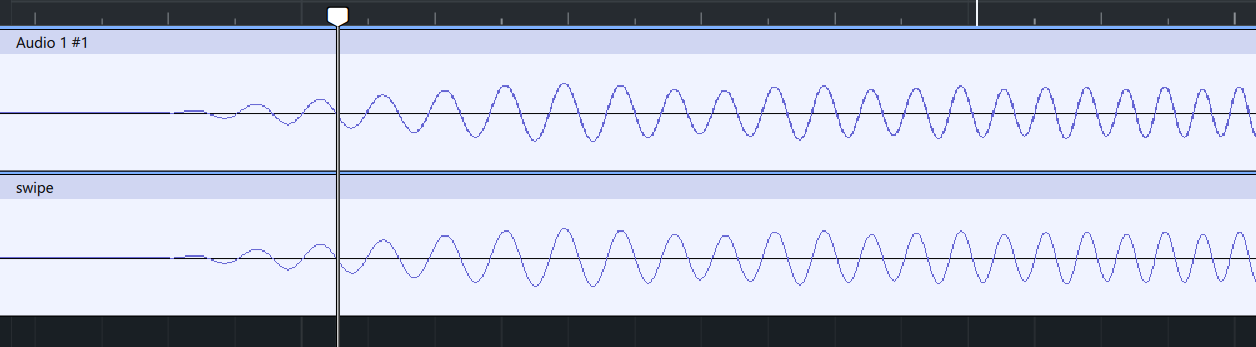
There’s no need for Cosmos. Besides, I haven’t yet tested if Cosmos doesn’t change phase itself. I did better: I played a sine sweep in Maestro and used loopback recording in Audacity. (Maestro sees fit to take forever to scan a one-file local library btw. I had to add many files to be able to play the one I wanted). I don’t see any phase inversion:

Wow! If only McGowan had revealed that Maestro sometimes corrected phase for certain 70s album rock and, as I’ve also noticed, many of the more obscure Django Reinhardt recordings, versus RAAT, I would have switched over earlier. My spidey-sense, though, has this deep-dive FUD working overtime to mask the failure of Maestro to demonstrate SQ improvements. Let me repeat: demonstrate.

It is…

1 Like

Yes. A lot of usability issues with Maestro for sure. That’s my experience as well.

Good to see absolute phase inversion eliminated although I seem to remember Floyd O’Tool saying it couldn’t be heard in normal listening rooms because of reflections. Most manufacturers, including roon, know this, so what they actually mean is polarity inversion. The terms are used interchangeably. So to eliminate that, my understanding is what is needed is an asymmetric rather than a symmetric waveform. You’ve probably had enough of Maestro at this stage but these days an AI can generate the python.

Now it may not be polarity inversion at all. It’s just that in my environment it sounds a lot like that. Its a very characteristic tightening of the base and pushing forward of mid-range vocals that many prefer. There are probably a lot of ways of achieving a similar effect, including accidental and unplanned and its personally a stretch for me that Maestro has been deliberately “voiced” in a certain way.

1 Like

Thanks for this. Are you able to do a null test? Or at least capture the output of maestro and raat out of the dac using your cosmos and upload the files?

I can’t do RAAT, I have no subscription. I am willing to spend a little time, but no more money. I can do LMS vs. Maestro, post the outputs and start a poll to see if anyone can tell which is which. Let me know if that would work. Also, do you have any track preference? Should be on Qobuz, at least 10 tracks, preferably 20. My Maestro trial expires on the 24th btw, so after that, Maestro will be dead for me forever.

Thanks again. I believe any well recorded track would do. For me, no need to overthink.

With LMS, would you use to upnp plugin, the squeezelite protocol, or go straight usb?

Are you able to do Qobuz direct also?

Also, it would be very nice if roon could grant you a 1 month license for this. It would help put this discussion to sleep.