That would be nice indeed, but last year there was Diretta, now it’s Maestro, and next year there’ll be Conductor, then Performer etc., all of them pretending they sound better because they send the packets in zig-zag instead of circles, so I might end up with a lifetime license.
ok. Got my hands on a Cosmos. I have a MSB cascade dac, with a network renderer module (MSB made). Recording is made in 32bits, 96khz. Playback obviously using raat or upnp, as the case may be.
Get Maestro to work was a bit of a pain. several reboots needed, interfacing lagging. Using the 30 days trial.
I recorded qobuz and local, same song (Paper Airplane, from Alysson Krauss). The local is 96khz, and qobuz is 44.1khz.
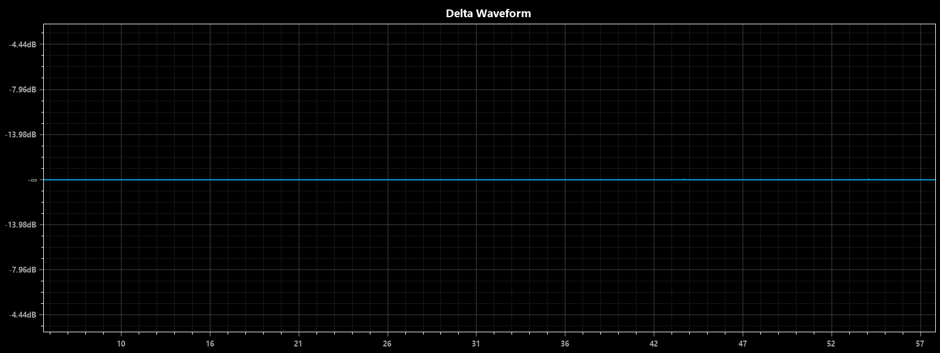
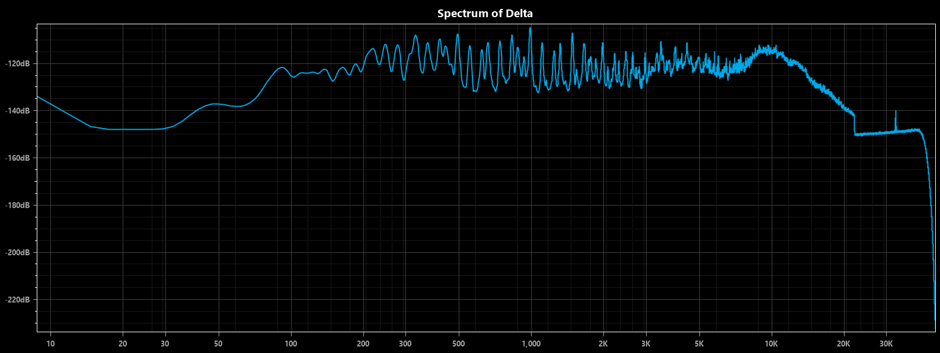
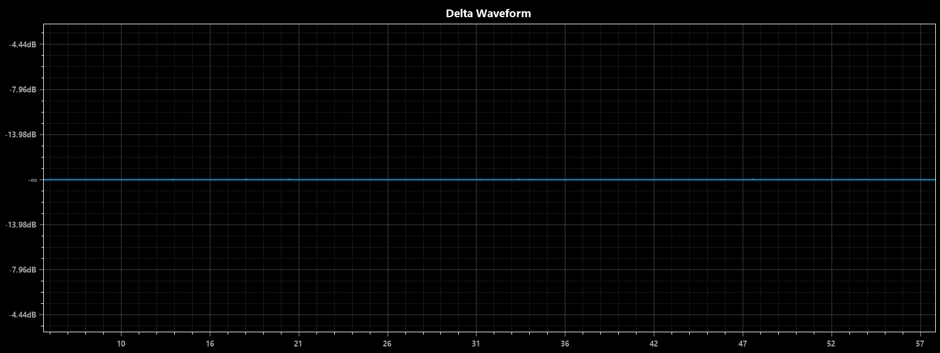
I then run the recordings through deltawave software. And guess what. It nulls almost perfectly.
This is the waveform of the difference of roon vs maestro wth the local file
Thank you so much for doing this and for posting the proof. Great work. I am sure that Paul will come up with a reason that even though there is no difference in a null test, they somehow sound different.
Null tests can also show that with power cables, interconnects, speaker wire, USB cables, network switches and power conditioners there are no differences. Doesn’t mean anything to audiophiles.
He already did, in the video linked by the OP. And people who believed him will probably continue to believe him, because bits are not bits and measurements are for geeks, or just because he said so.
While I can imagine someone arguing against “synthetic measurements” (1khz signal at full scale etc), I find it pretty impossible to argue against a null test of a 110 seconds clip of a real music file captured at the dac output. But, as others have said, one beliefs are treated as absolute.
I must say I have a soft spot for PSAudio. My very first amplifier was a BHK300, and I learned a lot from Ted smith. But the software player claim crossed a line for me that I cannot look the other way.
If the theory is that the difference is due to “software noise” or “transmission jitter”, using special signals like a sine wave or J-test should clearly show those two phenomena, better than real music, as they should be independent of the actual contents.
Yes. I completely understand. My point was that comparing using a null test gives a result against which it seems impossible to argue.
My take: digital has made the equipment audio hobby boring. Everything will sound the same with competently designed electronics, only change coming from room and speakers (and source material of course).
Th hobbyist needs to tinker. Even if to change nothing. C’est la vie.
But a commercial pitch using characteristics that are known to be irrelevant to the final results is borderline (if not completely) dishonest.
I keep watching McGowan’s videos because they seem to be ground zero for all the latest and greatest unproven audiophile claims. Kinda like a heads up for all the nonsense which will eventually make it into posts on the various audio forums, like this one.
W
By watching some of the various YouTube audio reviewers I’ve “learned” that stand alone streamers and DAC need external reclockers and master clocks but all in one units, like the EverSolo DMP-A8, don’t need these devices! The lack of even a hint of scientific rigor is just mind blowing. Since most of these reviewers are hoping to get their hands on some really expensive high end audio gear (for free, of course) perhaps their willingness to help spread audiophile nonsense serves a purpose and shows that they are not going mess things up with science.
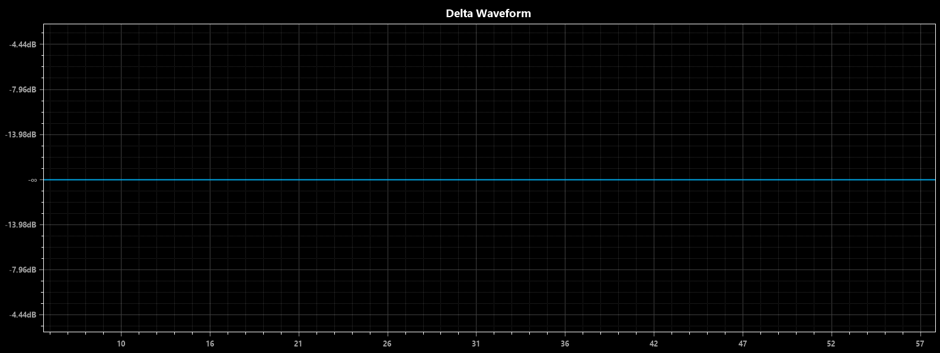
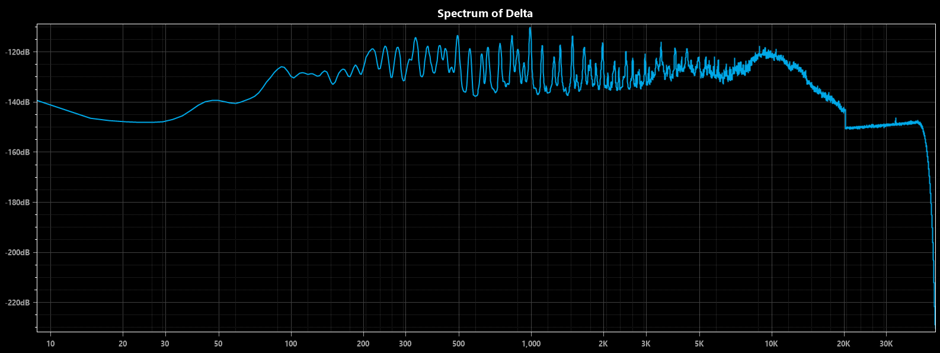
Weeeelll (as he says) I nulled Qobuz and local file both played through roon. Perfect null. I even nulled local file playback and Qobuz direct. Perfect null also. Nothing to see (or hear) here.
I sometimes feel guilty when I present the idea that you can’t trust your ears to friends who are heavily invested in power conditioners, fancy cables etc., and one friend in particular who has one of the big PS Audio power plants.
I feel like I’m ruining their fun with the idea that you can’t switch off the expectation bias in your brain that dictates there must be a change in the sound if you’ve made a change in the set-up. They simply can’t conceive that such a thing exists.
And - even if there were differences - these things would be so far down the food chain after the speaker-room interaction (massive) and the speaker-amplifier relationship (much less big, still important) - they would be vanishingly small.
The whole Maestro thing (didn’t they have an earlier abandoned attempt at this called Octave?) seems to me just to be an attempt to grab a few sales from established rivals. It’s a shame to me as PS Audio make nice equipment (I do rather like my PS Audio phono stage).
Yes, they had a project named octave that was ditched. Octave after became their record label.
The funny thing is that the products do have a function. Maestro will play your files (although still being very early in development, in the experience I had). Power regenerators can really help regulate the voltages (for instance, my home voltage is 127v, and the power regenerator that I had was able to keep it at health 115v avoiding additional stress to capacitors).
The thing is when they extrapolate to claims of sound quality. These are unsubstantiated and can really hurt.
Finally, as per your main point, I totally agree with you. The hobbyist seems to always need to pursue tweaks to make things better, and does not have the disposition (or the means) to really invest in the room-speaker relationship. If you sum it to the preconceived idea that eq is always bad (also very unsubstantiated) you end-up with fertile ground to these claims of sound quality.
Actually thought I would just mention that your statement is not correct. As there were three players and 20 sample tracks the 95% confidence level is 11 out of 20, the 13 preferences I recorded for 1 player gives a 99% confidence for what it is worth… or could of course be the sacred geometry of chance…
How did you work that out? The most likely outcome of random guessing is 10 out of 20, so that’s zero confidence. Binomial probability for that is 17.6%. Getting 11 only reduces the probability to 16%, so it can’t possibly boost the confidence from zero to 95%.