| Brand | Synology |
| Model | DS1821+ |(CPU AMD Ryzen V1500B, 4 (quad-core), 2,2 gHz)
| NAS OS Version | DSM 7.2.2-72806 Update 4 |
| Total Installed RAM | 64 GB Crucial Micron (2× MTA18ASF4G72HZ-3G2R) |
| Roon on NAS Method | Roon on NAS (installed directly in storage pool using NVMe SSD) |
| Main Drives: Brand | Seagate |
| Main Drives: Model | IronWolf |
| Main Drives: Quantity | 6×8 TB |
| Main Drives: RAID Configuration | SHR2 |
| Roon DB Drive: Brand | Synology |
| Roon DB Drive: Model | SNV3410 M.2 NVMe SSD 400GB |
| Roon DB Drive: Size | 400 GB |
| Roon DB Drive: Connection Method | Main Board |
| SSD Cache | 2 TB SSD read cache (SANDISK WD Red SN700 NAS SSD – 2TB – PCIe 3.0 – M.2 2280) |
| Local Area Network Connection Method | Ethernet via Ubiquiti EdgeRouter X and UniFi APs |
| Number of Local Tracks | 586,991 |
| Total Size of Locally Stored Music | Just under 20 TB |
| Number of Streaming Service Tracks | 0 No streming services ONLY local files on NAS |
| Geography | Sweden |
| Dedicated to music use? | Yes |
| Using in Parallel with NAS Vendor Music Solution? | No |
| Using ARC? | Yes (though rarely used due to persistent dissatisfaction with performance and reliability) |
| Using DSP? | Yes (resampling for some zones like WiiM and JBL) |
| Typical Number of Simultaneously Used Playback Zones | Usually 1–2 zones active; up to 5 zones in DSD256 can be used without issues. Of these, 2 zones play native DSD256 and 3 zones are resampled to lower bitrates. |
| Overall Rating**** | Everything flawless |
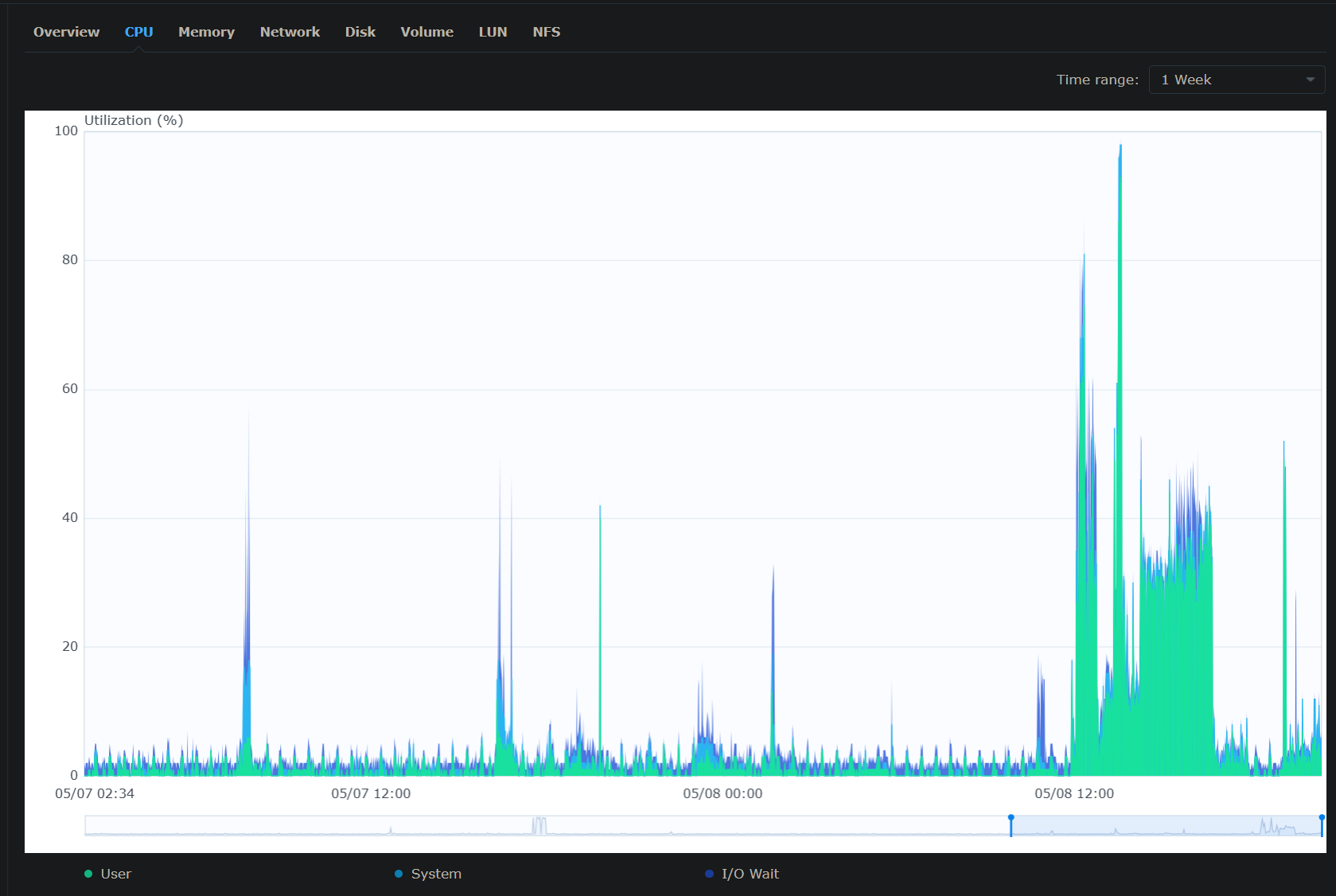
Under typical usage, Roon Server consumes 1–3% CPU and approximately 18 GB ±2 GB of RAM. During stress testing with 5 simultaneous zones, including resampling, CPU usage peaked at 20%, yet playback remained smooth and stable.
Navigation within the NAS interface is highly responsive — playback begins within a fraction of a second after issuing a command. Adding or removing playback zones typically takes 4–5 seconds for the NAS to update and resume.
For security, no ports have been opened to expose the NAS directly to the internet. Instead, Roon ARC is accessed via Tailscale, ensuring secure remote connectivity. That said, Roon ARC has never met expectations. It’s rarely used, primarily due to unreliable performance over mobile networks and a general lack of responsiveness. Despite secure routing via Tailscale, the server-to-client connection has not been consistently robust, and overall, ARC has been disappointing.
On rare occasions, performance has become slightly sluggish — commands and navigation slow down noticeably. In such cases, restarting the Roon Server software has resolved the issue. A full restart cycle takes approximately 10–15 minutes.