As a May user I also have my PCM moments. Even had NOS moments yesterday while comparing LPs from around 2006 to digital counterparts. The paradox is that HIRES doesn’t benefit from NOS while technically it gets less horrendous. I wonder if some recordings are/were mastered with NOS DACs for monitoring. Look for example to Elvis-Costello & Allen-Toussaint – The River In Reverse ; the LP has the magic dynamic drums/bass compression that appeals me ; sort of so had the Qobuz stream in NOS, clearly, beyond matter of flavour I think, much more punchy bass than SDM route. This CD was mastered at Mastering Lab, using Sherwood Sax in house electronics ; NOS DAC in the monitoring ? Would it make sense that monitoring DAC has an influence and that reducing the “circle of confusion” means using a NOS DAC at playback if the monitoring DAC was NOS ? Could this be extended to PCM vs DSD debate ?
I recommend using the -2s version for DSD output. It will eventually complete initialization, but it may take more than five minutes, depending on conversion ratio.
Maybe, in particular if you have 48k DSD + Adaptive rate enabled and rate limit set to 48k multiple. For conversion between rate families with the non-2s version will take longer to initialize.
You should use same filter for both cases, also -2s version counts as the same filter.
I would also look into modulator choice on this. Have you tried for example ASDM5EC-super?
Thanks @jussi_laako , I’ll try that 5EC super modulator and see how that goes for me.
I did try the non -2s version on DSD for fun, took maybe 15 minutes to start playing! So, will try the -2S
Long time listener, first time caller…
I have been wrestling with HQP for several years and trying to find the “right” filters (even building spreadsheets tracking albums and their best filters) and while I often did get titillated I was never fully satiated.
Then a couple weeks ago I stumbled into HQP’s EQ capabilities. It’s been life changing.
I’ve been an ostrich to EQ to this point in my listening career even though its likely where we should all start. It appears digital music is mixed for both high end equipment and the lowest common denominator, i.e. small blu-tooth speakers in mono. EQ fixes that.
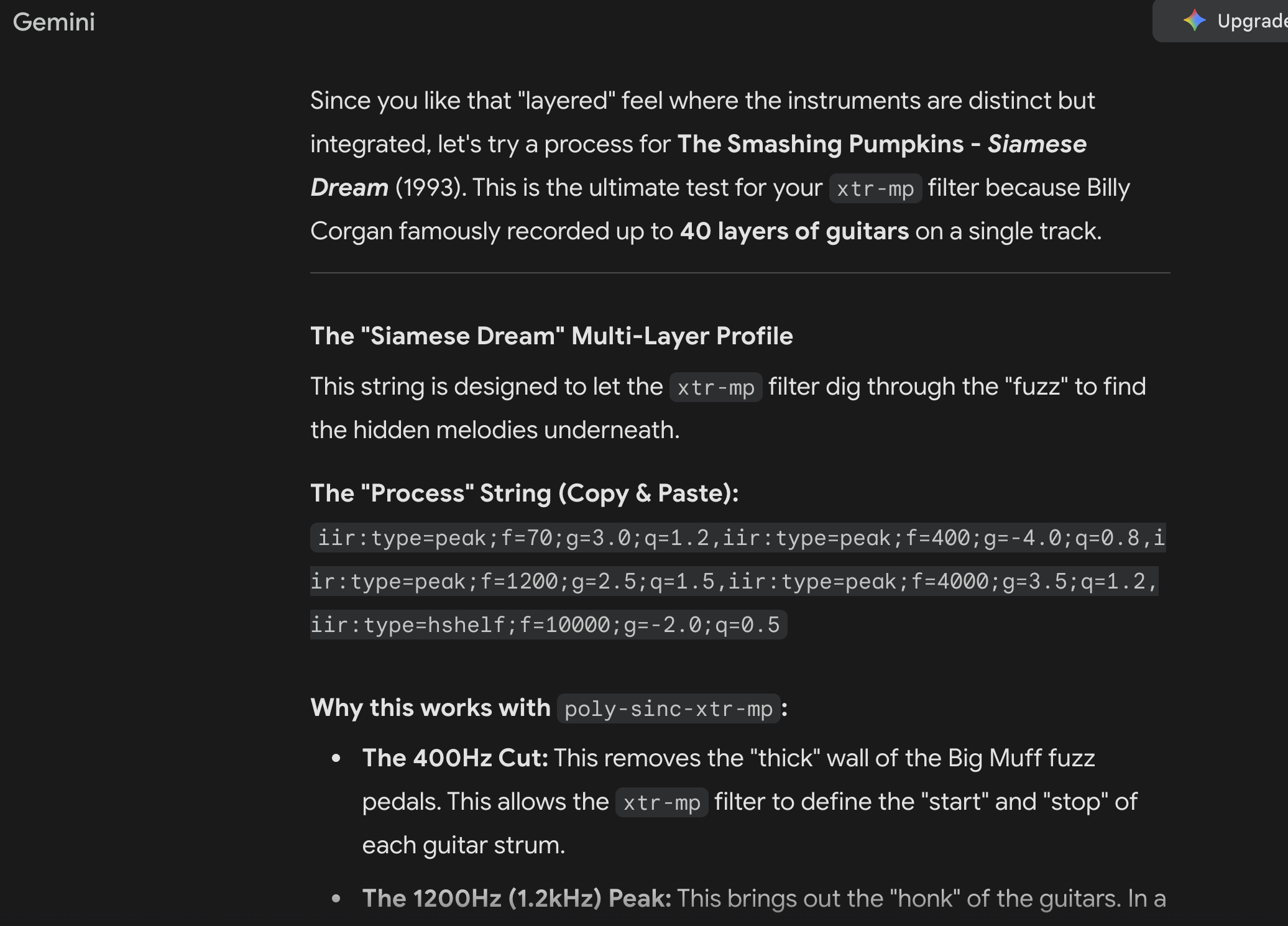
That being said, I barely understand it. But AI does. And I have been banging away at Gemini (see screenshot) and generating process strings (EQ settings you put in the Matrix profile) as I try to build my own intuitive understanding. But I don’t know if I’ll ever as be as good as the machines; if you don’t like the sound of the EQ you get from AI, then tell it what you want to hear, i.e. bring the guitars more forward, balance the instruments, or mix the vocals more with the instruments (useful if you like noisy 80s/90s alternative rock), and it will spit out something more to your liking.
In short: its a great time to be alive.
I decided to stop swimming upstream and switched to PCM with my Chord Hugo 2 (and soon TT2). The synergy is better with PCM, and the XTR filters along with the EXT3 are sounds so consistently right now. And I have run the gamut with the filters over the past few years.
I know I should haven’t known better than to do DSD with Chord products but there’s so much to like with that format.
Absolutely agree.
As a HQP/Naa user, I use the EQ with parameter display (wav file curves) in the HQP pipeline.
The effects of EQ are incredibly beneficial, as much as, if not more than, HQP for me.
I don’t use AI for this, but I opted for the Focus Fidelity solution, which allows for proper EQing by taking into account the audio system and the characteristics of the listening room. Ultimately, the difficulty lies more in choosing the target curve and its characteristics according to personal taste. Switching to EQ has truly boosted my listening pleasure. Everyone has their own philosophy on EQ; some are for it, and others against.
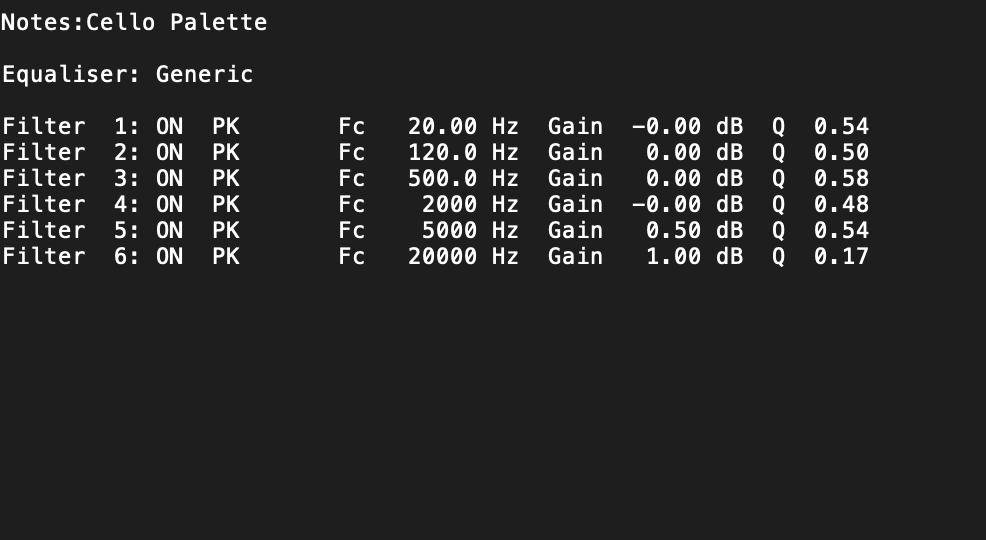
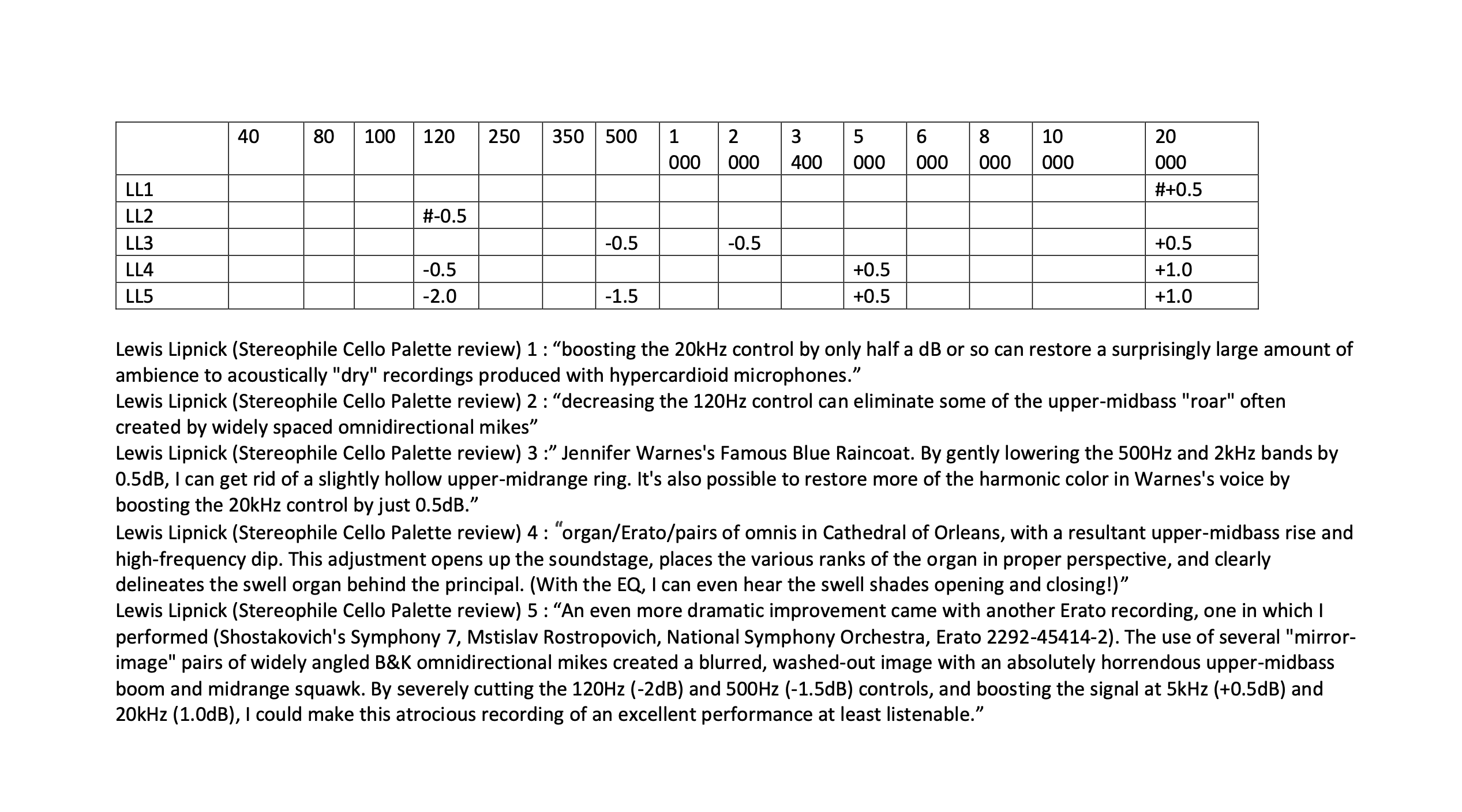
I wish you would elaborate more on how, practically, you use AI. Do you feed it with a microphone or does it pick from a base of mastering eQ recipes ? In the latter case you might find interest in the attached. What looks OK in your strings is the use of broad Qs, 2 to 1 bandwidth. This can come on top of DRC of course. I think that is what @MilJL87 is referring to but that’s two different things. If you haven’t tried DRC, beware of very bad advices on certain forum, flee any recommendation of eQing for your speakers in room beyond 5/600 Hz and start by googling for how to implement Virtual Bass Array, thanks to @OCA .
I also wish @jussi_laako would share his knowledge of the kind of DACs presently and historically present in mastering rooms. See my post above asking : “Would it make sense that monitoring DAC has an influence and that reducing the “circle of confusion” means using a NOS DAC at playback if the monitoring DAC was NOS ? Could this be extended to PCM vs DSD debate ?”
It’s not about denying NOS technical inferiority, it’s about taking into account that if a mastering has been monitored NOS, with treble roll-off then, you get too much treble with a linear DAC at playback. Plus there are subtleties in the presentation of NOS vs OSed PCM or DSD that could justify, beyond subjectivity, that a CD is better rendered NOS or PCM. That’s an application of @Floyd_Toole 's concept of “circle of confusion”, thus not limited to FR of speakers in room. Just yesyerday I appreciated NOS a RVG remastering, those being often

Practically all monitoring DACs are typical delta-sigma DACs. These days either what is built into the mixing board, or hardware from Avid ProTools Carbon, Merging Hapi, or RME interfaces like M-32 / M-16 DA, M-32 Pro II and M-1620, etc.
I doubt there are any notable number of recordings in the world mastered through a NOS DAC. Only maybe some of the very very first RedBook masters from the early 1980’s.
I would be much more worried about the loudspeakers used for mastering… 
Thank you, no rational then ; yet May’s NOS makes, at its theoretical technical worse, some 16/44.1 more palatable IMO.
While I have your attention : I’m now using AHM7EC8B @1024 for weeks and it’s 99% glitch free as far as I can hear (most major HQP issue for me is, sometimes, loud “bangs” when switching between PCM and SDM routes) and I don’t think I became deafer. Yet, if I pause play, thus no CPU overload, no loss of packets cause nothing is supposed to be transferred, I get the static I complained months ago. Happens just now, after I paused between 2 Beethoven’s quartets ; so no heavy metal masking… It’s even worse if I choose another modulator but keep 1024 rate (no music processed, no cpu overload or packet loss…) ; still there, but less, with, say, paused FAST/512 ; paused FAST/256 is clean. Explanation ? troubleshooting suggestion ?
If you get such with fast at 512 speed, but not at 256 speed, then the DAC is not keeping up for some reason. Holo Audio DAC SNR drops about 3 dB in audio band going from 256 to 512, but this is not audible, as it is well beyond 100+ dB. While the ultrasonic noise drops by some 10 - 20 dB. I assume you are using USB input of the DAC?
If you are using I2S instead (not recommended), please check that you have PLL enabled. As otherwise the clocking error may grow enough that you get such results. (if you get noisy DSD output, it may be due to a clocking issue)
thank you
ethernet to Holo Red, USB from Red to May
OK, quite weird… Are you running NAA OS on the Red? And the ethernet cable is CAT6(a) U/UTP type? (IOW, unshielded with plastic body connector ends)
Please also check that 802.3x flow control is properly supported and active on the network. As otherwise packet loss and related resends may overload the Red.
The big novelty with Tahoe is that “full duplex, flow control, energy efficient” now sticks. That was a rational for the disappearance of annoying statics while listening to music. The “static” now sounds like the “tic” when switching tracks or modulators, except it’s random, continuous (but not dense), sometimes more a channel than another… and only noticeable when HQP is paused (no traffic)
I think I have Red OS for yours did not solve the issue in the past and added the issue of stooping in the middle of a movie viewed via IINA
CAt 6 UTP ethernet from Studio to switch (HPE you recommended ) and from switch to Red but possibly Cat 5 UTP cheapos that came with ISP box/switch between Time Capsule and ISP box and the HPE switch (should matter only for Qobuz if it matters at all ?)
Small ticks that sound like dust particles on vinyl are usually lost or corrupted USB packets. These cause 125 µs long glitches to the audio that sound just like those dust particles.
I would look into trying another USB cable, one with official USB HiSpeed Certified badge.
Both Red and the DAC are connected to the same earthed mains feed? So that there is no possibility of ground current flowing through the USB cable. USB ground at Holo Audio side shouldn’t be connected to the main PE though (the USB interface in there is isolated).
But this certainly sounds like some USB transfer / clock issue in the DAC.
Was it a managed or unmanaged one?
Thank you so much ! What do you mean by “USB ground at Holo Audio side shouldn’t be connected to the main PE though” ? PE =Protective Earth ? Yes, Both Red and Holo are connected to the same earthed Supra mains block (Supra power cable too). Do you mean I should disconnect Earth on the power cable feeding the Holo DAC ? Or do you mean I should identify and cut USB ground on the USB cable ? At the moment I use the USB cable I got with my first Holo, a Spring. No label on it. Sold the Supra for I heard no difference but can order a new one. 1m 2meters does not matter ?
The HPE is the one you suggested, unmanaged : Aruba HPE OfficeConnect 1420 5g - Commutateur - Non géré - 5 x 10/100/1000 - de Bureau gris
Yes…
This should be perfectly fine.
No no! Just that the USB connector body shouldn’t be electrically connected to the PE (through the chassis) at the DAC side, as the USB interface in Holo Audio DACs is isolated. While it is likely connected to PE at the Red side. Any ground currents flowing through the USB cable shield can disturb the USB transfer, so considering grounding of the entities involved in the overall system is important troubleshooting aspect.
The issues you’ve seen with NAA OS also indicate towards either network or USB issue.
Those may be pretty random quality. I’ve had some issues with the cable’s I’ve got with Topping/SMSL DACs, so usually I try to avoid using such.
It doesn’t matter, what ever fits your use, but preferably maximum length of 2m. I recommend to check that the cable has the official USB HiSpeed Certified badge. Such cables are typically not expensive, some 10 - 20 EUR range.

Thank you ! just ordered a 1m Supra ; couldn’t find any other on Amazon with the badge… I’m not 100% confident though since swapping for a Belkin that was certified, me think, did not help. But that was back then when there was the ethernet flow control issue
Etching your NAA image at the moment, will keep you posted of results with Supra I should get by end of the week, thanks again
Promised feed-back : mystery thickens. I first noticed the nasty return of static at idle but now it’s 100 % there with AHM7EC8B @1024 that I just can not use. Aiming at a firmware issue ? 32 fs PCM is also plagued. remember 1024 was a second thought for the May… but others enjoy it and they can’t all be deaf and not notice static… Holo’s or your’s OS for the Red doesn’t change the issue, nor the Supra cable. BTW, I’m not sorry I ordered it : might have had serious bias issue when I sold the one I had and kept the Holo provided one ; guess the jargon in Stereophile and al would be : less congested and more authoritative (tested only on Adele’s Skyfall).
I’m sorry to report that I’m back on Red OS, yours causing issues (picks Red streamer as output instead of NAA, eventually with nasty continuous tone) when I select USB as May’s input after I used the optical input (sources with no way to synchronise audio and image)
You have NAA OS, and what is the hardware you are running it on?
Likely DSD1024 won’t work there…
This is likely the problem…
Ahh, just get another DAC for video use. Or use VLC for playback which allows you to adjust the sync.
I love my Kuro 500 plasma (modified, still 1080p but, in particular, high lights are now limited only by technology, not by environmental norms – I use it only a few hours per week) and Infuse does a pretty good job at mapping HDR 2160 but does not offer sync. . I would recommend IINA over VLC when sync is not required.
The issue of not picking the right output after switching from Optical to USB input does not exist with Holo provided OS… Or do you mean having an optical cable connected to the DAC is a liability causing the static to be revealed at 1024 or 32 fs ? I disconnected the Optical cable and that does not make the static disappear…
For weeks I had nice 1024 without glitches with Red OS on Holo Red hardware… Plus I did the test months ago when we first investigated static issues : old MBAir booted on your image had the static issue too…