I dug a bit deeper and started to realise that this is a can of worms. Traditionally, getting under the hood of something like this means access to a music copyright and/or IP lawyer. Of course, these days, just like a new generation of human musicians, the first port of call is also AI, so musicians are not the only ones in the music industry under threat. This is what Google Gemini has to say:
In professional licensing catalogs like Sonoton Music, tracks from the “My Documentary” brand (catalog code MYD) are categorized as functional tools for film editors rather than artistic albums for listeners.
Professional Categorization vs. Streaming
When you see these albums on Qobuz or Spotify, they look like standard music releases. However, in the Sonoton Professional Search, they are organized by utility and technical metadata:
Categorization by Use-Case: Instead of “Pop” or “Rock,” tracks are tagged with cinematic purposes like “Narrative,” “Documentary,” “Nature,” or “Exploration”.
Version Bundling: A single track like “Tropical Colors” by Vincent Perrot and Francisco Becker is often listed with 3–4 different versions (e.g., 60-second cut, 30-second cut, “no-lead-instrument” underscore) to fit specific video lengths.
Keyword Tagging: Tracks are heavily tagged with descriptive moods such as “bright,” “dynamic,” “sparkle,” and “Caribbean island instrumentation” to help music supervisors find them via search engines.
Evidence of “Industrial” (AI-Hybrid) Production
The professional metadata reveals patterns that suggest these are not traditional “band” recordings:
The “Work-for-Hire” Model: The label MYMA - My Documentary operates under a specific label code (LC-100425). The credited composers often provide hundreds of tracks across various generic themes, a scale typically achieved through AI-assisted templates or “midi-mockups” where software handles the bulk of the arrangement.
Copyright Compliance: By crediting human composers like
Rapid Release Cycle: The Sonoton Library adds “New in Repertoire” items constantly, with “My Documentary” titles like Exploration - Tropical Islands appearing in late 2025/early 2026 batches—perfectly aligned with the period where professional AI-composition tools became industry standard for background music.
Conclusion: While “My Documentary” isn’t a “fake AI band” designed to trick fans, it is an industrial production line designed to flood search results with “utility music.” It likely uses AI to generate high volumes of content, which human composers then “finish” to secure legal ownership.
Given the miniscule per play rates now available to professional musicians on streaming platforms, we are probably seeing the beginnings of a “volume”assault on streaming platforms by AI “enhanced” human musicians.
The biggest problem I can see is the people putting out AI tracks that falsely purport to be by established artists. My impression is that Roon (or musicbrainz) keep discography data for distinct artists that would omit these fabrications, as they are not part of any legitimate discography, and therefore those streaming albums would not ever be pulled into Roon. Is this the case?
Is that too optimistic of a service that has been showing me Roger Taylor of Queen’s collaborations with Duran Duran on its front page for six months because [like pretty much any other] it doesn’t know the difference between Queen’s Roger Taylor and Duran Duran’s Roger Taylor?
According to Claude ai when asked, “Can Roon make something?” :
What would actually solve this:
TIDAL and Qobuz would need to tag AI-generated content in their metadata — something the industry is actively debating but hasn’t standardized yet
Audio fingerprinting against a database of known AI tracks — but no reliable public API for this exists yet
Claude ai created an extension for me, AI Music Recognition Extension, which detects some (i.e., certain distributors of AI-generated music), but not all of the AI content introduced to TIDAL and Qobuz’s catalog of music. The larger distributors, like Suno and Udio, do not distribute music tagged with their name. Rather, it is tagged by the creator’s chosen name and is treated like human-made music.
Streaming services are slowly responding to those of us who are concerned about AI music “spam”…
…Tidal states that music uploaded to its platform will not be used to train AI models, which aligns with existing artist protection efforts. The platform does use AI internally for moderation and metadata, and also offers an in-app AI lyrics generation tool for artists—but it has not published a hard ban on AI-assisted tracks from appearing in its catalog.
The latest issue, fake artist releases, are even harder to detect. For example, here is a fake rock release on TIDAL by jazz musician Fred Hersch.
Maybe the only way to combat this AI-epidemic is to do the same thing some did with MQA on TIDAL…unsubscribe till they fix the problem.
Its the incremental steps I am trying to draw attention to. Artists → Tribute Bands → Avatars. Artists → Sampling → Rap → AI. Even Mozart → Pupil → Requiem and now Mahler 10th → AI.
This is old now (2019). I’m pretty sure I have a more recent example but rebuilding roon at the moment:
It’s not clear to me what the “red line” is. Seems a bit grey when you take into account the long history of music “manufacture” pedating AI.
mjw
(You want nice, supportive? Call a damn helpline.)
30
I think it is pretty straightforward. Human creativity is evident in all but AI.
I’m uncertain why you single out hip hop and sampling. The former is a style or genre that’s no different to any other in this regard, and sampling is an alternative to copying a chord progression–as Elvis Costello said, there’s nothing wrong with that when defending Olivia Rodrigo.
The best artists take what came before and create something new and original. I don’t think AI can do this.
I don’t think AI can do anything other than hide behind anonymity either. It certainly can’t perform live and entertain an audience.
As a minimum, I would like to see an AI streaming preference to prevent Radio playing AI-generated content.
However, my main concern is not filtering AI-generated music, but rather normalizing it at the detriment of real artists, many who already struggle to earn a decent living because of streaming (which is why I use streaming solely for discovery and buy my music.)
I don’t think any thing about this is straightforward. Streaming platforms like Qobuz have already purposefully opened the door to hybrid AI/human collaboration. Their charter only excludes full AI. As long as there is some human involvement it passes their sniff test, so that train has already left the station. This is probably a lot of what we are seeing although in a very loose regulatory environment there will also be significant abuse of loopholes.
This is mirroring almost every other industry trying to regularise hybrid AI/human business and workplace models. For example, the EU’s human-in-the-loop and humans-in-charge concepts.
It’s not at all clear to me either that all artists are opposed to these developments. There are also early adopters who see the productivity multiplier effect as new revenue streams.
I’d say it’s a hugely complex legislative, regulatory, copyright, and standardisation minefield. I don’t think any of us can predict with any certainty where it’s all going to land. What we can predict with absolute certainty is that no one will care very much what a few audiophiles think.
mjw
(You want nice, supportive? Call a damn helpline.)
32
Maybe for the streaming services, but Roon could take a different approach if that is what its customers want.
But how? What data from the Qobuz feed would roon use? Is there any usable metadata? Seems unlikely given the general issues with metadata before AI.
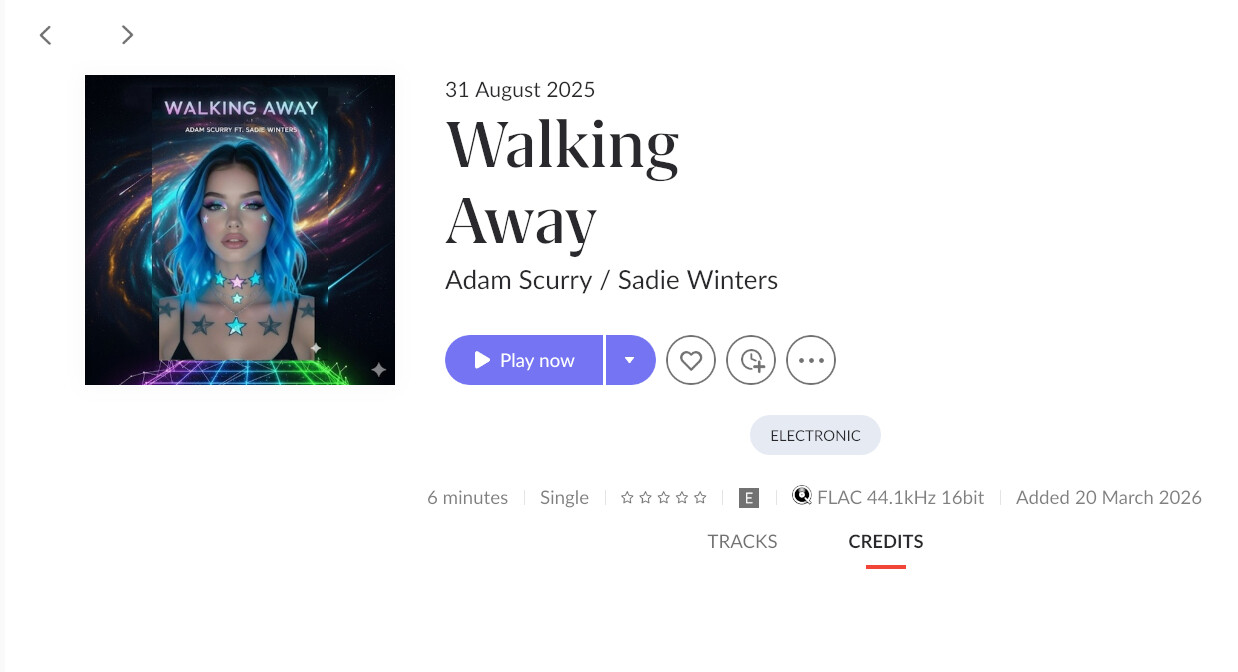
That Sadie Winters creation by Ray Beato in the clip above is now on Qobuz. Roon then makes a discography. I don’t see a Ray Beato credit but there is a human songwriting and production credit for an “Adam Scurry” so I guess that’s how it gets past Qobuz.
How? Don’t add anything to the Roon database unless you can attach it to a human artist’s discography. This stuff can be on streaming and be absent from the database. An artist and discography should not be created just because an AI track exists. Tens of millions of them do. And if an AI track falsely purports to feature a real artist, it should not added to Roon by virtue of not actually being in the artist’s discography.
It needs to be highlighted on streaming (qobuz releases apparently will soon carry this info just like deezer) as well as being reportable in Roon, at least.
mjw
(You want nice, supportive? Call a damn helpline.)
35
Using MusicBrainz metadata, i.e., disambiguation: AI impersonator. Alternatively, add a feature to Valence.
Here is Claude ai’s assessment of MusicBrainz when I inquired as to whether it could add their API to the AIDetector Extension it created for me:
MusicBrainz — Theoretically possible, practically limited: MusicBrainz has a free public API that allows querying any artist and retrieving their community-applied tags. If community members have tagged an AI artist with “ai generated” or similar, the extension could detect it in real time during playback. However, there is no organized effort in MusicBrainz to systematically tag AI-generated artists — it would be entirely dependent on whether individual community members happened to tag a specific artist. Coverage would be very sparse and unreliable compared to the Soul Over AI database.
Just a thought, soon there will surely be more AI “artists” than human artists. Quicker to tag the humans and remove false associations between them and false impersonation tracks. Or to say, if not a verified human with a date of birth and backstory then nope.
There is no real easy way for Roon to have a system to block AI/fake artists content from a streaming service.
Should it not be the streaming service to block this content completely from their service? I think so.
Ultimately it needs the support of legitimate artists/labels to give their albums/tracks a signature or “flag” that a streaming service reads/accepts. No flag, then not accepted.
But this would easily be gotten around I suppose.
Bring back DRM or *QA
Until the streaming services find a system that works, I feel the job is down to us, the consumer.
I for one will not be renewing my Qobuz subscription in a month or so. I’ve seen no improvement from them in blocking this crap from being on their service.
Yes. Cannot see what roon can or will do about this and the industry has rejected systematic provenance checking multiple times now.
I cannot imagine it was ever planned that way but streaming platforms are in effect acting as massive AI Reinforcement Learning (RL) engines with endless feedback from millions of users. So they just get better. Certain genres will soon be almost exclusively AI if that is what the market wants. Blanket exclusions are not going to work.
Would be interesting to know how the more discerning music listeners here in the community feel about the massive introduction of AI-generated music in TIDAL and Qobuz. Maybe a poll similar to this?
Has AI-generated “slop” from TIDAL or Qobuz noticeably degraded your Roon Radio experience?