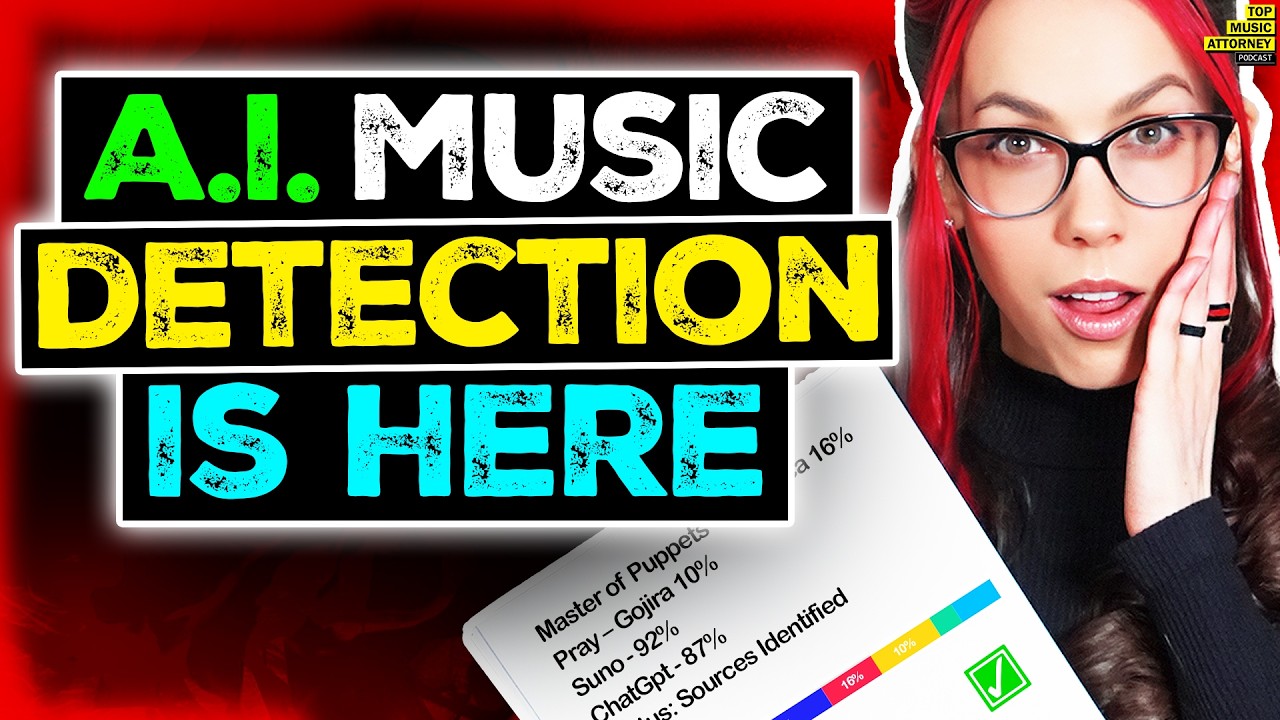
AI music recognition in Roon

This is of course another big part of the problem. But some (Spotify, cough) like it because it means that they get to keep the subscription fee and don’t have to pay royalties. And for the masses, it is NOT obvious that they even make a distinction and leave over it.

Case in point, I took a train across Austria last weekend, and a group of 10-12 year old pupils entered, taking the train home from the town where they attend school. They started to play some horrible music on their phones at full volume.

It was some overly dramatic German Schlager music with a female singer, very agreeable voice for this kind of music, but with the drama permanently turned up to 11, so not hard to recognize as AI. But after a few lines I realized that the lyrics were horribly racist & fascist, too, and after some googling I found out that this came from a Spotify account and Youtube channel created by full-on German Nazis, which created a blonde, pretty, German AI girl avatar and have released hundreds of tracks in a year, one worse Nazi crap than the next.

It has millions of views on YT, and people in the YT comments were fawning over such a pretty German girl making so wonderful music that “finally tells the truth about foreigners”. And as mentioned, they are on Spotify, too. These children (and their sibling, parents, …) are not the people who will leave Spotify over AI music. (And I tell you, even to people who are deaf it should be obvious as hell that all the images of the girl were AI, if only because the huge Nazi eagle tattoo was sometimes on “her” cleavage and sometimes on “her” neck… Then of course, who knows how many of those comments were bots, farming views to rank up the account)

My argument is that it will be impossible to distinguish at scale, and that the boundaries are fuzzy anyways.

I’m not saying that this is good, but if I have to choose between AI slop invading everything and the attempt of stemming the AI slop requiring some policing about what’s human, and necessarily excluding huge numbers of legitimate music along the way, this is a very difficult choice to make.

IMO either is impossible, because if it were easy to add all existing human music to MB, it would be there.

EDIT: And it’s one thing for an album to be missing, but another thing to take this as an indicator that makes the missing album somehow illegitimate.

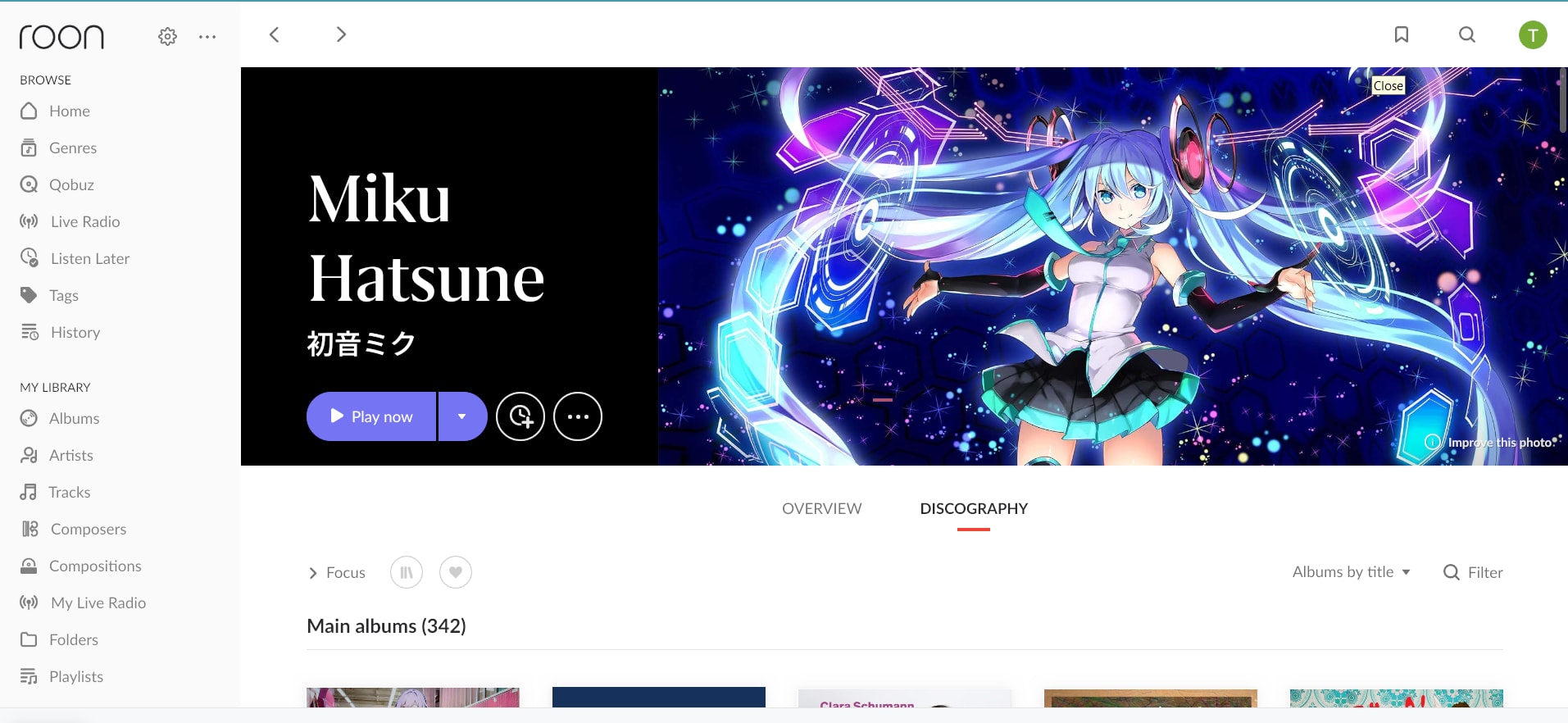
Musicbrainz already has more than 16,000 “Character” performer types to distinguish non-human and also fictitious human performers like Spinal Tap.

Currently, there is nothing similar to distinguish biological / non-biological composers. But there has been talk of introducing a type “Software”. That’s already 3 years old so I assume it didn’t go anywhere.

I must say I am not optimistic concerning metadata initiatives. It’s already a trial with human-generated music.

What would help me with AI slop invading my artists’ Roon discographies, and would also help with the many simply misattributed albums from artists who happen to share the same name with an artist in my library, would be a simple “hide” button that works without first having to add an album to the library, very similar to how global bans already work. I proposed as much in Support > Metadata in yet another post trying to disambiguate artists in some discographies, after I was told that Roon Labs doesn’t have the resources to fight all this.

Sony is working on a tool that may help lawyers file copyright lawsuits that may also discourage the creation of AI-generated music:

I’m also afraid that the best chances are in fighting fire with fire (AI tools to detect AI) but who knows where this leads us. We “live in interesting times”

Aren’t we just in the early stages of something similar to the the peer-to-peer Napster transition to Apple Music and Spotify streaming? Everyone just seems to be trying to figure out how to monetise this. My understanding is that Suno has already settled with Warner and Universal. So Suno has retired their original “scraped” training data for a “licensed” one and artists have to opt-in. Suno already valued at 2.5B$ so they don’t seem to be much bothered by the law suits. There will likely be also some kind of micro-payment system for artists similar to streaming which is where tool’s like Sony’s will come in for revenue share and also force human-in-the-loop compliance. No doubt the streamers will not have much of a choice about what AI content they get as part of their licensing deals with the labels.

My .02 on the subject …

I spent more than 20 years in the music business, and still do a fair amount of consulting. If you’re thinking that the answer to this is money, you’re correct. On many sides of the discussion.

A long time ago, well maybe not that long, you had to “register” your musical creations. There were copyright and publishing houses. Artists wanted to protect what they created, so they paid lawyers to do such things. Then there was sampling. I was there for the literal birth of it, at the software, factory and hardware level. We got through that mess and we will get through AI generated music.

To me, streaming services are not sustainable and I believe they have peaked. Why? Because now that they have everyone subscribed *cough addicted* to their service, they are re-writing the laws about copyright and ownership. If you read the fine print these days when you buy a digital album in many cases (not all) they have changed the verbiage to something that goes like this “You understand and comply that by purchasing this recording you do not own it, but merely have a license to listen to it …. yadda yadda yadda “ which means you own nothing and they own everything.

Hence the surge of vinyl and now CD sales in there last few years. Physical media will return, and sooner than you think. If you walk into any Walmart or Target store in the last 2 months, youll see the latest vinyl releases, and suddenly there are CDs next to them … The recording industry doesnt want to lose a dime. They are covering all the bases.

So what’s the answer? It’s the same answer it’s always been. Cliche as it may sound. You want to stop AI music, you need to send the message. That being quit streaming services and tell them you are not interested in paying them a fee to serve you fake music. Enough people do it, they start to lose money, you will see AI artists go away. Realistic? Probly not. Consumers are to self centered and their attention span is zero in 2026. Everyone wants the change, no one wants AI music, but consumers don’t want to do anything about it.

Now back to the money side. The real cure for AI music. Remember, artist use to have to register their music. Lawyers (yes, some friends of mine) made a ton of money in the copyright and publishing arm of the industry.

Creating a database is on the right track. Thats a huge undertaking. It’s not going to be done by volunteers. It’s going to be done by a company. A company that has no snakes in the grass and no skin in the music game. A company thats gonna want to pay people to do the work. A company thats going to charge you, to use that database that they work so hard to create to check if something is legit.

Yes small artists, no matter how small are going to need to register their musical creations with the database. If they want to make money off their music, go out and sell it, tour etc, it’s going to need to be registered. Any composition not registered will be considered suspect and therefore most people will write it off as AI. Its old school music business 101.

Of course there will be fees that you as the music listener will need to pay to keep the company in business. Even before streaming you were paying and maybe didn’t know it. A portion of the music you bought went to those copywriter and publishing houses.

Look at what is happening to people who invested money into buying digital albums and now those albums are no longer available for download, because when you bought it you trusted that the cloud would hold securely that “purchase” you made, while all this time the streaming service you paid 14.99 for an album decided to take that album off their service and now that album is no longer available to you. It’s a problem. Yes a big problem and streaming services have armies of lawyers to combat every problem the music listening public can throw at them. Except one. If people no longer subscribe too their service. Thats the one thing lawyers cant combat.

The bottom line and the question is, as a person who enjoys music, are you willing to go back in time and start buying physical media again, and the real question is this.

You don’t want AI music around? … Are you willing to pay to have a company do that? Its more than likely not going to get done by asking pretty please dont have AI music in my feed … Its probly also not going to get done by believing streaming services are “building tools” to combat AI. You have to wonder if they let it on their service in the first place, dont they stand to gain something from it and exactly what would be the incentive for them to remove it. People asking “please remove it from there service” …?

The lesson here is people have the ability to stop this. Unsubscribe from streaming services until they show you that they wont allow AI music on their service. If you’re not willing to unsubscribe from streaming services, the problem of AI on the services isnt all that big of a deal to you.

We have taken the bait, hook, line and sinker … streaming services offered us the golden ticket to all the endless amounts of music we could ever want …. now we have choices to make. Deal with the invasion of AI artists or go back and buy the music we love. Visit a record store, buy some vinyl or a CD … keep AI at bay, and make a choice not to let it into your listening habits.

Thanks for taking there time to read mu .02
Some food for thought:

Apparently, there are already 100 million Suno users and they generate roughly 7 million songs per day.

At that pace, Suno’s users are creating the equivalent of Spotify’s entire 100-million-song catalog every 14 days.

It crossed my mind that the reason these streaming services are not making much effort to control the influx of AI-generated music in their catalog is so they can offer a more expensive price tier to those who want AI-free music.

Lots of interesting stuff in your post, but I want to add a slight caveat. You’re absolutely right about digital purchases whilst they exist in the cloud. But once you download them, they exist as physical media. The exact legal status of this media differs from jurisdiction to jurisdiction and, in strictly legal terms, differs from purchased physical media (e.g. CDs).

But here’s the thing. In terms of real world experience, downloaded physical media and purchased media are virtually identical. Downloaded media can even be passed on to relatives as part of an estate.

I think that you’re right in that the challenge to AI infestation comes via media ownership. But I also think that purchased digital media, once downloaded, can be part of the solution.

It’s a long post so I’ll just pick some things.

This was an outdated model that never fit grassroots music and can’t work if anyone can create albums in their bedroom. Nor did all musicians care or have the means.

It’s probably something that can work better now than in the past because digitization means that registration would be easier and cheaper.

And this was always the case. Purchasing any physical record never gave you any ownership to the content, just the physical media. In practice, yes, because the physical nature meant that, well, you had the content now and it couldn’t be snatched back. (Though that’s in practice the same with downloads). But legally, never. It was always a license.

Now what you can do with that license depends on the jurisdiction, as @SukieInTheGraveyard pointed out.

But the majority of consumers don’t care whether it’s AI or not

The focus has been pretty much on non-humans creating tracks. But what about human artists that we may learn later used AI to create the lyrics and song chords, which they then performed to make the song/album and tour on. Bound to happen sooner or later.

Will this be a Milli Vanilli moment, or will we accept it as okay? If okay, where do we draw the line on what streaming services should and should not include in their catalogs? When does music become soulless?

Artists since the beginning of time have always used some kind of aid or tools to create music. In 2026 if an artist uses AI to create or assist in lyrics, thats something thats been done for decades. Every songwriter I ever met had a dictionary, thesaurus and a bunch of records or CDs to pull ideas from.

Many say that there are no original ideas in songs. They all derive from something or someone previous to them. Which is absolutely true. When I was a producer I use to get calls from record labels telling me they needed a song that was the next “Let it be” or “Twist and Shout” or “Desperado” … so as any good musician or songwriter did, when they weren’t familiar with a hit artists material, they went to the local store and bought an artists entire catalog of music and played and studied it for days. There were more than one occasions when the musician or artist created something that sounded very similar to one or more of the songs on those recordings they studied for days on end.

AI is just a faster assistant to the musician or artist in 2026. You go and feed a bunch of Whitney Houston songs into an AI machine model, it’s going to give you songs that Whitney Houston could make a hit.

The question is this … when it comes to songwriting or music creation, Is anything original or are songs just different variations of some created previously. There is, at least in my opinion, a “formula” to making a hit record. Motown created an entire music entity out of this very idea. Sit a bunch of people in a room, with a bunch or recordings and have that group mass create catchy tunes that would be pleasing to the listening audience.

So in 2026 … what separates large learning AI models from a human. Well something that AI will never be able to create is feel. Whether thats the way something is sung or the way an instrument is played. Many times it’s those imperfect things that artists and musicians do that make a song what it is. No matter how many AI machine you have they will more than likely not to be able to reproduce mistakes or imperfections. That thing that makes a perfect song, imperfect.

The problem with today’s listeners, and this might be mostly the younger generation, is that they don’t demand things from the music they listen to. They accept whatever is given to them by a streaming company as “good music” which in my experience is not good at all. This is a trade off for the cheap monthly fee, as a listener thats what you get, cheap results.

Now, if artists were forced to work at their craft, and sit in rooms with just their instruments without computers, without anything but their voice and a guitar or piano, we may get another “Let it Be”. But because we can have a machine figure all that out for the artist, why work harder at something that can take less money, less time?

The difference are a few things. One there will be no character to a song thats been created by a computer. There wont be those little things that make the song unique. They are feeding AI models with perfect instruments, perfect pitch of voice and the list of perfects goes on … but what the AI model isnt giving the listener is unique elements of a song.

Most of today’s music and the people who would entertain listing to AI generated music dont demand anything more. Why, because for 10 or 20 bucks you get everything, and not everything can be great, only a few things can be great. A few things stand out and a few thing … well, become “Let it Be”

Do not disagree that musicians have been creating things from what they’ve learned in the past. You’ve got sights like WhoSampled that can attest to that.

Would it be fair to say, based on your experience in the music biz, that AI-generated music is okay as long as it is performed by a human? In other words, if Sarah McLachlan had sung the song Rick Beato created on Suno in two and a half minutes, it should not be tagged AI?

You make a lot of great points. But the one thing, back in the day, before streaming, that music listeners never cared about? The legalize of listening to music. Only record labels and lawyers cared about that stuff.

Music and the ownership, for this instance, means it being in ones procession, is now free. Streaming companies have basically made it possible for anyone with 15 dollars a month to do whatever they want with the music thats on the service they are listening to. There are a lot of lawyers, but there aren’t enough of them to stop everyone that is doing whatever they want with the music thats available to them.

I dont feel the AI discussion has a lot to do with law. Well maybe one thing. If you buy an album under the belief that your buying product made by a human, and there is no indication when you buy to that its made by a machine, do you have a basis for a refund being you were led to believe something that wasn’t true? That will be years in a courtroom deciding if consumers are or have the right to know what their buying is created by human or machine.

Which opens up the cans of worms about piracy. If you copy something and distribute it to everyone, is it really piracy if you don’t own it, or in fact no one owns it? This is where the music industry is going to run into a big problem. They, like back in the days of Napster, aren’t playing for the long game, they are playing the short game, which since the beginning of time has always been the music industries problem, not playing the long game. They for years tried to sue 8 year olds with a computer in their room that they uploaded files to server. It took a really long time for the record industry to get it through their head that wasn’t a good play.

Years from now I can certainly see the same result with them focusing on the short game instead of the long game when it comes to AI.

I think if you ask 10 people who listen to music if they mind if the music they are listening to is created by AI, 10 are going to say they don’t want it. And again, unless they stop accepting what they are fed by the streaming and tech companies they are only going to get AI.

I dont ever think AI generated music is going to be ok to the listening public. It’s not something they want and given the choice they wont listen to it. AI generated music is a dead end and people who like and listen to music dont like dead ends.

You offer AI generated music to the public and the first thing they are going to say is thats not good because I may not get another album much less be able to go see this artist live and the list of emptiness goes on.

AI generated music only serves one audience. The company that allows it on their service.

I think if Sarah McLaughlin was performing AI generated music at her shows, tickets sales would not be all that plentiful. Live music, like vinyl, like CDs is something tangible that people want to experience. They want it real. I guess thats maybe why these hologram concerts by artists who have died have never really taken off. No one wants to see hologram Jimi Hendrix in a 20,000 seat arena. But you cant blame the music industry for trying to convince people it would be a good idea, right?

The hologram concert was a music industry idea, and not a very good one at that, but their egos got in the way and they are of the understanding they can sell anything to anybody if they throw enough money at it. The thought process of a record executive is that they can have 200 failures, but that one success is all they need to balance the budget. In other words they can be wrong many. ore times then they are right. It just so happens when they are right people pay incredible amounts of money that make up for all the times they were wrong.

So if you pitch the Sarah McLachian idea to one of them, they might think it’s genius. It wouldn’t sell, but they can be wrong, as long as the next Zac Brown Band is in their office and tour plans are being made.

But how is the public to know if Rick Beato demo’d Sadie Winters’ version of “Walk Away” to Sarah, agreeing to not release Sadie’s version to the streaming services, and she made a big hit out of it? I guess what we don’t know won’t hurt us.

I envision AI being a very handy tool for human musicians going forward. But I’m not sure how you make musicians give proper credit for the AI-generated portion of their creations.

Its complicated:

Neither am I. It was discussed on MusicBrainz 5 years ago, and still, there is nothing official in the style guidelines. So, whilst volunteers are adding information, it is inconsistent.

Discogs do seem to be addressing this now.

This is why I think Roon could offer a crowdsourced solution, possibly integrated into Valence.