But then, my $75 miniDSP measurement mic came calibrated and can be made flat from 16Hz to 20kHz in free field at 0 and 90 degrees. Why use a different mic for different genres? Isn’t neutrality what fidelity is about? If you need coloring, you can apply DSP to taste after capturing sound as close to original as possible.
3 Likes
The situation as described in the opening post : yes, I would describe that as scamming. Any other valid release : I don’t have a real opinion, or I don’t feel it’s worth sharing it  .
.
Just wanted to comment on this one :
You may believe that, sure. But in reality, we are limited in our observations, and indeed it can be almost a brick wall limitation. Simplest example : have you ever looked at a rainbow ? Did red transition smoothly into infrared, and did violet transition smoothly into ultraviolet ? No, to most of us, a rainbow is quite sharply outlined. Indicative of very sharp low- and high pass filters in our visual systems. And they can be explained by our physical properties. The same can be said, admittedly by a lower degree, for our auditory systems.
Point being : ‘brickwalls’ are not uncommon at all, in human beings.
If only it were that simple…
It really isn’t a simple example.
Edit - this is close to the diagram I remember from school…
@AndersVinberg, you are basically correct that nature does not have brick-wall filters. I’ll point out that audio systems don’t either. An ideal brick-wall filter is infinite. What is used as reconstruction filter (and for sample rate conversions) is finite and thus it has a finite slope. Redbook reserved 20kHz-22.05kHz band for this purpose. Is it steep? Yes, relatively. Is it too steep for being practical? No, at least not these days. Is it too steep to cause audible artifacts? Empirical data say no.
The sampling frequency of the file is right there. If the FLAC file is 24 bit 96 kHz, for example, then 96 kHz is the sampling frequency. That is not in doubt.
Sampling frequency, though, does not deductively indicate the audio bandwidth of the file. Sampling frequency limits the audio passband to the Nyquist frequency, which is half the sampling frequency. But sampling frequency does not guarantee that the audio bandwidth will occupy the entire passband.
See your own example above. That Mark Knopfler track may be a 24 bit 96 kHz ALAC file. Inductively but not definitively, however, it appears to have passed through an 88.2 kHz stage or conversion at some point – because the spectrogram shows an audio bandwidth cutoff at 44.1 kHz.
AJ
Early 1980s ADCs and DACs used analog filters – for anti aliasing filters and reconstruction filters, respectively. They did not use FIR digital filters, so filter taps are not relevant to those early designs.
Per my understanding, Philips in the mid 1980s developed the first oversampling DAC, which utilized FIR digital filtering. And I do not know if it was the first, but Stereophile highlights Chesky’s 128x oversampling ADC in the late 1980s as one of the first oversampling ADC alternatives to the Sony PCM-16xx that was ubiquitous for CD mastering in the 1980s.
AJ
Thanks for your reply, could you explain how you identify the cutoff on the graph? I did not get
ottima investigazione e direi che sarebbe opportuno un adeguato sputtanamento sui giusti canali che però io non conosco
(excellent investigation and I would say that it would be appropriate an adequate bad publicity on the right channels which, however, I do not know)
Thanks Roberto
In the meantime I received feedback from the record lab (ACT) confirming that their technicians checked the files from E.S.T. album “Live in Gothenburg” and those are high res ones (???)
thanks – no doubt the file analyzed is 24/96. however, i am trying to discover if a file was actually captured at a hi-res sample rate or if it was upsampled from a lo-res file. imo, the later would be a “scam” if it is being represented as a true hi-res file… ymmv.
(btw: i am not the OP)
This from Wikipedia about the recording…
Knopfler, Fletcher and Ainlay spent much of January and February 2012 mixing the tracks for Privateering in Studio 2 at British Grove. The mixing to master process involved three analog two-track Ampex ATR-100 tape machines, fitted with one-inch, half-inch and quarter-inch head blocks. They also mastered digitally via Prism and Apogee interfaces in Pro Tools at 96k and 192k and in Nuendo at 96k. The team would then listen back to all the formats and decide which was best for the song. Fletcher later wrote, “The results are rarely what we expect with both digital and analog gaining preference although the analog tends to win most of the time.”[3]
Bottom line - could have passed through almost anything; and likely different for each track…
Edit - digging a little further into the studio ‘diaries’…
I should give a quick mention about the tape machines being utilized on these sessions. Three mighty Studer A800 machines, two of which are fitted with 16 track head-blocks (24 track is the usual configuration) and the one on the left is an 8 track two-inch! Not something one sees every day. Audiophiles will know that the benefits of passing audio through tape are clear. (or not, as the case may be) In modern recording studios, we have become used to the advantages of hard-disk recording both in speed and quality. However, the sound produced by analog tape is impossible to recreate (plug-ins try but just don’t do it) and so most of the instruments that we track, pass through the well machined head-blocks of these devices…The traditional method of doing this is to synchronize the machines with a time-code track and ‘lock’ them to out digital system (Nuendo in this case). However, we now use an ingenious system known as CLASP (aka CRISP, COLLAPSE, LISP, CRAP) whereby a very clever plug-in runs the tape and automatically compensates for the delay generated by the gap between the tape machine heads. The more you think about this, the more clever it seems (trust me) but it is extremely complex in terms of audio switching and doesn’t always work fluidly…but when it does, it’s utterly seamless and you forget it’s there and your record sounds like it was recorded analog.
 scammy service
Glorifying analog is a sport some people practice. According to the same article, the album was not released on tape, it was released as digital download, on CD and LP. It guess digital was able to retain whatever character the tape machines had conferred.
The closest approach to the sound you expect to hear…
(with apologies to Peter Walker)
I guess it comes down to $$££ and what you are willing to pay. There are some truly appalling CD versions of original analog masters, some are beautifully remastered which show what is possible if the original source is up to scratch. There are very few albums recorded in true 24bit 96K and 192K. I just stick to CD because I like collecting CDs 
1 Like
Sounds like you were treated well.
Unfortunately for me QOBUZ refused to address what was clearly an upsampled album.
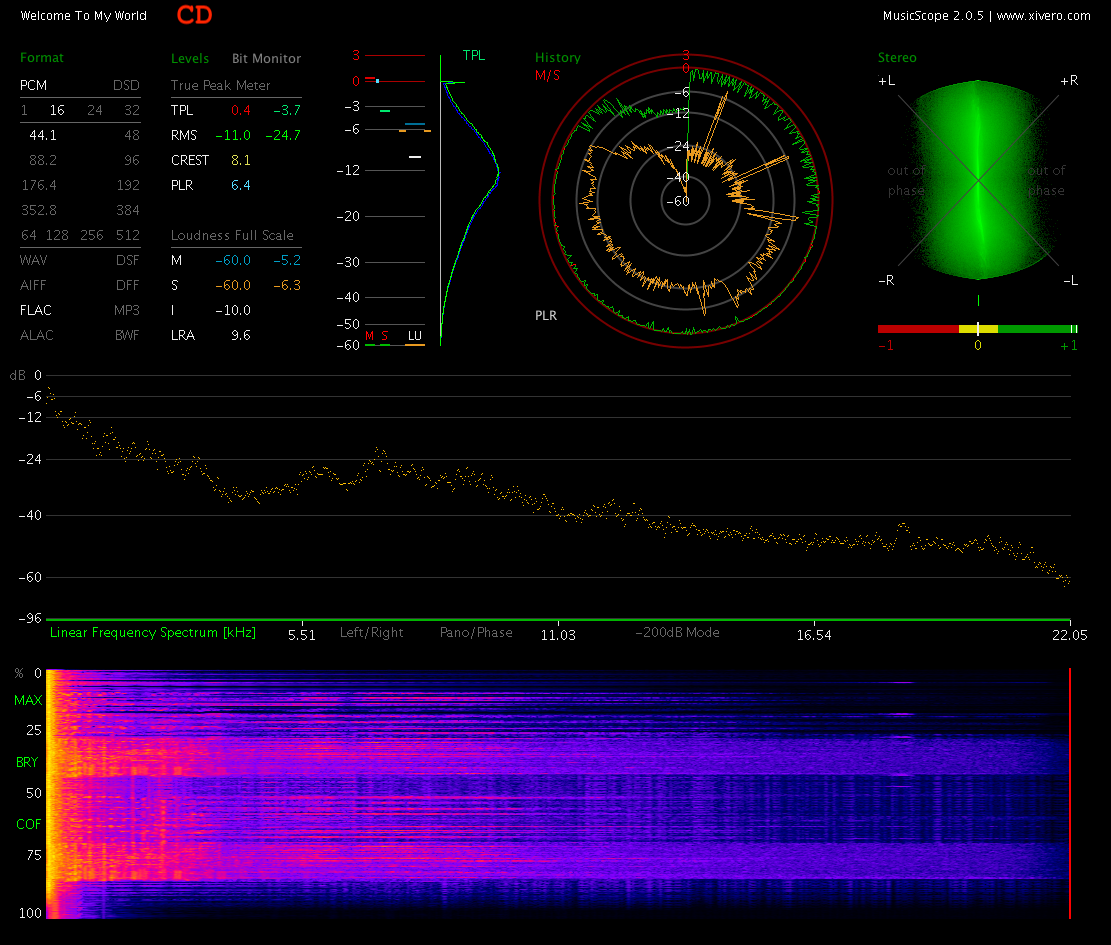
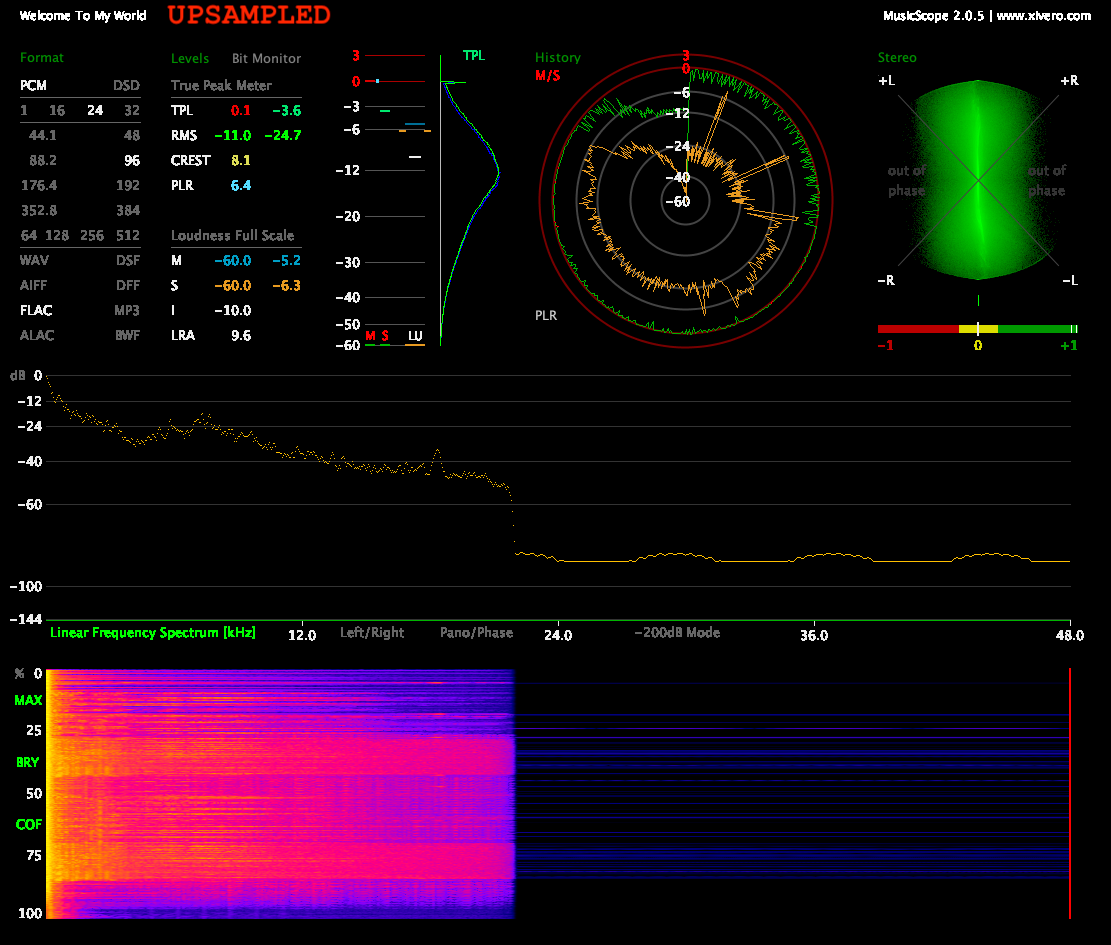
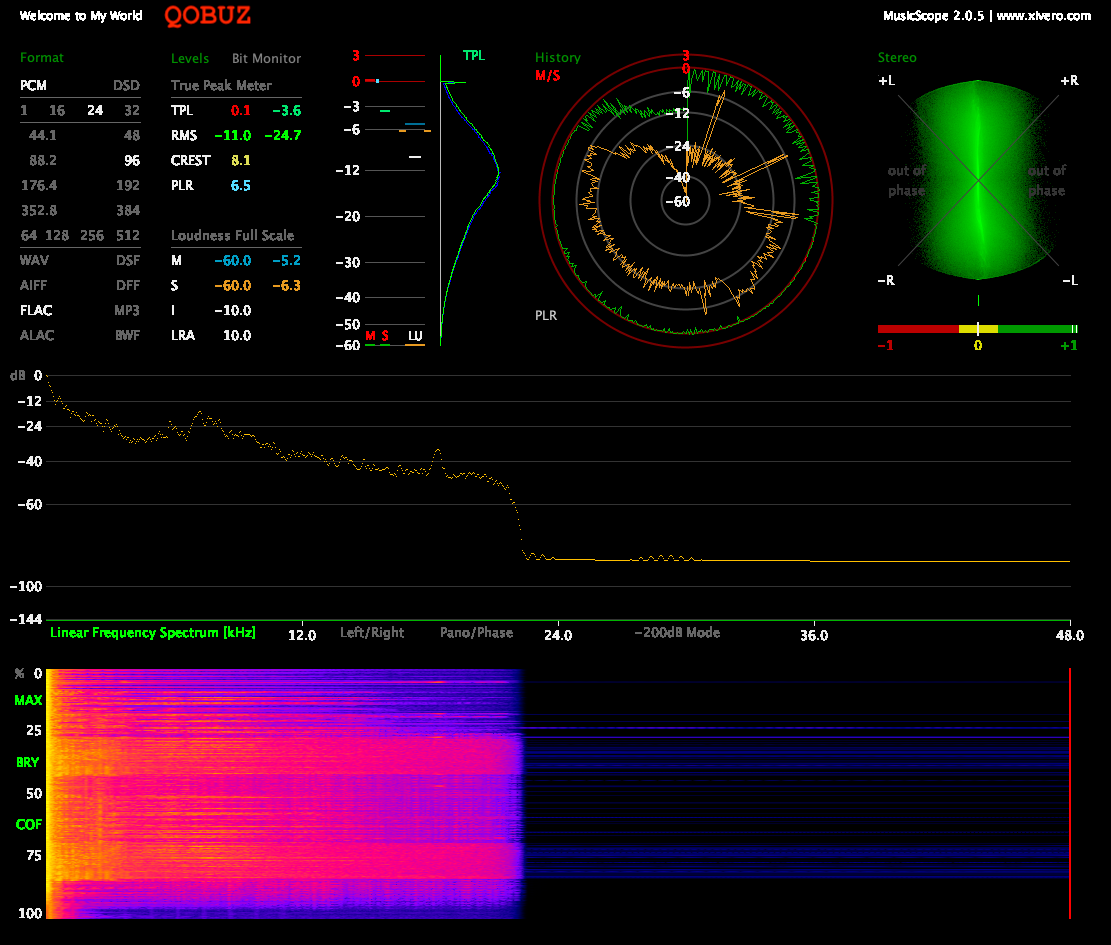
@stubaggs
How many people analyze their tracks? Can people detect an up-sampled track just by listening? If a recording is done in hi-res, will it still contain relevant content above CD? And assuming it did, if you down-sampled that to CD, then up-sampled back to original resolution, would you be able to tell the difference if you didn’t know which was which? All hi-res is bogus. As long as people keep paying more for it, the hoax will continue.
Beware of gross generalizations…
1 Like
Your questions are good. Your conclusions are not proven.