Measurements should easily show the ‘noise’ you’re talking about, but they don’t.
It may well be due to the fact, that Ethernet communication works with a differential signal, thus virtually completely cancelling out the interferences you mention.
2 Likes
Have you looked INSIDE any ethernet devices?
They almost invariably all contain internal HF switching regulators to derive lower voltages from the supply.
The same argument about SMPS vs LPS applies here too.
No.
A dac is encoding the analogic signal at
freqencies betwen 44,1 up to 380khz or more and this has nothing to do with
audio frequency, if there is noise the encoding will be sheet, with jitter and hf modulations at different level of harmonics.
A smps noise can be well filtred, but it is not well done in network equipments because it is useless, and this nouse is transmitted througth ethernet to your player and dac that has nothing to stop it.
Your DAC can have a well filtered smsp suplied with no effect on dac and very low noise but this is not the issue.
Yes i did open a lot of network equipment.
Each time you find a small grey/black self on the pcb close to the dc input you can go away.
… And i finish to find tge DELOCK 86442 media converter that is 3,3v input with no voltage regulator at all.
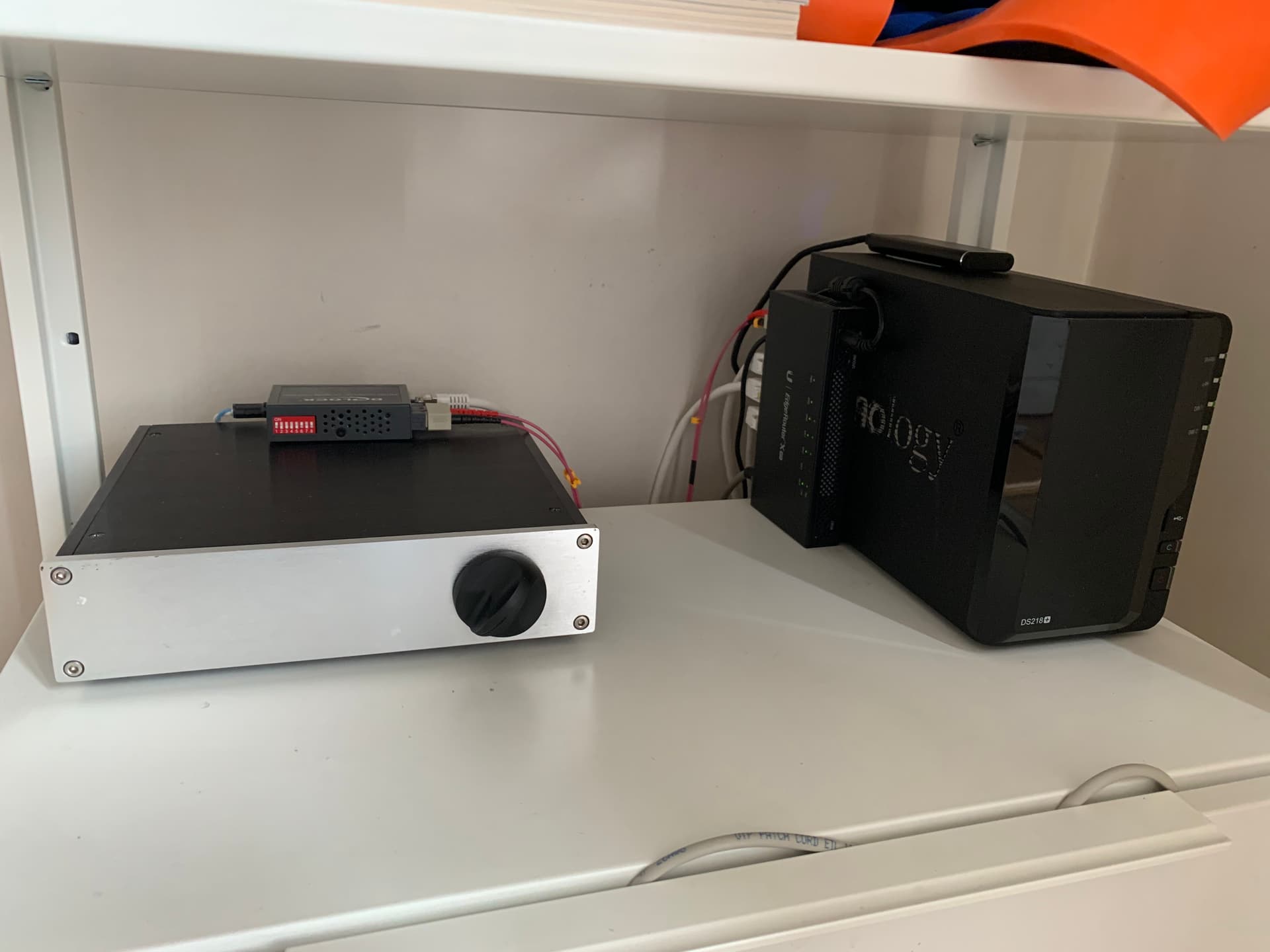
The measured performance of most decent DACs is very much at odds with your claims of noise.
Power supply “noise” doesn’t find its way into the analogue output unless the DAC is very poorly designed.
Ethernet noise, we’ve already discussed as a non-issue.
I don’t think you’re understanding this stuff very well.
2 Likes
I had a run in with a friend today who’s keen on Ethernet filters and the like. He tried to get me to hear a difference on a filtered Ethernet cable.
So playing him at his own game, I got him to agree that nothing a filter or wire could do, would Influence the data or the 1’s and 0’s. So once we got to that point he reasoned it must be something else coming in on the cable.
So… I asked him to play a song…. Knowing fine well the streamer buffers… and got him to just unplug the Ethernet cable entirely. Surprise surprise zero change. Music kept playing and sounded the same.
This did not go down well.
3 Likes

I think the problem is that audiophiles have been sold the line that in the analogue domain, absolutely everything matters.
The unscrupulous Snake-Oil peddlers have applied the same marketing philosophy to the digital domain, all the while completely failing to understand the differences.
3 Likes
Anyway, I’ll just use wifi on my new DAC 
Problem solved. Wires are so old school. I do find my speakers sound better when I use a wire though. Even if it does affect my perfect noise floor.
2 Likes
Nails it pretty much. Established (and mostly adequate) narratives from the analogue age which need to be transitioned into the digital age. Preserving business models.
Should be failing due to obvious reasons but the for… believe is strong in some.
Bit of a tragedy as there is enough to care and invest into once one is able to let the old patterns go with way bigger payback. Rooms and more so speakers.
2 Likes
Indeed. I’m
Amazed in the “speaker or source first” thread, that there are those that can’t understand that digital is so easy to get right these days that you can essentially save a fortune and spent it on the best speakers you can afford, and improving your room.
Instead they’re spending it on £5000 DACs, audiophile Ethernet and USB
7 Likes
Indeed very strange. They stick with their old speakers and started “upgrading”, which means spending thousands of €, $ or £ on placebo’s. And I also did that and will still do every once in a while. Marketing and the reccommandition of friends can be very strong.
1 Like
Agreed! I’m not immune to it and often find myself wondering if I should try “better” cables!
Then I shake my head and try to get a grip 
1 Like
I never wrote that the noise finds a way into the analog output. Learn to read.
If you are rigth, oversampling has absolutely no effect on the sound as it it done far beyong the audio band, rigth ?
What are talking about then?
I’m genuinely curious enough to ask what you are saying for clarification. You must believe that it affects the analogue output, or there’s nothing to worry about. If it’s not transfer then you believe it affects the DACs reconstruction process? I can read BTW, as can most of the forum members.
1 Like
It seems I’m also having trouble with my reading as your statements seem contradictory. Perhaps you could clarify what you mean by “the noise affect the dac chip voltage reference and the I/O triggers for analogic encoding”. This seems to be saying that noise has a direct effect on the analogue output, but your reply to @Graeme_Finlayson states otherwise.
The DAC chip construct the analog signal with discrete voltage steps.
For a 1Volt ouptut analog DAC chip signal and common 16bit input stream, the step is : 1V/ 2exp16 = 0,00001V and 0,00000001V for a 24bit stream.
That can be far beyong the noise level of the ground reference of the DAC chip if there is too much digital noise.
The noise change too the triggering timing of quantification that cause jitter and bad sound.
It produce too phase noise that destructs the sound stage image.
The worst enemy of every DAC, that is the core of digital systems, is electric HF noise.
This is why Sabre works hard on this for many years, and have now its own LDO regulators.
This is why 80% of high end dacs have linear supplies and not SMPS (that work no so bad and decrease the DAC prices for not high end products).
Streaming is no so recent on market, and incomming data stream from a TCP/IP network no well managed by the couple player + DAC (supply noise is much better managed). And there are now new problems that CD players did not have.
The network equipment ans components are made for applications that do not care at all the noise as long has a 1 is not changed to a 0.
Wifi and bluetooth cause the same problem with higher impacts, this is why mosts of the dacs cut the bluetooth chip supply when the bluetooth input is not used.
Getting the music straigth on the player on a hard disk cause the same problem because hard disk access are very noisy.
Adding components to remove the noise (see uptone products), is a problem because each active digital component will add his own noise and you loose one a side what you get on the other.
I have tested many ethernet filters, (not the somt), the one that realy make a big difference is Etalon filter but it is expensive.
All cheap filters are not made to reduce the noise but to protect equipments from surge or DC.
So the first question was : can the ethernet cable have an effect on sound. The reply is yes.
It has nothing to see with data transmission that is of course perfect (it is more complicated with usb). Don’t buy gold plated or CAT20 ethernet cables because the price and category is not linked at all to the result.
Buy sereval cheap ethernet cables (any way you don’t need a large bandwith for music streming), if possible disconnect the shiedl on player side only. Put the longest cable you can (roll it behind a furniture). Il the sound level decrease, the sound stage is less wide, the treblles thinner, your are on rigth way. Then adjust the analog side if needed, moving your speakers, change interconnects, power cables and speakers cables.
There are many short cuts in this explanation. That can be sure is that the last thing i would remove from my system is my battery supplied optical bridge.
It’s sad. I’ve got 20Gbit ethernet between my Synology Rackstation which runs the core, 8 QHD IP cameras, a Plex server, serves files and syncs my off-site backup and my main switch. The enterprise, managed switches that connect my fibre network were bought used on eBay for about £200 each. The fibre cabling (40 m of armoured 8 core OM3) cost me ~£400. Ubiquiti router £400 and 3 UAP-Pro access points about another £400. ~£1600 for an all-singing, all-dancing enterprise grade fibre backboned network with connectivity for up to 96 devices, 72 of them with PoE. Yet some audiophiles are prepared to spend more than my entire network cost on a single “audio grade” network switch 
And the range of human hearing can’t tell the difference between 16bit and 24bit. Your point is?
You’re claiming lots of “audible” differences here. How about some measurements of noise levels to back up your claims?
Thanks for taking the time for the detailed explanation. While I’ll confess I disagree with much of it it’s much appreciated.
FWIW I just go optical TOSlink to the DAC, for peace of mind not because I’m sure it sounds better. I’ve not bothered with upgrading the DAC PSU as the designer is adamant it makes no difference and I trust he knows best.
Thanks again