This concern about the last bits of a 24-bit signal is not warranted.
Stereophile (I think) published a test of a Benchmark power amp, called it the quietest amp they had ever tested, dynamic range was 21 bits.
Nobody mentioned importance of bits, they want to know how it gets there.
2 Likes
Quantization errors can appear as cyclic artifacts anywhere in the output waveform, that is, at any level above the 24’th (LSB) bit. I’m sure the folks at roonlabs know they should be dithering. I’d just like to see it displayed in the signal path graphic if it’s happening. And if they’re using noise shaped dither, the noise itself can be louder than LSB, though perhaps out of the audible band. I don’t think that this can be so easily dismissed for 24 bit endpoints. And what about endpoints that require a 16 bit signal from roon?
1 Like
Options to dither to a specific bit depth in DSP would be cool as well. 20 bit for Schiit DACs as an example.
I’ve always firmly believed that the best SQ is achieved by keeping the signal path as simple as possible. This goes back to analogue days when phase distortion was an issue and contacts on physical tone controls would become noisy with time.
A few months shy of turning 60, I’m now seeing DSP as essential - primarily to use the parametric EQ to boost highs. My current audio gear (Hegel H190 and Totem Sky speakers) seems to roll off the highs and leaves the upper midrange lacking detail.
I haven’t bought/subscribed to Roon yet, but the DSP - something I’m philosophically opposed to - has become the main driver in my decision to go ahead with Roon. Ironic eh?
Can anyone here comment on how well they feel Roon DSP helps to compensate for hearing loss?
4 Likes
I seem to have the opposite problem. As I’ve aged, my hearing seems to be more sensitive to high frequencies. Albums I used to love (classic rock, pop music) are now unlistenable due to distorted high frequencies. Are they distorted because of my system or my ears? I don’t know, but Roon’s DSP (parametric EQ) does help tone down what I perceive as sibilance without losing too much detail in the top end. I use a Schitt Loki on my main system for the same purpose, and it seems to work reasonably well. Still, a lot of music I can’t listen to anymore because it’s so fatiguing. Used to love it. My current theory is, my system has achieved a quality that I can now detect poor mastering that never used to bother me before.
3 Likes
Roon’s DSP (parametric EQ) does help tone down what I perceive as sibilance without losing too much detail
Interesting in that parametric EQ may be more useful in decreasing as opposed to increasing. My instinct is to punch up the highs but perhaps it would be more effective lower the frequencies that aren’t a problem.
I also have tinnitus. I think when certain resonate higher frequencies “mix” with my tinnitus frequency/frequencies, I experience that harsh sibilance effect you describe.
1 Like
Yes, we dither when reducing bit depth. The dither used is TPDF. Dithering is a basic responsibility in this situation. It’s always worth thinking about significant figures and information density variations (in terms of frequency, amplitude, psychoacoustics) when considering the impact of processes like this.
We dither for all reductions…it’s the most important for 16bit output. Some people debate the necessity for 24. For 32, it could probably be skipped but it is still more technically correct to do so, so we do.
Roon’s DSP Volume should be shown in signal path–if you are seeing it missing, that is probably a bug.
5 Likes
I have hearing loss in my left ear. I was a professional musician for many years and blame drummers whom I stood to the right of throughout that time. In latter years I used ear defenders but the damage was done by then.
I went to an audiologist, had a hearing test and obtained a report of my hearing, complete with frequencies and decibel loss.
I use this information within the dsp in Roon boosting as necessary. It has made a tremendous difference. The whole soundstage has returned. Prior to that it seemed like vocalists were positioned at 2 o’clock in the mix and cymbals were panned to 4 o’clock.
I use parametric eq within the “procedural eq” section. This allows you to apply it just to the channels you need, the left in my case. I have noticed no deterioration in sound quality using Roon dsp, either through speakers or headphones.
10 Likes
Even though I’ve acoustically treated my room in a pretty big way, there are still areas of frequency that are anomalous. Using Acourate I’ve gotten things so the response is almost idea. That program also helped with some time dimension problems. So overall I think the convolution filter it produced for Roon is awesome. I don’t feel I’ve lost much of anything in the delicate nature of music, but its much more natural feeling without frequency humps (especially mid-bass).
Are there downsides? Yep. In correcting the nodes I’ve gotten pretty significant attenuation so I can’t play as loud as I could before (which isn’t a big problem).
With this sort of DSP you can tune the filter to roll up or down to compensate for how you like to listen to music, including high frequency hearing losses
2 Likes
Where is the
‘apply all changes automatically’ menu button?
I don’t see it in DSP.
Thanks,
Steven
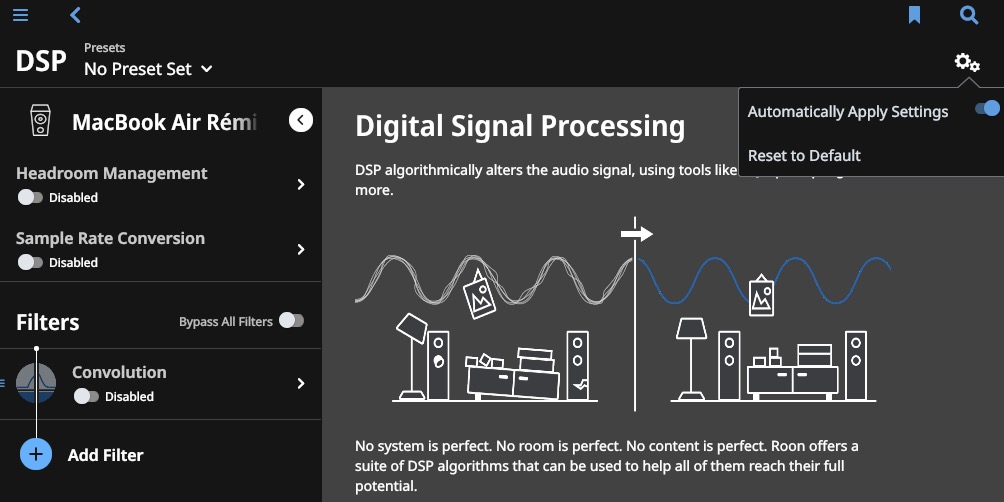
So…for all the ROON ‘laymen’ out here. Should the DSP toggle switch be on or off or does it not effect the SQ at all? 72 responses and I’m still confused…WTF?
I’m set up ‘as is’:
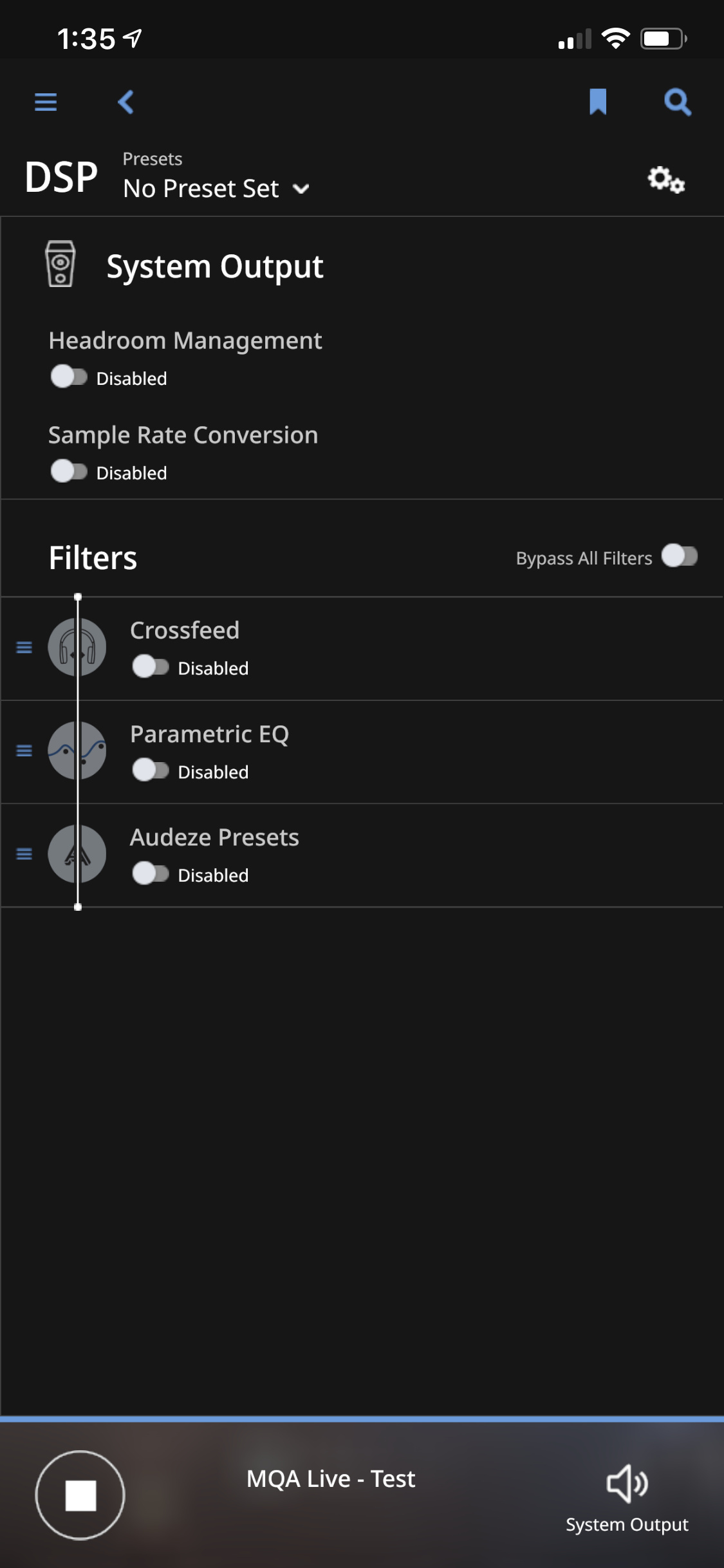

No difference.
Per @Brian, it can’t, based on what it does.
I leave it off as I don’t use it.
Hi, I think that back in 2017 there was an issue that caused an audible change in presentation with DSP toggled on for those that had really resolving systems. I believe that issue was rectified and it should no longer be the case. Regardless, common sense applies. If not using DSP just leave it off.
1 Like
I may be remembering incorrectly but I thought that there was not an issue and in fact it was running exactly the same code with no technical mechanism identified that could be causing differences. For my main headphone system I leave it off as that is my most resolving (Stax 007, Carbon energiser, Chord TT2 and Chrot M-Scaler, Optical Rendu) but in other speaker systems I use it in difficult rooms such as my system in my octagonal summer house.
You may be right, after a quick search there was a topic about convolution with null filters not being transparent and that was what I was thinking of.
This is an old thread and I am fairly new to Roon (ROCK 10i7) but still:
I have the same experience. When I use a tiny bit of DSP to correct for my room, sound quality diminishes. Like less dynamic.
Even more serious, there is a slight cracking sound with sudden bass driven music (timpani drum in classical music) when DSP is active. Irrespective of volume level.
DSP Off and it is all oké again.
Any suggestions?
It’s possible that you are running out of digital headroom.
Even a tiny boost can max out a track that has been mastered to use the full bandwidth.
You can find advice here https://help.roonlabs.com/portal/en/kb/articles/dsp-engine-headroom-management#Introduction
1 Like