I know that’s not true. Never say “no one.” The point is, people should not violate copyright laws by sharing music files with other people however they do it.
I’m with you on that, but in Germany I’m legally allowed to share with my closest circle of friends, that’s how the laws are made here. Selling is forbidden. Borrowing allowed, copying limited allowed. But I haven’t experienced that for 20 years. Everyone I know streams and I’m the last idiot.
I guess that the high holy ones who will not even stream because the artists don’t get paid enough never listened to or owned a radio. By the way, non-commercial radio stations, such as all college radio station, do not pay any royalties to the artists. Talk about abusing the artists.
Is the streaming model perfect? Absolutely not but it’s the one we were given and I’m fine with that., at least now some of my money goes to the artists rather than to some file hosting site. Rapidgator anyone?
For an interesting example of how ideas about artists should be paid read up on the history of radio. Radio was going to kill the revenue that artists received from the sale of sheet music! Or perhaps the history of acting. Long before actors lived in multi-million dollar Bel Aire estates they passed the hat in hopes of getting enough money to eat.
Anyway it’s good to read that I am not alone in my feeling on this issue. Remember that artists create for a living while the rest of us poor souls have to work. 
2 Likes
BMI and ASCAP are never quite that charitable. They always get at least something.
1 Like
Published on the same day (and Roon gets a mention)
CD, download & co have ruined the market, streaming is rehabilitating sales and bringing new sales records
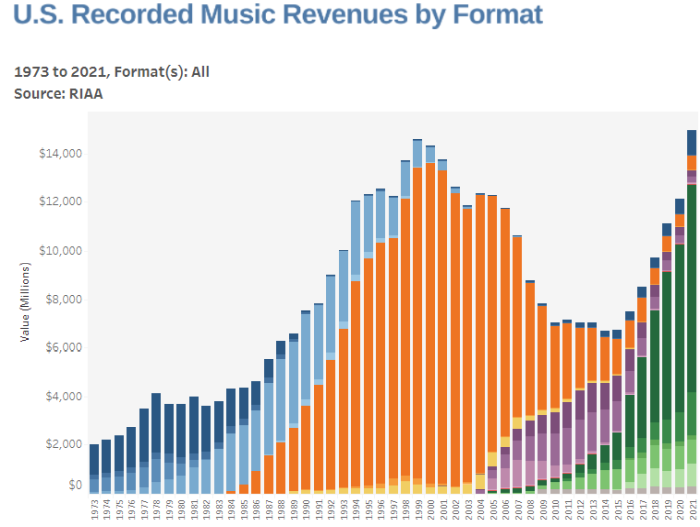
People who aren’t even interested in free streaming, don’t want subscription services, are also less likely to make LPs or other purchases. It is the few music lovers here and on the services that support the music market.
1 Like
I don’t know someone who own a large collection but I guess there are many passionates who have lot of copies of the same opus (the same album in many mastering propositions, multiples editions, sources [vinyl rip / CD…] and format [compressed, Flac, Wav, DSD…].
I don’t own a large collection, but In some towns, there are public libraries where anyone can borrow multiple CD’s and Dvd’s for less than 30 $ annual subscription. In the city where I live, it is possible to borrow up to 40 CDs at a time. You just have to return them to be able to borrow others. It’s legal to make copies for personal use but it’s illegal to share them. If the person has been doing this for decades, she can quickly constitute an important library. Maybe it’s an explanation
I think in most cases here, it’s not that people have these locally (although my 42,000 track / 2 TB collection is 100% local). I think many of them are in their Qobuz/Tidal collections.
I never asked for more detail earlier in this thread about this, and I guess that would have been interesting to do! But my original question was to suss out whether or not people actually could give attention to that much music. I did get some good answers here, resulting in the conclusions you see (way) up above.
1 Like
This is not true. At least not in the USA.
1 Like
Correct. It is legal in the US to make copies for personal use of CDs you own. Not ones you have borrowed from the library or friends. In fact, legally speaking, if you get rid of your physical CDs, you are supposed to delete the digital files as well. All this said, the police will not be knocking on your door asking to see your CDs. Unless you are running a large illegal file sharing operation out of your house. 
1 Like
There are countries where it is legal to download content as long aas you are not selling it further or upload it. It is ridiculous, I know, but it is the law.
yep. and it used to be (may have changed), that technically in the UK, one was not even allowed to rip digital copies from one’s own CDs.
I’m sorry to hear this, but in my country of residence it is perfectly legal to make a copy of a work borrowed from the library provided that the material used for the reproduction is private, so you cannot use a library scanner to make a copy of the book.
In addition to the fact that culture is accessible to a majority of people, it’s a good way to discover artists and works and eventually buy them later; being able to borrow and copy any work is paradoxically the best reason to not do it : a bit like Qobuz’s offline mode, which we rarely use because we know that it’s useless to saturate a hard disk. It’s a waste of time to make rips when you just have to literally cross the street to get a work and rip if you really have to do it.
I never asked for more detail earlier in this thread about this, and I guess that would have been interesting to do! But my original question was to suss out whether or not people actually could give attention to that much music. I did get some good answers here, resulting in the conclusions you see (way) up above.
It’s a good question. I think that the radios have conditioned the listener not to consider the albums as being the primordial unit of listening, but the track. This phenomenon has become more radical with streaming platforms. In conclusion, I would say that having a plethora of offers (in streaming or locally) fits perfectly with the way music is listened to today. For this offer to be combined with attention to the album, it takes a lot of discipline on the part of a listener, discipline which is more or less necessary depending on the type of music that one listens to.