I doubt that
From my knowledge of Roon Meridian heritage and from my last experience Roon Ready system integrated Streamer& DAC RAAT perfect bit configuration is much higher level than Roon Tested Core Audio USB DAC, Chromecast or AirPlay 2.
In my opinion the Roon Ready system performance can produce absolute sound with perfect instruments and calibration and get highest sound quality with less perfect items.
I have a pretty decent system, an ARC REF 6, Pass 250.8, an MSB Discrete DAC with Premier Power Base, Wilson Sabrina X’s, a REL s/510, a Shunyata Everest power conditioner, and a full Shunyata Sigma loom. I can honestly say that Roon sound great, and with bit perfect playback, what you hear is a function of your system, cables, power, room treatment, etc. Roon neither detracts from nor adds to the signal coming into it, because it is bit-perfect.
Hmm…“time domain”, as it relates to data transmission over session-based protocols (like TCP/IP), comes down to throughput and latency. Nothing more.
Correctomundo!
“the most expensive app in the world of hifi and high end”
I am paying for much more than audio quality.
From my perspective, Roon advertises it’s product with focus on the “Music Experience” in mind. I would interpret that as; It should look good, feel good and obviously sound good. I am pretty sure that they have nailed it. Having lived through Vinyl, Cassette tape, CDs, Napster, iTunes and Tidal…I struggle to understand how it gets any better than this.
For the majority of the people who consider themselves an audiophile at any level, it’s a fairly amazing time to be alive.
As always, thats just my 2 cents.
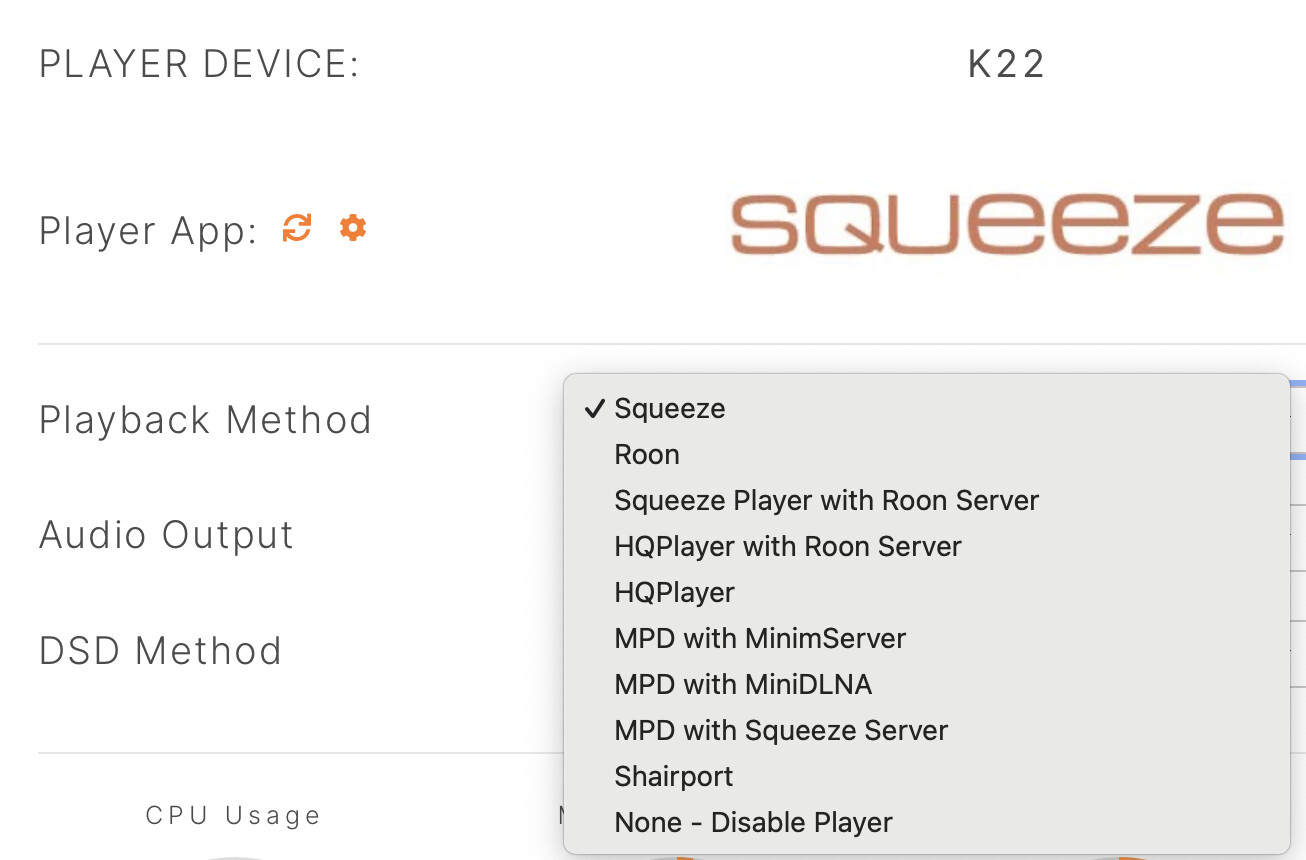
Full disclosure: I am a lifetime subscriber with Roon. However, it was not until I purchased my Antipodes K41 server and K22 player that I experienced SQ on an entirely different level. Antipodes places Squeeze server at the top of their hierarchy via their drop down menu. They give every customer a choice of using any number of servers (screenshot attached), one of which is ALSO prominently offered - Roon. So I use Squeeze even though the user interface from Roon is without question best in class. Nothing really comes close, imo.
Now, a few weeks ago, I was introduced to Jplay and must say, that while it doesn’t sound (to my ears) as good as Squeeze, I DO prefer it to Roon. I would also add that while Roon support for Qobuz is excellent, Jplay support for Qobuz is, well, as though on steroids. In other words it is simply much faster. Way faster.
So whereas I would typically visit Roon on Fridays or Saturdays to check out new albums from Qobuz, I now visit Jplay because it is more robust for both local files and Qobuz. I DO understand many enjoy Roon bc of the DSP options, but for me this adds no value as I stream digital/digital into my Lyngdorf MP-60 which of course features RoomPerfect. So thanks to RP I have no use for any DSP functionality. This (D/D) connection actually sounds considerably better than the sum of my two Mola Mola products - the Tambaqui DAC and Makua preamp. Why does it sound better? One fewer machine (DAC) and one less cable in the chain. So the entirety of the signal is digital until the very final stage where the MP-60 converts to analog on the way to my amplifier.
Everything in life comes with a trade off. I think Roon RAAT sounds very good. Improvements have been made for sure, but the SQ is simply not as good (apples to apples) as Squeeze, NOR is Jplay. That said, in percentage terms I would say that Jplay is between 5-10% behind Squeeze. Just my two cents…
Do you have more money in the bank account too after sending it over one less cable?
Haha. Not yet because I haven’t yet sold either of the two cables 1/USB and 1/AES) that I can (potentially) connect once again to my DAC. But one day if I am feeling rich I might just purchase an integrated Lyngdorf amp to drop between my Makua preamp and Krell amplifier. RoomPerfect is the secret sauce.
As your one less cable system has magical capabilities now, you should be able to get more money into your account without selling something, and better news on the internet, too.
Not a very convincing explanation. The DAC is still there, but in the same box with a bunch of preamps, and a bunch of analog outputs, a bunch of HDMI inputs, circuitry for processing video etc. Some audiophiles would cringe at using an AV receiver. Many also swear by having everything separate: DAC, preamp, pair of monoblocks.
Sooooo, if I understand your reproduction chains, you have:
(1) Roon streaming directly into Roon Ready Lyngdorf MP-60 with Room Perfect room correction out to your power amps.
(2) Roon into the Tambaqui DAC then out into the Makua preamp and out to your power amps.
(1) likely sounds better because you have room correction.
But none of that has anything to do with the Antipodes server providing superior SQ via player software to anything. Bits-are-bits are either arriving in the MP-60 or the Tambaqui for analog conversion. The DSP being applied is only in the MP-60 for Room Perfect-ion.
I2S was for component interconnect in highly constrained designs - eg PCBs. As soon as you ask it to perform where there are multiple uncontrolled variables - ie interconnects between random devices - you’re asking for trouble.
FWIW, I did build an I2S and tested my Tambaqui with network, USB & I2S. If I squint hard at my own perceptions, I’d say that the Ethernet connection was best, with zero discernible difference between the others.
I prefer not to get into a discussion about “bits are bits.” Sorry, but I will not go there because it’s a similar conversation when people insist that all cables are the same. But it’s still for the time being a free country and one can believe what she chooses to believe. - 
But to answer your question, I have both a USB cable and an AES/EBU cable coming out of my K 22 player connected directly to my Lyngdorf. I have spoken with high-level audio techs and installers who are very familiar with the architecture of Lyngdorf and have explained to me that there is something very special in sending a purely digital connection directly to the processor, essentially bypassing another layer of interpretation - that being the DAC that converts the digital stream to analog, and then sends it off to a preamplifier, and then off to the amplifier itself. Lyngdorf uses some very sophisticated filters in conjunction with their EQ a.k.a. RoomPerfect.
Perhaps not surprisingly I like most Lyngdorf users had the perception that the company’s focus was in video processing because they have sold so many thousands of MP-40’s and MP-60’s throughout the world. It never occurred to me that their processors could do double duty in the realm of two channel stereo. It took me four years of ownership to realize the scope of what is possible with this box. Many people on a Lyngdorf Facebook group I am on ask if the MP-40 or MP 60 will sound as good as the TDAI 3400. Most people seem to concur that the sound should be identical. The only difference might come into play when the end user has a dedicated amplifier that might arguably sound better than the amplification section of the 3400. Never having heard that I cannot speak to that, but it makes sense to me that amplification matters, of course.
And for what it’s worth the factory is three weeks backlogged on their new multi channel amplifier, the MXA – 8400 which I have recently ordered and I’m waiting patiently to receive for use in my home theater. Peter Lyngdorf along with Bruno Putzeys are both geniuses. Brino co-founded Mola Mola and is now working for Peter Lyngdorf. They are both wizards in the realm of digital audio. I believe Peter Lyngorf spent 9M some 20 years ago to develop RoomPerfect and in today’s dollars represents about 15M. That is far more money than most audio companies realize in total revenue all year. Most manufacturers will buy a cheap license for Audyssey EQ which for me is unlistenable. DiracLive good also, but not in the same league as RoomPerfect. Little known factoid: if you look at the McIntosh surround sound processors, their entry-level processor uses Audyssey, but they’re high-end surround sound processor that sells for about $19,000 US uses RoomPerfect. Lyngdorf used to build the digital boards for them. Not sure if they still do but for sure Mac is licensing from Lyngdorf. In fact, McIntosh sells a dedicated RoomPerfect box for $6,500. It is the MEN 200. Obviously there is a demand for this software if folks are willing to spend that kind of money for room correction. I think you have to hear for yourself.  I really don’t have a dog in the fight, personally. And since I DO have an investment in Roon I would LOVE to see enhancements in Roon SQ.
Finally, I should point out that at any time I still have the option to listen to Roon or Squeeze or Jplay using my “previous” connection. That is:
K41/K22/Tambaqui DAC/Makua Preamp via Cerious Tech interconnects/Krell Duo 300XD/Dynaudio Confidence C2’s.
I THOUGHT I had a great sounding system with the two Mola Mola pieces ,and they are GREAT. But Einstein was right . It is all relative. When compared to my Lyngdorf, it is essentially unlistenable. I believe that the distinction is more a function of the Lyngdorf providing AMAZING room correction more so than the digital digital connection delivered to the Lyngdorf. But both play a factor for sure. You can actually do a lot of research on forums on the McIntosh MEN 200. Most users will acknowledge that they could never listen to music again without it… Maybe worth checking out…
Soooo, your second and final paragraphs support my suggestion that room correction is likely responsible for the differences you are hearing. In your second paragraph, however, you seem to be confused about how this stuff works: the Lyngdorf uses DACs to convert digital bits into analog signals just like the external DAC does. The L. might do digital volume control on the outputs unlike the outboard Mola Mola pre-amp, however, so there is that difference.
But there is not any obvious way that Roon SQ is in any way different than other software players because bits are in fact bits. To reiterate, all of these software stacks provide precisely the same bits to the DACs, whether they are part of the Lyngdorf box or the Mola Mola (sans actual DSP being applied in the players).
The rest of the praise for various products and their evolution is largely irrelevant to this thread, of course, but I am glad you are excited for your setups! 
PS: The Tambaqui measures SOTA but some Lyngdorf products lag a bit (not able to find MP-60 measurements):
There is also an analysis of RoomPerfect with the same product:
Where it exhibits excellent performance but on par with Dirac, etc.
My bad…I often hit the wrong button at the bottom when I intend to reply!
Well, because I am ostensibly confused, I consulted ChatGPT and rather than tap into my own knowledge which I confess is quite rudimentary and entry-level compared to many on this platform I thought it best to consult the omniscient AI bot and this is what ChatGPT has to say regarding the belief that “bits are bits” and that somehow “Lyngdorf isn’t on to something.”
CharGPT knows way more than I do, so here is what AI has to say on both matters. And FWIW, I am NOT a fan of AT ALL of Audio Science. Why? Bc music is as much art as it is “science.@. Emotion cannot be measured by instruments. Many senses in fact cannot be captured by instruments. so the first question I asked ChatGPT was if all bits were equal and if bits were bits. Answer below:
“No, it’s not true that all digital music sounds the same. While digital music is stored as bits (zeros and ones), the way those bits are arranged determines the unique sound of each recording. Factors like audio file format, bit rate, mastering quality, and playback equipment also significantly influence how digital music sounds. Each song or recording can have distinct characteristics, even in digital form.”
And then I asked a specific question relating to the discussion on Lyngdorf and their philosophy and this is the reply I got from ChatGPT below:
“Lyngdorf believes the best sound is produced by sending a pure digital signal to the processor because it minimizes signal degradation and preserves audio integrity. A pure digital signal avoids the noise, distortion, and loss of detail that can occur during analog-to-digital or digital-to-analog conversions. This approach ensures high fidelity, precise sound reproduction, and maintains the accuracy of the original recording.”
And all I would add as a listener is that everyone I know who owns Antipodes favors squeeze with the exception of a few who prefer Jplay and many who prefer room once they have taken the time to take advantage of HQPlayer or other DSP’s.
Bottom line is while many contend that “bits are bits” I ask rhetorically, why is it that I can listen to the same exact file that resides on my server and hear it expressed differently depending on the platform - be it Roon , Squeeze, or Jplay? And this holds for for using Lyngdorf or Mola Mola.
All good, buddy!
Well, your first result from ChatGPT is correct but irrelevant. Sure, something like low versus high bit rates in compressed audio can result in audible differences, but if the same streams are delivered by different players to the same DAC they will sound the same. Thus bits are bits.
The second ChatGPT output is also irrelevant since pure digital streams are being sent to every DAC. The DAC then decodes the digital stream into an analog signal and outputs it. That’s all that happens. There is no analog-to-digital then digital-to-analog, etc. happening. ChatGPT is hashing a bunch of marketing gobbledygook and rather badly.
Finally, your comparison in the final paragraph between Lyngdorf and Mola Mola listening is not relevant because we have established that the L. is performing DSP for room correction. But, if you are saying that different player software sound different on both the L. and the T independently. then it is most likely that you are simply mistaken since there is no engineering or rational reason for that. There are a range of biases that might be at work, including your expectations given that you know many people who claim Squeeze sounds better. Therefore you are primed to think that is true.
But I can’t be sure why you think you hear a difference. You can potentially establish the truth of your claims through careful testing (ABX/Null/AP on the audio outputs) but it would require a neutral and earnest interest in measurements, which you seem to find uninspiring. I personally am humble enough to doubt magnified marketing claims, hallucinatory AI mimicry (and I’m in the field!), and magical thinking about how music gets rendered in these great machines!
Roon is a fun toy to play with but not for serious digital audio playback. If you’re looking for ultimate streaming sound quality, Roon is not your solution. Roon is noisy and is significantly bested by dedicated/in-built network streaming platforms from Aurender, dCS, CH Precision and the like. Just how it is…bit perfect or not.