I suppose that works as well - the point being that despite us looking at (or listening to) the same thing, how we perceive it may not necessarily be the same.
1 Like
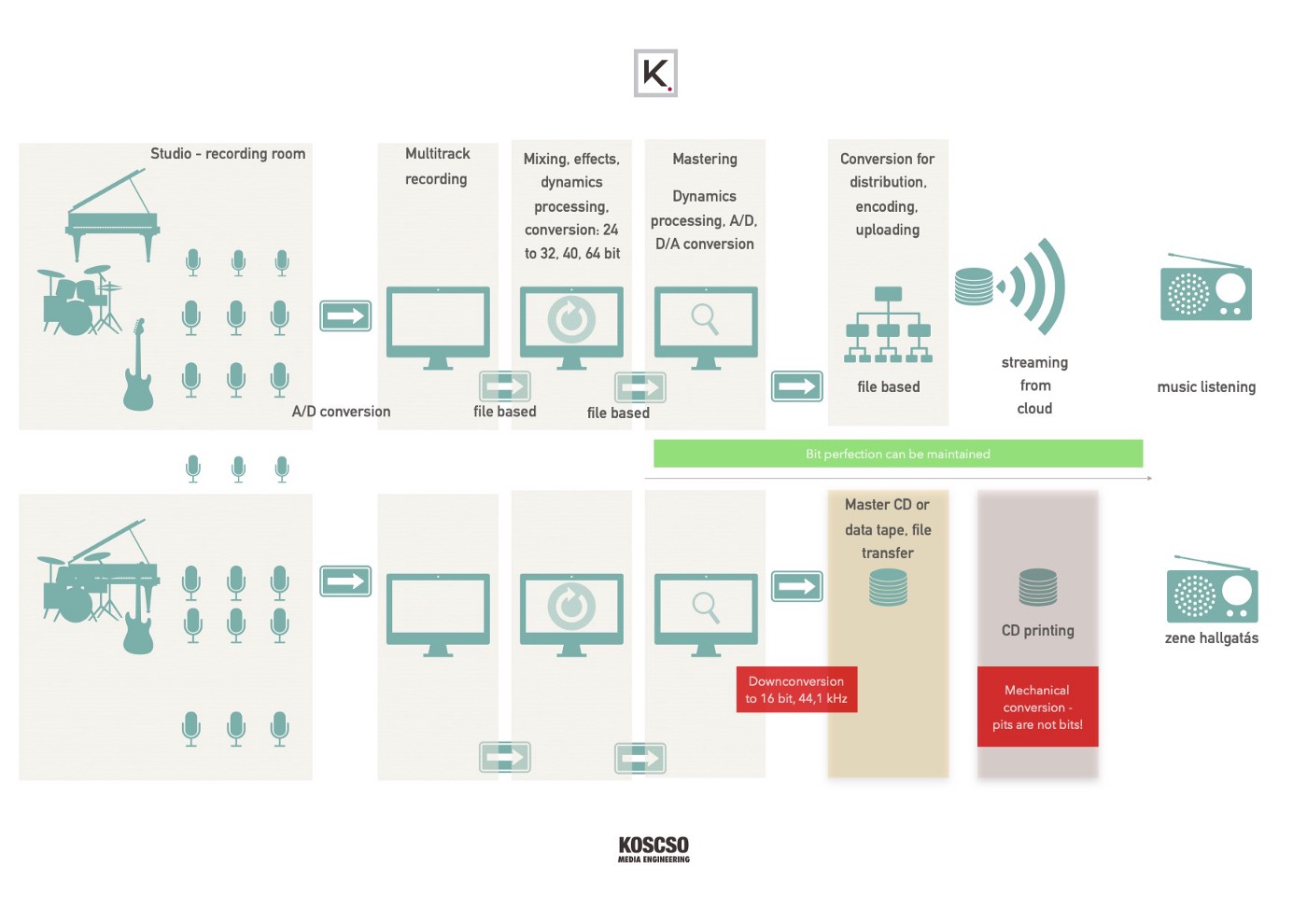
Here is a simple infographic below I did for an article, which shows how CDs and streams are “made” and what is the difference to the actual master file.
Until the final steps of mastering, everything is the same. Then there will be differences.
-
The master could be saved in FLAC with the same sampling rate and bit rate and then uploaded to the streaming provider.
-
The master could be converted to 44k/16 bit and then uploaded to the streaming provider.
The CD manufacturing process starts from here from the 44k/16bit format. However, as the master is usually higher than 44,1kHz/16-bit audio files, mostly 48k/24 bit or higher, there will be a conversion from the master on CD in all cases.
CD manufacturing involves an electro-mechanical process (music CDs are pressed) for making it (pits printed or molded in case of CD-Rs) and an optical-electrical process and error correction on the playback side before the D/A conversion. Playing a CD means following the spiral of pits and lands. Playing CDs back properly requires all sorts of processes, like error correction, optical reading, reading head controlling through servo, etc. In addition, a well-designed power supply is a must to minimize distortions on the D/A conversion part of the playback process. Playing CDs always involves motors, servos, spinning discs.
So technically, a high-res stream from Qobuz, will be “closer” to the master than any CD, ever.
If anyone likes CD better at home than streaming, it is possibly caused by the local system or its limitation, not by the streaming technology itself.
Streaming companies are content managers. They have or hire cloud storage and operate the subscription and revenue sharing system behind it. Most of them do not do anything with the files uploaded by the labels, right holders, or so-called music distributors. Even normalization is done at the end of the chain by their apps, not in the cloud.
So if you hear a difference between using a CD and listening to a stream, I think there are few potential reasons, but not the streaming and cloud storage technology itself:
-
The masters are not the same. Even 0,5 dB difference here and there can make a difference. There is a chance that in this case, the overall loudness of the track will be different too (so-called LU(FS) value). None of us know if the masters are different just a little bit.
-
Gain structure is different in the different paths. Therefore, these comparisons are not completed with the same checked and calibrated loudness.
-
Personal bias
-
Different playback chains.
-
Tidal (Qobuz) are not in exclusive mode and/ or using normalization
As it was mentioned, adaptive streaming is not used by Tidal or Qobuz at all. Netflix does this. You can see that sometimes the first few seconds are much worst than the rest of the movie. This is because tidal and Qobuz continuously fill a buffer and plays from the buffer. No spinning disks or servo-controlled heads are involved. The PC-based streaming can be strongly influenced by the audio subsystem of your PC, how the memory content is fed to the audio output devices.
I sold my Accuphase SACD transport/DAC (DP100/DC101) 15 years ago; since then, I have been happy with playing files and streams (and I make recordings too in DSD mostly since the late nineties). I always try to optimize my systems for file and stream-based playback.
Optimizing a streaming-based system can be tricky. An optimized CD-based system can rely on the knowledge of the manufacturer of your CD player/DAC.
One should have to be quite a bit more involved to optimize and get the most of a streaming system as it involves some networking skills.
12 Likes
Okey,
This thread triggered me in doing some tests myself.
I have this Yamaha CA-1000 amp. Vintage? Yes! As new? Yes!!
Hooked onto my amp I have a Yamaha CD-S2000 CD player and an Auralic Altair G1 streamer/dac/server/whatever
Sources I’m comparing:
Original CD (1992)
CD ripped to Apple Lossless using iTunes and stored onto the Auralic Altair G1’s internal ssd
Qobuz 44/16
I have a VDSL internet connection 100 MB/s
I have a Fritz! modem/router of some sort.
The connection with the Auralic is wireless.
Software is Auralic’s iPhone app (LDS). I don’t use Roon at all.
The album of choice for testing is Mike Oldfield’s Tubular Bells II from 1992. It’s an amazing recording, full of details. (and some amazing guitar work 
The amp is switched to class A.
No EQ, no upsampling, no tube buffers, no funny stuff or anything. Just flat signal.
Listening using headphones (BD 990Pro), eyes closed in full concentration.
Now, what’s so nice about the amp is that I can switch between sources SEAMLESSLY by switching a knob between Aux 1 and Aux 2.
Seamlessly comparing is mandatory when perceiving and evaluating sound by comparison.
The trick first is to sync the Auralic to the CD, but that’s easy. Volume is matching from the start.
First listen is CD player vs Auralic internal SSD.
After 15 minutes or so switching between the both of them my conclusion is: IDENTICAL sound.
Next up: CD vs Qobuz
Result: IDENTICAL
Now,
Why is there soooo much discussion on forums like these regarding issues with streaming? There’s always something up with streaming it seems. Why is that? People choose streaming for it’s convenience and this seems never to be the case. People never buy streaming products to change the sound which makes sense because basically there shouldn’t be a difference at all. But yet, there are lots of issues which seem to degrade the sound.
Not quite sure myself about the point I’m trying to make. Just sharing thoughts and experience.
You say your CD player sounds way better, but that’s not the case. You’re CD player is nothing special. It just works like it should.
You suspect a weak link in your setup and I think that’s spot on. This can be a faulty product, something is broken, there’s a compatibility issue or it’s the router or the software or a setting in the software six submenu’s deep. Or you’re comparing different masters which is tricky if you’re unaware. It’s not the ‘streaming technology’ itself.
Why don’t you try to get your hands on an Auralic Aries Mini, put an SSD inside and do some testing with that and streaming Qobuz using this device only.
Whatever the case, if your issue gets demystified and solved, your streaming will sound good again, but not better than your CD, just identical. 
Cheers
7 Likes
On the weak link, all I can say is “Takeo Morita”
My thought is that it must be the way my streaming is interfacing my DAC vs the way the CD transport is. The ethernet cables the streaming runs through into my wifi router then onto my DAC have to be the cause of the degradation of the sound vs CDs in the transport. I will have to look into trying a USB connection from the Nucleus plus to the DAC and see what I gain with that connection. It’s not surprising to me they might sound different. Some here are going to say all digital cables sound the same or USB or ethernet cables cannot make a difference so to those folks we don’t have anything to talk about and no offense. I don’t claim the same things I am hearing here would play out in another persons system or with totally different gear. If I had you over to listen on my system you would agree with what I’m saying. I had a buddy over to listen and played some CDs after streaming to show him and he was shocked how much better the CD replay was. Vinyl is on a whole other level as well.
Hi Ryan,
I thought this was the case myself.
I started streaming just 1.5 years ago because TIDAL gives you FLAC (i.e. cd quality) as a minimum.
I still had my recordplayer (with 180grm audiophile pressings as a reference + SACD as a second reference.
When I moved from traditional ways to Musiccast I enjoyed the fact that instead of turning around LP’s or changing CD’s I could use my iPAD as a control centre.
I then moved to Roon + TEAC DAC / 10Mhz master clock (HiRes up to max. PCM & DSD 512) it started to become more interresting.
But the cliffhanger is that the ‘digital’ feeling to the music only disappeared when I made (modest) tweaks to the power supply chain.
- ISOTEK Gemini block to separate my two HMS filtering power bars (one for the digital and one for the analog equipment).
- linear power supplies for my Roon core (Farad super 3) + Cambridge audio dac.
Then, my brother in law could not distinguish between Diana Krall on high quality vinyl and streamed …apart from some static noises from the LP
Please take care of your DC and AC supply chain…
Even very expensive digital equipment will sound digital without doing that.
Regards,
Hans
Ryan, Your hardware is high quality so that shouldn’t be the problem. I’m getting very satisfying results from my streaming setup which I’ll describe as follows. Netgear router in the basement with a shielded CAT6 ethernet cable (75’) plugged directly into a rear port on the router. CAT6 has been kept away from any high voltage power cables from the basement and along it path to its destination going upstairs to my dedicated music room. CAT6 is plugged into an EtherREGEN Uptone Audio switch. Do your research on this switch, it has transformed the sound of my streamed music and well worth its price!! Audioquest Ethernet cable from the EtherREGEN to a Small Green Computer Sonic Transporter I5 server. Audioquest Ethernet cable from Sonic Transporter to an Ultra Rendu. Audioquest USB cable from the Ultra Rendu to my PS audio Stellar Gain DAC. I upscale the native rate of 16/44.1 streams to 88.2 with the Roon DSP processor. I leave Hi Rez streams alone and listen in its native rate. The Stellar Gain DAC has three digital filters and I typically select the filter with the least digital ringing. The Roon DSP processor also has filters which I have engaged with the filter that has the least digital ringing. Qobuz streams sound great through this hardware, processing and signal path. No complaints, although when I do an A/B comparison of streamed music vs CD’s of the same source material on my Marantz CD/SACD player used as a transport to feed the PS Audio DAC, I usually give the edge to the Marantz / PS Audio signal. But it’s close in sound to my ears. Of course my turntable, phono preamp, well recorded and freshly cleaned and vacuumed vinyl simply are the best sound of all. Much better and so much more natural of a sound to listen to. But I spend more time streaming from Qobuz / Roon than vinyl because I like to hear a variety of music during a session, instead of one side of an entire album of which I may only like one or two tracks. The key for me with streaming and hardware is to experiment with the signal path and the multitude of settings that are available. I just make one adjustment at a time a sit back and listen and document my findings. Don’t give up on streaming and get yourself a EtherREGEN Uptone Audio switch. Peace.
- use USB from your Roon core to your DAC
My thought is that it must be the way my streaming is interfacing my DAC vs the way the CD transport is.
I think so too.
The ethernet cables the streaming runs through into my wifi router then onto my DAC have to be the cause of the degradation of the sound vs CDs in the transport.
That would be silly, but not impossible if there’s an electrical issue running through that cable.
I will have to look into trying a USB connection from the Nucleus plus to the DAC and see what I gain with that connection.
Indeed, this might cancel out something or another.
If I had you over to listen on my system you would agree with what I’m saying.
I think that’s actually true, but it is exactly this that makes it all so difficult.
Don’t forget your problem can be caused by something very silly you’ve overlooked.
That happend to me last week. I was listening to this new album by a Dutch musician through Qobuz. From the start, the sound was plain ugly. Vocals not cutting through, a feeling of deafness coming from the left speaker and it seemed like something is out of fase.
I was tinkering with the idea to contact the artist to ask why this recording was so weird when I suddenly realized I had the interconnect cables out of my amp for a moment for cleaning a couple of days before.
I checked the connection and it appeared I had them put back in the wrong way. I accidentally switched left and right!
After putting them back in the right way, I could finally enjoy the album which (suddenly) appeared to be VERY BEAUTIFULLY recorded! 
So if you think there’s something VERY wrong with your sound, you’re probably right. I’m curious what’s the cause of your problem.
Keep us posted.
All the best,
JW
1 Like
Having read this whole thread and many others like it over the years the one thing I’m always left wondering (and until today have been too afraid to ask) is that after you are done with the whole bits-are-not-bits argument and accept the premise that there are problems unique to high end audio with noisy and less reliable data transfer ways that even thwart the error correction that years of software/network engineering anticipated … shouldn’t it be the expectation that once those bits make their way to the destination it would be a feature that the $24,000 DAC would be able to compensate for any of these gremlins?
2 Likes
Yeah, that would be the logical, common sense approach. I would add that some DACs in the $500 range can do that too.
3 Likes
This misrepresents the situation, there’s nothing unique about high end audio from a data transfer/network engineering POV. There may be sub-optimal implementations of USB/ethernet and poor noise rejection in some audio gear. Some of that gear might carry a high price tag. None of this means that audio data transfer is a special case.
2 Likes
Spanner in the works: I like to think I have a highly resolving system, and spent too much on kit!? (OK I stopped spending) … I reached a point where streaming (in house from a NAS and or NUC - not subscription services) I could not hear the difference from CD and sold my CHORD Blu CD player and Tag McLaren DVD 32R. What I found was key is to keep the signal clean, clean, clean from once Ethernet/USB enters the HiFi chain. I found DDC (Digital to Digital Converters/re-clockers) to be of value in this regard… CD is still very good and I can not say that it was better than streaming (I am a RED book guy) I know I know!!!
1 Like
Not so much a spanner in the works,
is pretty good/universal advice. My take on re-clockers and the like is that the same board/chip could be built into a streamer to prevent the problem occurring in the first place. There maybe be some isolation advantages to keeping the different parts in different boxes. The point I was trying to make is that the protocols, hardware components and software available are more than adequate for audio data transfer.
I reckon at least 95% of my listening is Redbook, I’m far from convinced I can spot any hi-res improvements…
2 Likes
hi
Did you run a blind test ? that save me a lot of $ like I didn’t have to buy a stuff that didn’t change anything … and believe me when I know that a new toy is playing i ‘hear’ that is performing better … 
I know that you already bought CD player but it could be great if you can do such test and share your findings .
1 Like
@ryan_stratton My story short:
3 years ago. LP preferred (Linn LP 12 top setup), then CD player (Linn top model 1.1), then Laptop as NAS, then streaming using Roon/Tidal - both through Chord Qutest DAC.
2 years ago. Got an Auralic Aries G2 streamer. Huge difference. Compared USB to Aries connected harddrive against wireless to Aries from Laptop connected with router via network cables. Wireless much better. Auralic do some magic to the wireless signal and lower noise significantly. LP still preferable but Streaming from NAS or Tidal via Roon a little better than CD-player. Later that year I godt an Auralic Vega G2 DAC/preamp instead of my Chord DAC/Linn preamp. This moved the sound to a different place with air and space.
1 year ago: Using LP and CD player as reference I updated all ethernet cables to Bluejeans and fed router, network hub and Roon/NAS Laptop from one powerstrip (cheapest from Wireworld) which again is connected to the wall by an old Ansuz A powercable. This made a leap in lowering noise and creating more relaxed and believable sound. Also changed to Qobuz. Earlier I found it difficult to hear differenc between Tidal/Qobuz, but with this setup Qobuz in general has a lower noisefloor.
Today I find my best 5% LP’s still have an edge on analog feel and being there, but otherwise streaming from Qobuz using Roon or the (even better sounding) build in Lightning DS in the Aries sets the standard. NAS is comparable to some degree, but a little noiser. The CD-player is sold.
Conclusion: It is possible to get REALLY good sound from streaming, but is does’nt come easy and dealing with noise is a major factor.
Good luck
Hi
I agree, I’ve found CDs in WAV and Lossless Flac format to be far superior them through streaming Tidal, qobuz etc . It’s a more fuller sound and louder (when you compare volume output).
But as always vinly tops everything. Nothing can beat that.
I agree completely, even at 1/4th the price my vinyl rig is much better to my ear. It’s not always been that way though I had a vinyl rig before that left me cold. There is a lot to keeping a vinyl rig sounding great and not everyone is up for the challenge I get it. I swore it off years ago and convinced myself streaming was good enough, ripped all my CDs and called it a day. Now I’ve come full circle and thank god I didn’t sell all my records. Collecting the actual physical media is fun too, I missed that connection to the music I love for many years. It’s hard to justify paying for something that is just vapor, I like to have the product in my hand and on my shelf
1 Like
If you’ve got audible noise in your digital chain, and it must be audible to be perceptible, then something must obviously be wrong.
1 Like
I guess I should keep all my savings in cash under my mattress then? “Vapor” can be applied to so many things today that are anything but. The ultimate purpose of media is to reproduce sound, which would totally qualify as “vapor”. Also, a digital copy that is backed up in the cloud is immutable and virtually indestructible, while physical media is subject to all sorts of degradation and will turn to dust at some point.
2 Likes