Version 1.8 improved sound quality

So I suppose being a bit more pedantic is necessary then. A company like dCS is going to put out their own app for many reasons - for starters, Mosaic is an app that was built upon another app that dCS had built, only improved upon a lot of features. At that time, Roon was just getting started and wasn’t as main stream as it is now. Further, as you stated, they very likely (my assumption) felt it necessary to produce a streaming and playback app for the DAC’s they were making since they are so expensive. Most people would expect as much – hell, look at Bluesound, Sonos, etc. and the prices of their products. If those come with an app, then one could argue a $30,000 DAC should too.

Finally, I never said a) that these companies use Roon exclusively, or b) that it’s a standard across all companies. I said they all use it. That said, there clearly are some that have their own solution and don’t. But Roon will work via USB for a lot of solutions. Just not necessarily streaming.

I will back my statement up by saying that I have been in many of the 6 figure audio dealers in the U.S. and I have yet to find one that didn’t use Roon in some capacity. Some didn’t simply because the product didn’t support it. But in my personal experience, dealers selling Constellation, D’agostino, dCS, Wilson Audio, Audio Research, Focal (Utopias), Sonus Faber, Dynaudio, B&W, and dozens more all used/use Roon in their showrooms.

Yes, a lot of companies are going their own direction - and that’s a great thing for competition. This is what drives our industry to be better: the fact that someone is always out for your position at the top of the mountain or along the path to the top.

I would also argue that 1) Your Aurender IS compatible with Roon - you just have to use Airplay. And this is practically true for most network enabled DAC’s: they use a protocol that can interface with Roon – not all, but “most”.

And I would argue that this is not a logical fallacy. That Roon’s performance is on par with the standards many audio companies keep, not to mention the dealers that sell their gear. Why would they even measure their gear with only Roon? That’s a recipe for disaster when it comes to compatibility and a myriad of other issues like the inevitable customer complaint: “my XYZ DAC from you sounds great over your app, but sounds like crap when I use USB or Airplay or RAAT, or …” It’s called integration testing - they all do it, and some use Roon as simply that; some use it as their baseline. Nothing is certain in this business and for you to say anything to the contrary is quite frankly “the logical fallacy”.
As I mentioned, this is beyond my level of expertise. Are you saying that there might be some surplus chattiness going on in one or more of the other seven layers?

That’s your personal value. I don’t think it’s fair of you to judge what others value relative to your own. I’ve spent 25 years trying to build a system that sounds as close to live music as I can afford. We should all understand that not everyone is going to share our values.

1 Like

No, I’m simply saying that this needs to be looked at holistically.

It very well could be that I was being too pedantic. You said “up to ‘audio snuff’”. I inferred you were speaking only about sound quality. In hindsight I see that you had a broader meaning. As such I think your argument holds water very well. I was so focused on sound quality that I read into something you hadn’t intended. I apologize for that.

1 Like

Sorry, should have said, “in my opinion”

Think time for me to bow out. Not my intention to upset anyone. Just on these forums for fun. I try not to take it too seriously.

Mods have temporarily closed this topic to clean it up and prevent further inappropriate and off-topic comments. It will re-open in three days. Please remember to talk about the ideas and not each other.

9 Likes

This topic was automatically opened after 2 days.

I want to point out that the difference between WiFi and Ethernet was solved in another thread. It was just a grounding issue caused by a shielded Ethernet cable. Switching to an unshielded cable gave me the exact same sound whether I had it plugged in or not with WiFi activated.

So with Ethernet problem solved I tested Sqeezelite vs RAAT and RAAT still won. Better soundstage and air.

I also came across posts about sound differences in using RAAT on RPI4 with Ropieee vs new OS called VitOS. Claims VitOS sounds better. I’m not going to bother trying to reformat my streamer to test this but interesting none the less.

While I like that the information is presented as bullet points you can quickly skim over, I was disappointed to find Jitter put into the esoteric domain. For years we are able to measure Jitter. If you can measure it, it’s no freaking esoteric thing.
This argument seems outdated or like claiming that wind doesn’t exist because you can’t see it.
Some people want to just having their bias confirmed because „bits are bits“ and do not take into account that even digital can go wrong in the time domain.

However I agree that (probably) no change in the RAAT protocol would have impact on Jitter because this is happening after the Streamer.

2 Likes

That was some funny satiric comment :grinning:

Just wait until someone asks if cable lifters are augmenting SQ,
Then a can of snake oil worms is opened :wink:

1 Like

Here is the specification for USB 2.0. I quote from section 4.5.1 “The core bit error rate of the USB medium is expected to be close to that of a backplane… The protocol includes separate CRCs for control and data fields of each packet… The CRC gives 100% coverage on single- and double- bit errors”.

Elsewhere you can find that the acceptable bit error rate for the physical layer of USB is 1 in 10^12. That is one bit wrong every 1,000,000,000,000. So one bit every Terabit might be wrong, and will nonetheless be corrected by the CRC. To get an uncorrectable error you would need 3 wrong bits in a packet, and that really is not going to happen in your lifetime.

http://sdphca.ucsd.edu/lab_equip_manuals/usb_20.pdf

3 Likes

The Video was about AES/EBU and SPDIF connections.

But then, such specifications, are always out of clean lab circumstances. In real life the performance may be a little different. Like when you’re buying now an all electric car. They claim you reach 400 miles or kilometers with the battery but in real life it’s always like 50 less. This just as an example how it’s difficult to transport specifications into real life application.

However I don’t contradict that USB is supposedly better than SPDIF when done right.

1 Like

As a owner of both I asked Aurender why they didn’t support Roon.
Answer: Roon needs more CPU power and Aurender would need implementing more powerful CPUs. Because of the EMI problem they won’t do this as they want to use minimalist CPU. So RAAT was not the the reason they won‘t. Just in case some took that conclusion.

My Innuos Zen mk 3 still offers that „experimental mode“. It‘s meant to be that you can use a Roon core with a Squeezelite player. I always considered this to be a service for compatibility for users in the logitech media server environment, than an expression of dislike for Roon.

Wondering what CPU Aurender uses?

A punk Celeron in Innuos devices doesn’t stop them from being advertised as Roon Core capable.

Maybe it‘s not the spec for simple audio playback but the extra for (optional) DSP functionality that would Aurender urge to use another CPU.

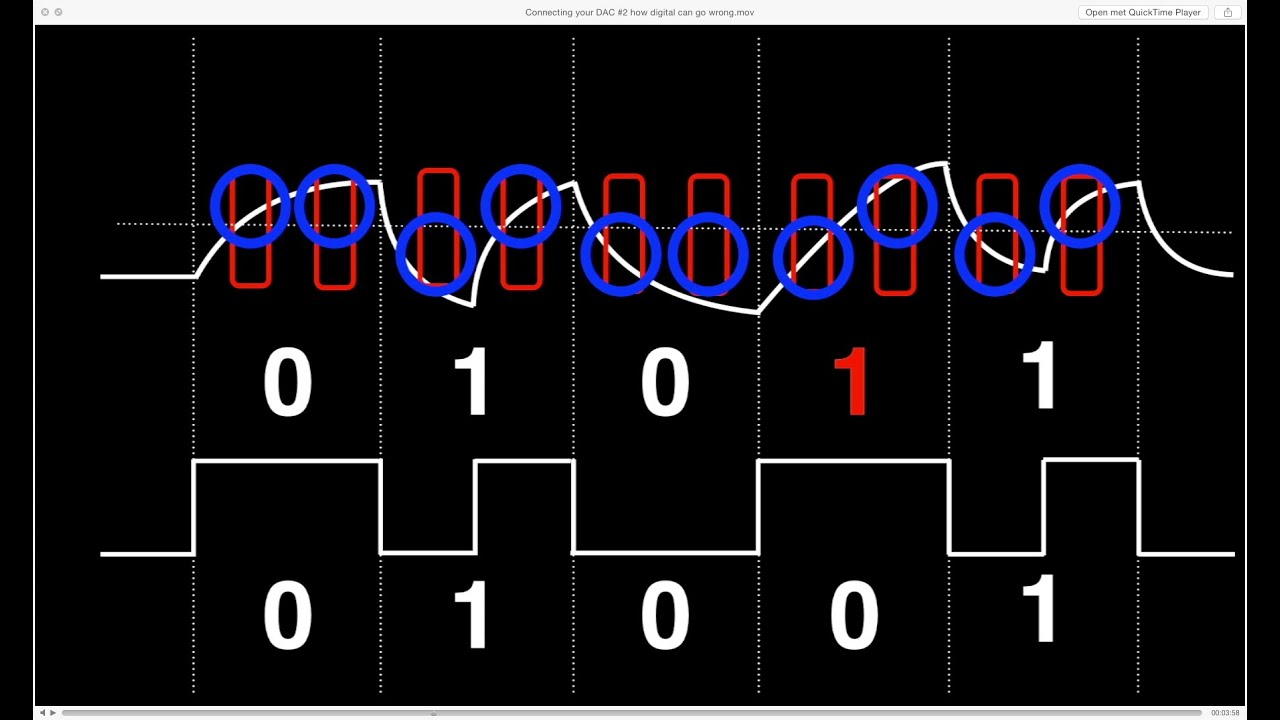
You don’t get better sound because you get less bit-faults, for most practical purposes we can assume that the data is delivered intact. But don’t confuse bit-errors with jitter, they are very different. In fact, in a time dependent dataflow like SPDIF or after packages over USB Audio has been unpacked, you can get a type of bit-error if you get high enough jitter, which is not covered by the bit-error data you mentioned (and which would not show up as a bit-error if for example you copied a file). This type of bit-error will also not trigger a resend and will go unnoticed.

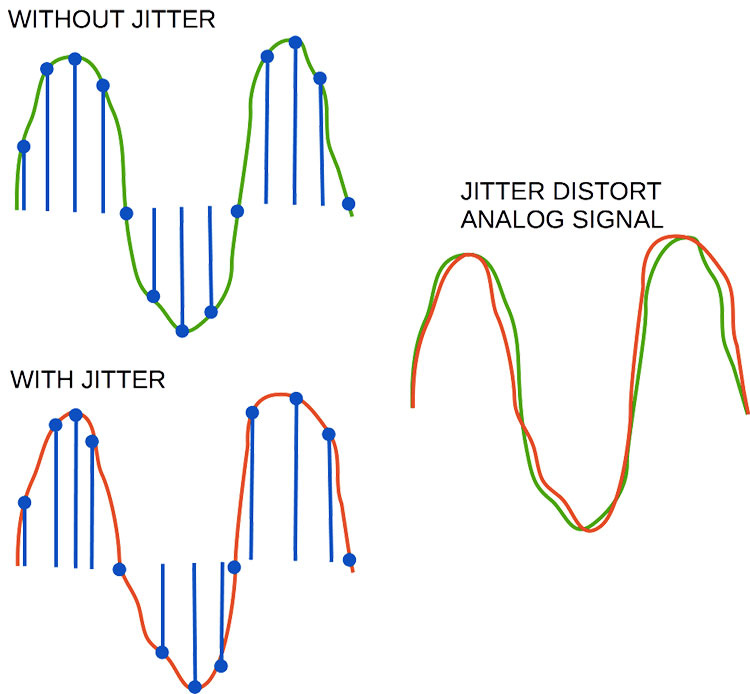
And even if jitter don’t cause bits to be misplaced, they can put the bits in the wrong time-slots which affects music. Here is an example (and note that in this case there is no bit-errors involved):

5 Likes

Here’s a blog post from Archimago discussing bits are bits. If you check out the section on jitter, his assertion is that jitter from reasonably well designed equipment is inaudible.

2 Likes