I hope the dr80n is in the pile, need to know if its a true native dsd, sales are on and the clock is a ticking,
No, I don’t have that. I have DR70n, DR80n seems to be two DAC modules instead of one, but otherwise it looks similar what I can see from their website.
Gosh, I know I’m late to the party, but I just repurchased in the last month or so an RME ADI-2 DAC FS, specifically to have the AK4490 chip with the moving average filter cutoffs at exactly 50 and 150 kilohertz. I believe that would equate to a 24-tap equally weighted and an 8-tap equally weighted filter in this particular config, and that seems to match what is in the chip specs.
And I’ve been running it with HQ Player at DSD256 in its bypass mode, and it is just absolutely outstanding even to this day in 2026. Of course, my most modern answer is I’m running the Holo Cyan 2, and I just use it in source mode. I believe it works best in source mode with HQ Player. It’s actually almost tailor-made for it, being non-oversampling. Well, non-oversampling in the sense that it has no reconstruction filter-- in the way that allows you to take advantage of the extremely high PCM sample rate to do things like noise shaping.
And I’m pretty sure that the Holo on the inside is using proprietary dithering mechanisms to get their incredible dynamic range measurements that they quote and are third party verified, which are very real and do contribute to the actual listening experience via PCM. ( Actually the theoretical 16 bit ladder + temporal freedom of 32 repeating samples at 44.1 or 48khz base, the math if optimized comes conspicuously close to the measured dynamic range.. 16 ‘real’ bits plus 5 potential LSB bits using a proprietary ultrasonic dither. No, this does not make it an oversampling DAC. The measurements are clear. It has the real deal sample and hold artifacts and the rolloff and impluse reponse to show it. Pulse repetition, not interpolation, allows one to have their cake and eat it too, as long as the ‘purists’ are okay with their LSB using a bit of DSP to actually offer a massive improvement in performance. Also explains well, as one small reason among others, why 18 to 20 bit input is recommended in HQPlayer. There just isn’t enough temporal freedom to accomodate more temporal averaged resolution at the LSB and said sample rate)
The DSD side doesn’t give up much at all and has a very similar tonality. It’s using a vector shift system, which can do things like make Hamming distances much shorter and maintain the filter kernel. You can also, once the parallel number “sum” has been created, you can also creatively rearrange the ones and zeros after the delay line and optimize switching, and keep the kernel intact. which I think is why, for an eight plus eight differential equally weighted moving average filter, it has such excellent measurements. For instance, take mid-point zero. The bistream is 10101010. Assume the pattern is unchanged. The next clock will shift every bit at once. When both are saying the exact same thing. So why not just use a control mechanism to prevent unnecessary switching? THe filter kernel is unchanged. Great DSD converter with tech that makes an 8 tap boxcar perform way better than one might imagine.
So honestly, those are my two answers to your question: very old and very new.
Anyway, those are my old and out of style recommedations. Others to consider? Ifi Neo. Burr Brown still uses a variant of the old DSD1700 8 tap differential DSD filter. But in their later segment DAC’s with approx mid 60 number of equally weighted elements that use DWA, Elements and their analog output can be grouped together to create the weighted response and is why it is a true native ‘1 bit DSD conversion ladder’. Doing it in analog like that means no exploding digital coefficients and multiple filter choices.
One could use a DSC if you can find one… I have a lovely 2.5 that is well built and bulletproof in operation. I almost wish it has the active filtering and op-amp vs transformer though. Most ‘analog’ sounding of all of them, even if i hate using that kind of language.
Jussi, I’ve been studying your wideband measurements of the Topping D900, particularly its analog output when driven by HQPlayer’s ASDM5EC-fast and ASDM7EC-fast modulators at DSD256. I’d be interested in your assessment of its actual reconstruction performance, beyond the exceptionally good conventional audio-band measurements.
One thing that immediately caught my attention was the regularly spaced spectral nulls extending across the ultrasonic spectrum. They appear to reveal the D900’s 32-tap moving-average FIR reconstruction architecture quite clearly.
At DSD256 in the 44.1 kHz family:
- Sampling frequency: 11.2896 MHz
- Moving-average FIR length: 32 taps
- Predicted null spacing: 11.2896 MHz / 32 = 352.8 kHz
The normalized magnitude response of an equally weighted 32-tap FIR is:
|H(f)| = |sin(32πf/fs) / [32 sin(πf/fs)]|
This predicts successive nulls at approximately 352.8, 705.6, 1058.4, 1411.2, 1764, and 2116.8 kHz, continuing throughout the measured spectrum.
Those positions correspond remarkably well with what I’m seeing in your graphs. The substantial ultrasonic lobe around 500 kHz also appears consistent with the first sidelobe of a rectangular moving-average FIR, whose peak attenuation is only approximately 13.3 dB relative to the passband.
So I believe we’re seeing the recognizable spectral signature of the D900’s physical 32-tap reconstruction filter, superimposed on the noise-shaped output of your modulators.
What particularly interests me is the interaction between that relatively modest sidelobe attenuation and the ultrasonic quantization noise. There’s considerable energy in the region around 500 kHz, along with some conspicuous narrowband components approaching 4 MHz.
Given your emphasis on extremely high digital reconstruction accuracy, how do you personally assess the D900’s actual analog output performance when driven by your best modulators?
Do you consider its 32-tap FIR sufficient to realize the advantages of your digital filtering and noise-shaping algorithms, or do you see meaningful limitations in its ultrasonic rejection? I’m also curious whether you’ve identified the origin of those higher-frequency discrete components.
I’m not questioning the D900’s excellent audio-band performance. I’m interested in how you reconcile that performance with the wideband spectrum of the actual reconstructed output, particularly when comparing different DSD modulators.
Finally, I have two questions about Topping’s firmware:
1. Has Topping finally implemented proper direct-DSD bypass support for the 48 kHz clock family, specifically DSD128 at 6.144 MHz and DSD256 at 12.288 MHz? My understanding is that bypass has remained limited to the 44.1 kHz family.
2. Is true bypass still restricted to DSD128 and DSD256, or has firmware support expanded to other DSD rates?
The D900 is an interesting converter precisely because its conventional measurements are so impressive. But your measurements extending toward 5 MHz reveal considerably more about its physical conversion architecture than the usual audio-band tests.
I’d be very interested in your technical assessment of those results, especially how much of the final performance you attribute to HQPlayer’s modulation versus the limitations of the D900’s own reconstruction stage.
thanks very much
Yes it has no digital reconstruction filter, but all Holo Audio DACs have a very good analog reconstruction filter, which is very important for the final result!
Too bad the newest TI “flagship” PCM1795 is worse in terms of DSD performance than the older BB model they use… And I have more than one PCM1795 based DSD DAC to verify this (Musical Fidelity, etc).
Or then manufacturer needs to figure out a “secret sauce” to make it perform well, as is the case with ESS chips…
P.S. Don’t forget about T+A DACs! Like DAC200/HA200 and the 3100HV-series models.
1 Like
Yes, that is also what they sort of advertise. And it is similar to DSC1, except that DSC1 has better analog post-filter.
It is quite decent though, about 15 bits worth of ultrasonic SNR around 500 kHz, and it is totally uncorrelated noise. So any intermodulation products ending up in audio band would be just hiss in the old tape style (many tape-to-RedBook transfers are worse in audio band).
This is why I have 4th order transient optimized analog post-filter in DSC1, with fc=100 kHz. This combined with 5th order modulator gives completely flat noise floor at DSD512.
You can also see similar result for example with Holo Spring 2.
At least when doing DAC corrections, I’ve included both rate families for DSD256. DSD128 performance was too bad to get sensible correction measurements.
Although I don’t see why it would be a problem to stick to 44.1k rate family for output. For example SMSL D200 is pretty nice for its price and it supports only 44.1k rate family.
Yes, AFAIK it is. You could check the firmware release notes, as there has been quite many firmware updates…
You would also like T+A!
But one reason why many of the Topping/SMSL etc DACs measure so nice in audio band is because they have very little analog reconstruction filter. In worst case it is just output straight from I/V section. When you add a nice 4th - 8th order active analog filter it becomes much harder to get such audio-band results. And the device price also goes up if you want to still make it perform almost as nicely. And then the Audio Precision’s anti-alias filter is used as the actual reconstruction filter and you get a nice looking result!
This is my old sweep measurement result from the DSC1 prototype, from 2014, running at DSD512:
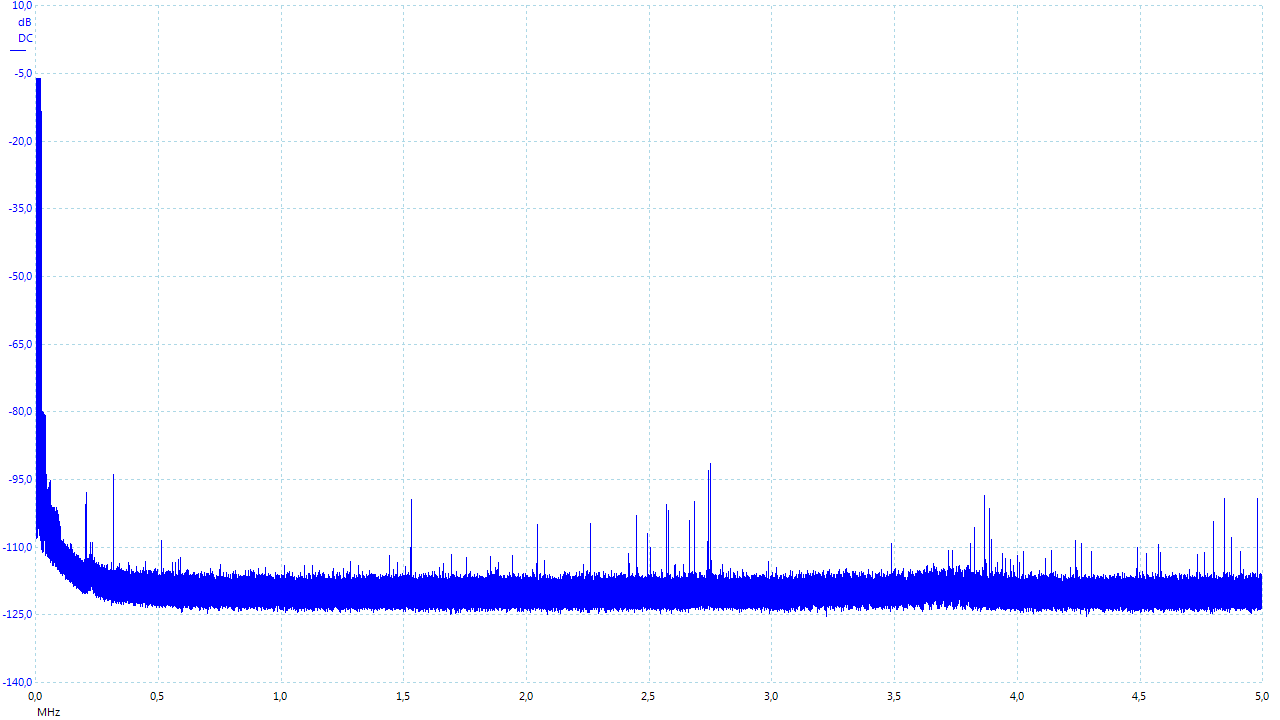
Open prototype board on a table with some wiring, so it has some interferences, but you get the point probably.
By the way, good timing! Since as of today, you now also have DAC correction available for it too!
2 Likes
That’s great news, Jussi, thanks. I’ve been hoping for this for my RME ADI-2 Pro FS R BE - I presume this will be covered by the ADI-2 Pro driver there (it’s AK4493 based)?
Edit: perhaps not as I see that the original pro was 4490 based.
As mentioned in the release announcement, both Rev-A (AK4490) and Rev-B (AK4493) are supported. ESS based ADI-2 models are not supported.
Now there’s also the new ADI-2 Pro that was just launched at the summer (with AK4493S). I will need to check that one out once I end up buying one, I’m not sure how much it has changed.
1 Like
WOW!!! LUCKY ME. I have been using correction on the Holo Cyan 2. What was your correction goal on the Holo? What frequency and or temporal response were you correcting for?
Same question for RME!! I just happened to fire up the RME this morning via HQPlayer 6 and will immediately get an update!!
yes, indeed I meant no digital reconstruction. I never mention the analog because it just seems a given to me. I need to remember to be more clear. And i agree… one of my first impressions is Holo must have an outstanding analog output stage and filter. PCM and DSD have very similar timbre and response via the Holo. Not the most simple of engineering feats. I remember Mike Moffat saying when they begrudingly built the Loki as short lived as it was, that it was not possible or perhaps he meant way too much work for the result to covert DSD and PCM in same box and same/similar analog chain. That does not seem to be the case here, however. Wow.
I also see where iFi went to PCM1795. Better measurements, and no built in I/V for more analog ‘flexibilty’. I am not convinced on paper it was necessarily the best decision. But time will tell.. meaurements I am sure will look better. Sound? I may grab one of the new portables that use it and test it on my E1DA. I just got the new E1DA ADC Dual Mono that can see up to 384khz, to go along with the APU and Scaler I already own. A but funny to me, I now own all three E1DA ADC verions. The first two were class “B”. I was lucky and snagged the latest DM verions at class “A”. I am a bit disappointed though, finding out it offloads mono summation to REW rather than keep it in its internal app/driver. Now to complete the collection, I should grab the DAC. Curious as to it’s sound. Of course i am sure it measures state of the art.
yes, I have DSC 2.5. Wish i had the active filtering version with op-amp. I measured an output of 1.8v RMS on my example. It is NOT enough to drive the known low gain SMSL SP400 headamp I use. At least not on the steady diet of classical and jazz i listen to. I used the pentconn balanced output sections of an iFi iCAN pre-amp/head-amp to provide appropriate gain for the SP400. May have well just used the iCAN directly, but I enjoy the SP400, and using iFi’s analog signal processing for bass and space made for a pleasant result.
Unfortunately they don’t…
Thanks @jussi_laako - apologies, didn’t check the news section. I’m probably doing something stupid but don’t see the option within my pipeline setup. I’m using HQP Desktop 5.17.3 on Windows but connecting via NAA running on Ropieee - I presume that Ropieee counts as “connected through a Linux based device” but perhaps not? Or is this HQP6 only?
Edit: Log shows 2026/11/19 19:56:23 NAA output endpoint ‘RPi4-Testbed [RoPieeeXL-SittingRm]’ : ‘hw:CARD=Pro52101067,DEV=0’
Sorry, but it requires HQPlayer v6 and networkaudiod >= 6.1.
You could check with the free trial if you get it working, you can install v6 side by side with v5.
Thanks, will give that a try as a starting point.
Edit: All worked well - it definitely seemed to bring a worthwhile improvement and the load on the machine was lower with HQP6 + DAC correction then with HQP5 without. I can see this might nudge me into upgrading on Black Friday!