If you flip that curve, it kind of looks like my audiogram.
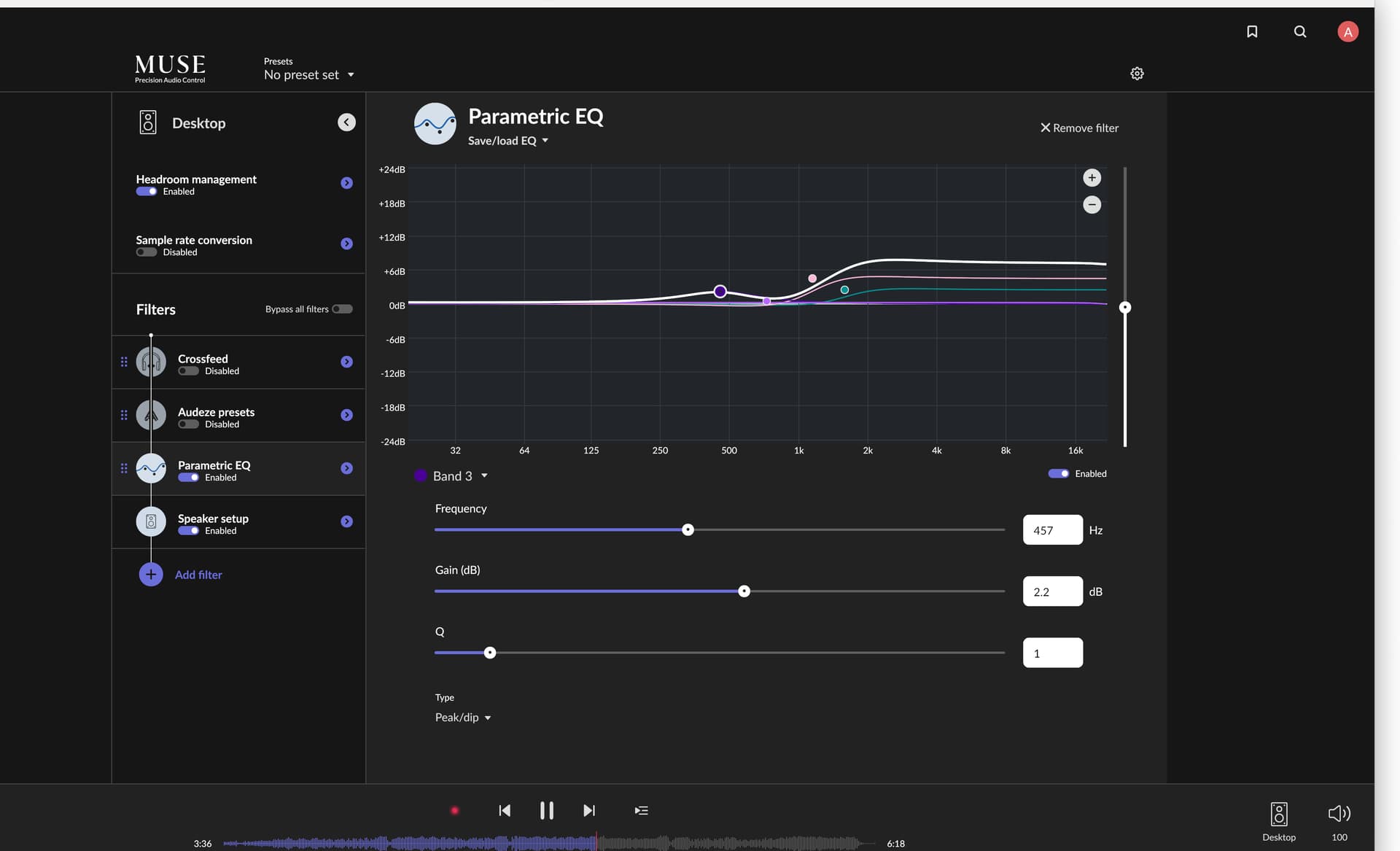
Roons headroom and digital volume controls are lossless more a less if your dac supports 32bit as it’s all applied in 64bit. Many test been done to prove thisI. I don’t notice any difference at all when it’s applied during any DSP and it’s returned to the same listening level as before. Applying boosts at the levels you’re doing there and the likely clipping you are going to get are certainly having more affect on how it sounds than Roons headroom management but it’s your choice.
This is a bit like taking six sugars in your tea… you might like it, but it’s not doing you any good.
I’d still be wary about pushing the system into digital clipping. The effect on the speakers may depend on how your DAC deals with a string of 0dBFS samples - there are many factors that may be in play - and one assertion that it’s ‘probably ok’ doesn’t convince me.
My suggestion would be to dial down the overall gain on the EQ so that the curve doesn’t go above 0dB, and turn up your amp to get the same overall level. You could check this using a sound level app on your phone - it doesn’t need to be accurate, just repeatable.
If you do this, just listen for a while and get used to the sound - like cutting down on the sugar. I suspect that your brain is currently interpreting the distortion as ‘extra detail’, and after a while you won’t miss it. Or damage anything… 
1 Like
Ah okay, considering what you’re saying, to play it safe, I think I’ll go back to shooting for no clipping at all then. I think I ended up doing just what you said, with a different pair of speakers, the Formation Duo’s, and learned to adjust, and am now perfectly happy with it. I think I need to turn my Headroom up to -9 to avoid clipping and will do so.
2 Likes
You can also just lower the whole level in PEQ instead of using headroom, it equates to the same thing though. You can drag the waveform down until it’s below 0 using the slider on the right.
If analog clipping is dangerous because it creates flat signal regions (i.e. sustained, DC-like high voltages), you can do that in the digital domain too. It may be a bit harder to do that with PEQ, but possible.
It’s pretty much impossible to do without also pushing your amplification chain simultaneously, and not really worth worrying about… Otherwise, so many modern, terribly compressed, clipped recordings would be ruining speakers every day. Think about your digital PEQ more or less as real-time remastering, and it will make the best sense.
1 Like
Fair. It’s not clipping per se that damages speakers, it’s excessive power. But, excessive clipping can lead to excessive power. A full scale square wave has twice the power of a sine wave at same amplitude. Clipping during mastering - or PEQ - is unlikely to be that extreme.
This is a nice article about it:
http://www.ovnilab.com/articles/clipping.shtml
1 Like
Not sure what happens with digital amplifiers and clipping in the digital domain.
For analogue signal chains, when passing a clipped digital signal through a D/A-converter and further through the amplifiers (pre- & power amp), there’s a good chance that the clipped signal (the DC parts) will not reach your speakers, since most analogue equipment is not DC-coupled (a few high-end brands like e.g. Gryphon Audio have DC-coupled amplifiers), and therefore will not be able to pass the clipped digital signal to the speakers, in which case the speakers likely won’t be damaged.
In addition to this, if you have passive crossovers, it’s not the tweeters you should worry about in case of clipped signals, since they are protected by the crossover, it’s the woofers that will get the DC.
I don’t see why it won’t. Clipping doesn’t add a DC offset. A square wave, for example, has no components below the fundamental.
(The higher the sample rate of the clipped signal, the higher the frequencies it can carry and the squarer the wave. Unless there’s a low pass filter in the analog domain, the tweeters won’t be very happy about that. Just another reason why hi-res is a liability and not a benefit.)
Yes, the tops of the signal waveform are clipped occasionally, alternately in positive and negative cycles (and here’s the rub, since your input signal is AC still), so those are always comparably brief moments not to be misinterpreted as being DC.
What’s the problem caused by clipping, actually, can properly be seen when looking at the signal spectrum, rather than the waveform.
Clipping generates higher frequency harmonics that gain in quantity and level with severeness of overdrive.
Once amplified enough, those reach the tweeters and overheat the voice coils.
Bass driver‘s voice coils usually overheat due to too much clean power.
Hope that clears it up a little…
1 Like