If the master is made from an analogue safety master, the transfer can be done at 24/192 PCM and released as high-res.
If the master is made from a 14-bit recording and mixed analogue, then it is allowed to make a transfer in 24/192
This is not related to MQA, but to the recording industry. Read this if you are interested
p.s. Sad to notice that you feel the need to insult me with your Stockholm Syndrome post.
You’ve never been in close contact with the Music business, have You?
In deed, the record companies used to care about sound quality. Today all mainstream mixes are checked to see whether or not they sound bad in lossy formats.
Well, You put in the effort. One can see why it comes to mind
If You discount the added noise that comes from “hiding” information on which lights to turn on and how much to upsample in the LSB’s
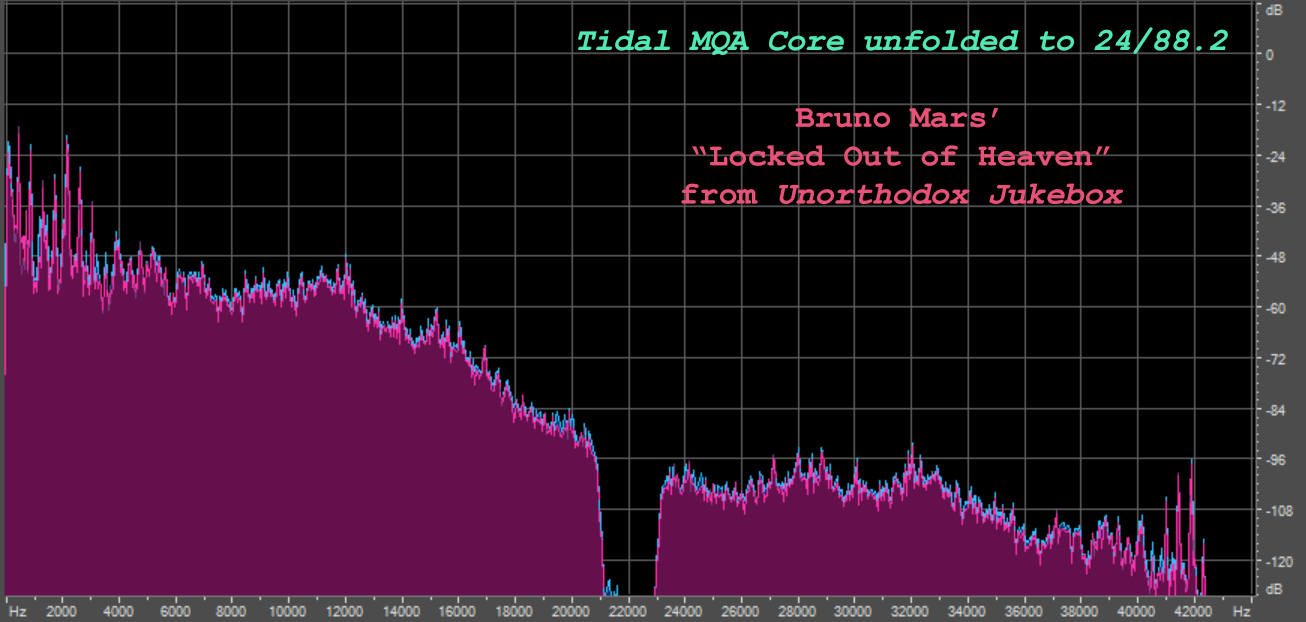
Guilty, have You seen the pic that I posted “The MQA gap” it clearly shows that anything above half the sampling rate is a mirrored signal.
No Kenneth, all contacts I have are via Facebook groups. I visited MQA in December 2017 on my own initiative out of curiosity and to thank them for the innovation. It was a friendly visit and we had some laughs about a lot of things.
On my last count I believe there’s around 1.5 million tracks showing out of a 70 million alleged in Tidal so putting this into perspective Hi Res is a niche market still in lossless streaming and MQA is carrying approx 2% of Tidal’s total output, plus they only have Tidal propping this up where is the expansion coming from. Amazon / Qobuz / Deezer are FLAC PCM and Spotify is soon to go lossless unless they persuade Apple then they are stuck, my concerns are why buy into technology that doesn’t have a good road map going forwards
It looks like You read the Grammy paper in a Cherry picking way.
Grammy clearly states the following: “Labeling audio recordings as 96/24 or higher resolution when the source audio was 44.1/16 CD-quality or less is seriously problematic”
An analogue studio machine according to the same Grammy paper: “Considering that the best dynamic range from an analog tape machine without noise reduction is about 80-dB (equivalent to about a 13-bit recording)” Constitutes such a problematic scenario.
Sad that You do not get the joke.
Someone that is as dedicated to defending a “format” that has been shown to not live up to ANY of the marketing claims. Do fit the description though.
If it makes you feel happy Kenneth, I am grinning all the time when everyone is talking about MQA, positive or negative…If it would not be of interest or importance, everyone would ignore it, but that does not seem to be the case
I suppose that if you have problems with the 24/192 MQA version of “Like A Virgin” on Tidal you will have it as well with the 24/192 FLAC version on other streaming services.
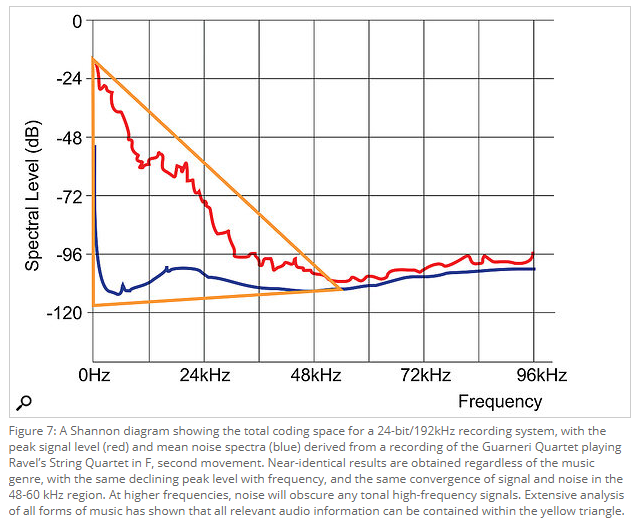
So in defence of MQA You show us a Shannon diagram, which has nothing specifically to do with MQA
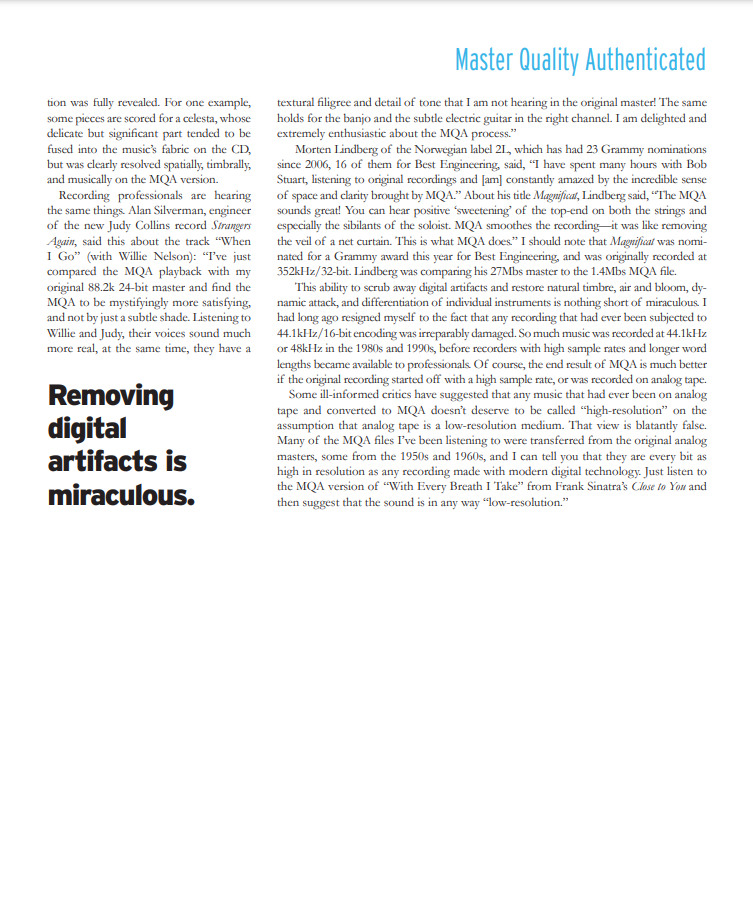
Followed up with two album reviews that compares MQA to CD
Did You notice that the MQA version of the latter is more expensive than the fully lossless 24/96 version.
Do note that the"content" above 24 kHz is still a mirrored image of the signal below 24 kHz. Meaning that it is not actually music information.
And then they noticed it wasn’t enough and they started converting redbooks. Apart from filling Tidal screens with “master” logo’s a totally useless thing to do because there wasn’t a single frequency >22.05kHz captured in the first place, so nothing to fold/unfold. Yet when you play a 16/44.1k the core decoder makes it a 24/88.2k which is of course ridiculous since there are no frequencies between 22.05 and 44.1k to restore. All upsampling, nothing more.
The only reason to do so is
to make the originals unavailable,
offer a lower quality placebo, (it’s no longer 16/44 but 13…15/44)
and if you want to listen to a restorated attempt of what it was,
you now need extra $ software and/or $ hardware.
You pay more, and still don’t get the quality it was.
And then some people keep claiming mqa is not about $. It’s only about $.
You need to acknowledge the source from which You post. But once again You post a payed piece.
With no substance. The diagram in the posted picture is again a theoretic representation from MQA.
In other words, again, You post marketing material.
I am a bit disappointed in you both, Kenneth and Wim, you are both completely wrong.
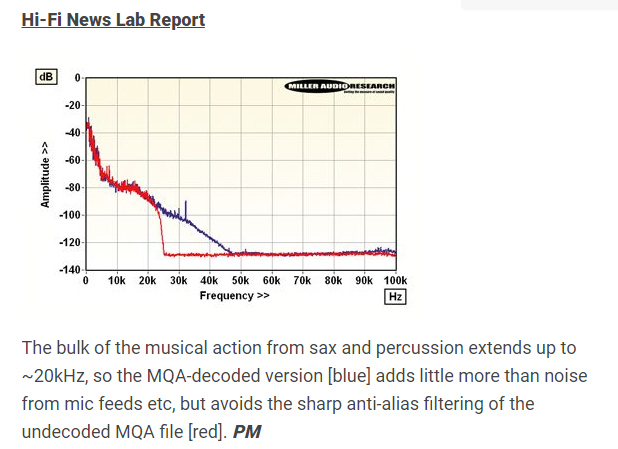
MQA delivers lossless all frequencies up to 48 kHz as you can see in this analysis made by Paul Miller from HiFi News. But you will need to unfold it of course!
Let me translate that :
But you will need to pay extra for it of course.
Unfold = mqa software / hardware so $ mqa license
When you can have the original pcm for free !
You are now acknowledging the fact that 1st unfolds of 24/88.2 and 24/96 MQA files do deliver the above spectra? And you are also aware that 1st unfolds are available free-of-charge in the Tidal app?
It will sound better when you with an MQA DAC, are they expensive…?
Come on…! You are fooling yourself and others, but since we are talking about MQA, it’s all fine with me…
I have never told the opposite, so what is your point exactly? They do losslessly restore estimates (so lossy anyway) in the first unfold - which is also the only unfold.
No they are NOT freely available in the Tidal app.
You pay extra for it in Tidal’s monthly streaming subscription fee.
That’s why Qobuz is 5$ cheaper a month.
The names of the recording engineers are mentioned and thse are their statements:
Recording professionals are hearing the same things. Alan Silverman, engineer of the new Judy Collins record Strangers Again , said this about the track “When I Go” (with Willie Nelson): “I’ve just compared the MQA playback with my original 88.2k 24-bit master and find the MQA to be mystifyingly more satisfying, and not by just a subtle shade. Listening to Willie and Judy, their voices sound much more real, at the same time, they have a textural filigree and detail of tone that I am not hearing in the original master! The sameholds for the banjo and the subtle electric guitar in the right channel. I am delighted andextremely enthusiastic about the MQA process.”
Morten Lindberg of the Norwegian label 2L, which has had 23 Grammy nominations since 2006, 16 of them for Best Engineering, said, “I have spent many hours with Bob Stuart, listening to original recordings and [am] constantly amazed by the incredible sense of space and clarity brought by MQA.” About his title Magnificat , Lindberg said, “The MQA sounds great! You can hear positive ‘sweetening’ of the top-end on both the strings andespecially the sibilants of the soloist. MQA smoothes the recording—it was like removing the veil of a net curtain