Then Catia BOM exported to .xlsx and verified by deadliest function ever =VLOOKUP
2 Likes
Dear friends,
Just a question. Is this about technology or about enjoying music?
Person A enjoys music using a 30,000 euro DAC
Person B enjoys music using a 150 euro DAC
I just bought a FiiO KA-3 for less than 90 euros and can now use my balanced Sennheiser 660s with my laptop or smartphone…
As long as you can feel the emotion in music anything is OK.

Take care
7 Likes
Have you seen the Khadas Tone Board? ~ £100/$100/€100,110 dB SINAD. Outstanding performance for a budget price.
3 Likes
And the schematics are up on the Web.
Lots of info and parts to play with right here
Now I believe everybody can understand what I meant by “properly designed” DAC - exactly something like this (Topping to be exact).
Indeed DAC can sound different if they mess up PCB design, don’t measure properly and put it in big shiny box with air vent holes only in area where PCB is so nobody can see that the box is actually empty just few passive cooling blocks to be heavy and give impression of quality.
surely it’s sensible to put the holes over the PCB rather than over nothing.?
I agree that some hifi gear has a lot of fresh air inside it. This is usually because if you buy amp, dac and streamer from the same manufacturer, most people want each device to have the same proportions.
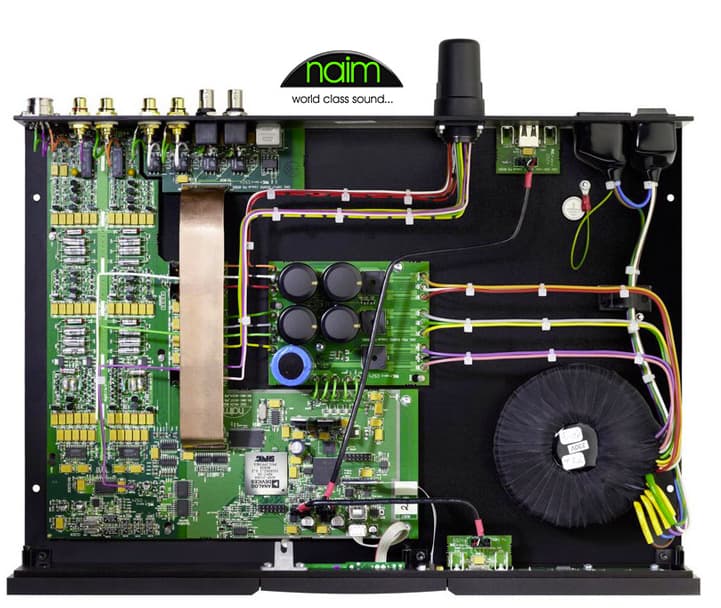
Here is what my properly designed (and old and no longer sold) Naim DAC looks like inside. No dead space, just deliberate space between power and digital. No holes anywhere, the case is the heatsink.
2 Likes
This one is a puzzle for me. Many DACs seem to measure pretty much identical down to -120dB or more and I certainly am not listening at over 120dB SPL 
And yet…
I can generally tell the difference between ESS and AKM based reference implementations that used their own output stage chips, less so some of the others as they seem between those (albeit very subtle) extremes and less so when other party output stages are used.
As for filters, with the right content, then again yes, and sometimes even between the different filter types with the similar approximate roll-offs. I can’t typical say which is which (beyond sometimes fast/slow), just that they are different. A big problem here is I think that the production will tend to mask the potential benefit of one filter over another (along with likely speakers in room etc).
I have long come to the conclusion that there are still some details about our hearing perception waiting to be uncovered or at least correlated by science and thus there is still a significant gap between measurements and analysis by the likes of ASR etc and what we can actually potentially perceive from actual music and natural sounds around us (rather than test tones/sweeps etc). Where I think we are perhaps most lacking is in the detail of how we perceive transients.
I suspect that the research that led to MQA is probably where we need to be looking for at least some of the missing answers (I don’t mean MQA specifically but rather the transient perception and timing research considerations that seem to drive some of its aims). Maybe we need to look more closely at how sound systems handle complex tone transients and correlate that with what we perceive?
1 Like
You could not pay me enough to use a Topping DAC….they sound horrid…some worse than others.
1 Like
Is it this one?
I agree it was some state of the art device back in 2009 and one of few who shown at least some measurements at that time (obviously they knew what they want to achieve).
But nowadays this can be achieved with much smaller form factor and consumption and with betted SINAD.
I cannot judge I tried E50 only. Could you be more specific?
I believe they are very pure in general and maybe that’s what you don’t like? Maybe you’re used to listen and prefer the sound and warmth of 3rd/odd harmonics and audible distortions?
I defer this question to Hans: What defines the quality of a DAC? - YouTube
Hmmmm, he’s somewhat hung up on jitter, it’s rarely a measurable issue with a competently designed DAC. The video the switches halfway to a sales pitch for pricey add ones and some bold and unlikely claims. If he understands what’s required to deliver a good DAC why has he spent a fortune on add ons and constant upgrades of said add ons?
Does anyone know if Hans’ oscilloscope works?
2 Likes
He claims using it but almost never publishes measurements. More of a credibility wallpaper. Apart from that’s all the same: the Hans, Herbs, Steves - in their seventies still thinking to own a pair of golden ears. It’s a business in the end. Need to pay their bills.
1 Like
That sort of old-schoolers somehow missed the digital age. In last century was audio defined by expensive heavy devices with lot of distortion and records with low dynamic range. Studio mixers were hundreds thousands of dollars and equalizers were circuitry.
Indeed there were some initial issues with digital where most of them gave up but this problems passed already decades ago.
Now for them it’s hard to believe that lightweight, small, portable and power efficient audio devices can do better job. Even sound engineers works now in digital domain on laptops and everybody can have his virtual studio for fraction of price.
But still those people tend to old-school sound style (warm, distorted,…) because of habit and nostalgia even today’s remasters are digitally cleaned, dynamic range is restored and the quality is significantly better. “It doesn’t sound as good as in old ages.”
4 Likes
Yeah. Warm. Non fatiguing. Holographic. Cringeworthy.
1 Like
Today’s remasters of older recordings are, more often than not, not as good as they tend to be compressed with less dynamic range. The fact that you don’t know this is curious. All one has to do is look at the Dynamic Range database to see this. Most “modern” recordings are highly compressed. The “loudness wars” are to blame.
I have spent a lot of time seeking out the best masterings of the albums in my library. Anyone that has done this knows your statement is not correct.
1 Like
I would suggest that the only way to answer a subjective question is with subjective impressions. To try to provide a theoretical answer to a subjective question is fraught with difficulty.
In trying to arrive at a theoretical answer you then start with two fairly bold assertions and I disagree with both of them.
I suspect that the basis of our disagreement is that you seem to view DACs as “digital” devices, i.e. devices working with mathematical manipulations of ones and zeros. DACs are electronic devices, in reality they work with voltages and currents which are entirely analog phenomena. The “digital” parts of the circuit process voltages that are in fact codifying ones and zeros but while they are “digital” in the logical domain, in the real world they are still very analog.
So while some of your logic holds true in the “digital” domain (the mathematical result of performing a filter function on a dataset will always be the same on paper) this is simply not how things work in reality. Rise times are not instantaneous, linearity not perfect etc.
Add to that the fact that many parts of a DAC are not “digital” at all, i.e. they don’t even process symbolic ones and zeros (power supply, output stage etc.) and it becomes clear there is actually no difference between a DAC and any other piece of audio electronics like an amp. While some might argue that all “well designed” (by which they often mean “in theory and abstracting away all imperfect real-world behaviour”) examples “should” all sound the same, in fact they all sound different.
And since DAC chips are not pin-compatible (unlike for instance op amps) it is not really feasible to build a test harness that eliminates all other variables in order to easily compare them. So in practice you are comparing whole systems or at least subsystems, where there are many more variables.
4 Likes
Don’t confuse mixing volume level, track dynamic range and media (tape etc) dynamic range. Even when track has wide dynamic range but is recorded/mixed on low dynamic range analog media with low SNR, then you hear a lot of noise and and/or distortion (on magnetic media) or clipping.
2 Likes
Jason Stoddard and Mike Moffat talk about developing Yiggy
Jason reminds us that the transducers matter. Get the best you can afford and the power amps that make them happy. I can’t stress this enough, the sources and transducers (headphones or speakers) own the sound. Good electronics have a lesser effect.
Many add-in DACS are employed using example circuits and filter setups from the data sheets. Even the lowliest commercial DAC chip-set has more configuration choices than you can shake a stick at. The example choices will sound OK but did the component developer explore the configuration space? How you do this differs widely between Burr-Brown, AKM, and the Sabre familes.
Mike and Jason have worked hard to find the best configuration for each converter chip-set they have used in Schiit products. Jason points out that there configuration choices can result in significant differences in a chip-set’s sound. He discusses this as he was forced by the AKM fire to redesign their popular-priced components.
Jason tells this story in later episodes (2021 and 2022) of his head-fi.org blog.
I’ve used a number of DACS over the years and they do sound different. My DAC history includes
- iThing built in DACS
- Apple AirPort Express DAC
- Cambridge DACmagic (original)
- The Parasound Halo P5 built in Burr-Brown DAC
- Schiit Magni (dangerous gateway drug)
- Schiit Gumby (multibit main listening DAC)
- Schiit Modius (TV DAC)
Associated equipment through the ages has included
- Dhalquist DQ-10
- Original Conrad Johnson PV-1 preamp so old it didn’t have a name
- GAS Ampzilla
- Parasound P-5 Halo preamp
- Schiit Vidar
- Schiit Freya+
- Magneplanar LRS
As the electronics and transducers improved, the sound improved but also as the DAC improved the sound improved.
The improvements noted occur most notably in the time domain rather than in the frequency domain. Although, the better DACS appeared to be cleaner at broader extremes. You may hear the difference in voicing. But, listen to the transients. Are they clear? Do they sound live?
How do the Toms sound? Can you hear sticks hit skin? Is the Tom sound rich and resonant? Does the Tom sound like its been tuned? Is the fundamental clear? Is the Tom sound complex?
How does bowed bass sound? How do the violins sound? Like in the hall or is the slip and grab of the bow gone. That’s where the resiny sound originates.
The first component change and one that made a dramatic change in sound was to move from Apple AirPlay transport to Google Chromecast as a transport. Suddlenly, there was space!
As things changed, i most noticed the differences in the frequency domain listening to WHRO TV bumpers between shows. Up through the P5 DAC, they were always muddy. Come Modius, Vidar, Freya+ and the Maggies, they became crystal clear.
With Gumby and Modius in the Freya+ Vidar LRS system, the two can be compared directly. Mike Moffat has voiced the digital parts of both. Jason has voiced the analog parts of both. There is a definite family resemblance but Gumby (the Gungnir Multibit device) is definitely richer in its transient presentation. This appears in bowed strings, bass play, cymbals and drums, and transients in general. The objective system with Gumby on service (where I ended up) is able to deal with big and little sound elements together. So you have to listen beyond pitch to timbre, attack, and decay. Listen to the cymbal decay. If the DAC builder put the money in the right place, it will sound like you’re at performance in a good hall.
Mike Moffat talks about this more in the Schiit Ask Me Anything YouTube series. Mike points out that frequency domain measurements are sufficient for testing of many signal processing systems but not those used in music recording and reproduction.
Mike feels we have lessons to learn about making and using time domain measurements in system design and analysis. I agree with him. APx 555 frequency domain measurements are great for production QA but don’t address big and little sounds together or sound transients. We still have to judge these things by ear. And that by and large are where the differences between well designed and made DACS lie.
2 Likes