I used to think the DAC was 90% of the sound. This sub-$300 DIY project proved me wrong

Sorry for the delay, but testing is taking a while. You can’t rush science! Well, at least not during Thanksgiving…

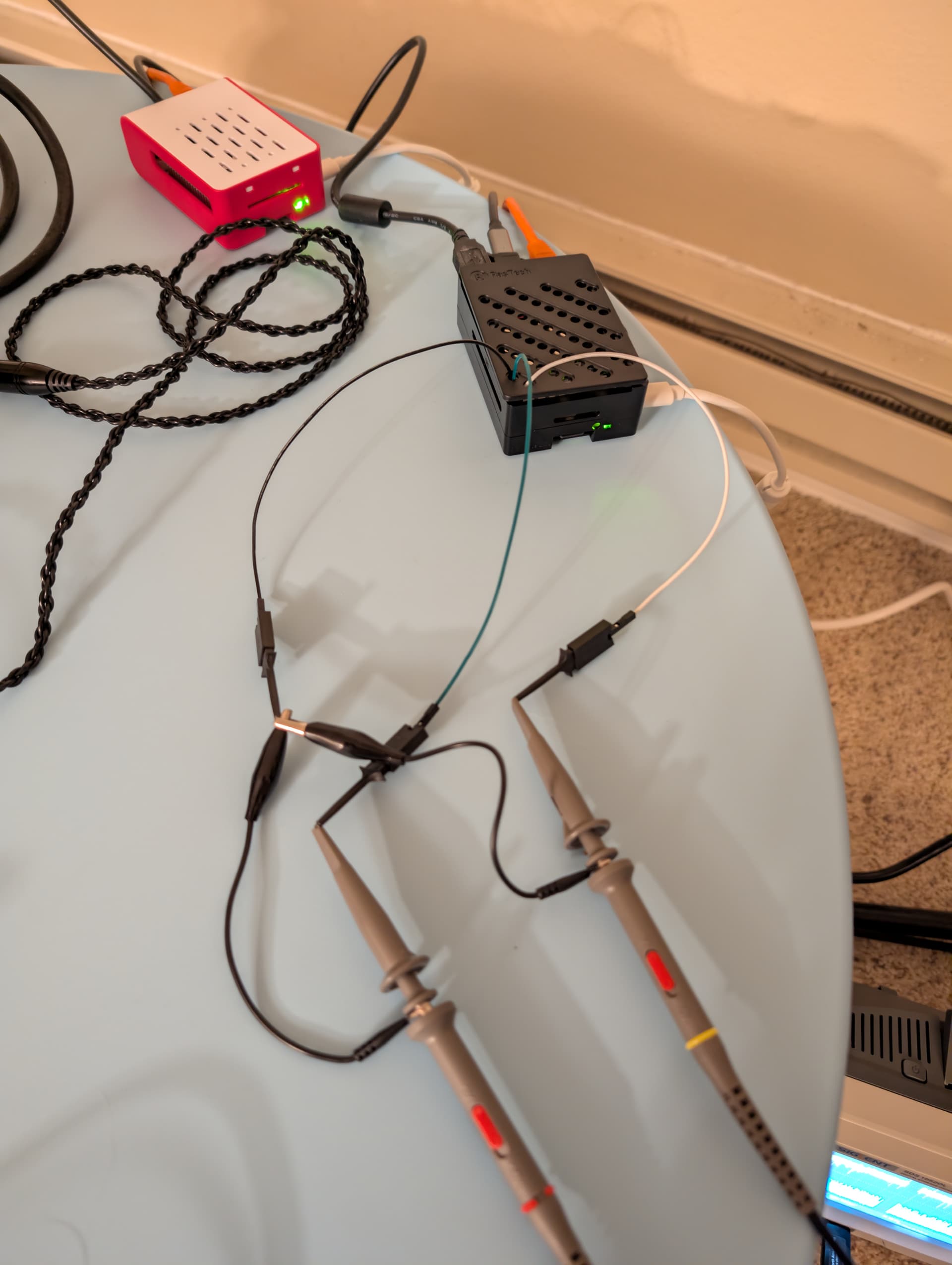
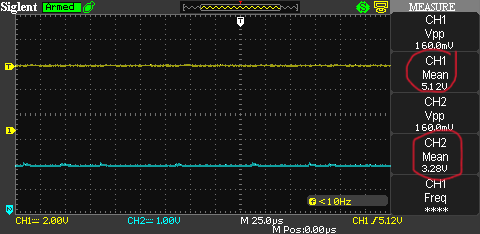
I have completed power rails measurements and will post them in the next one or two days. Here’s the setup:

Black wire is GND, blue is 5V (on scope CH1) and white is 3.3V (on CH2). I used both channels so I can see both rails at the same time:

Also, the first round of listening tests is complete, but I need two more, as I will explain in the results. You can’t really do a statistically relevant ABX test with two people, but I’m doing my best.

I will start a new thread dedicated to presenting and discussing the outcome of this evaluation and post a link here. I intend to make that a technical discussion, and I’m sure it’s going to be very interesting for a lot of people.

6 Likes

Skimming back through this thread, this seems very easily verifiable/falsifiable using a Cosmos E1DA stack and combo tests with sines, IMDs, and null tests. Statistical significance of ABX testing is luxury class and the protocol is always questionable.

3 Likes

Received the SOTM 200 (Used price £240).

Equipment and a bit of history.

PC: Lenovo P3, Core i7 14700T, 32Gb ram, Windows 10 IoT Enterprise LTSC running essential processes only. Roon + HQPlayer. Music is on external USB SSD.

Headphones: Susvara with original balanced cable.

Head Amp: Woo Audio WA22 with We422a/ECC32/TS5998. I have lots of other tubes but these are my current favourites.

Pre Amp: Ifi Ican Pro Signature. By itself the WA22 doesn’t quite have enough gain for the Susvara

Dac: Lampizator L4G5 Dual Mono with chipless DSD512 engine

Streamer: SOTM 200 Ultra SE

Long time HQPlayer Desktop user (8 years)

Discovered Diretta about 4 months ago on the Roon Forum when SOTM began beta testing.

Prior to setting up Diretta my network was fibre to Etheregen-SOTM200-Dac.

Installed the Diretta/SOTM ASIO driver on the PC and configured the 200 Ultra as a target. Installed a USB Ethernet dongle on the PC and connected this via a crossover cable to the SOTM target.

I was very impressed with the presentation of the sound. I thought it more natural and even handed (I don’t really know how to describe it).

I spent a lot of time going through the HQPlayer modulators and filters, finally deciding on ASDM5EC-Fast512+fs, Poly-Sinc-Ext2-Short. I considered the Ext2 a little sharp in the higher frequencies but enjoyed the overall clarity.

I also very much liked Poly-Sinc-Gauss-Short for it’s more balanced/relaxed presentation but it didn’t quite have that bite to vocals compared to Ext2-Short.

Diretta Host & Target installation

Downloaded the V6.2 firmware and flashed two micro sd cards.

Followed the setup procedure as documented by SOTM and Andrew. I ensured all settings (CPU and Latency) on the SOTM devices were at default.

I initially experienced problems with the Host not seeing the Target.

This issue was resolved by ensuring the Host was powered up first and given time to display the Eunhasu web GUI before powering on the Target.

Initial impressions (headphones) was very positive. I definitely thought I noticed an improvement in clarity. In fact I found the Ext2 filter slightly to sharp. Substituting the Ext2 with the Gauss filter is now perfect to my ears. I now have that balanced/relaxed presentation and don’t feel I’m missing anything.

It’s early days and I’ve got a lot of listening to do but I’m absolutely delighted with how my system is sounding.
2 Likes

Hope everyone is recovering from the turkey coma!

I’ve spent part of the holiday break configuring a new Raspberry Pi 5 Target kit for @stevebythebay. Since I usually test with my trusty 1GB RPi4, this was my first time really sitting down with the Pi 5 running the new 147_13 (Mode 3) build.

Subjective Observation

Perhaps it is the dedicated RP1 southbridge isolating the USB/Ethernet interrupts, or maybe just the extra headroom (and I’ve not ruled out recency bias), but the Pi 5 Target does seem to have a slight but audible edge over the Pi 4 in this configuration. Yesterday afternoon, I was almost late to a Thanksgiving dinner gathering because the sound was so engaging that I could not put my headphones down.

The “Skip” Test

While we often talk about A/B testing, I find the “Skip Test” to be a more reliable indicator of system quality.

  • The Metric:
    How deep can you get into a playlist without reaching for the remote to skip a track?

  • The Theory:
    When digital glare is present, our brains get bored or fatigued faster, prompting the urge to “find something better.” When the noise floor drops, you just let it ride.

I’ve been using this “Show Stoppers” playlist (curated by HR Music Evangelist on Qobuz). It is 71 tracks of absolute torture tests for a system—extreme dynamic range, spatial cues, and complex textures:

https://play.qobuz.com/playlist/9292025
(here’s a TIDAL version: https://tidal.com/playlist/e5b31983-0059-4b9d-a21a-5a281e71e2cb)

Give it a spin this weekend and let me know how many tracks you get through before the itch to skip kicks in!

Happy listening.

1 Like

Yes, was about to flag this exact point! Well done :nerd_face::+1:

1 Like

A few hours pulling my hair out but absolutely worth it.
I spent the whole evening listening to music, it was bliss.

4 Likes

I’m now suspecting that, sooner or later, you’re going to say “Gotcha!” or “Bazinga!” or something like that. When that moment comes, I’ll be the first to say, “Well done, sir. Well done.”

4 Likes

No

Changing my brand of paracetamol has made more difference lately to how my system sounds.

8 Likes

There needs to be some evidence behind such statements, but I can’t seem to find any. I think that, when it comes to focus, quite the contrary is true: the longer the test, the more the mind wanders, the higher the variability, and the less reliable/repeatable the results.

Both my sons expressed some frustration at the inability to do rapid switching during their listening tests and tended to push back when I suggested they should listen for 20 minutes or so at a time. I can’t blame them.

2 Likes

25 years?

Never heard so clearly
62 year old ears with tinnitus

(No measurements were hurt in this process, nor young people cruelly forced to look away from their screens)

2 Likes

Oh, and to David’s point :backhand_index_pointing_up:

I listened to the whole LP, which I’ve not done for 20+ years

And.. it’s an even more extraordinary recording than I ever knew

2 Likes

This simply demonstrates how poor audio memory is. When you don’t listen to something for even a short while you forget how much is going on in the mix. Listen to something at a later date and ‘a veil is lifted’ and no doubt ‘the musicians are now in the room’ etc etc . May your blacks be inkier than before as you listen to it ’ like it was the first time’.

1 Like

Nope, a few tracks are on my reference list so get played often, my point was I listened to the whole LP

1 Like

I put on Marian Hill’s ACT ONE (The Complete Collection). I had intended to just listen to the first track, Down. An hour and a half later, I took my headphones off, having played the entire 2-disc, hour and 27 minutes album.

When listening sessions start running longer than expected on a regular basis, system changes are moving in the right direction.

5 Likes

This really just showcases how hilariously terrible our audio memory is. Stop listening to a track for, what, ten minutes? Suddenly your brain has wiped half the mix like it’s clearing browser cookies. Come back later and—bam!—“a veil has been lifted,” “the musicians have materialised in your living room,” and the bass has apparently achieved newfound inkiness previously reserved for black holes and luxury fountain pens.

But of course, the real wizard behind the curtain is psychoacoustics. Our ears and brains love to throw surprise parties: update a kernel, dust a cable, blink twice—and your mind eagerly serves up the deluxe remastered experience. Not because anything actually changed, but because your brain enjoys starring in its own hi-fi reality show.

It’s not that the experience isn’t real—far from it. It’s just that sometimes the most powerful upgrade in the signal chain is the human imagination, working overtime with a pair of headphones and a fresh mood.

7 Likes

I agree that nearly everyone fails in memory for such things. I know that this is true of all our senses. In the past when using a new lamp in my video projector, which degrades in light output over time, I don’t notice what’s occurred until I put in a replacement. And my ability to recall the taste and fragrance of a particularly “memorable” bottle of wine, is stimied if presented with the same wine in a blind tasting.

However, as others have pointed out, when we are all quite familiar with the sonic presentation of music from our existing systems, and make a change to it, which suddenly exposes heretofore unheard sounds, or psychoacoustic characteristics of what a microphone picked up in the recording process, that seems to me a valid alteration in our system.

As David has indicated, the experience of less noise in a system, making us more capable of relaxing into the music, is less “heard” than felt. The brain is no longer taxed and we’re less agitated in the process.

4 Likes

Other people do however report improved detail, clarity, soundstage etc., which are very much “heard”. Then, “noise” is a very specific and quantifiable term, so it doesn’t fall into the “je ne sais quoi” category. And finally, the degree of “agitation” - or conversely, “relaxation” - during music listening can be attributed to anything and everything, including the idea of experiencing something special, original, ingenious. Once we take into account how we “feel” about various “upgrades”, any connection to actual audio quality is lost, and any attempts to find technical explanations for such “quality improvements” are futile.

2 Likes

perhaps you should stop trying, and just enjoy the music.

2 Likes

Well, if you read the thread, you’ll see I’m not the one doing that.

3 Likes

My general position on the complex nature of hearing: the audible, and conductive elements through our bone structure, as well as the external air pressure - and how our brains map these features, leads me to believe we’ve much to learn. So, if I can’t explain what is going on, that doesn’t mean it’s not “real”. It simply suggests I’ve no current means of measurement, especially in the absence of some theory or proper language of sonic representation.

3 Likes