I used to think the DAC was 90% of the sound. This sub-$300 DIY project proved me wrong

I’ve been reading the recent comments, specifically the suggestion that this project is a “self-deception event horizon” and “not worth the trouble.”

I feel the need to clarify exactly what this project is—and what it is not—because the characterization of it as a casual flight of fancy is disconnected from the reality of the engineering work I’ve put in.

What This Is Not
I do not own a $28k Audio Precision analyzer. I have never claimed to measure the analog output of a DAC. If you are looking for a graph showing a change in SINAD, you are looking for a different project.

I am also not a kernel developer. The credit for the Diretta drivers belongs to Yu-san (who is working with the IEEE on standardization of his L2 protocol). The credit for the AudioLinux real-time kernel belongs to Piero.

What This Is
This is a project of accessibility, orchestration, and validation.

While the underlying tech is brilliant, it was undocumented and difficult to implement. My goal has been to build the bridge that makes Diretta accessible to any Roon user.

Since June 2025, I have pushed 589 commits to my Diretta project repository on GitHub. This isn’t just a readme; it is a suite of over 9,000 lines of code and documentation including:

  • 2,800+ lines of detailed documentation (Diretta.md) explaining the how and the why for every step.

  • Python analysis tools (analyze_benchmark.py, plot_traffic.py) to mathematically validate network stability.

  • Orchestration scripts (diretta-host-checks.sh, purist-mode-webui.py) to automate the configuration and tuning.

[4.0K]  rpi-for-roon
├── [112K]  Diretta.md              <-- 2,806 lines of documentation
├── [4.0K]  scripts
│   ├── [7.2K]  analyze_benchmark.py  <-- Custom network analysis tools
│   ├── [ 16K]  diretta-host-checks.sh
│   ├── [ 12K]  diretta-target-checks.sh
│   ├── [6.3K]  plot_traffic.py
│   ├── [ 20K]  purist-mode-webui.py  <-- Custom management UI
│   └── ... (36 files total)

The Technical Rationale
I’m not guessing about performance. I measure it after each change using the tools listed above and then spend hours listening.

The result of this architecture is a transport with a network transmission jitter (IQR) of 2.00 µs. That is not a random fluctuation; that is a relentless, steady heartbeat of data.

--- Timing Precision (Steady State) ---
Mean Interval:         699.72 µs
Median Interval:       700.00 µs
Standard Deviation:    14.29 µs
Jitter (IQR):          2.00 µs          (Core Stability)

--- Stability Events (Steady State) ---
Stability Score:       99.91543 %
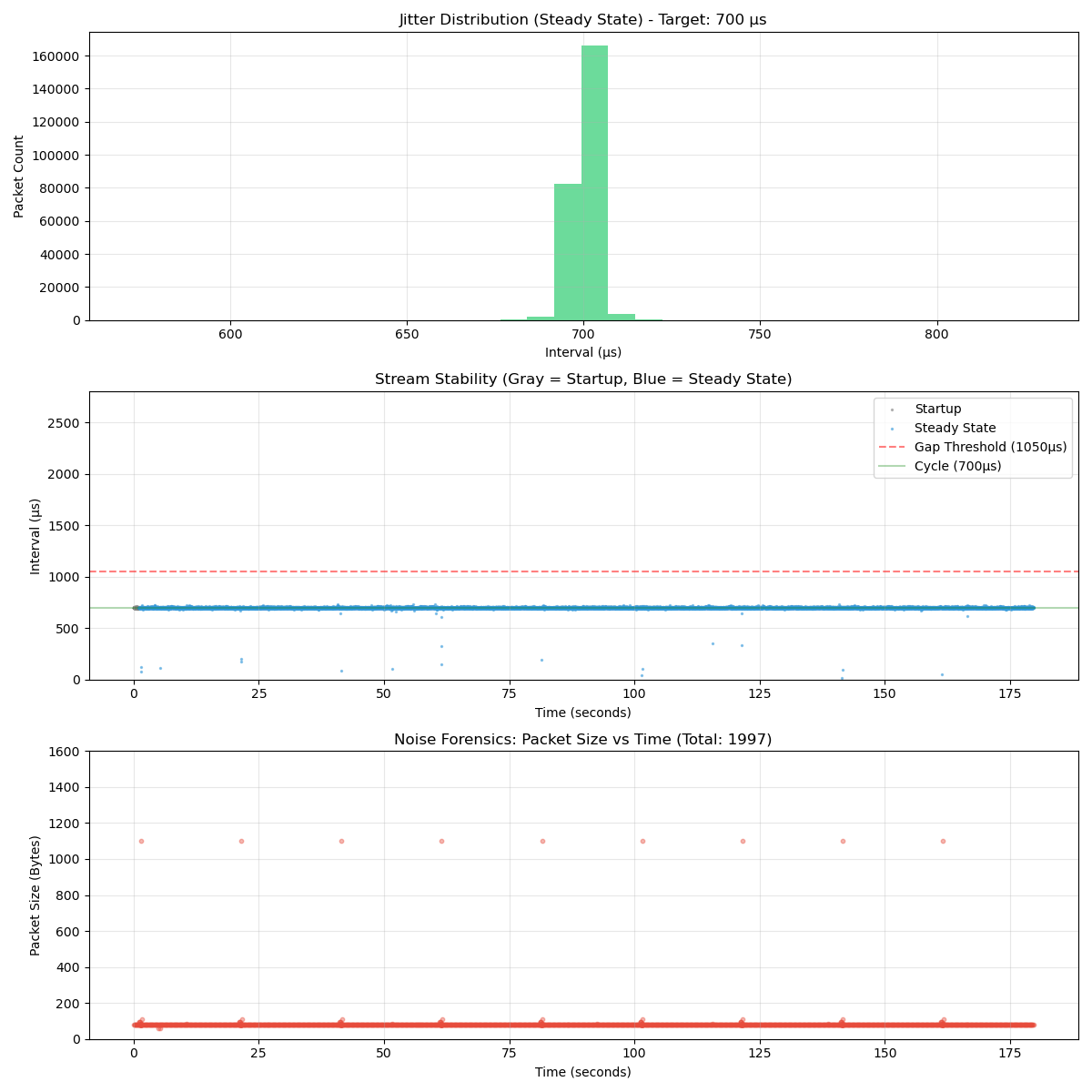
My hypothesis is that this extreme consistency reduces processing overhead by stabilizing interrupt loads, creating predictable CPU usage patterns on the endpoint. While I cannot provide an analog measurement to satisfy the absolutists, I have provided the code and the data that proves the stability of the transport.

The World Has Taken Notice
To the claim that this is “not worth the trouble”: The wider audio community disagrees. Based on the traffic to the repository, there is a massive appetite for a high-performance, DIY streaming transport that actually works.

The Bottom Line
To dismiss a project that achieves a stable, 2µs-jitter transport using nothing more than a pair of $50 Raspberry Pis and stock power supplies as “self-deception” is simply ignoring the code, data, and anecdotal evidence from scores if not hundreds of users who have evaluated this project. These results do not require custom silicon or exotic linear power supplies—just better engineering.

For the builders here who are listening and enjoying the result: thank you for your support and testing. Let’s get back to the music.

9 Likes

It’s a cool project. Good work!

Now show that it makes music better.

3 Likes

@ExUnoPlura
David hasn’t to prove anything. You have to prove it yourself with the help of your ears. That is what this topic is all about.
I have done the test, and I am convinced that for me, with my equipment in my room the Diretta-implementation has improved my music listening experience drastically. It will stay in my system as long as I can.
So you can jump on this Diretta-stuff or you can stay out of it, that is your choice. But David doesn’t have to prove anything. @David_Snyder has put in enough energy in this topic already.
Kind regards, Frank.

4 Likes

But David, I really don’t understand why this obsession with transport jitter. How does the 2 microsecond transport jitter translate to audio quality in the context of an async USB connection to the DAC, when DAC clocks have jitter that is often measured in pico- or even femtoseconds (i.e. some six orders of magnitude better)? Or how does the 2 microsecond transport jitter translate to a less fatiguing listening experience? Is there a correlation between transport jitter microseconds and hours of listening endurance? I’m really struggling to understand the relevance of this 2μs figure.

4 Likes

I disagree! I think this topic should rightly be investigated on its merits. From the beginning there is a claim that this transport improves sound quality and I’d like to know if that is true. There have now been listening tests with ears that suggest it is unlikely. More testimonials aren’t convincing.

3 Likes

I can only admire @Marian that he doesn’t “believe” in it but he tried it out and then convinced himself that it is not working for him. No problem with that. But don’t say that someone has to prove that Diretta is improving sound quality. Test it out for yourself and you will see if it helps your system or not. “the proof of the pudding is in the eating” is here spot on.
I have eaten the pudding, and this one is delicious to me, even if I cannot measure or prove it. That is, for me, not important.
That are my final thoughts on this Diretta saga.
Kind regards, Frank.

1 Like

I disagree! If someone is advocating for a technology that does X, then I would like some clear evidence that it actually does X. While the onus is primarily on the advocate, it’s really cool that we have these communities with technically sophisticated people who can check the claims. So far, for Diretta, evidence from the performance of DACs and listening tests suggests the claim is false. In addition, we have solid reasons to doubt that the architecture can do the claimed thing.

Enjoy your pudding!

4 Likes

I also disagree. Most people don’t have the equipment or the opportunity to test system changes like this objectively and, having put a not insignificant amount of work and potentially a significant amount of money into the setup, they are invested in the change which means that subjective listening tests are unlikely to tell the true story.

It also seems to me that there are so many supposed ways to improve your system proposed at different times that, if anyone was to try to objectively test each and every change, then they would likely spend most of their testing and not enough time simply listening and they would have an accumulating pile of junk because ‘someone said x made the the system better’ but when x was purchased it made no difference or maybe even made things worse.

This is why I, for one, do two things:

  1. I look for objective tests and measurements by third parties with well documented test procedures whenever possible since I lack the ability to do so myself.
  2. I don’t fret about getting the best possible audio quality. Once a system is good enough, and many are, for me to be able to listen to my chosen music without the system performance getting in the way, it is good enough for me. To be honest, I probably couldn’t even tell which one was best when presented with two good systems that differ by only a little and even if I’m lucky and I am able to hear a difference, I would likely be unable to reliably tell you which was the ‘better’.

Edit: I should also have added that I use my engineering knowledge and background to filter out a lot of products which appear, on that basis, to be snake oil. e.g. ‘audiophile Ethernet cables’ such that I don’t even consider purchasing.

5 Likes

Sometimes I’m wondering what’s driving the objectivist camp in these threads. Why see such a huge effort and waste your (and our) time coming here with the same questions and arguments over and over and over again. What is it, please enlighten me.

And to answer the question of why OP sees such an effor for this method. It’s because it matters, like so many other small things in this hobby. It makes an audible improvement.

3 Likes

I also disagree, and I think this is the essential point to make:

It’s that simple. Do we really have to say it? There has to be some kind of accountabillity. The fact that some people have zero interest in keeping sellers honest is simply incomprehensible to me. This is technology, not culinary art. If anyone comes up with some idea that kind-of-sort-of makes sense in some way and say “try it for yourself”, it’s almost guaranteed that half of the people will say it works and half that it doesn’t, and it will most probably be based on their pre-existing beliefs about what bits are or are not.

6 Likes

Because nobody else bothers to ask the questions and offer the arguments.
(And in a forum, everybody wastes their own time.)

3 Likes

Maybe it’s because no-one ever answers our questions in a meaningful way. If answers were provided, then there would be nothing more to say.

How do you know? Based on uncontrolled, subjective listening tests, the best that you can possibly say is that it makes a difference that the person listening prefers. This is very different from being able to say that an improvement is heard. In practice, when someone says ‘I added x to my system and I heard an improvement’, you can’t even definitively state that the observed difference is real.

There’s no answers to your questions in these threads and you very well know that before you come here asking those same questions over and over again. No, we haven’t done controlled ABX double blind tests since most of us could care less about such thing. And no, we do not measure our Diretta streaming rigs.

Yes obviously when I say that there’s an audible difference, it’s based on my own listening. People mostly listen to their systems in an open conditions, seeing and knowing every piece of gear they have in their setup. If the difference is real in those conditions, then it’s real for the listener. Nobody listens to their systems blind so it really doesn’t matter what we hear when we are in double blind ABX conditions. Even if those conditions would make the audible differences disappear, the audible differences would come back immediately when we’re back in the open condition listening situation. So really why audition anything in any other conditions than the ones we do our everyday listening?

And hey, I like to measure stuff also. Mostly with REW and UMIK-1 though. I very much believe in measurements, where they matter. But clearly they don’t tell the truth to me when it comes to stuff like measuring DAC output or measuring power cables. The audible differences there are so obvious (IMO, so nobody hurts their feelings) that I can only wonder how people are so skeptical about them.

1 Like

Who are these dishonest “sellers” of an inexpensive DIY project? You could rail against people who profit from pricey network solutions that you deem to be deceptive, but, in this case, you insist on protecting sincere hobbyists from themselves.

2 Likes

I am not talking about David’s project and have nothing against DYI. I’m talking about what it’s actually about, i.e. Diretta. That’s the seller. I’m not confusing these. Also, “keeping honest” is an idiom, right? Whether the seller is literally dishonest or truly believes in their solutions is debatable, but that doesn’t change the nature of the solutions. I have no idea what Diretta’s motivations are, I just think their product is hot air.

I can rail against people who profit, period. The price itself is not relevant, it’s the principle. (Aslo, if you dupe 1B people into giving you one penny each, they probably won’t care much, but it will still get you $10M in fraudulent money.)

3 Likes

The same ol’ objectivists suck the fun from this hobby.

1 Like

I think of it as a gentle siphon, like a vampire bat straddling a cow’s neck on a humid, moonless night. :bat:

If staying stuck in the circle of confusion (hint: read Toole’s latest issue of ‘Sound Reproduction’ or find his speech on Youtube) is a fun hobby for the subjectivists, then that’s a true statement.

2 Likes

There’s nothing confusing about subjective approach to hifi. As o matter of fact, it couldn’t get any more straight forward than this.

1 Like

Hey David,

2 Asus PRIME N100I-D D4, 4 linear powersupplies, network to 10Mb/s half duplex.