Lumin Amazon Music and QRONO d2a

I am running a Lumin X1 in a highly optimized setup with Acourate DSP room correction and phase alignment. Tomorrow I will start testing the new QRONO D2A filter.

Most user reports I’ve seen so far come from systems without DSP, where the room still plays a big role. In my case, with a fully corrected response and extremely low noise floor, I expect QRONO to be audible mainly as a fine improvement in transient precision, vocal clarity and overall “truth to the mastering” – not as room cosmetics.

I will share my impressions after the A/B sessions between Linear Phase and QRONO. Excited to hear how it integrates into a DSP-based high-end chain.

System summary:
• Speakers: Gauder Akustik Cassiano Mk2 (3-way Accuton ceramic drivers)
• Electronics: Coincident Line Stage (101D tubes), Willsenton R800i (805/300B SET), Bryston 4B³ (solid-state option)
• Source: Lumin X1 with separate LPSU (Audio Sensibility OCC-silver DC cable)
• Signal processing: Acourate DSP (full frequency, phase and ICPA correction)
• Power & grounding: IsoTek Mosaic Genesis, ATL DC blockers, Telos GNR 5.1 grounding system
• Room treatment: absorbers, diffusers, heavy concert curtain behind speakers

2 Likes

Looking forward to your findings.

As announced, here is my initial feedback after some hours of intense listening across a wide range of recordings.

General Impression

The QRONO filter is not an effect filter, but a subtle yet very audible refinement.
Listening becomes more natural, more relaxed, more real. I constantly catch myself wanting to listen to every track until the end – a clear sign of long-term musicality.

For context: I run my system with Acourate DSP linear filters, which align my speakers and room in perfect phase and frequency balance. With that foundation in place, QRONO complements it at the DAC stage, refining micro-details and natural flow.

I will also test the filter without DSP correction and make a direct A/B judgment – to see how QRONO performs both on its own and in synergy with DSP.

Concrete Examples
• Marianne Faithfull – Madame George (Live Montreux)
→ More live atmosphere, stage rock solid, tones floating in the room.
• Marianne Faithfull – Broken English
→ Intro: guitar on the right rear sounds a bit harsh with Linear Phase – QRONO makes it detailed, present, but never fatiguing.
• Malia & Blank – Magnetic Lies
→ Greater depth, bass more defined, the musical flow feels more logical and organic.
• Mercedes Sosa – Misa Criolla
→ Timpani resonate longer and more naturally, the room illusion is captivating, guitar and flute merge in perfect harmony.
• Musica Nuda – Come Together
→ Petra Magoni’s voice reveals the finest lip vibrations, rolling smoothly in waves. Double bass remains defined, everything feels intimate and self-evident.
• James Blake – Limit to Your Love
→ The deep bass moves clearly and structurally from left to right. No boom, just flowing energy through the room.

Interim Conclusion
• QRONO delivers more transparency, more depth, more stable imaging.
• Instruments and voices sound more real, embodied, and relaxed.
• The musical flow has a natural logic and self-evidence – free of strain or technical distraction.

:folded_hands: Thanks to Lumin

It’s truly remarkable that a manufacturer offers such a feature as a free update.
Instead of pushing new hardware, Lumin invests in genuine sonic improvements for existing customers. A big thank you! :clap:

:backhand_index_pointing_right: For me, without question, the QRONO filter is a keeper.

7 Likes

Thanks for your feedback. I’ll try some of your test tracks with the filter.

1 Like

Thanks for write-up.

I have a suspicion this may be the world first public positive and detailed user report of QRONO d2a, as far as I have come across. This suspicion comes from the fact that the only company (which is a sister company of MQA Labs itself) that released the same technology before us did not allow users to disable it. So those users never had a chance to properly evaluate it. At this moment, I think only Lumin users have this chance / choice.

Objectively speaking, not everyone will prefer the same DAC filter for all music. However, there must be some people that prefer a minimum phase filter in the same way that some people that prefer a linear phase filter. There was (and probably is) so much hate surrounding the company and its goals that the technology itself was not sonically evaluated as much as the filter (as opposed to the company or its goals) itself deserved.

It does not need to be a sonic improvement for everybody. If some users tried it out and listened to it to see whether they liked it or hated it, I’ll be pleased.

6 Likes

Hi Peter, new to the Lumin family :slight_smile: Recently bought the D3 and very impressed so far.

Just wanted to know why QRONO d2a is not supported on the D3?

Or let’s say as an optional support, just to also try out.

Thanks

Thank you for your comment. To clarify: in my system the signal is already processed in Roon with Acourate DSP using a fully linear phase filter (time alignment, phase, inter-channel balance, and frequency response). My impression is that the QRONO d2a filter simply renders this more truthfully.

That said, I want to be clear: the standard Lumin filter was already very good. But in my setup, the QRONO filter hits the sweet spot — it integrates with my DSP work in a way that feels both natural and convincing.

Of course, this will not apply to everyone. I will also test without DSP and share my feedback. My assumption is that without DSP, the QRONO filter may not deliver the same positive effect.

And lastly — I feel honored to receive this “medal” from your comment.

1 Like

Since you are using Acourate and linear phase convolution for DSP loudspeaker and room correction, I am going to presume that you are well versed in making acoustic measurements.

Please take some measurements (e.g. temporal step response) with the QRONO d2a filter active and post them here. If the QRONO d2a filter is affecting the resultant audio output at all, then the minimum phase characteristic is undoing some of your carefully crafted phase/time alignment.

AJ

1 Like

D3 has fewer hardware resources making it more difficult. Product differentiation is also a factor.

Thanks for sharing your observations Michel. Curious to know what you observe without DSP.

Thanks Peter for the response, clear to me now.

Yesterday, along with 3 other friends, we had the opportunity to try out the QRONO d2a in a listening session that lasted about three hours. We used the Lumin P1, which belonged to one of the friends.

I’ve read some comments from people who don’t perceive the difference with the QRONO filter active. The key to hearing the differences lies in knowing what to look for.

The filter effectively and audibly eliminates the ringing produced during the conversion process. Just listen to a guitar or any impulsive signal to clearly notice a “smear” left by the transient, which is eliminated as soon as QRONO d2a is activated.

The effect is truly sensational and is audible across the entire frequency spectrum, including the low end which, with the filter active, sounds cleaner and less resonant. Perceiving the differences might be easier with a fairly rhythmic electronic music track; during complex passages with many instruments, a “haze effect” is generated which disappears when the filter is active, making all instruments more outlined and intelligible.

Another striking difference is in the soundstage reconstruction. It shifts from a very wide and holographic stage (extending even behind and all around the speakers) to a reconstruction that is more frontal, precise, and stable with the filter active. The change is so noticeable that a new speaker fine-tuning might even be necessary to restore some soundstage depth. A more in-depth analysis is needed, but since I no longer have the P1 available, this won’t happen anytime soon.

During the test, I also made some comparisons between the P1 and the Mola Mola Tambaqui, the latter used via the Ethernet input. The Tambaqui produces an even more holographic and ‘material’ sound, at the expense of a certain “weight” in the mid-low range, which it gains when using an external streamer (like I did in the past with Auralic Aries S1 - now sold - you know why).

With my ears “tuned” to look for the negative effects of ringing, it immediately became clear that the Tambaqui seems immune to this phenomenon; evidently, its sophisticated proprietary conversion system must have accounted for it. Timbrally, the Tambaqui is more rigorous and neutral, while the Lumin is warmer and has a slight emphasis on the midrange. Very pleasant indeed.

In short, I would say that QRONO d2a genuinely impressed me. I consider it a must-have for all Lumin owners, as it effectively solves the inherent timing issue of the Sabre DAC Chips. I will find it truly difficult to listen to a Sabre-chip DAC without this function activated in the future.

QRONO d2a will give you the awareness that you’ve solved a problem you didn’t know you had.

Regards,
Giuseppe

P.S.
I have few questions for Peter. @wklie

I’ve noticed that the P1’s display shows the filter status, but I’ve observed differing behaviors.
When the Lumin is set to full MQA decoder mode and QRONO d2a is ON:

  1. MQA source file ==> The display shows “MQA Studio” and seems to disable the QRONO filter.
  2. PCM source file ==> The display correctly shows “Qd2a < PCM 44.1 kHz 16bit”.

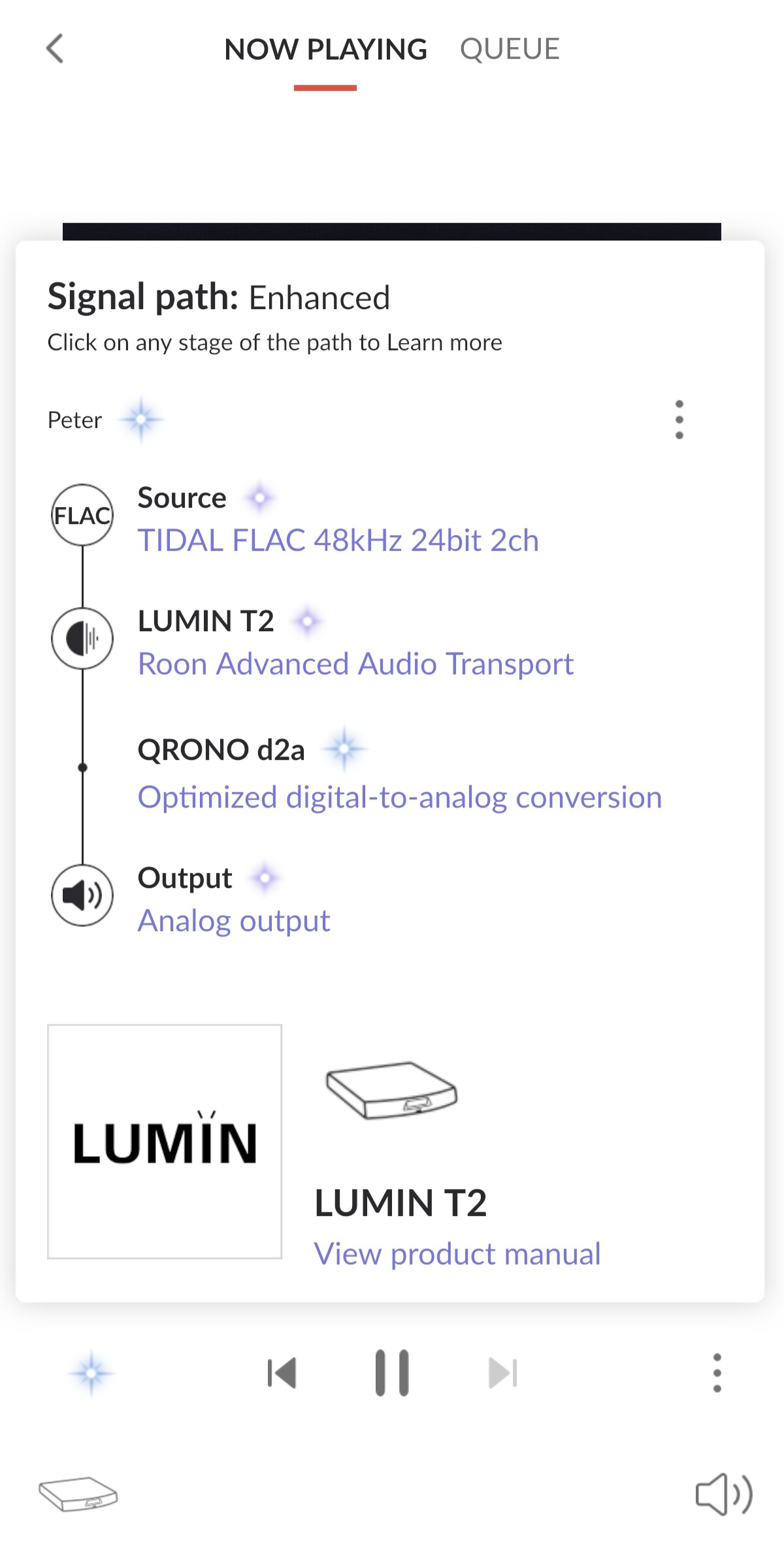
However, when using Roon and letting Roon perform the first MQA conversion (the first unfolding), the QRONO filter on the Lumin remains active. This suggests it’s being applied even after the initial MQA software unfolding.

I have two questions:

  1. How exactly does the QRONO filter behave when an MQA source is playing?
  2. Roon currently has no visibility into whether the QRONO filter is active or not. Do you think it would be possible to implement a mechanism to display the filter status in the Roon signal path? I recall that Roon was able to correctly detect and report when I had enabled the upsampling function on an Auralic streamer, for example.

Thanks!

2 Likes

Thanks for the detailed listening report. (If you are sensitive to ringing, it’d be interesting for you to hear Chord M-Scaler or DAC products and see what it feels like for you - since I guess its sonic approach is the opposite of what QRONO d2a tries to achieve.)

This is correct. QRONO d2a is only meant for non-MQA PCM music. MQA Full Decoder takes the elimination of ringing (that you experience with QRONO d2a) further with preconversion of the music file to MQA format - which was a primary factor in its controversy.

I’ll need to recheck this scenario, and see if there’s anything that needs to be adjusted for the display.

This is already done in Lumin firmware, pending an update for Roon Server to recognize this signal path element.

1 Like

I have checked this.

If Lumin device is set to MQA Renderer, the correct type of MQA indication would be shown. If it is desired to let Roon Server do the MQA Core first unfold, then this would be the correct setting.

If Lumin is set to “No MQA Support”, then the result would be what you observed. For the purpose of playing MQA track, this is not the preferred setting.

No firmware adjustment is necessary.

1 Like

Hi Peter,
Thanks for your input, but I still have some doubts.
As far as I understand, an MQA file inherently has its own specific decoding path and, consequently, I assume a well-defined digital filter.

I would like to focus on the specific case of the following chain:

  • Lumin: Set to “No MQA Support” and QRONO D2a: ON
  • Roon: MQA Core Decoder ON (MQA first unfold)

In this configuration, the data stream arriving at the Lumin is already expanded by Roon’s MQA Core Decoding (up to 88.2kHz or 96kHz), but it technically still retains the full MQA encoding.

The question is: Which digital filter is applied by the Lumin in this case?

Doesn’t the combination of the first decode in Roon coupled with the active QRONO filter on the Lumin result in an overlap or conflict of digital filters on the semi-decoded MQA data stream?

Thank you in advance
Giuseppe

I’ve done some experiments with the current Roon Server. It appears that it actually removes MQA signalling if you choose “No MQA Support”. So the above quote is technically incorrect.

The first unfold (Core decoding) restores the music signal to 88.2kHz or 96kHz that captures all music information present from natural music instruments according to MQA marketing materials. The MQA signalling metadata (instead of music data) determines the MQA rendering operation.

With MQA signalling (“MQA Renderer”), best MQA performance is achieved through MQA renderer.

Without MQA signalling (“No MQA Support”), it operates as QRONO d2a, which is likely less good in terms of MQA metric since it is originally MQA music. There is no overlap or conflict. It’s only a matter of whether the most optimal rendering (filter) strategy is applied, or a less optimal one.

2 Likes

3 Likes

great achievement peter!