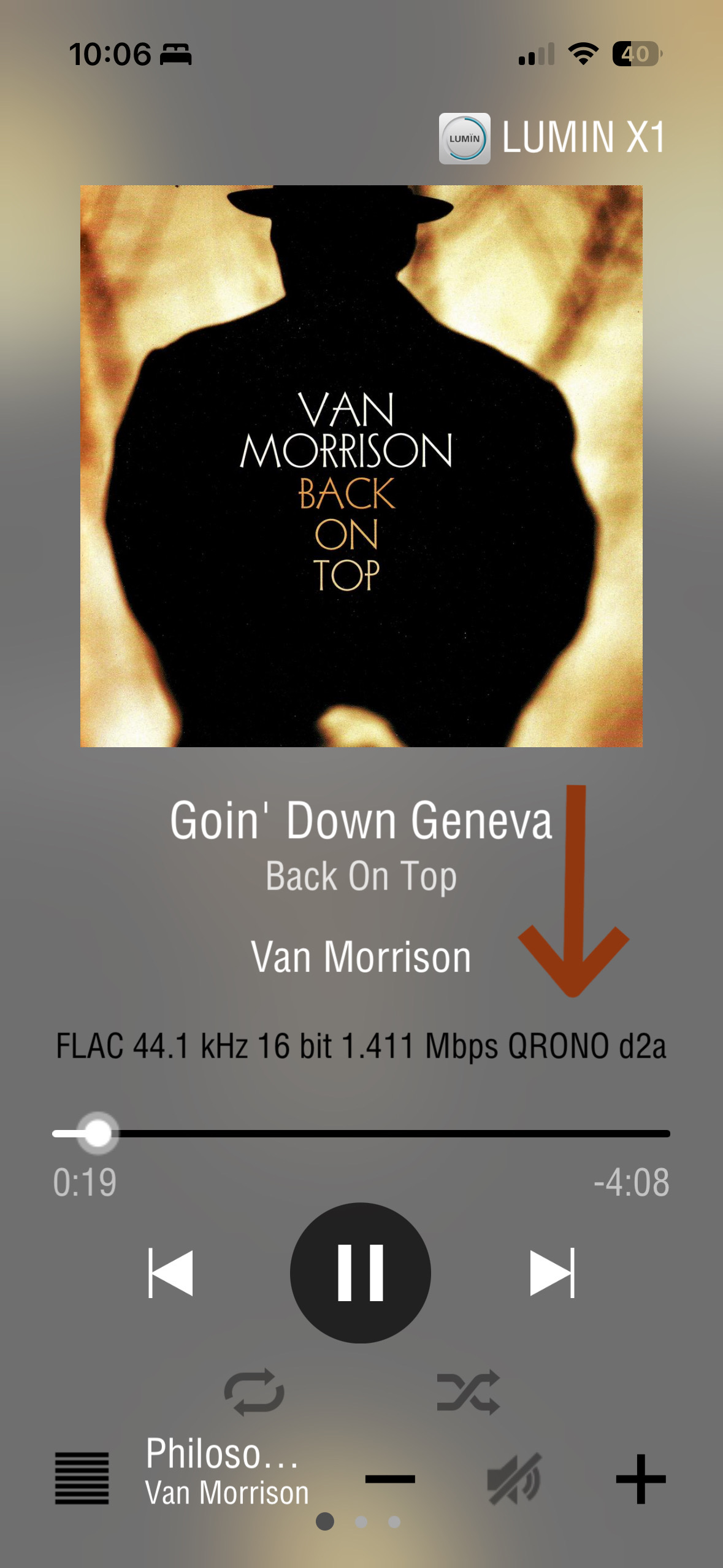
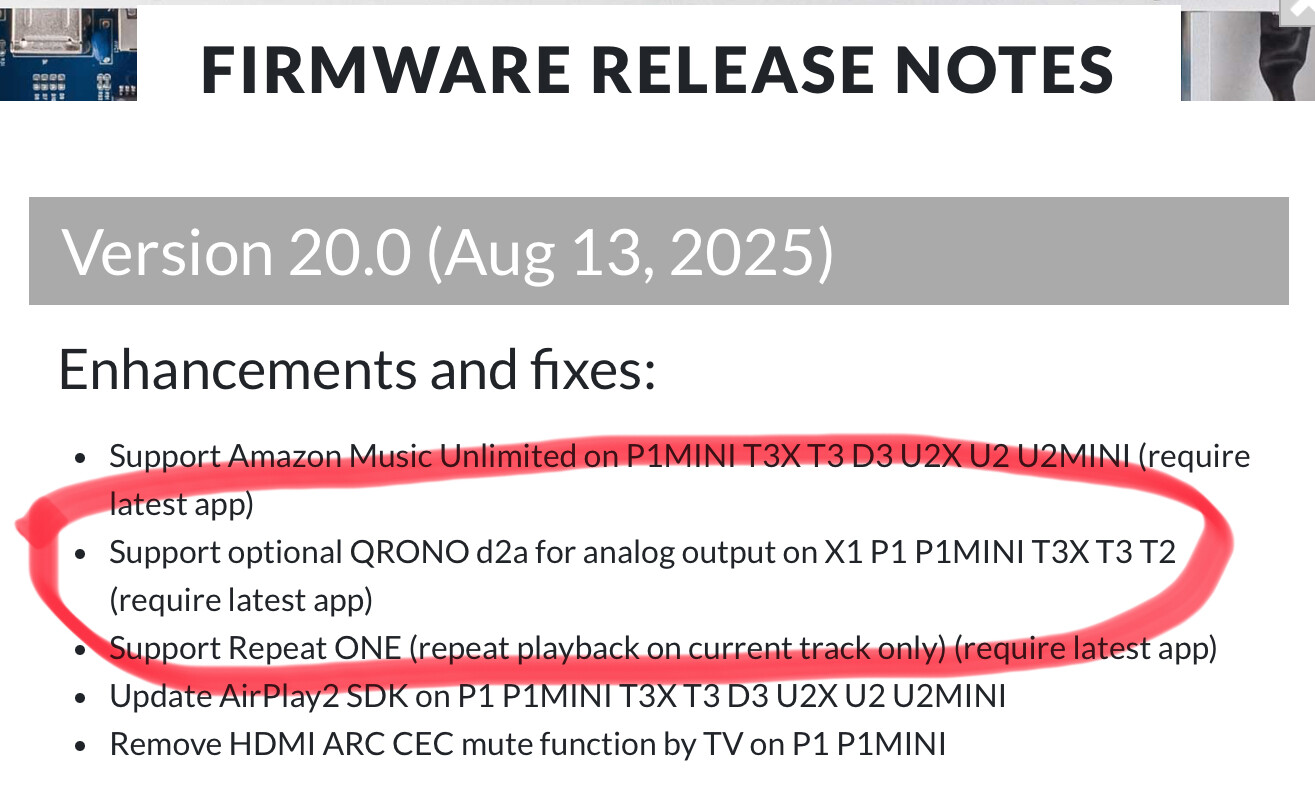
Firmware 20 adds support for Amazon Music Unlimited and QRONO d2a - both require the latest Lumin app 12 for iOS, or app 9 for Android.
Amazon Music Unlimited is available for Lumin P1MINI T3X T3 D3 U2-series.
QRONO d2a provides a MQA-style sound signature for non-MQA PCM music. QRONO d2a is optionally enabled, available for Lumin X1 P1 P1MINI T3X T3 T2 when using analog output.
Several years ago, when people tried to compare the sound between a non-MQA album and the corresponding MQA album, there was always a question of whether both came from the same master, which is impossible to know. In specific cases, there was a criticism of differing loudness. Now Lumin QRONO d2a is optionally enabled, so users can listen to the same PCM track in Lumin default linear phase filter vs QRONO d2a, to see which sounds better.
For those who are interested in carrying out this test, I suggest using 44.1kHz PCM. Please let me know your preferences.
In Lumin app settings of MQA Mode:
QRONO d2a: enables MQA Full Decoding for MQA music and QRONO d2a for PCM music
Full Decoder: enables MQA Full Decoding for MQA music and Lumin linear phase filter for PCM music
QRONO d2a is only supported for playback using Roon, Lumin app playqueue, and Tidal Connect.
QRONO d2a? Never heard of this but a quick google seems to suggest it a relabelled MQA? What is your opinion on this? Is it any different and why do I need it?
Developed by MQA Labs (under Lenbrook Media Group), QRONO d2a applies tailored filters and noise shaping during playback to allegedly reduce timing errors (“time smear” or ringing) in digital-to-analog conversion, leading to clearer, more lifelike sound and improved micro-dynamics and stereo imaging.
It works on any digital audio source—not just MQA or DSD—making even standard PCM files benefit from enhanced playback fidelity.
As of the recent Firmware 20.0 update (August 2025), certain Lumin models now offer optional QRONO d2a processing for PCM playback via analog outputs.
This is MQA technology applied to non-MQA PCM music.
It fills the role of a certain type of PCM filter commonly seen in different DAC and Roon. Why does one need Minimum Phase Smooth filter from Roon DSP engine?
As a company we standardize on linear phase filter, but I respect users’ choice if they prefer minimum phase, in the same way I respect users using tube amp and vinyl even if we do not produce products for these.
Again, I’d love to hear users opinions on whether they like the sound effect. Whether one likes it or hates it is not a concern to me, my concern is that users have an easy and accessible way to determine this preference at no additional cost (to users since we absorb the costs).
What I hear with QRONO, regardless of how sophisticated this filter may be, is more or less what I hear with dacs or software that allow one to choose between various linear and minimum phase filters. It’s pretty subtle but the difference is there. There’s tons of hand wringing and debate regarding MQA, linear vs minimum phase filters that has been well documented ad nauseam elsewhere online so I’ll refrain from going down that rabbit hole. I’ll just say that while the arguments are interesting from a technical standpoint, at the end of the day I’m more interested in how they sound than how they measure.
Music via QRONO, as with other min phase filters sounds a tad louder to me or perhaps a better way of saying it is that instruments, vocals sound more forward or punchy. However I think the timbre of acoustic instruments such as a piano, an oboe, cello etc sounds more “correct” to me with Lumin’s linear phase filter. Again this is in line with past experience with dacs that allow choice of filter.
I’ll sum up that I for any acoustic music e.g. classical and jazz, I prefer linear phase but with heavily processed music e.g. rock, electronica
, I prefer QRONO/minimum phase. Again, it’s pretty subtle and not that big a deal to me. My preference in playback with my X1 is to upsample to 176.4 or 192, depending on base rate either with the X1’s onboard upsampling or via Roon with their linear phase, slow roll off filter.
I’ll continue to play around with QRONO, as I admit that it’s sort of fun to play around with all these options. Thank God I don’t suffer from OCD or I’d be a mess
Wow. That is good news. I love your innovation and quick adaptation . I have been hanging out to listen to Lenbook’s offering. I use Tidal, but am very happy that you have now included Amazon. Thank you.
I tried a few nasty sounding records such Oasis’s What’s the Story Morning Glory and the Stones’ Hackney Diamonds, truly wretched sounding no matter what filter you use. I admit it was a little less unpleasant or even softer with QRONO engaged. For records like those I usually upsample in Roon and use the headroom management feature. That takes some of the edge off.
What do you hear, Peter? Or perhaps other things to listen for?
QRONO is not MQA relabeled as it does not encode the higher bit rate content into the noise floor, however it does use similar filters to MQA (see other comments) that largely eliminate the pre and post ringing and undesirable time domain distortion associated with traditional digital filters.
1 Like
mjw
(Father! Father! Resist not! Let us destroy the core! Set us free!)
15
With MQA the Render stage was supposed to be unique for each DAC. @wklie, is this true for QRONO d2a?
If not, then the benefit is moot since such filters are already available to Roon and DACs.
AFAIK, only Bluesound (owned by Lenbrook, who also own MQA) and Lumin (privately owned) support QRONO. Why do Lumin think QRONO will succeed whereas MQA did not?
Even if were not true, different vendors of filtering might sound different. In the same way that we have different software (Roon, HQPlayer, etc.) offering upsampling.
We need to include it for some reason, it does not imply what we think of it ourselves. It’s not enabled by default.
Hi @Paul_Candy, thanks for your tests and comparisons. I get what you’re describing and can hear it in a similar way on my setup with Lumin X1. With Qrono I hear a bit less timbre, but the music sounds a bit more forward and dynamic or even punchier. The guitar of Ulf Wakenius in Youn Sun Nah’s Vouyage sounds slightly more polished to my ears, but less full and rich, for example. This effect is of course very subtle as usual with digital filters, but significant. I can hear the difference playing from Lumin App or Roon in a similar way. What’s better? I don’t know. It and depends on personal preferences and recordings or style of music I guess. To my ears the Lumin standard filter sounds more natural with well recorded acoustic music and is therefore my preferred option for most of jazz. Qrono might be more fun with some electronic and pop music albums. Anyway it’s worth to try and compare.
I’m used to linear phase filter since I have been listening to it for all these years.
Many years ago I asked some users to participate in a blind test for a linear phase / minimum phase setting (not the current QRONO d2a). Excluding some who did not think there was much difference or did not pick a preference, roughly half preferred linear phase, and the other half preferred minimum phase.
There was also a matter of audio reviewers preference that does not concern users directly, but I believe is more important for manufacturers. At the time I did this survey, I found multiple audio reviewers who preferred minimum phase. Other than MQA Labs, I think there are also manufacturers that preferred minimum phase. Last time I checked, Roon DSP engine default was also minimum phase.
A Lumin P1 user e-mailed us saying QRONO d2a improved “clarity, calmness, precision” for him.
Anyway, I think having a choice is the most important thing.
WOW.Thank you Lumin. I am enjoying Qrono d2a. I listen to mostly acoustic music, piano, cello…plus some old school vocalists. I appreciate having this filter to choose.
Peter, I am curious how Lumin compensates in its music playback for the putative effects of a linear phase filter. I ask this because I received today a newsletter from David Chesky (Audiophile Society) that reports the following:
"This became viscerally apparent to me recently in the studio while comparing linear-phase equalizers to minimum-phase EQs. Set to identical filter shapes, the sonic difference was striking. Linear-phase filters preserve phase relationships across the spectrum but introduce pre-ringing artifacts — a kind of temporal smear that occurs before the transient. Minimum-phase filters, by contrast, do all their damage after the transient, creating post-ringing that, while technically less ‘accurate,’ can feel more musically natural to the ear.
“The ear can hear this ringing — not as an overt tone, but as a kind of blur, a clouding of the leading edge of a note, an inability to localize or feel immediacy. And this is just from a software filter. Now imagine the cumulative effect of every physical object in the playback chain doing its own version of ringing, from capacitors to cables, from enclosures to air gaps.”
So David Chesky says the use of a linear phase filter introduces pre-ringing artifacts. If this is the case, can you tell me how Lumin compensates for these artifacts? As an aside, now the Lumin offers as an option the minimum phase filter QRONO d2a from MQA Labs, you have made the excellent point that Lumin users may now experiment with the two filters to determine which filter works best in their systems.