The one disappointment for me was realising I couldn’t do headphone equalisation on DSD256 material I have, on my Nucleus One. i.e. without downsampling it to something lower, or converting to PCM etc, first.
You can’t apply equalisation to dsd it has to be converted or done in the analogue chain.
Thank you, yes I think that’s what I meant: the nucleus one couldn’t handle that conversion along with the DSP.
It was a while ago, I’ll test again and clarify what doesn’t work.
I’m suspect we are talking about the same thing  but just to clarify, it’s not that roon or the nucleus can’t do dsd equalisation, the format itself can’t be equalised.
My memory was that my Nucleus One is not up to the task of headphone equalising my DSD256 material, and I’ve just confirmed that: when I try, it plays a few seconds of the track, at 0.7x processing speed (see signal path), then skips to the next track.
When I disable the headphone eq, and switch to a simple headroom adjustment DSP, the processing speed jumps to 2.4x, and there’s no problem.
DSD128 or below plays fine with headphone eq; DSD256 does not.
I don’t see any sign of format conversion in the signal path, before the DSP, in any of the above cases.
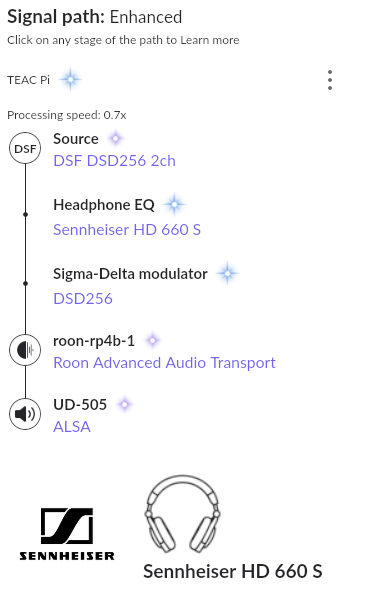
I assume that perhaps Roon is indeed converting the DSD into PCM to do the EQ, but not showing that conversion in the signal path? [But apparently not; see next post]
So I have to disable headphone EQ when listening to my DSD256 material, which is a shame. I assume I’d not have that issue with a higher-performing Roon system.
If I tell Roon to convert DSD to PCM, and send that to the DAC, then all is fine, even with headphone EQ enabled: processing speed 2.8x with DSD 256 → PCM 352.8, and EQ on.
That suggests that when I tell Roon to send DSD native to the DAC, with headphone EQ on, something else is happening?
You have a setting in MUSE, “Enable DSD Processing”
This is what is affecting the intermediate processing within the PCM domain, or not. It is absolutely possible to manipulate some aspects of a DSD stream, but it is very CPU intensive.
A one box set it and forget ot solution. For music at any resolution, in any home environment. The raw specs of the computer device are inmaterial, you could easily run it comfortably with a Pentium II. All the Nucleus One does is run the software and pass on data. It can run 100 THOUSAND files and multiroom EQ at the same time… Again the hardware is massively capable for any imaginable home environment. having more computer power really doesn’t do anything at all. Stick a 4 gig SSD in it an it becomes the only musical digital source anyone could ever need. Plus unlike most digitalsources it is built as an actual audio component, isolated power supply, star ground design and a case that is a crafted Faraday cage. The whole thing is designed to work back to back with other sensitive audio equipment such as phono stages. For 500 bucks it the digital audio deal of the century.
Depends. Even Roon states the Nucleus One has limitations when it comes to DSP, especially with DSD (multichannel, upscaling, etc).
For 8 zones. That’s around seven more than 99% of Roon users 
I dont use the DSP at all, despite, by every measure, being excellent and transparent. For ne and I suspect, most its simply a directly connected, worry free server/ streamer that runs the best digital cataloging software. No configurations or protocols or other "computer tasks. Plug it in and done. Love the device. Basicly transforms the Roon expirience to a level that most music aficionados can handle.