Hello all - is there a resource or table giving the hardware specs (processor, installed RAM, I/O Ports, etc.) of the various Roon Nucleus models?
Not that i know of, but the information is not hidden.
First Gen:
Nucleus - Intel Core i3 based on the NUC7-series (4Gb)
Nucleus+ - Intel Core i7 from the NUC7-series (8Gb)
Nucleus RevB - same as above but based on the NUC8-series.
Nucleus Titan - Based on the NuC13 Pro series, Intel Core i3
Nucleus One - This is Celeron based, but i assume it’s from the NUC13 series as well.
Thank you Mikael - so the Titan uses a Core i3? Of course, the exact version, number of cores, heat etc all play important roles.
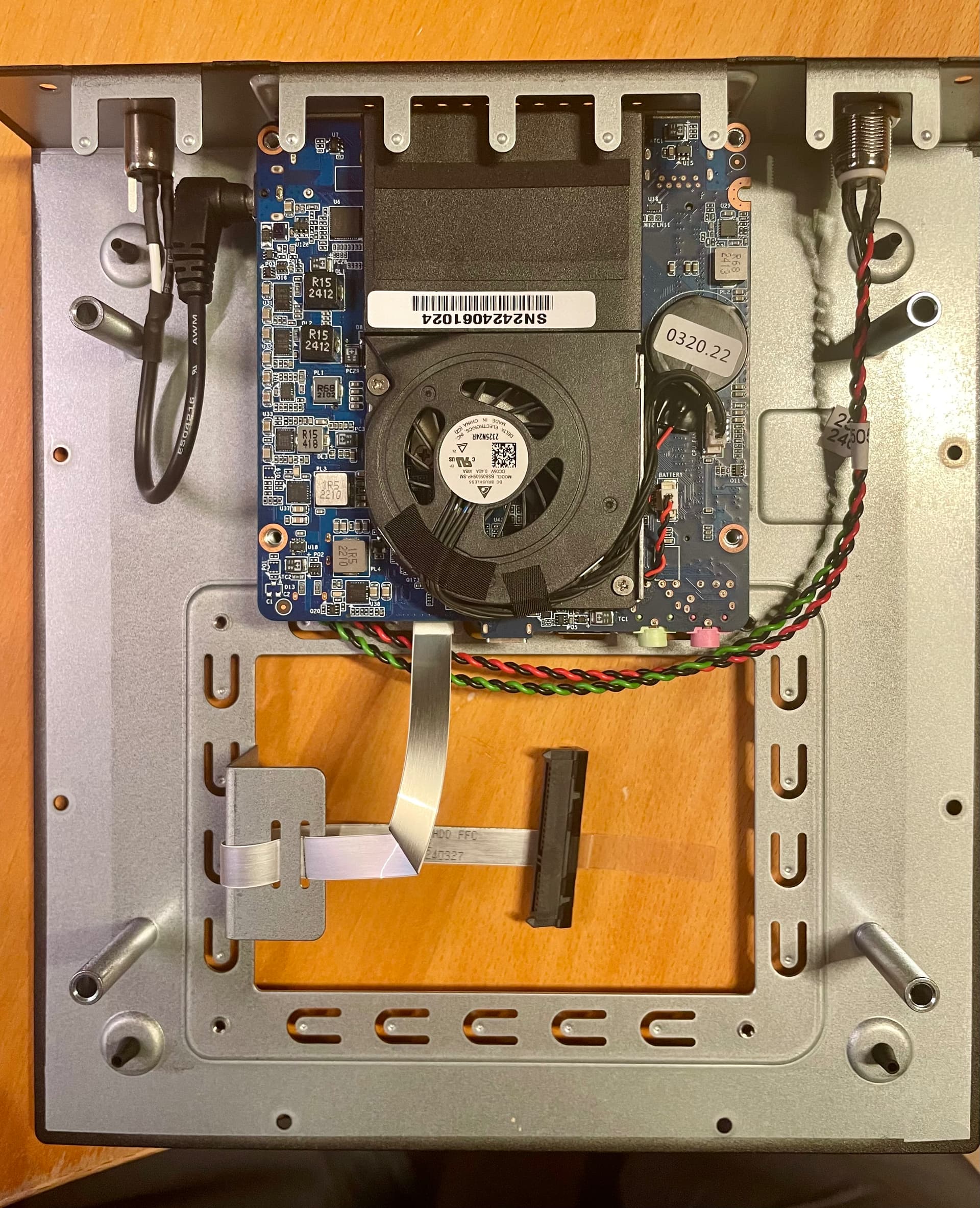
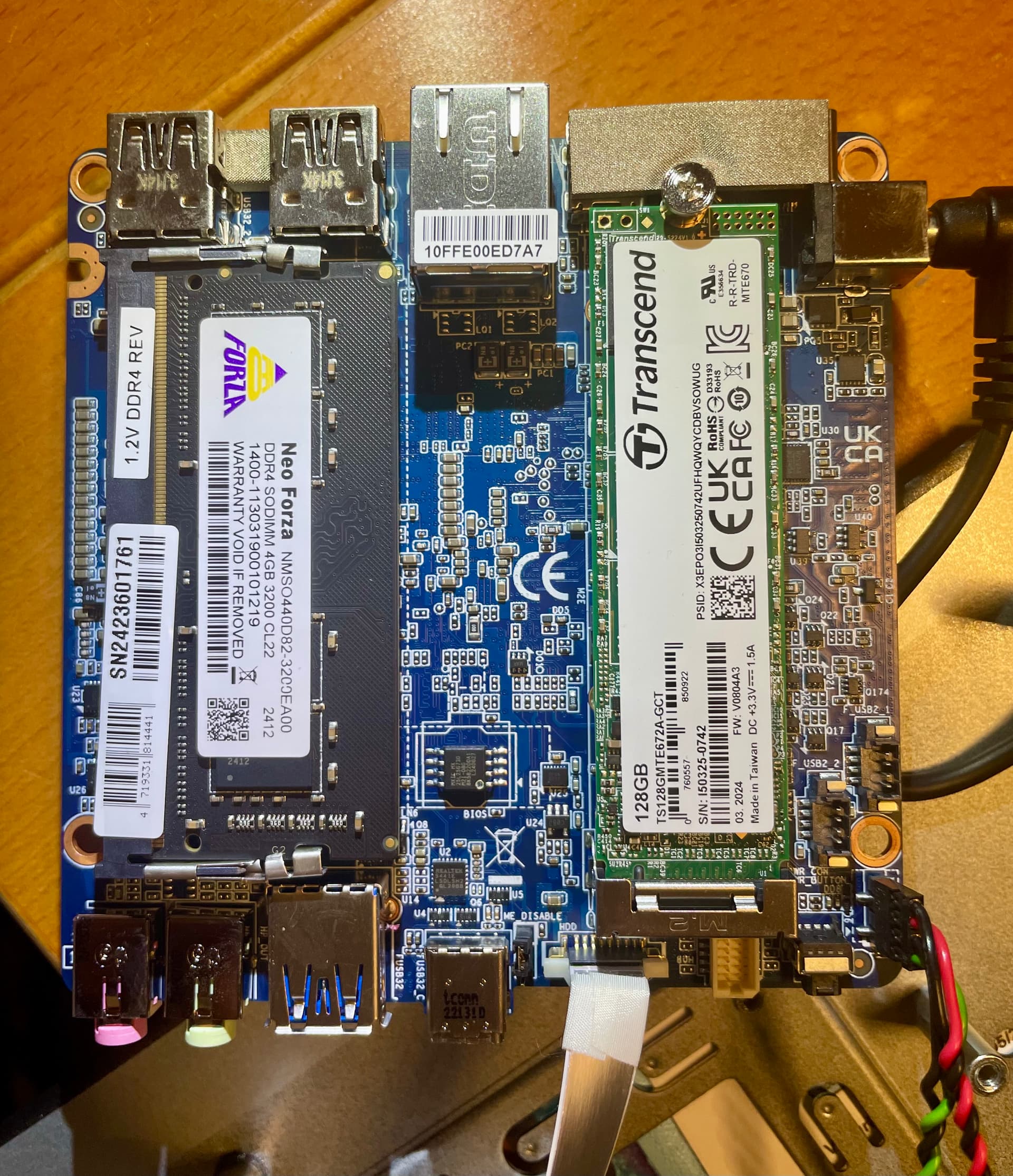
I didn’t dare remove the radiator to check the Celeron version of my Nucleus One 
You can see a 4GB DDR4 RAM array and the Roon OS dedicated 128GB NVMe SSD (pre-installed).
The motherboard is from Gigabyte, probably from a BRIX GB-BMCE-xxxx mini-PC (so not an Assus NUC!!).
Are you sure it is a Gigabyte BMCE Brix ?
There is only listed 2 Brixx Mini Computers on Gigabyte Websides and both are fanless.
GB-BMCE-4500C (rev. 1.0)
GB-BMCE-5105 (rev. 1.0)
Greetings Dirk
The model is Ultra Compact PC Gigabyte BRIX GB-BMCE-5105 (rev. 1.0) with Intel Celeron N5105 @2.0G ~2.9G Turbo, 4C/4T Core, 4MB L3 Cache,10W.
Hello everyone and a very good day to you all! I purchased the Nucleus One as part of the Black Friday deals Roon was having. That said, until it arrives, I configured the Roon server on a QNAP TS-453D which based on the above has twice the memory as the Nucleus One and the same processor. I have the core/database on a 2TB Samsung EVO SSD and my music on a 4TB Samsung EVO SSD. So, my question is, what value will be gained by switching to using a Nucleus One? My thoughts are (and please correct me if I am wrong) that my current setup is better than what a Nucleus One would provide. Please note, I don’t use this NAS for anything else. The music plays without issue as well. THANK YOU so kindly in advance and I look forward to any replies on this. Most sincerely!
Nothing really
Functionally they should be equivalent. I’d still recommend giving the One a try as a more “focused” Roon server. Qnap have pretty busy OS and apps as they try and be everything to everyone.
Either you find it beneficial or you don’t!
Congrats on the Roon sub!
Hi there Suedkiez,
Thank you so much for your reply. I really appreciate it!
Hiya Mikael_Ollars,
I thank you so much for your reply as well! If I am understanding you correctly, with the QNAP, I could possibly see some issues as various apps related to the product run, etc. Whereas, the Nucleus One is dedicated solely to playing my music. That is a fair point.
One thing my mind keeps reverting to though is that right now, playback from the NAS seems to be fine. No issues at all.
It may also be worth mentioning that I only have 4468 albums with 22114 tracks. Well below what many others within the community have! 
Thank you both and everyone for the help!
Several reasons but
Pretty (in the eye of the beholder)
Self maintains, all future updates are automatically applied
Can take a small internal drive like your 4Tb SSD
Self contained unit
V good value for money
I could go on . I moved from a desktop win 10 to a NUC/ROCK 4 yrs ago just happy
Thank you so kindly Mike. I appreciate it!
Is it just me, or do all these server machines from ROON seem very under-powered? I think y’all should look into Small Green Computers’ offerings before making a purchasing decision.I bought mine a few years back and it had an I9 cpu even back then. Plus, you can go with a fiber connection to your network.
There are many types of Roon users, and any of these would serve most of them just fine. There will always be edge cases like me and you, with bigger libraries, other requests such as SFP connectivity but we remain; edge cases.
I may agree that letting the older NUCs fall out of supportseems wise though. The Gen8 NUCs are fine for most libraries (i have a spare NUC8i3 which runs fine with 150K tracks + 200 Qobuz albums)
And feel free to use SGC builds, but they are “Tinkering” and fall under the MOCK moniker.
I did this table, looking at the NUC models available Best used NUC for ROCK 2022/2023? - #17 by simon_pepper
I had just moved or was moving from a NUC5i3 to a NUC7I7DNKE which is the same processor board of the RevB Nucleus+, just I was configuring with 16GB and a faster NVMe PCI Gen3.0 SSD.
But also look for my benchmarks on the performance obtained with the NUC5i3, where I was then able to support multiple zones each performing DSP (downconverting, upconverting and transcoding formats), completely debunking the ‘oh, you must have the latest and highest performance’ camp.
You need to look carefully at single thread performance, as that’s the limiting factor for RoonOS as used in ROCK.
There’s more here NUC 8th Gen still the best option? and best retailers? - #33 by simon_pepper
And here NUC 8th Gen still the best option? and best retailers? - #34 by simon_pepper
Also need to consider the TDP - this is an device which is left powered on 24/7, so big difference between 15W and 28W
Sweet spot still for me is the NUC7i7DNK range, Gen8 ‘quad-core’ CPU but at 15W.
There is also the NUC10i5FN, NUC10i7FN & NUC11TNHi3 all delivering all round the same single thread performance.
All will be better than the Celeron based Nucleus One, can be picked up secondhand & rebuilt with more RAM & faster SSD, and way cheaper than a Nucleus Titan or even a S/H RevB Nucleus+
I agree 100%. Any of the Nucleus devices will likely support the majority of users who fall within the advertised library size limits. i.e. less than 100,000 tracks aggregate for the Nucleus One (Or the original Nucleus).
However, when @Chris_Lord1 suggested the use of an SGC device I did not take that to mean putting RoonOS (Using the ROCK installer) on the SGC device so this would not constitute “Tinkering”.
As well as supporting large libraries and SFP connectivity (the latter not, to my knowledge supported by RoonOS), the other reason that a heavyweight Roon Server machine might be entertained are due to the processing performance needed to run exceptionally heavy MUSE DSP (such as upsampling to DSD512 which is beyond the capabilities of the Nucleus One at least).
There is a further use case that may demand a very high spec Roon Server machine. Running HQPlayer on the same server. However, this cannot be done if the Roon Server machine is running RoonOS anyway and so someone entertaining such a setup would not be looking at Nucleus devices.
Who does that? Do may DACs support DSD512?
Why?
At the risk of going off topic:
Well some Roon users do. I have even seen feature requests for support of DSD1024.
Again some do, although many more seem to be limited to lower rates.
Good question. Who knows?
I suppose it is possible that, given an oversampling DAC that converts and upsamples lesser rates to DSD512 internally, you might feel that Roon’s upsampling implementation may be better than that of the DAC and thus you can improve the sound quality by performing the upsampling in Roon rather than leaving the DAC to do it - but that would likely be a subjective claim.
Other than that, I can think of no other valid reason. It can’t be to improve the sound (even if you believe that the effects of higher sampling rates are audible) because upsampling is just changing the representation of the original lower sampling rate stream. It does not change the content of that stream. For example in PCM, upsampling a 44.1kS/s representation to, say, 352.8kS/s does not magically restore the high frequency content (22.05kHz and above) that was necessarily filtered out to make the original 44.1kS/s recording. Similar arguments can be made for upsampling DSD.
I play material in the original format it is stored in, mostly 24-bit PCM in FLAC, some DSD64 (71% of overall library), some Redbook FLAC/ALAC, and a handfull of lossy M4A & MP4 (less than a 100 of the overall 102k). I do have some DSD128 & 1 album in DSD256, but these are played as DSD64
All PCM is presented to the DAC as uncompressed WAV files, and the DSD64 as DoP.
I want minimal ‘messing’ with stream, so no DSP, volume-leveling etc.m I very analogue approach.
The only time DSP is applied is in RoonARC for headphone equalisation, against measured profiles.
Puts a lot less processing requirement on any part of the playback chain, and therefore less chance it is interfered with.