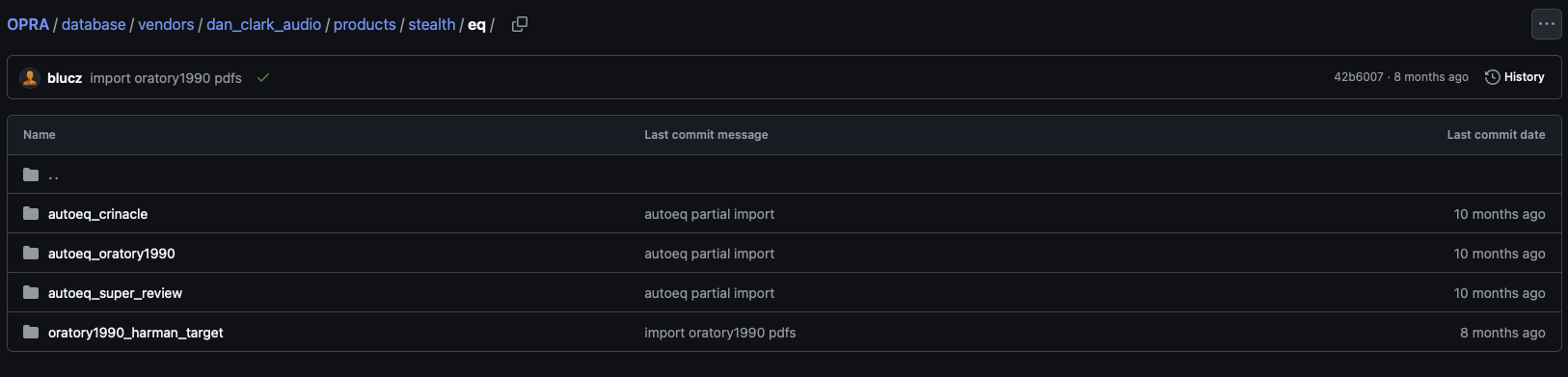
I noticed that Roon OPRA has a new(?) Headphone EQ choice called “oratory1990: Harman Target” available for some of my headphones. For example, for the DCA Stealth I can now choose between “AutoEQ: Measured by oratory1990” and “oratory1990: Harman Target.”
The “Harman Target” is a less aggressive correction and I like it a bit better, on initial listen.
I’m wondering if these are new and what the story is behind them? Who created them?
I thought AutoEQ also used the Harman Target, so why are these different? And what was the goal?
I also tried the new one for the Audeze LCD-R and like it a lot better than the previous one I was using.
(In case it is not clear, my questions are specifically about the EQs labeled “oratory1990: Harman Target,” not about OPRA in general.)
That page does not address any of my questions. It is a very basic overview. I also already looked thru all the recent PRs, but did not find anything relavent.
Reading up on it a bit at the AutoEq site, I think the answer is right there:
Target (or sometimes called compensation) is a frequency response which represents the desired or optimal for headphones. This could be a neutral target such as the ones produced at Harman by Sean Olive et al. or a “flavored” target which you prefer over neutral.
I’d be interested in the facts here too. I have no evidence to base this on, but my assumption was that oratory1990/Konstantin had actually plugged said headphones into Roon (via a flat endpoint/DAC/amp obviously) and configured a PEQ to his liking using MUSE.
The AutoEQ one has presumably been based on an automatically measured profile on a specific headphone test rig – albeit by oratory1990 in this instance – then passed through the regular AutoEQ algorithm to generate a N-band PEQ. One would expect there to be differences between that and the ‘hand tuned by ear’ PEQ above.
Well, the default AutoEQ target for the OP’s Stealth heaphones as measured by oratory1990 is “Harman over-ear 2018” so the question then is which 'Harman Target" is used for the in-house version.
The reason I speculated above is that oratory1990 offers PEQ presets specifically for the RME ADI-2 which are obviously different from the ones generated by AutoEQ.
Torben
(- A Dane living in Hamburg, Germany - Roon Lifer)
8
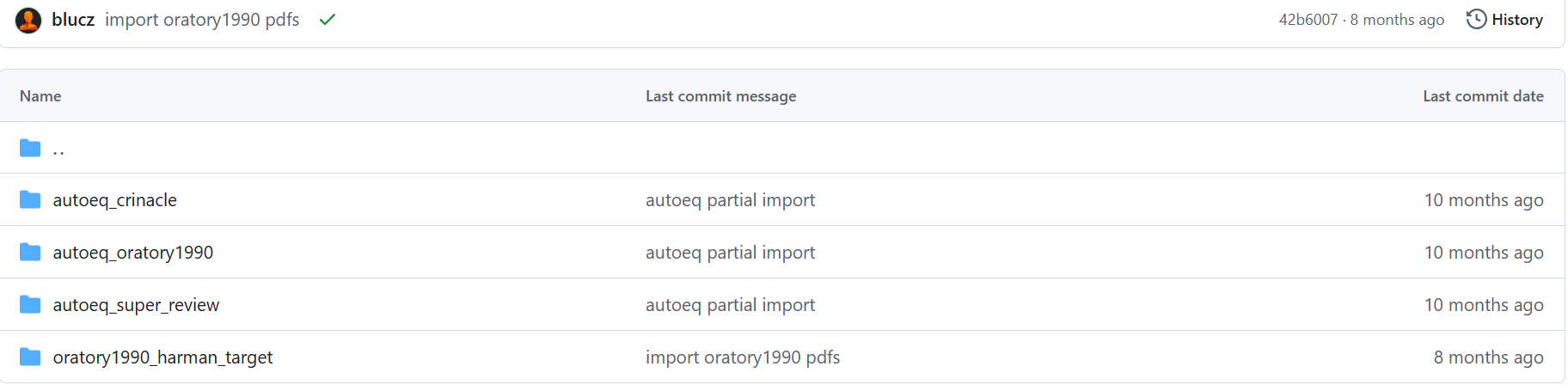
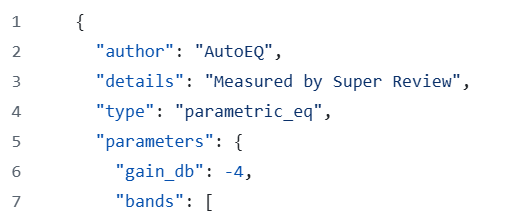
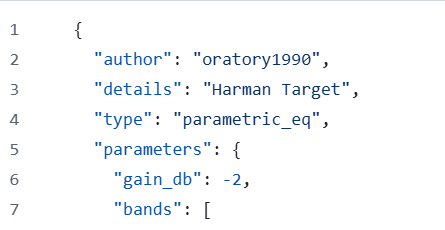
I see four on that screen and in Roon. I’ve tried them all. The ones from Crinacle and Super Review are fine, but I preferred the original one from Oratory1990, which is very good. The newer Oratory1990_harman_target one is my favorite of the bunch. Hence my questions to know more about it. Interesting that they have gain differences.
There is little info regarding the person behind them, so I posted two videos with a caveat. I guessed the one may have been a troll, but it may have given balance to the origins of the person behind them and their credibility
@Nick could also have done a Google search like it did.
@Nick says he watched the 5 year old video back then.
They are not new. They have been available for some time. Obviously not for new releases headphones.
I think you are totqally misunderstanding. I know that Oratory1990 did the measurement, but I don’t know who produced the new Oratory1990_Harman_Target EQ. I’d like to know who created it (maybe Oratory1990, maybe post-processing by someone else, perhaps Roon), what the goals are vs the earlier Oratory1990 EQ for the same headphone.
I don’t know why some of you guys find this so hard to understand. I think my original question was pretty clear.
You can see from the commit dates that the EQ I’m asking about is newer. That explains why I did not see it when I first tried OPRA, right after it was announced.
You are not giving balance if you promote a video that smears the person it is about. You are spreading lies and hate. I mean, disagree with someone fine, but call them “a pathetic loser”? Come on. BTW, Oratory1990 is not a janitor, he is an acoustics engineer.
Probably the best and most definitive thing you could do is go and join his channel on Reddit, and then you could post this question and see if you can get a direct response from him. The guys over at Headphones.com also know and interact with him quite frequently, so you may try there too.
Hi @Nick. There seems to be quite a bit of noise on this thread, so I’ll do my best to answer your question.
When OPRA was originally set up the EQ settings all came from AutoEq. AutoEq generates PEQ settings from measurements made by a series of individuals, including oratory1990. These measurements are put through a programme that generates the said settings. All of the AutoEq settings were imported into OPRA.
Oratory1990 doesn’t have any involvement with AutoEq. He does, however, publish his own PEQ settings on Reddit. These settings are personally tested by him, so they differ quite a bit from the AutoEq oratory settings. The “oratory_1990_harman_target” options that you see in OPRA are taken from oratory1990’s own settings published on Reddit and were imported into OPRA more recently than the AutoEq settings.
In short, oratory1990 created the “oratory_1990_harman_target” settings. The “autoeq-oratory1990” settings were created by AutoEq software from oratory1990’s measurements.