Hello Community,
first of all – please excuse me, this is my first initiated post here. I’m not a native English speaker and certainly not a software expert – just a user and music nerd  with a little experience in using REW and generating room correction filters. (Biquads, Dirac Live, Genelec GLM…)
I’d like to share my current ROON setup with you and get some feedback from the real experts on where the design/setup might not be optimal yet, and where improvements could be made. Of course, in the end it all comes down to musicality and personal taste, but I’ve already tried out a lot of different options – sometimes even had too many – so I’d be happy to hear your thoughts.
And – this might be a bit unusual – I’m running a TRINAURAL chain for my stereo.  recently I’ve used an Bongiorno Trinaural analogue Processor. The issue with that unit was always that it takes the analogue stereo signal and converts it into three channels. It generates a real center and subtracts the phantom center information from the Left/Right channels. A brilliant concept, especially if the listening room isn’t perfect, and it creates a fantastic soundstage – even though it may feel unfamiliar at first.
However, this becomes a real challenge when using FIR filters and convolution.
The center channel cannot be corrected with its own FIR filters – only indirectly via the Left/Right channels. I was not willing to accept that. The center must also be properly equalized and room-corrected.
It actually took me quite some time to realize – and to understand Roon’s full functionality – that Trinaural processing can also be implemented inside ROON.
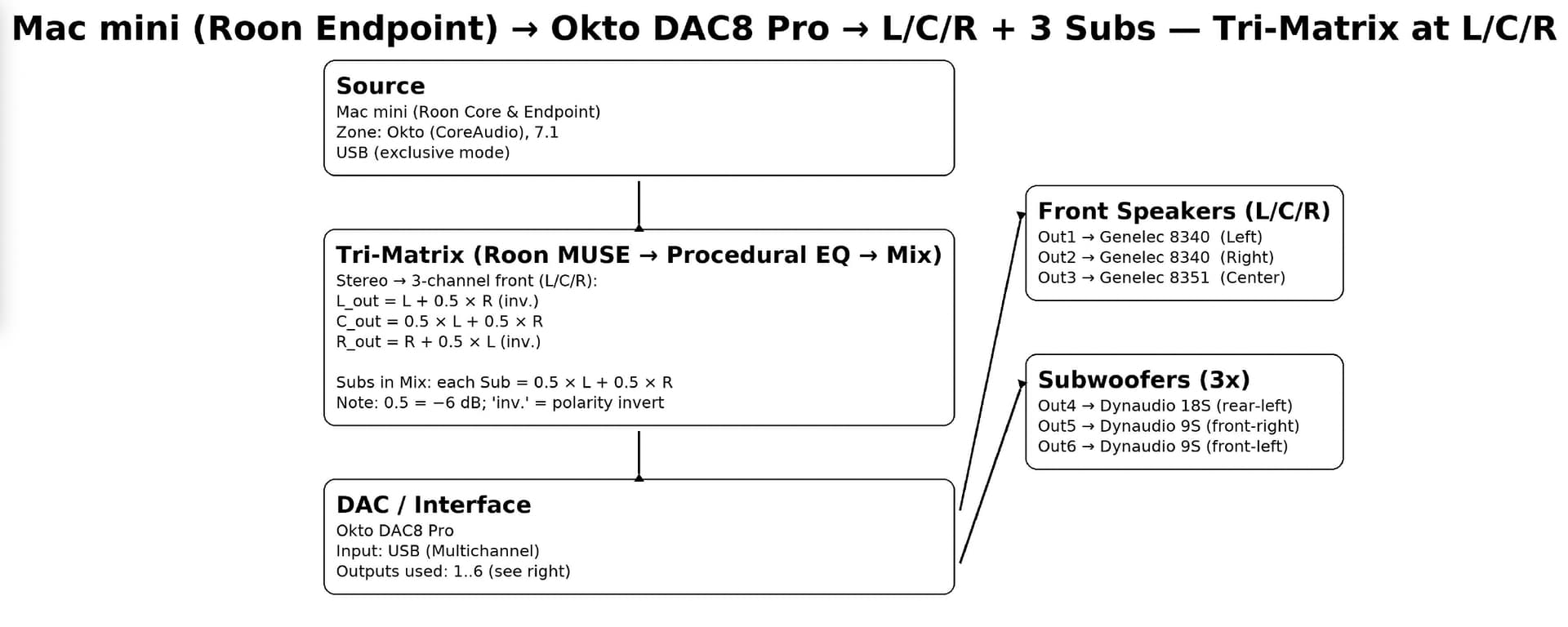
Key was to use “Procedural EQ / Mix”, with a Mix I was able to recreate Bongiorno’s math. The calculation is straightforward.
- L = L + 0.5*R (inverted) =>-6dB
- R = R + 0.5*L (inverted) =>-6dB
- C = 0.5L + 0.5R
This can be implemented as a little custom mix in Roon. The soundstage really opens up when the relative levels are properly balanced. But with 3 Dynaudio subs, I need to realize a 6-channel Convolution/FIR. Finally I decided to buy a OKTO DAC8 Pro, which fits the bill perfectly.
Playback is fed from a Mac mini via USB exclusively into the OKTO.
The XO’s are baked into the FIR’s as well, generated in RePhase - a really annoying process with 6 channels and 44.1, 48, 88.2, 96, 176 and 192 kHz. than generating .cfg files… but you know! 
Finally I got things running, and the result convinced me that this was a worthwhile job to finish properly.
ChatGPT made a little scheme to help myself and you to get a quick overview of the setup.
And if you have a proper center speaker and 4ch-DAC to play around with - try it out, stereo music in TRINAURAL is worth a little listening session.
Add images

 This is a complete new experience!