In may be an old recording (1967) but my wife and I still like this one (which my wife first acquired on cassette):
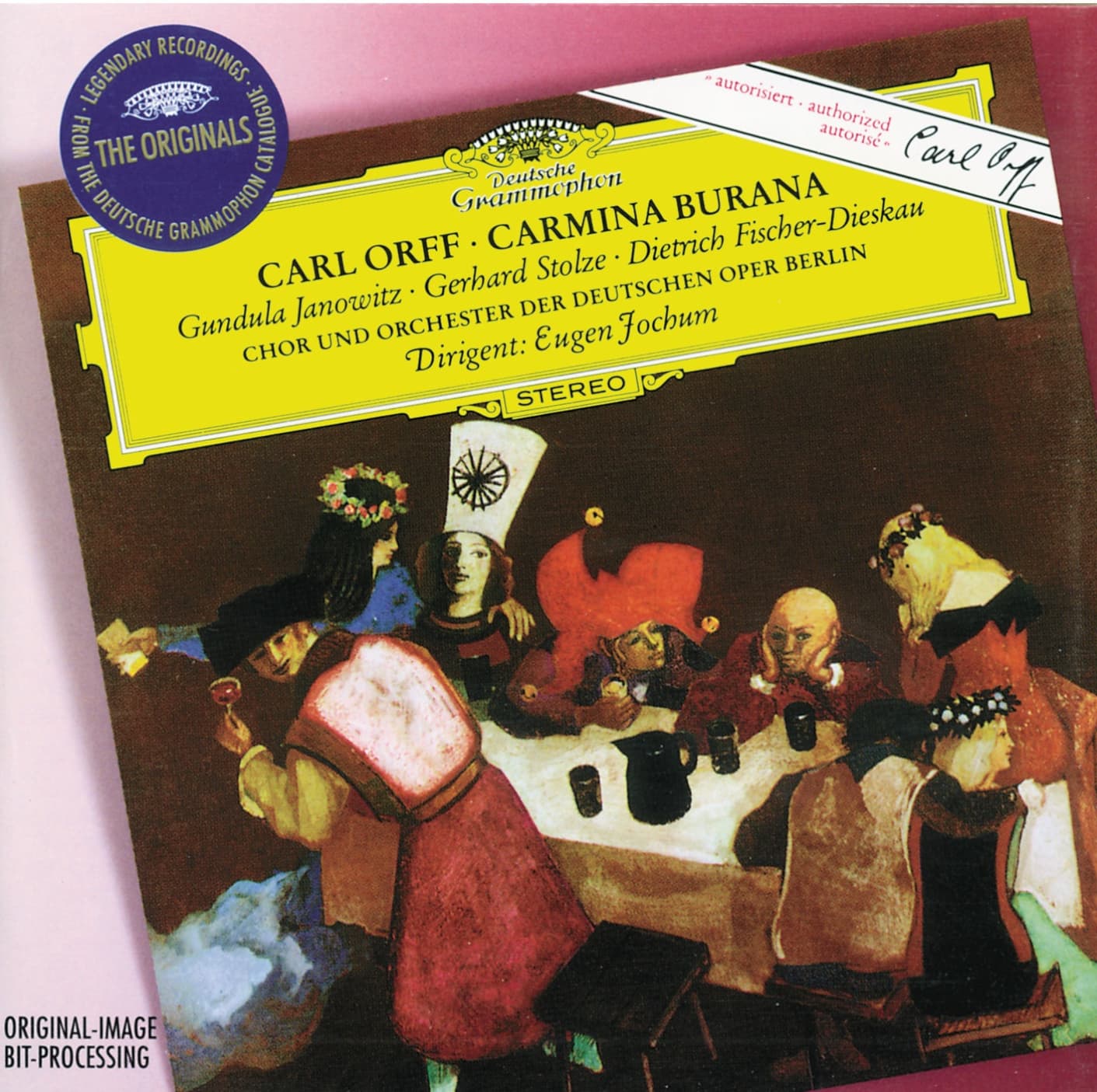
Apparently recorded in the presence of, and approved by, Carl Orff.
In may be an old recording (1967) but my wife and I still like this one (which my wife first acquired on cassette):
Apparently recorded in the presence of, and approved by, Carl Orff.
There are so many wonderful recordings, it’s almost impossible to go wrong. In addition to the Jochum, which remains a prime recommendation, here are a few others I enjoy:
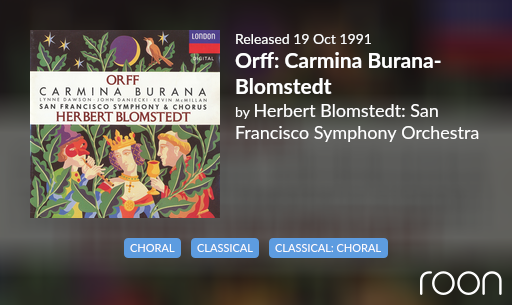
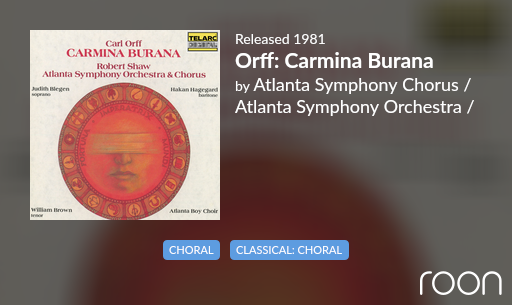
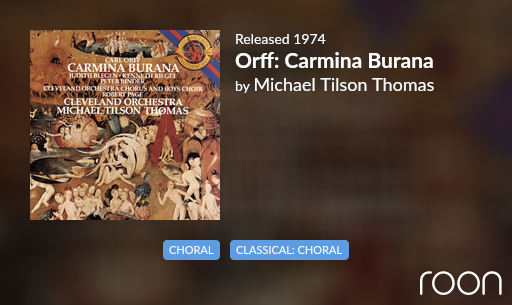
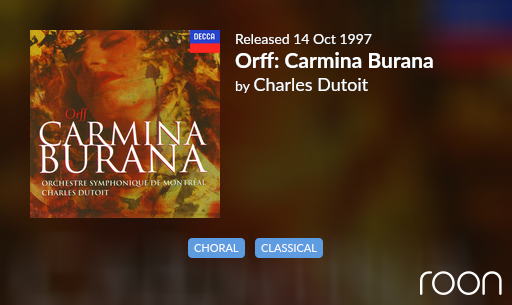
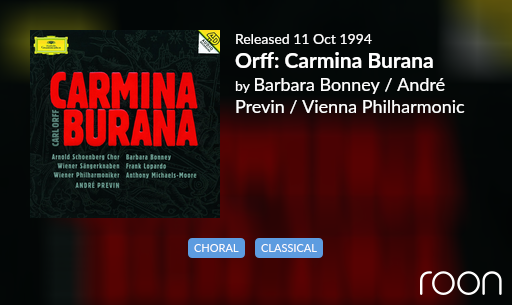
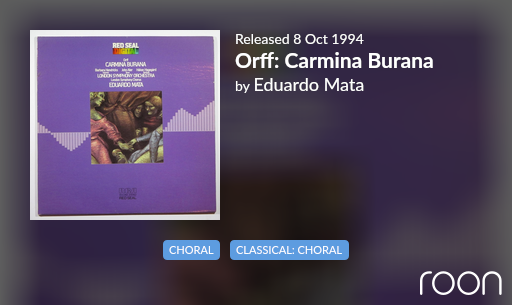
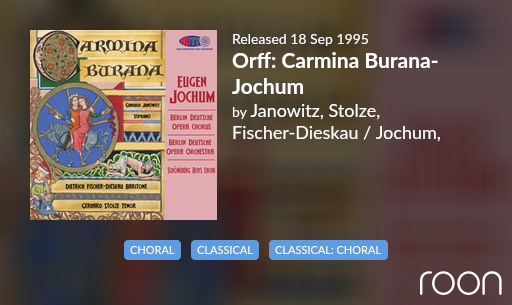
of these, I have a particular fondness for MTT’s Cleveland recording, with Judith Blegen, who also sings on Shaw’s recording.
another classic I should have included, and in MQA for the moment. I also have this on vinyl.
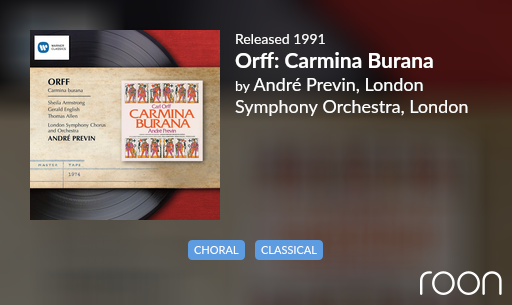
Thanks a lot for all of these recommendations! I agree that there are a lot of good ones when it comes to choir, orchestra and soprano.
In contrary, I feel myself unable to agree when it comes to the baritone’s and tenor’s parts. These are enormously difficult to sing properly, and unfortunately the risk for a complete embarrassment is pretty high.
Jochum´s classic recording is in my ears the worst example. Surprisingly energetic, precise choir, wonderful soprano. Fischer-Dieskau: Just no! Ridiculous falsetto, declamation on the edge of caricature, it sounds like a sequel of Beckmesser´s price song. Stolze … I feel myself unable to comment on that publicly. De mortuis nihil nisi bene…
Except from this version, out of the recommended ones (thanks again to everyone) I have Shaw and MTT/Cleveland in my core collection (Currently no streaming, so I will check the other ones later). Shaw is really good but I do not like his male soloists here.
I was positively surprised by Michael Tilson-Thomas´ reading. It is a bit on the naive, lean, chamber-like side, sometimes even with a glance of folk and jazz style playing and singing. I really like it for its precise playing, MTT is seemingly a master of finding a way to the core of this piece. And the soloists are very good, particularly baritone Peter Binder and soprano Judith Blegen. The tenor is falsetto-wise reaching his limits but he is doing it with style and confidence. Only thing that is below my expectations: The choir. I do not intend to insult anyone but it is a bit sounding like volunteers rehearsing a piece until everything is in time but nothing is breathing anymore.
Nevertheless a great achievement which is meeting the composer´s intention as I understand them pretty well. I own a lot of recordings on LP which I cannot access currently and among them is Eichhorn´s recording also approved by Orff himself. Although this is not my favorite one it gives a good impression how it was meant to be.
Have two more recordings in my collection which I marked as favorites which I will feature and discuss later. Thanks again!
if you have a chance, listen to Dutoit and Mata.
Try the Ormandy/Philadelphia, which happens to be the Penguin **** recommendation.
Instrumentally, I put the Eugen Jochum recording very high.
From a soloist/choral perspective, perhaps Herbert Kegel Carl Orff Edition with Karl-Heinz Stryczek, Reiner Süss, Magdalena Falewicz and others?
Another great from a soloist performance perspective, perhaps Riccardo Muti/Philharmonia Orchestra & Chorus with Arleen Augér, Jonathan Summers and John van Kesteren.
I love the combination of broad humor and seriousness required for these pieces.
How about a performance strong in both vocal and instrumental parts? I tend to favor Shaw (the version I imprinted on), Ozawa and Runnicles.
Then there’s the whole Trionfi thing (Carmina Burana, Catulli Carmina and Trionfo d’Afrodite, for which listen to or read about Eugen Jochum’s recording)
And musical antecedents
I was at one of the San Francisco Symphony performances from which this recording was made. Back in 1991, I didn’t know Carmina Burana and had never heard the music. I noticed that some people in the row in front of me were giddy with anticipation. Once the music started, I understood why – it was great fun and a sonic spectacular. It was quite an experience to hear Carmina Burana live as my first exposure, and it instantly became one of my guilty pleasures (let’s face it – it isn’t exactly profound music  ).
).
I got the CD as soon as it came out, but it isn’t possible to reproduce the sonic impact of such large musical forces on a home system. Carmina Burana is one of those works that you should try to hear in live performance if you have an opportunity. Another work that I would put in this category is the Mahler 2nd Symphony.
Thanks a lot, really appreciate the ton of recommendations! The classic ones from the analogue era (Previn, Kegel, Ormandy, Eichhorn…) are currently unavailable (LPs stored away), but will check them later.
Meeting all my expectations equally best so far:
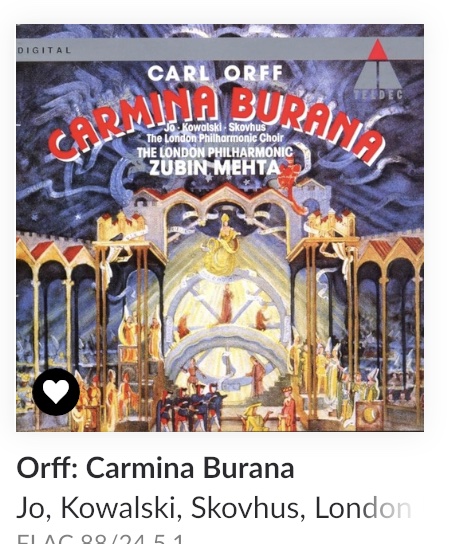
Zubin Mehta and the LPO plus LPO choir. A bit extreme in terms of dynamics, orchestra sound spanning from broadest fff to sugercoated pp, at times almost cliché-like Sforzati effects. Choirs are excellent, powerful, precise and full of humor without ever showing a hint of shouting (at times they deliver this impression of listening to the Comedian harmonists). The star in my understanding is baritone Bo Skovhus. Have neither heard anyone that versatile and intelligently dealing with the challenges, it is a delight.
Have to get used to Jochen Kowalski (who was the best countertenor I have ever heard live) who is (staying in his countertenor registers) replacing the tenor. It is just one part of ´In Taberna´, but it sounds pretty unusual, combined with the sweet and spheric soprano of Sumi Jo giving a certain impression of heterogeneity.
Another recording from my limited digital collection stands out and I think it will become my personal favorite:
Simon Rattle with the Berliner Philharmoniker and the Rundfunkchor Berlin (one of my favorite choirs of all, and I am pretty picky with choirs).
This is the big show from the very first note, explosive, rhythmic and thrilling, a bit Stravinsky-like. At times too much of instrumental show-off but it cannot get any better in terms of orchestra and choir acting as a unit. Christian Gerhaher sounds a bit more serious and operatic than Skovhus but he is really mastering the falsetto parts as well as the a cappella dialogues and declamations. Much much better than Fischer-Dieskau although he in some passages is resembling the declamation technique of the latter.
Choosing an haut-contre (Lawrence Brownlee) turns out to be a brilliant decision as he is exactly hitting the (in my understanding) desired tone between what you expect from a tenor and how he sounds when being constantly pushed way beyond his tessitura. Soprano Sally Matthews is maybe not sounding as sweet and angel-like compared to Sumi Jo, at bit out of her comfort zone at times, but still very good.
Really enjoyed listening to that very homogeneous and precise recording. Purists may despise it as it at times sounds a bit Hollywood-like, more John Williams or Howard Shore than Carl Orff, Rattle is pretty extreme with his own understanding of changing tempi, excessive use of accelerando and at times the big choir scenes sounds rushed.
Ormandy is available on Tidal/Qobuz, with a variety of masterings and cover art.
does the Penguin Guide still exist?
@woodford, Last Penguin Guide to Recorded Classical Music edition was 2010.
Was a great resource. Nothing quite like it anymore. The trade magazines are not exhaustive and have, shall we say, interests.
Hard enough to keep track of all the classical music recordings being released, for which I use
https://www.importcds.com/search?mod=AC&ex=New%20Releases#!?pagenum=2
One of the best places I’ve found to obtain disinterested pointers to wonderful recordings with varying degrees of commentary is right here on this Roon Music Blog thanks to folks like you. I’ve rarely been disappointed (more a reflection on me) and often had my listening skills and depth/range enriched by recommendations made here.
Thank you to all the contributors and the most gracious hosts for this wonderful resource.
@Arindal Thank you for the vocal performance-focused recommendations. Loved the Sforzati mention. Some Italian music indications are an enjoyable puzzle to this old dog.
I am on the older side, and have a belief that most of the best recordings are from the past. BLASPHEMY, I know  ! I recognize that this is not a universal truth, but, well, it’s arguably quite true for rock & pop music, and in my book, there’s a lot to be said for the 50s-70s in regard to discipline in the performance of classical music, and for the 80s in regard to period instrument recordings.
So, a Penguin Guide from 2010 is going to go a long way toward helping distill the best from decades of those superb recordings, and shouldn’t be completely irrelevant anytime soon!
I am completely neutral when it comes to choosing either recordings from the analogue or the digital era (monaural or full of noisefloor I despise). There is great and there is questionable stuff from all decades. Comparing them side by side often reveal some interesting details and might bring me to a surprising decision. Since I do not have a streaming service attached to roon anymore, I tend to recommend more of modern recordings as they are the majority in my library and well-curated.
I did some side-by-side comparisons and found no tendency hinting to this period when it comes to discipline. I know all the legends about the half-god-like conductors of that era and their sheer presence bringing discipline to the orchestra. Never found any proof of that, in contrary many of the classic recordings from the 1950s and 1960s are rather conducted in a style I would not call discipline. Many might deliver a broader, richer sound of the orchestra, full-bodied choir sound and soloists giving their maximum - I guess this was just in fashion and I do not think this is the perfect fit to most of compositions being popular these days as much as today.
I would not overstate the wave of historically informed recordings in the 1980s. It was quite relevant for sacred music and indirectly influenced the preferred way of singing as well as choosing faster tempi, but I would not call it a mass phenomenon.
Had both the Penguin and Gramophone guides from around 2005 but they kind of lost their purpose for me. Too many very good recordings were released after that date, and I had the feeling that many editors are biased towards the heroes of the past (not as much as other guide like the Harenberg series which is really terrible in that regards).
As the utes might say, “Based”
You just taught me something. 
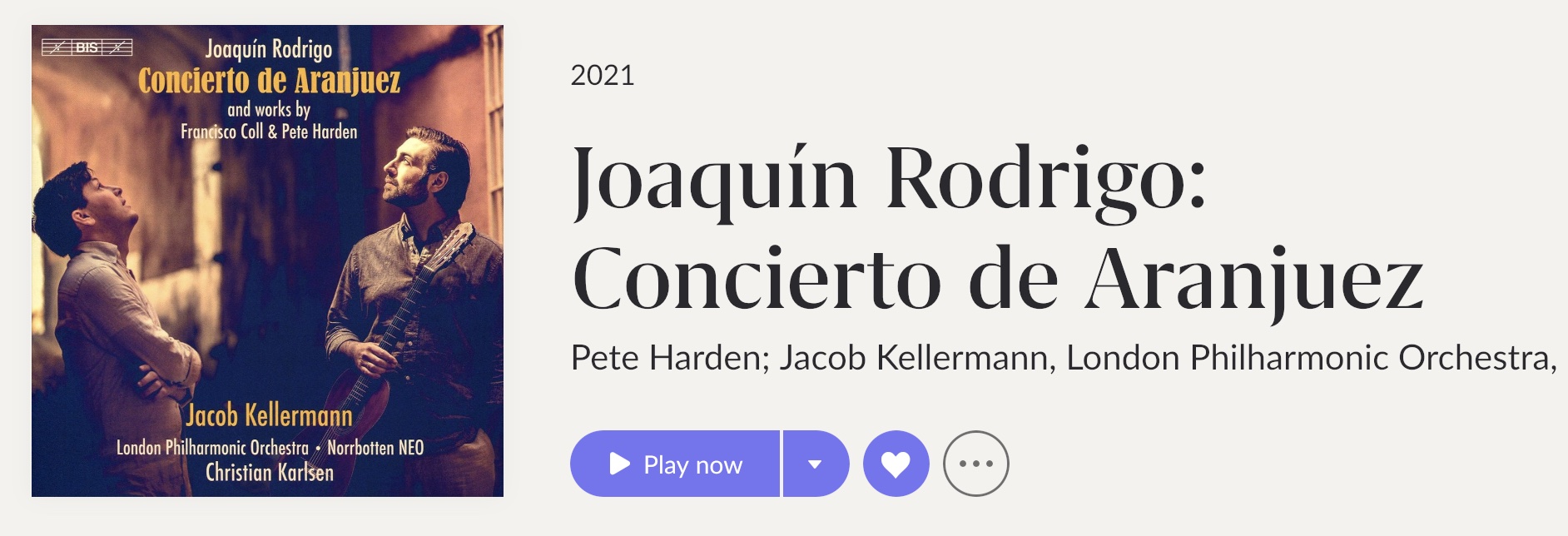
An album I discovered via eClassical and which I can highly recommend:
Okay, probably most of you have several versions of the ´Concerto de Aranjuez´. This one has more street credibility, sounds more vital, more folky, flamencoish, jazzy or show sound-like from both the soloist and the orchestra than others while retaining a classical manner of respect to the orchestration.
These are quite good too, although I slightly prefer the Wurtz recordings I posted previously.