[Moderator edit: Off topic discussion split out to own topic]
—————
Earlier this week, I added a switch between the computer running my Roon core and my Airlens streamer, which is 10’ away. The local switch has an uplink to a switch in another room, but the only two other devices on the local switch are my computer and my streamer. I noticed an unexpected and very welcome improvement in sound. Better bass, less glare(!) and a slight improvement in sound stage. I can’t explain this, but I trust my ears (as I have since I was gobsmacked to hear the difference a RAL prophecy I2S cable made between the Matrix reclocker that preceded my streamer and my DirectStream DAC.) Previously, my computer and my Airlens were both directly connected to the switch in the other room by longer runs of in-wall ethernet cable (CAT 6). I can’t explain why it sounds better, especially since the Airlens has galvanic isolation. Maybe it has something to do with electrical noise. Maybe packet ordering, although that shouldn’t matter. I was so impressed that, two days ago with the encouragement of ChatGPT, I took a flyer on ordering Belden bonded CAT 6 UTP cables to replace the connections near my stereo equipment. It will be interesting to see if that causes another incremental improvement. (Fwiw, I spent my life in the computer industry and used to be in the bits-is-bits camp. My earlier self would scoff at me today for upgrading my cabling!)
Your “better bass” observation should be easy enough to test with something like REW and a relatively inexpensive microphone, should you be so inclined. It would be a monumental fact if proven true since almost all of your tweaks have no impact on audio sound quality. I qualify with “almost” since some replaced component might have been defective.
Occasionally I like to mention the “effective altruism” movement that optimizes charitable giving to maximize the impact of giving money to achieve the most good. A corollary to that is some kind of minimalism that doesn’t spend money on stuff without good reason. I am both a failed minimalist and failed effective altruist myself, so I’m not trying to be too preachy, and buying little audio tweaks is clearly only harmful when subjected to microscopic analysis, yet I do hold that we should collectively strive towards understanding the difference between real value and irrational whims when and where we can! There’s at least consistency and some beauty in that…
Thanks for your thoughts, Mark. I agree, it would be interesting to run that test, but I’m not that concerned about measurements anymore, so I think I’ll save the time. At 66, I’ve learned to mainly trust my ears. What put me over the top was the completely inexplicable (to this former computer scientist) yet unmistakably significant improvement I got from replacing a single digital cable. Digital! And my wife heard it too! My brain didn’t concede this battle easily, but as Hamlet said, “There are more things in heaven and earth, Horatio, than are dreamt of in your philosophy.” I have reluctantly concluded that my bits-is-bits thinking hasn’t serve my ears well over the decades.
I don’t find your comment constructive, Suedkiez. Look, when I first started down the bits-is-bits path in the 90’s (or was it the 80s?), I didn’t appreciate the importance of jitter. Now it’s widely accepted and measured. More recently, I realize I’ve been underestimating the importance of noise, and apparently there are different kinds of noise. The fact that I can’t explain something or that the industry hasn’t thought to measure it doesn’t mean it doesn’t exist. I think my audio experience would have benefited from a little more humility when I was younger.
Well, you not understanding it doesn’t mean that engineers and scientists don’t understand it up to and including the limits of measurements. So when you are informed that it is highly unlikely that cables–especially digital ones–impact sound quality because of both well-understood theory and comprehensive measurements by scientists and engineers, you can take that as a good working basis for further conjectures.
Well if I was a computer scientist and a cable in an entirely digital connection changed the sound, I’d sure want to know why and I’d have the means.
As you surely know, jitter is entirely irrelevant on Ethernet assuming sufficient buffer size.
Edit: And FWIW, I find „I am 66 and I trust my ears, a digital cable changed the sound and you have to just believe me because I was a computer scientist“ not constructive either. In particular if the thread is about solving technical connection problems, not esoterics.
10 Likes
Torben_Rick
(Torben - A Dane living in Hamburg - Roon Lifer)
8
The only thing that is relevant is common mode interference.
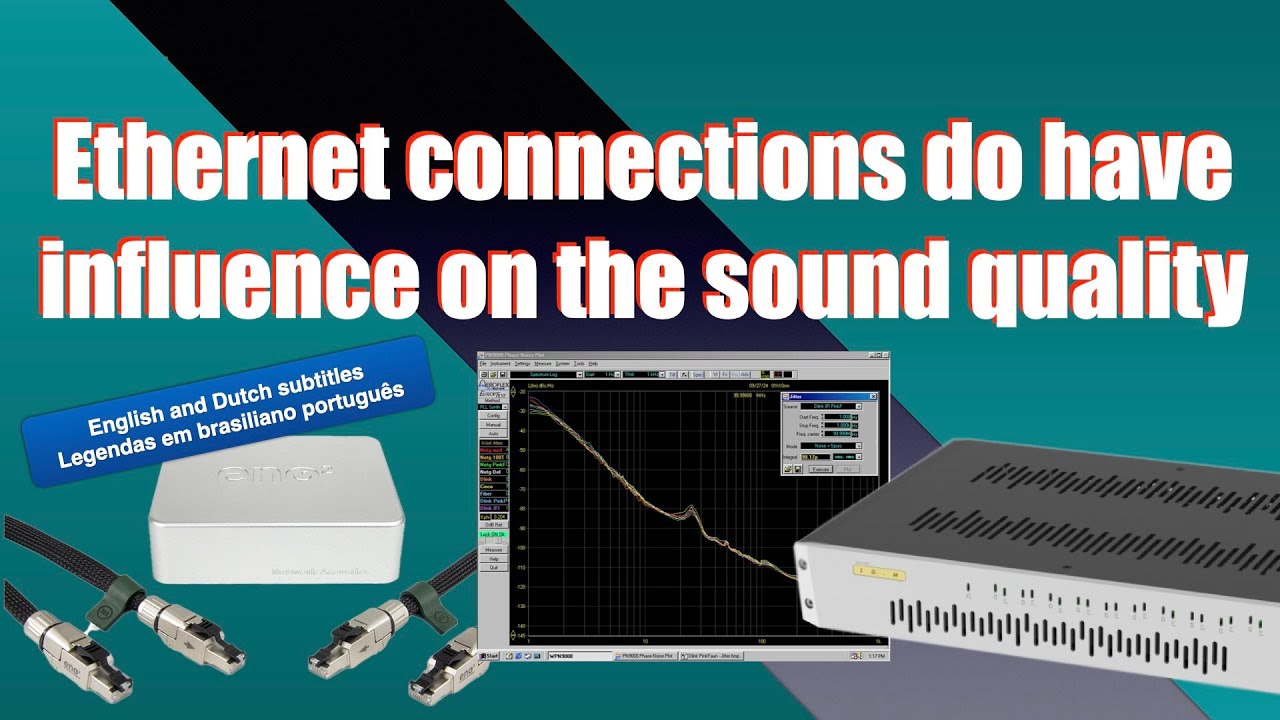
While quality power supplies and dedicated audio-grade components certainly play their part, the fundamental design of standard Ethernet networking provides a significant and often underappreciated contribution to achieving a clean, noise-free audio signal from your DAC.
There are a couple of contradictions in Hans’ video. First, he acknowledges that asynchronous digital connections should not be subject to jitter. He even notes that good clock sync engineering can eliminate it for non-asynchronous feeds. He then points to results of a specific streamer/DAC that was influenced by timing via the ethernet connection (apparently violating the good engineering principles he admitted helped to eliminate such issues). Finally, he points to the sensitivity of clock crystals to vibration as a final, somewhat unrelated point.
It’s both a bit contradictory at the front end and also fails to pass the audibility threshold test that he brings up. We know from measurements that jitter results in specific patterns of distortion. There are even specific test procedures for the Audio Precision products for jitter. And we also can see when jitter rises to the level of audibility.
So, in combination, we can’t really trust his broad claim that these phenomena are audible except when they rise to such a level.
It’s a shame Hans has never (ever) powered up any of his own measuring equipment that he keeps in the background in order to make his opinions appear “scientific”. Instead he shows PowerPoint slides and the measurements of others.
I spent 10% cognitive attention on Hans’ claims all afternoon and I’m still baffled at how he thinks jitter arrives in the streamer/DAC. If jitter is disrupting the communications on ethernet and overshoots any buffering, then there is packet loss, retransmission, etc. But I think he’s conflating that jitter with the jitter that occurs during reconstruction of the analog audio signal within the DAC, which can be caused by things like using S/PDIF or other clock-sync protocols. That’s what Jaap is measuring and is the usual beast. Hans seems to understand that sometimes but at other times seems to bounce between ethernet filtering and the DAC jitter. Moreover, though timing issues are causal for jitter, the result of it is a spray of distortion components in the frequency domain. It has a particular pattern of clustered, descending-intensity offset components. It’s also easily measurable and rare in SOTA DACs these days.
As you’ll see, if you follow the previous link, the “philosophic burden of proof lies upon a person making empirically unfalsifiable claims, as opposed to shifting the burden of disproof to others.”
I watched the video that @Mr.Flibble shared. It’s fascinating. He asserts that we can’t be burdened with the cost and complexity of double-blind testing and then proceeds to demonstrate how a man on a mission to prove that ethernet cables differ in “sound quality” spared no time or expense on his quest. If you’re on a witch hunt, you’re going to find a witch. Similar methods can be used to prove that vaccines don’t work, the earth is flat, and humans never landed on the moon. In this case, an oscilloscope is used to illustrate that if you thump on some sort of enclosure, it will react. This is junk science at its finest.
Skeptics should note that the internet at large isn’t in constant discussions over the impact of ethernet cables on the quality of emails, digital images, files, voice calls, Netflix streams, or anything else. Every moment of our waking lives, we depend on, and take for granted, that data travels thousands and tens of thousands of miles to and from our computers and phones without being impacted by the cables on which it moves. The underlying protocols are reliable and self correcting, though systems can suffer from reliability and availability issues, which is a different matter altogether.
We spend too much time on this forum trying to protect vulnerable people from being taken by scammers selling gear based on bogus claims. It’s akin to trying to teach your mother-in-law not to click on Social Security scam emails. Unless Roon takes a stand on it, which they won’t because their partners sell this stuff, this problem is here to stay.
Why do you think @Robert_Holbrook has any “burden of proof” at all? He is sharing his own experience and his own conclusions. He is not insisting that you share them.
Most people purchase stereo equipment based on how it sounds to us. Measurements can be useful but they don’t tell us definitively how a given piece of equipment will sound in our system in our room.
If you think someone is selling snake oil, by all means don’t buy it. But Robert isn’t selling anything here.
I believe it has been made quite clear here that since the reviewer in question has some good things to say about Roon, he is off limits to any criticism even though he has not been factually correct about anything in his entire career.
But they do have very high predictive value, unlike brand names, price, or or claims from youtube shills.
A lot of people here may not be selling snake oil per se but rather trying to justify buying it to themselves.
Because he is making a claim that has no objective foundation, and basing it on other false claims, e.g. that jitter is somehow important to the digital transference of data.
And, by extension, suggesting to others that there may be good reasons to buy this stuff … when there is absolutely no objective evidence to support any of the claims that are made.
Why it is of concern to you, how another person justifies their own purchasing decisions, is truly beyond me.
Not to mention your “by extension” reasoning. I shared a review of the MBL C 41 streamer. If you think “by extension” I was suggesting you or anyone else should purchase it, you are entirely mistaken. I haven’t even decided that I should purchase it (if I could find a way to afford it).
We are not discussing matters of public policy here. How individuals decide to build their own stereo systems and how the music through those systems sounds to them does not require correction by others.