If that’s true, what do we need MQA for? High resolution PCM is “lossless” in both of the senses explained above…
5 Likes
That’s nonsense, with MQA you do get what you started with, the numbers are a means of achieving this. It’s all about analog sound.
1 Like
If its all about the analog sound, whats it doing in the digital domain? Hopefully absolutely nothing that anyone would notice, and therein lies the problem 
4 Likes
In the modern world, you have to deliver analog music (all music is analog) down a digital pipeline. This needs to be done with as little harm as possible to preserve the analog sound. This also needs to be done in an efficient way without losing sound information.
This is what MQA was created to achieve and its my opinion that they have succeeded spectacularly with the goal.
1 Like
“Music” is neither analogue nor digital. Recording technologies and music (re)production technologies are.
5 Likes
Not sure how your ears work but even if you use brain conduction, sound perceived by humans is analog. Speakers produce analog sound waves, that makes it analog. Digital sound would be something like the DTS stream hiss and although not Music as such, the sound is analog if you can perceive it.
You could say music is an out crop of thought and if written down, remains just that until interpreted by a person with an instrument or instruments to create sound we call Music. That’s analog.
If composed whilst noodling on an instrument without being written down, it’s thought provoked analog sound. It could even be called music dependant on the skill of the individual. Hmmmm
1 Like
Chris, the problem is your post touches on an extremely wide range of topics/phenomena – such as sound production, sound recording, sound reproduction, sound perception, physical characteristics of sound, music composition, musical notation, human thinking and creativity etc. You can’t just lump all these things together. The distinction “digital vs. analogue” is NOT applicable to all of them. Neither is the term “music”.
7 Likes
British English spelling! 

Yes, but there are “analog” clocks and watches – even in BrE.
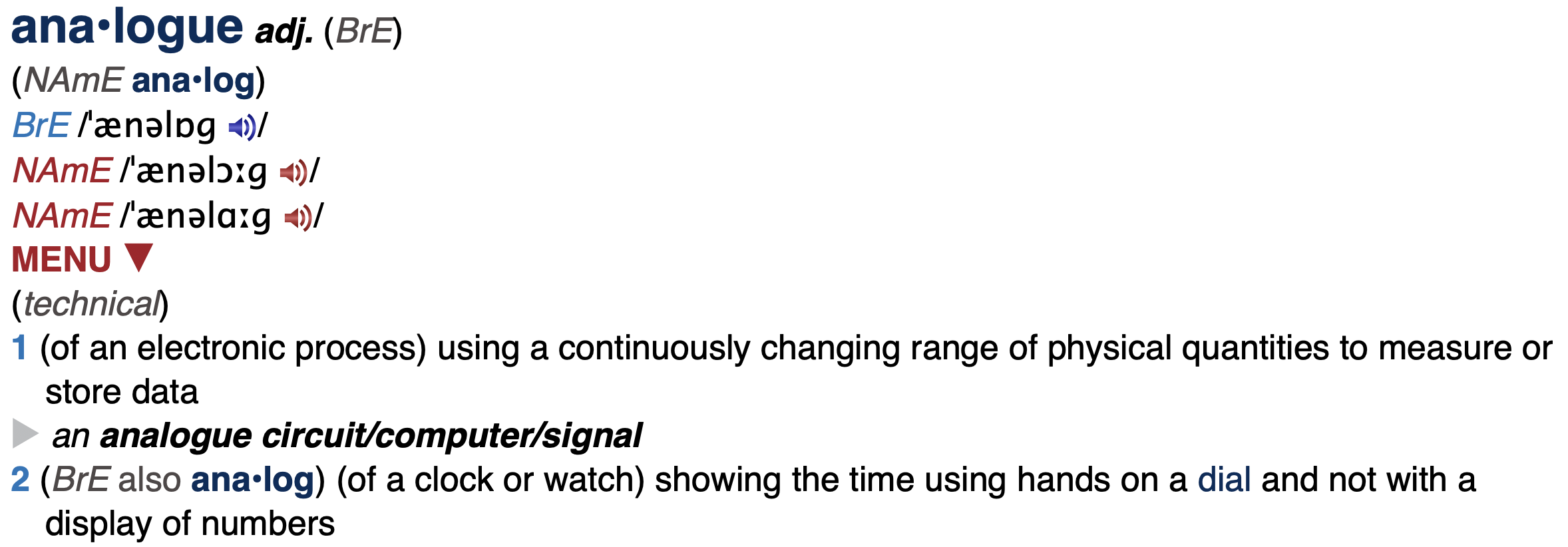
(entry from Oxford English Dictionary)
We all know what we mean by analog in this context. Sound waves traveling through air.
Even mastering engineers will use headphones or speakers to make a judgment on the result of any amount of digital manipulation.
If that were true, people here wouldn’t keep asking you what you mean by “lossless in analog terms” etc. The way in which you use the words “lossless” and “analog” and “musical information” etc. obviously differs from the way (most) other people use them.
5 Likes
I don’t think most people is accurate at all, I think most people fully understand what I am saying and meaning. Others choose to deliberate miss understand for their own motives.
Still, it’s all part of the cut and thrust of an audio forum.
I can only speak for myself. No deliberate misunderstandings here. Although English is my mother tongue, I’ve never heard, read or said things like “analog sound perception” or “lossless in analog terms” etc.
4 Likes
Well, all the words are in the dictionary and there meaning in relation to this subject are not hard to decipher.
Analog sound perception, that’s the perception of analog sounds. Perhaps the use of analog is unnecessary as all sound is by default Analog.
Similarly, Lossless in analog terms means that no analog information, sound you can perceive, is… lost.
Lossless is a term from digital data processing and is now used in a misleading way to substantiate an assertion for which there is otherwise no evidence.
Welcome in the world of alternative facts.
Well, you could compare what goes in and what goes out. Then subtract the difference if life isn’t short enough.
Lossless is a word that can be used in any context as far as I can see. The meaning is simple enough to grasp. Here is the news, language constantly evolves or maybe we would all still be speaking Latin or Greek. Welcome to the evolution and the new paradigm of MQA
Lossless, losslesser, the losslessest?  The word “lossless” is a non-comparable adjective. In other words, if something is lossless, it can’t be “lossless in analog terms” only. Lossless is an either-or kind of thing…
4 Likes
Very good, but it gets us no where and you know what I mean
I am not personally knowledgeable of the intricacies of lossless. To me, what is important is the audible sounds emitted by my speakers are the same as the audible sounds entering the microphones when recorded. As far as I know, MQA accomplishes this.
3 Likes
I fully agree with your reasoning, @Alan. But just because MQA is lossy, digitally speaking, doesn’t mean that all MQA albums sound bad (to my ears). I know some MQA albums that I really like a lot. I usually prefer HiRes PCM, though (i.e. if I do hear a clear difference, which I often don’t, to be honest).
5 Likes