With SDM, try:
1x - poly-sinc-gauss-long
Nx - poly-sinc-gauss-hires-lp
4 Likes
Same here - dropping out after ~9 sec - however, am using poly-sinc-gauss-long.
If your using a pc you could add an older titan x which has a compatible compute version and 3072 CUDA cores for a around $500 on Amazon. The CUDA offload can help handle the modulator and convolution load which usually frees up enough cpu cycles to prevent dropouts.
You could also go to a gtx 1060 or 1080 for about the same cost, they are newer cards but they have fewer CUDA cores. Even the rtx2080 has fewer cores (2944) and is going to cost at least 250-300 more than a titan x if you find a good deal on amazon.
I’m not sure how much of a role the compute version plays into the performance.
@jussi_laako Do you know how much (if any…) the compute version plays into the performance of CUDA in hqplayer?
Performance has been improving on each generation. Not entirely clear why, because the dirty low level details on the GPU behavior are pretty much secret on Nvidia side. They don’t document how certain CUDA operations relate to the hardware features.
One thing they have been improving over time is multitasking capability of the GPU and it’s “OS”. HQPlayer uses this heavily too. Another area they’ve been improving is the “unified memory” access over PCIe bus. Usually each generation brings some 20 - 50% speed gain over the previous.
Another thing that changes for certain models is the single vs double precision floating point performance ratio. In normal situation (like Intel/AMD CPUs) this is 1/2 according to the size, so double precision is half speed compared to single precision. However, on most Nvidia consumer cards this is 1/32. On some professional and data center models they’ve been maintaining 1/2 ratio. HQPlayer uses double precision floating point, so this matters. However, this is not as simple and straightforward as it may seem.
In any case, there are many unknown performance factors. So only testing will tell you how things perform on HQPlayer workloads.
1 Like
Thank you.
I’ve been searching the forums for hours, but can’t find a clear answer to:
Has anyone achieved DSD512 with their M1 Pro using a Pi 4 with RopieeXL + HQP Naa? If so, then what filters and modulation are you using?
I’ve been trying and even though the processing isn’t more than DSD256 when I look at the activity monitor, it results in intermittent playback. I can however still run DSD256, but then I’m not taking advantage of the NAA setup. I’m wondering what the lowest CPU load filters and modulation could allow for DSD512 playback. Also wondering if this is only achievable on a PC with high end hardware and Nvidia GPU or what.
1 Like
When you have drop-outs, you cannot trust the load figures anymore. But if you look at load of DSD256 and double that, you get the level DSD512 would take.
1 Like
Lately I’ve been enjoying poly-sinc-gauss-hires-ip.
Here’s my signal path:
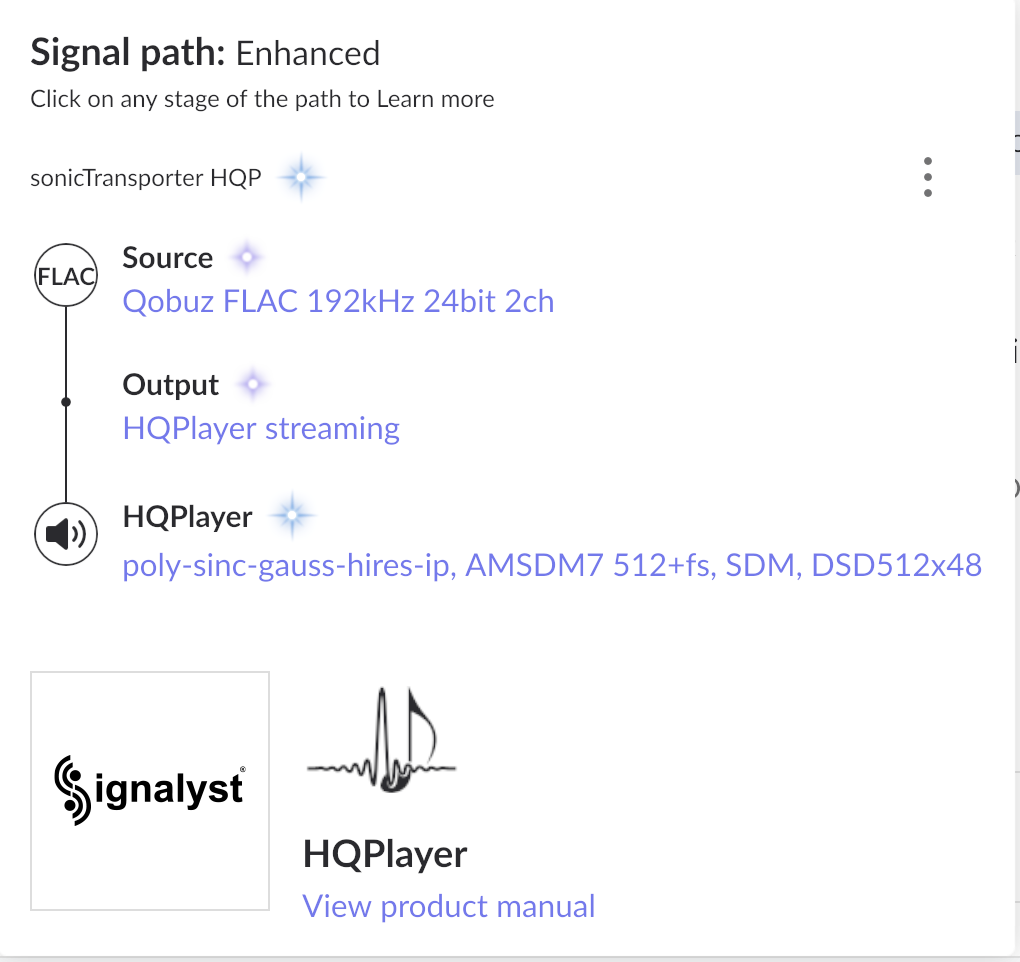
sonicTransporter i9 running Roon Core + HQ Player >
ultraRendu NAA >
Matrix Audio Element X (USB input) >
Benchmark AHB2
Ive just added 2 “better” ethernet cables to my chain and its amazing that these small changes have an effect on what you actually hear.
So adding these, I found that the “gauss” settings I was using sounded wonderfully wide and clear however it lost the punch of the kick drum.
Trying a few different filters, I found that IIR was great but lost the air and space that that the gauss filters had.
So, after experimenting (and I dont think these really should fit as a combo) using 1x filter IIR and nx filter poly sinc gauss hires lp NS15 at 384 kept the punch of the kick and had the space and air I wanted from the xla/hires filters
Now, im not suggesting this would be good for anyone else , however I found this to work very well in my chain…
SOtM Cat 7>SOtM Switch>SOtM Cat 7>Antipodes CX>SOtM Cat 7> Antipodes EX>HiDiamond RefUSB> Aqua La Scala Optologic MKII DAC
My ears suck…
Somehow, with the help of my wife, who has better ears than I, and my youngest son, who has yet better ears, I’ve come up with this:

2 Likes
These are shielded cables right with metal connectors?
Do you have a multimeter with continuity test feature, to see if there is continuity between 2 end connectors?
For any Pontus II owners, or even more specifically Iris / Pontus (i2s)
Have you tried PCM 768k - Sinc-Ll + LNS15 (Pontus set to NOS)
Couple of thoughts on this specific to the Pontus II: PCM is 24bit R2R ladder while DSD is 6 bit 32 step FIR filter. It would seem PCM would be the clear choice here to best utilize the hardware of the DAC. To my ears this is why native PCM sounds so spectacular just letting the Pontus II do its thing in NOS mode without HQP.
Also worth noting 768k is my limit on PCM output when using the Iris DDC over i2s, I would expect the above to hold true for owners of the Pontus II that could do PCM 1536k as well.
@jussi_laako thoughts? Am I off base in my thinking on this one? Is PCM better than DSD for Denafrips DACs? (Its not as clear of a choice as say Chord DACs which convert DSD to PCM but it seems that PCM would offer some benefit over DSD on Denafrips DACs based on the architecture of the DAC)
(Also worth mentioning, previously I was using DSD 256 - gauss-long (1x) / gauss-hires-lp (Nx) + ASDM7ECv2, and so far the PCM settings above are a dramatic improvement, more punch, better timbre and air, overall more analogue sounding than DSD)
1 Like
The Pontus does not have a real NOS mode. It uses some kind of linear interpolation filter so it is not NOS.
Yes, I realize that but its not relevant to my question so I made a concerted effort not to include it.
It’s relevant in that it might explain why you think the DAC sounds better not using HQPlayer to upsample and filter.
I never said it sounded better without HQPlayer. I said it sounds great just playing PCM files and letting the DAC do its thing (utilizing the 24 bit R2R architecture of the PCM ladder) I have been upsampling to DSD256 (which uses a 6 bit 32-step FIR analogue filter) but think upsampling to PCM would be the preferred option on this DAC because of the architecture of how PCM is handled versus DSD.
Well, what does sound better to you? Maybe you should pick whatever that is….
I already addressed that, PCM upsampled to 768k sounds better to my ears than DSD 256, and its what I am currently listening to (both sound great but I would give PCM the edge here. I’ve been using DSD since I installed HQP for multiple DACs). I’m not asking for a recommendation on my setup, I’m trying to understand the mechanics of why either PCM or DSD would be preferred in a Denafrips DAC due to their architecture, its why the question was directed at Jussi.
Happy listening!
3 Likes
Not very clear which one is better. But if you run it in PCM mode, set DAC bits to 16.
1 Like
Thanks for your input. I have a Pontus 2 as well. Been using the same DSD settings as yourself. I occasionally go back briefly to PCM once in a while. I think it depends on your ears and system. I don’t notice a dramatic difference between the two, either sounds good.
1 Like