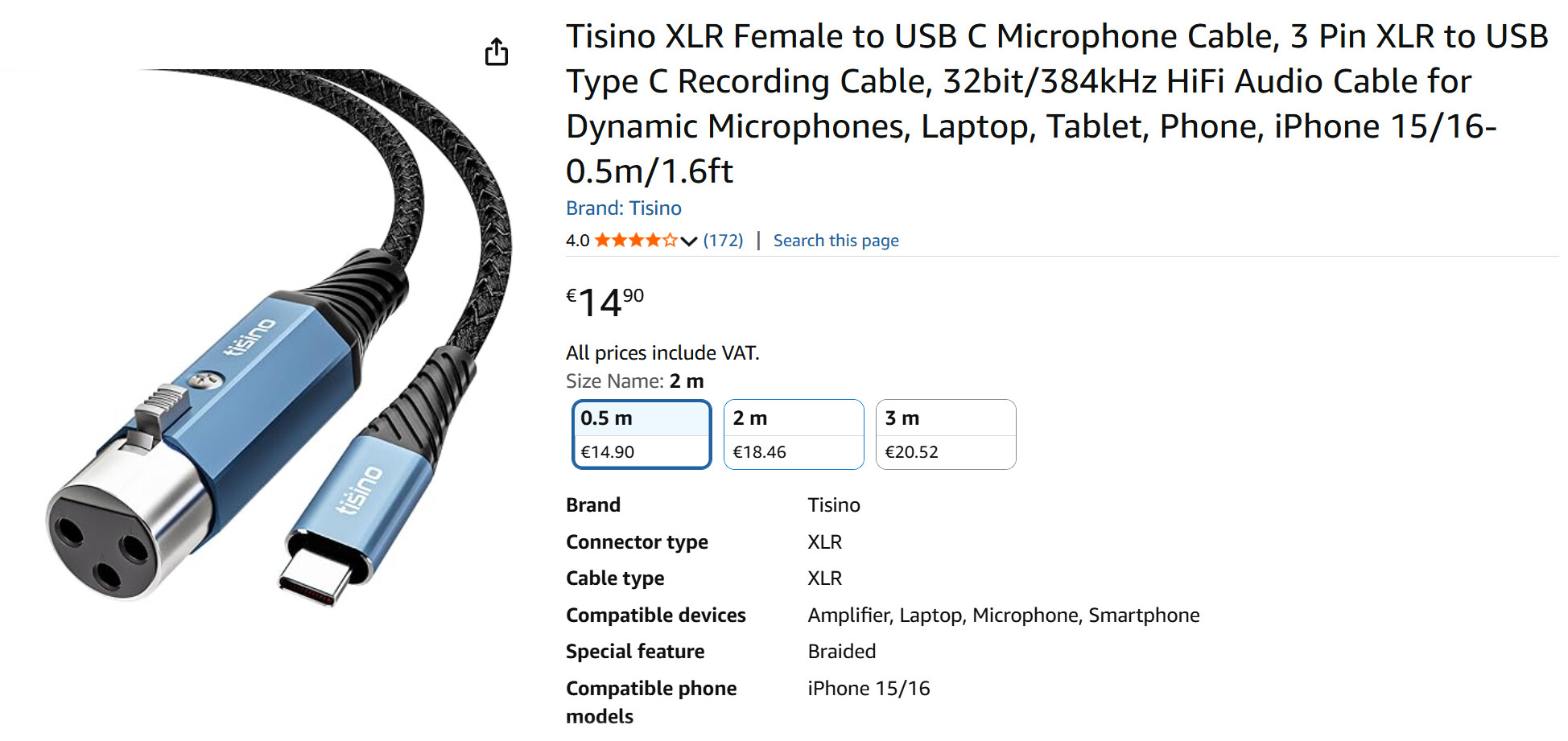
I want to buy a cable to connect my Raspberry Pi 4 to my power supply with XLR outputs (HDPlex). This cable would have an XLR female connector on one end and a USB-C connector on the other. I saw a cable on Amazon, this one:
Now, this is intended for connecting a microphone to an audio device, whereas I want to use it as a DC power cable. Is that possible, or will I damage my Raspberry Pi?
Thanks for advice, Bert.
mjw
(You want nice, supportive? Call a damn helpline.)
2
Don’t use it!
First, the cables will not be rated for power delivery, but a microphone, and second, the interconnections are unlikely to be correct.
Moreover, for a Raspberry Pi power delivery is important, and using a correctly rated power supply, such as the official one, is crucial.
Please confirm the make and model of the PSU you intend to use.
In the meantime, I have ordered a DC cable from Ghent Audio specifically for my HDPlex PSU (5V 3A) XLR output and the USB2-C (5V) to the Raspberry Pi. I think this will work just fine.
mjw
(You want nice, supportive? Call a damn helpline.)
6
This doesn’t meet the minimum requirement for a Raspberry Pi 4/5, which is 5V/5A.
It may work fine, but you may also experience playback issues including pops and clicks.
Actually, I am running 3 Raspberry Pi 4b’s using the official Raspberry Pi Power supply (UK model) which is rated at 15W (5.1V x 3A). The requirement that you quoted (5V 5A) is only for the Raspberry Pi 5.
The specs for the Pi 4 power supply (from ThePiHut.com):
I use this Raspberry as a NAA (network to digital audio signal converter) , which places a fairly light load, less than 10W, and therefore the PSU provided 15W is more than enough power.
For the Raspberry Pi 4, with no hats (or even with a low power hat) and not being asked to supply lots of power to a USB connected device, 15W is, as you say, more than enough power when the Pi is in steady state operation and is normally enough even to cope with peak loads (exceptions can occur if multiple HATs are used all drawing power from the power USB 5V supply). Thus, your HDPlex PSU should work.
However, there may be other issues at play that could affect you ability to use that power supply. I have a mains socket with a 5V 3A rated USB power socket built in which should be good enough to power the Pi 4. However, in practice, the Pi will not boot when powered from that socket presumably because the voltage/power stability on first connection is not stable enough. The power light comes on, the SD card indication light flickers once or twice and then the Pi powers down. Thus, I assume, the dynamic behavior of the power supply is import as well as the static power delivery.
When choosing a power supply, you still have to bear in mind that even if, when in steady state, your PI may only drawing 5W or less, it still has to cope with higher peak loads - for example, on power-up. If the power supply is OK for the steady state load but not adequate for the peak loads that may occur during power up or maybe at other times, then your Raspberry Pi may be unstable or, in the case of power on, fail to boot. Thus you should always use a power supply of the recommended power capability.