And list the errors? Otherwise it is a bit wishy washy statements
The Cosmos ADCiso has been checked against an APx555
Ultimately if my multitone shows 120dB clean signal range (just an example - same logic applies to every measurement) I conclude that the DAC is at least this good. ie with a $30k or $100k analyser the DAC could even be better than I am seeing
Its all a bit cryptic which makes technical discussion quite confusing.
Anyway for the measurements I do it shows differences between DACs in great resolution between DACs (for those measurements).
I can see the differences between a D200 and AH90 and Spring3 - for those measurements
I have a friend in Japan with APx555, we are in an international whatsapp group of DSD Direct DACs enthusiasts and he did set of AH90 measurements with APx555 (same measurements I do, same test tiles) and get same results as my Cosmos ADCiso + Scaler combo under 100kHz - he is quite shocked given price difference. I’m pretty happy with that
I guess my measurements are riddled with issues and in future I’lll just keep my future measurements to our whatsapp group general users here can trust the DAC marketing and their ears
Yeh over the last 10+ years these are mostly the same category of measurements you’ve been posting.
I doubt you think they are useless otherwise you’ve been posting useless content ?
In addition to your Pico and IMD and 1kHz and J-test plots you’ve shared, I’ve added a few more “inspired” by ASR, with multitone and IMD vs level, one of the more interesting ones.
To me if a DAC nails all these , it correlates to great sound quality (in my personal experience).
To write it another way : I’ve yet to have a DAC that nails all these and sounds crap
So in that sense, the Cosmos combo is quite excellent. I Can’t see a long list of “issues” and “errors” for this set of measurements, the same you’ve been sharing publicly for so long?
The original Cosmos ADC that you have as bigger ESS IMD hump than the negligible new ADCiso. One reason I will redo some of my measurements. Cosmos Scaler fixes the impedance issue. As long as you use it correctly, use a powerbank to power Scaler and separate powerbank for ADCiso , per the designers recommendation
I have full understanding for Jussi not sharing the intricate details of his measurement suite. After all he is the developer of HQ Player, a commercially sold product. It cannot be expected of him to share his IPR that forms an essential part of his product. Jussi has been extremely helpful in this forum. In my view it is fully up to him to chose to which extent he wants to disclose information.
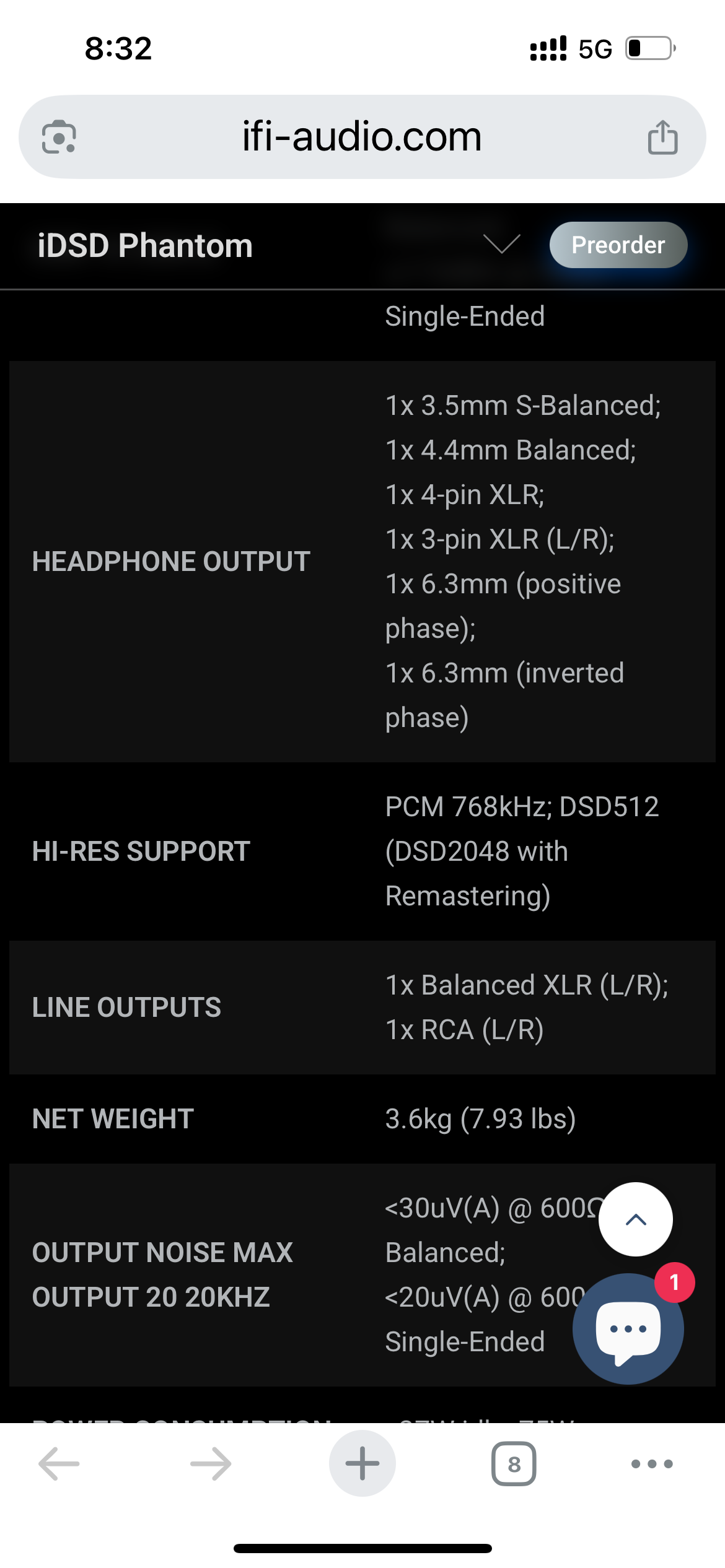
Maximum inputs it can take are 768k PCM and DSD512 though. It has some internal upsampling to “DSD2048” which in this case means it is running four DSD1793 DAC chips at DSD512 in interleaved mode. This is same way they did “DSD1024” earlier.
Accuphase has been doing this interleaving approach for at least couple of decades. They do it also in the DAC-60 card.
So the “DSD2048” in this case is not useful in scope of this thread (as it is supported input rate nor native).
What is the best way to determine how many bits to send the DAC? I have a Fiio K11 R2R, which recently got an update enabling native DSD support. I currently have the Bits settings at “20”, but I have no idea if that’s optimal.
The setting is only relevant for PCM output mode, it doesn’t apply to DSD outputs.
The way to determine initial value is to check linearity sweep measurement result and find the place where it begins to deviate from straight line, and then convert the dB value into corresponding word length (bits). Then the exact value can be iterated further by playing sine at -120 dB level and looking at the THD measurement results. There shouldn’t be any harmonic components present and level of the fundamental should be exactly -120 dBFS.


 My MA RX8 are saying thank you