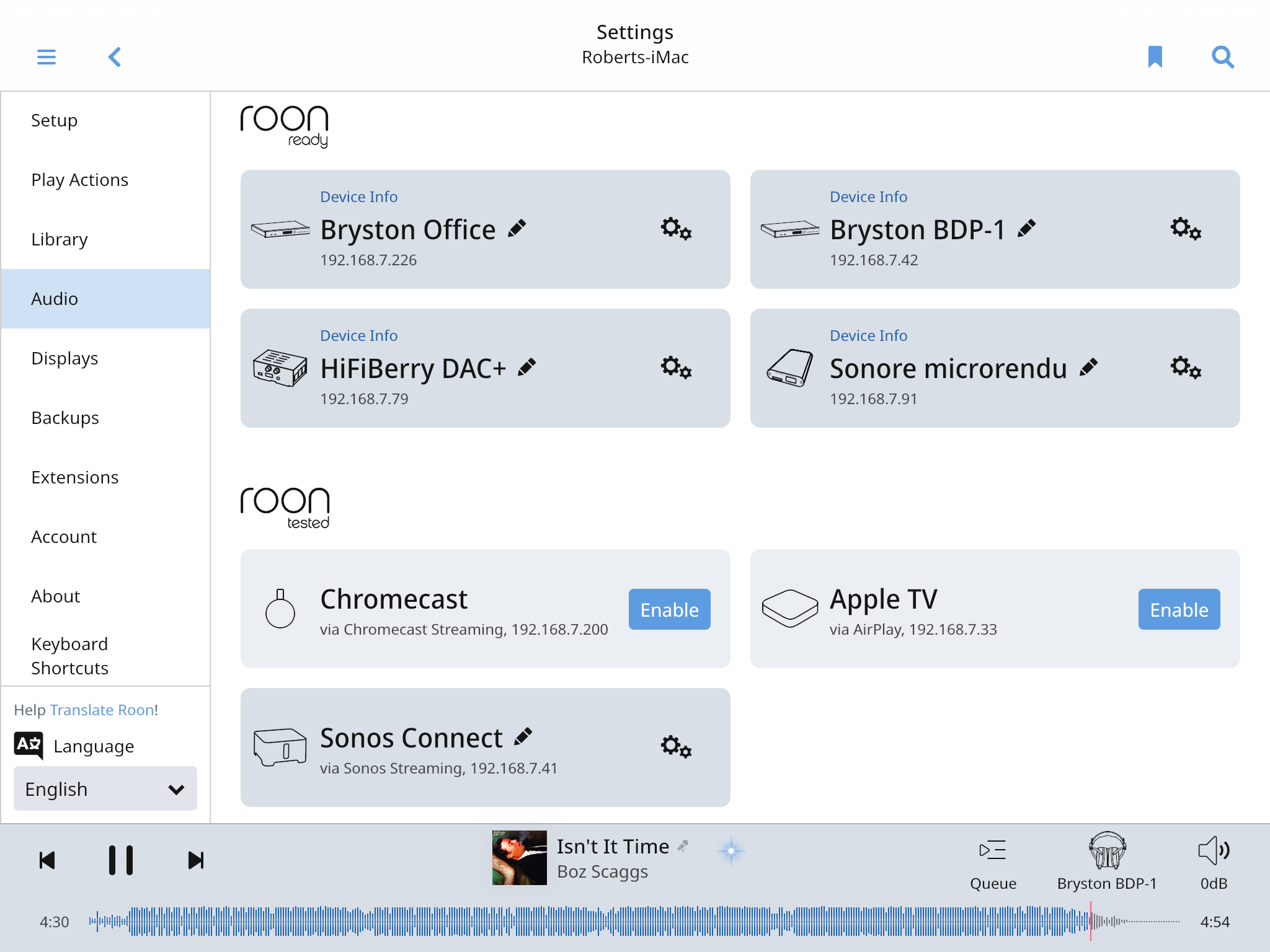
My first post here - I started using ROON about 3 months ago and I like it much. I am looking for advise for my next move - opinions are for sure very welcome.
i would like to add a seperate end point but I am not 100% sure of what I want. I am currently using a NUC i7 (7th) with ROCK that drives my Audio Alchemy DDP-1 (USB connected). I would like to move the NUC to another room, which means I need an endpoint. My natural choice would have been a used Audio Alchemy DMP-1 (despite it is a bit old) but it is almost impossible to find on the used market. In the context of saving on $, I am considering a used Bryston BDP-1. Since the heavy listing would be done by the NUC, would I be missing anything with the Bryston due to the age of that technology?
thanks for your feedback. Do you feel sometimes you would be better served by a -2 or a -3? do you feel you might be missing something with a -1 due to the age?
I have two of them. The BDP-2 or BDP-3 might outperform them on paper, but the BDP-1 is solid as an endpoint. I threw a similar question out there and this is what the response was.
That is exactly the info I was looking for - many thanks. As a note, I was not aware there were two different versions of the -1. I will make sure I buy the right one.
The advice on the USB model would surely depend on the DAC you intend to connect. Depending on where you read on the internet, the BDP-1USB is basically a stripped down BDP-2 - I think this info came from Bryston and is published in a couple of different reviews online.
Regardless, any BDP-1/2/3 for me makes an excellent endpoint. They have serious on-board power (no fussing or fretting if this or that linear PSU may improve things, as Bryston took care of that), Secondly, they can be remote controlled from a Logitech Harmony or similar (or the Bryston unit if you’re feeling flush with cash) for track skip / pause / play / stop. I can’t overestimate what a difference this makes to Roon, not to have to wake a phone or tablet to move on or repeat a track. Thirdly and finally, they’re built like tanks - I’m sure they’d survive the apocalypse. (As said elsewhere they’re reliable and rock-solid from a networking point-of-view - just “there” all the time.)
In my system, Roon into the BDP-1USB sounds clearly and usefully better than a nice CD transport over S/PDIF into the same DAC. And that’s before you start dabbling with hi-res, DSD and the like. The finest digital component I have ever used.
Thanks Malcolm - interesting point of view and usefull. I wil be using an Audio Alchemy DDP-1 with its PS-5 (external power supply). My first choice remains a used Audio Alchemy DMP-1 streamer that I would connect to the PS-5. Since the Audio Alchemy is almost impossible to find used, I will now be looking for a BDP-1.
ah, good to know. Thanks for the insight. I must admit I have always been interested by Bryston, starting when I was a teenager miking rock bands on tour. our old 4Bs were reliable and great sounding on our Fane speaker kits. Now that I am over 50 with more financial freedom, I am sometimes tempted to restart my main kit at home entirely based on Bryston. But being cheap by nature, I have never made the move to invest $40K+ into what I would like to have. Just sharing a nostalgic moment about a fun time in my early life with Bryston stuff!
Worse thing I have ever had happen to a BDP-1 (nine years) is I had to unplug and reinsert a cable that either worked loose or had a connection issue. Bryston support is excellent. You can actually talk to someone on the phone.
If you’re using Roon, you don’t need a BDP remote. I don’t have one.
i acknoledge Bryston stuff are built like tanks (i sound like a Bryston add - lol!). Yes, I only use ROON - it is really fun to use for the whole family, including the less technologically inclined members (better be careful on this one…).
Bill_Janssen
(Wigwam wool socks now on asymmetrical isolation feet!)
12
I hope you guys will pardon a really dumb question…
What exactly does the BDP-1 do? From the What Hi-Fi review: “The BDP-1 simply takes music data from a memory stick or hard drive via one of its four USB inputs, processes the data and squirts it out digitally for an external DAC to complete the task.” I guess I could see it with a hard drive containing music, but with Roon?
For me, the BDP-1 would be mainly used as a music streamer (for Tidal, in my case) and as an endpoint if I use Roon. This means I would be using an ethernet conne tion to access my network (and internet). I could use it to connect my usb hard drive but I plan to keep my hard drive directly connected to my NUC i7
The BDP-1’s original purpose (mentioned in the What Hi-fi review, probably written before Roon was even a thing) was to enable simple, local file playback - there are some interesting early videos on YouTube showing completely disconnected playback on thumb drives using just the front panel buttons. A network (Ethernet) connection allows control of this playback from a PC/tablet - as well as the ability to access music on the network. It can do Airplay through Shairport (?) and I believe it can now stream Tidal natively.
A firmware update a few years in added Roon Ready support early-ish (?) in Roon’s life, so it sits alongside Raspberry Pi, Microrendu, dCS Network Bridge, Pro-ject Stream Box et al as a Roon endpoint without a built-in DAC. For those of us who like to keep the Roon core machine in a different room to the hi-fi.
I’ve probably only just skimmed the surface here. Articles about the BDP-1 written around the time of its launch don’t mention Roon, as the device pre-dates Roon by a few years I think. Its status as a Roon Ready endpoint is a bit of a glorious accident and thanks to Bryston’s ingenuity.
The BDP was designed as a media player deciphering media files. It has it own firmware. The current version is Manic Moose. It can be used as a DLNA streamer, renderer, and Roon ready endpoint. It also can play music files from an attached drive (HDD / SSD / USB STICK) via MPD. Works with Audirvana.
The Roon Ready certification was added in 2016. BDP-1 came out around 2011. The BDP-2 was the current version in 2016, and they designed the firmware so BDP-1 could do many of the same functions, horsepower permitting.
Stumbled across this thread again thanks to a Google search on Bryston stuff. The BDP-3 is apparently a current model still (£6,000 in the UK - I wonder how many they actually sell).
After a power cut mid-playback with a dead internal battery, my BDP-1USB looked like it was bricked. Still powered on but didn’t boot up and got an error message,
I opened it up to an impressively clean and dust-free interior (wow - they really must bolt these things down firmly), reflashed the firmware on to a new CF card, replaced the coin cell battery and bish, bash, bosh - as good as new. Now living in my office/second system with a Marantz HD-DAC1 into Meridian 502/557 and KEF LS50 Meta, the BDP-1 is still very much alive. I wonder whether the change to the Eversolo T8 was wise (I wanted to add native Apple Music and Spotify support to my lounge system). Certainly no sound quality improvement from the T8 - I haven’t done an A/B shoutout - but the T8 is quicker to boot up to Roon from stand-by.
Listening today in the office to a recent Qobuz DSD download of the Mozart Horn Concertos from Karajan and the BPO, I am reminded that some of the best digital I’ve ever heard is from the combo of the BDP-1 and a Marantz DAC. This combo with the Meridian amplification and LS50s is absurdly three-dimensional and solid, and impeccably smooth with not a rough edge in sight. Gorgeous stuff.
(Now browsing a DAC upgrade - but I must calm down a bit!)
I just started using a Bryston BDP-1 as a Roon endpoint, and I agree about the improvement in sound. I disabled all the MPD, Samba, and USB stuff and go right into the DAC with the AES interface. I’m delighted with the improvement in sound over computer USB. I don’t try to use it to manage a local library. That’s what Roon is for, and I have dedicated Roon server to handle all that. Even better, because the BDP-1 is considered by many to be obsolete, you can pick these up for just a few hundred bucks. They’re the audio bargain of the decade.
You are absolutely right about the gutlessness! I also agree about being built like a tank. I wouldn’t recommend using a BDP-1 with any kind of storage, but as a pure endpoint it’s pretty fabulous. For anyone reading this thread, the late production BDP-2 devices have the upgraded Bryston card. Early production used the same one as the BDP-1, so caveat emptor if you want the more modern hardware. For my purposes, the BDP-1 is an awesome price performer.