Roon server only (dietpi on Bookworm)
I didn’t know DietPi has RoonServer. But since it is based on Bookworm it is not so far from the installation I have… 
A lot of us run Roon server on DietPi X64 these days.
It’s a very good setup and I have been running it since early 2024 after moving from Rock
4 Likes
Yep been running it since feb last year.
Hi everyone read a bit here because I was interested in trying Jplay has roon and am very satisfied fanless linlux based computer rj45 to rendu
From what I can understand they do a little different things I don’t know if roon shuts down ping which jplay seems to do, they also have different network protocols and if you do different things you will probably get different responses depending on your own system, you might have a good switch or something else that silences
so what is best
 JPLAY vs Roon – Sound Quality Comparison by PinCha Audio
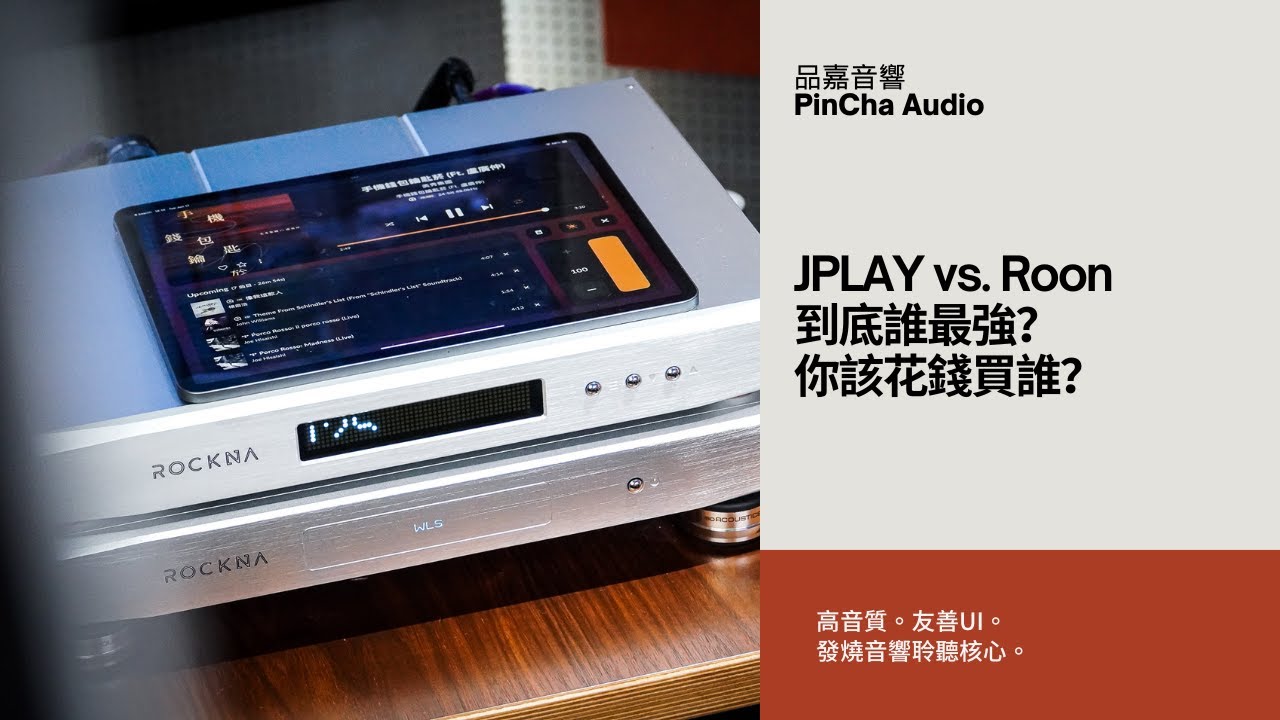
You can turn on subtitles with translation directly on youtube below the video
Torben
2 Likes
I am a Roon and hqplayer user. Both resides on a mc mini m4. A rpi4 runs gentooplayer w diretta. And that controls the Holo Red w Gentooplayer acting purely as a diretta target.
A bit of sidetrack. I recently bypassed diretta and use naa on the Red w Gentooplayer. But Diretta sounds better, against Hqplayer’s advice to bypass Diretta. I would really have preferred to bypass Diretta to have a simpler system. If NAA on its own had sounded better.
Now w the mention about JPlay. Today I tried JPlay to NAA. Vs Roon to NAA. And they sound different. JPlay sounds cleaner. Roon seems to have a filter added; it is less clean sounding but by just a little. Roon to NAA is still very detailed and pleasant. I need to have more time to listen. At the end of the day, we need to listen, and decide. As I suspect most who are arguing based on theoretical reasons are really not experts. To me, as someone who has invested in Roon, this discovery is not good news.
1 Like
How does Diretta sound better to you? Can you describe it? I have GentooPlayer with Diretta license also but the problem with Diretta is that you can’t use HQPlayer’s DAC correction function with it. And DAC correction is much bigger improvement than Diretta. Actually, in the long run, I couldn’t spot much difference at all between Diretta and NAA when I compared them so now I’m back at HQP dedicated NAA image for Holo Red.
About JPlay and Roon, yes there’s a difference in SQ. But JPlay is just too far behind Roon with their user interface.
Hi. I remember that the focus is better w diretta. Diretta is quieter so more low level details emerges. It is more natural. I am not using dac correction.
I like JPlay interface better for how I interact w the play queue. When I look at a queue that is playing, I would like to click on any track on the queue for it to start playing immediately. I also would like to look at the every track’s quality and source at a glance. JPlay does that.
For Roon, when I look at a queue and want to skip to a track, I need to press on the track to get a pop out window then press play on the pop out window. When I do that all the time, the need to look and click twice just to skip to a track is very unpleasant over a long time. Once I skip to a track, the in between tracks that are skipped collapsed and hide themselves. This frustrates me to no end. I prefer no collapsing. There is no collapsing w JPlay. I also cannot tell at a glance in Roon the quality of a track in a play queue, but I can see its source.
Just now I sat my 10 year old down. And let him listen to A and B. He has no idea what is A and B. He does not know we need to check that theories need to line up. I stream a tidal track and played a local track as well. And he consistently picked JPlay over Roon. And he is right. Sigh. It sounds clearer, cleaner, more details come through.
I am listening now. As I have used Roon for a long time and I always listen to the same tracks all the time. Now on Jplay, they are sounding better. No brainer better. It is very very obvious the more I listen. Anyway, this is good news for how audio is advancing. Roon can catch up too. Everything is constantly improving. Roon can overtake in time to come. It is good news for music lovers. Anyway, Roon is a server and does a lot more. I use ARC in my car to stream Tidal and access local tracks at home.
3 Likes
Ok so you use playlists a lot. I rarely use them, I just browse albums from the album view and start playback from there with one click. Most often I sort them by the day added and listen to more recent stuff, but also by date or most played and pick music like that.
I first thought Diretta sounded slightly better also but the more I tested the less difference there was. In the first place, the difference was already very very small.
But I do agree that JPlay sounds slightly better than Roon. Or should I say, UPnP protocol sounds better than Roon’s own (for example, there’s no SQ difference between HQPlayer client and JPlay). It’s the UPnP server which is in charge and JPlay only works as client/remote control. Too bad JPlay lacks many vital functions to me. For example:
- it doesn’t sync playback between devices
- no desktop app for Windows (most often I use Roon client on my laptop)
- poor metadata compared to Roon
- no support for last.fm scrobbling (I’ve done this since 2005 and have no plans on stopping)
HQPlayer support was nice addition and that was when I tested JPlay.
1 Like
Technically Diretta is electrically much more noisy, in particular at audio frequencies…
NAA is very quiet and low power, and low resources. It can do DSD256 on a single core 400 MHz ARM9 CPU with 64 MB of RAM…
2 Likes
That’s a controversial statement Jussi, would you mind expanding a bit? Diretta makes my DACs sound remarkably better, not just different.
How can a protocol for transferring audio over ethernet even have noise “in the audio band”?
Same way as USB can. USB has packet interval of 125 µs which translates to 8 kHz frequency. This is measurable in number of cases from the DAC output, depending on the DAC and overall system setup. 8 kHz natually falls right into audio frequencies.
Also frequent packet interval keeps the overall hardware activity high and increases overhead related to for example DMA transfers and kernel task wakeups. And prevents hardware from entering low power states.
I wanted to avoid the USB issues with NAA by keeping packet intervals well below audio frequencies and allowing hardware to stay in low power states for majority of time, including maximizing benefits of 802.3az. And also keep the overheads as low as possible and maximize DMA efficiency and hence provide lowest CPU power usage.
In addition, NAA avoids one layer of driver interface access with network endpoints, since the NAA support interfaces directly with HQPlayer’s DSP engine. This lowers overhead and power usage as well.
So, as with everything with HQPlayer, also the NAA overall the design is based on careful measurements from the DAC analog outputs to ensure best quality.
P.S. Of course, NAA works nicely over WiFi to provide air gap isolation and more flexibility when desired. I can easily do 8 channels of DSD256 over WiFi using NAA.
3 Likes
Thanks for the elaborate reply!
So your idea and solution point towards the opposite of Direttas? Bigger packets, less frequent? Hope i understood!
Well, NAA is designed to lower noise and improve isolation, since it’s introduction in 2011. Since the approach gives objectively better results, both from power consumption and electrical noise perspective (level and frequency distribution). Which are of course also linked.
If it happens to be opposite of Diretta, it is just coincidental, since I believe Diretta is much more recent. Roon’s network endpoint implementation didn’t exist yet at that point either.
The protocol has gone few revisions over time, and is now on 5th generation, which added support for multiple simultaneous inputs and outputs per endpoint, multi-room support, and support for metadata displays on endpoints, including cover images, etc.
1 Like
I also realized that Roon settings can be tweaked to optimized it for sound rather than function. I did the tweaks and the sound from Roon improves. I will do further tests of Roon vs Jplay.
Which settings have you tweaked that you feel improves sound quality?
I always wonder about this person’s take which comes down to if it’s bit perfect then it’s bit perfect. Archimago's Musings: Roon in 2025, 10 years on: Sound quality, thoughts, and suggestions. And an increasingly AI-generated Internet.
Scroll or use find to see what is said about jplay.
Like others in the space it’s possible some people can hear differences while others can not. Based on some of the crowd sourced listening tests the person above did, it did appear if my recollection is correct that there was at least one Golden rear out there.
Hi. I was using this guide. https://www.head-fi.org/threads/roon-optimization-guide-for-increased-sound-quality.968792/
After tweaking I need to do other things so I do not have time to do any serious comparisons yet. By my current usage pattern, I am likely to use JPlay or Roon depending on which offers me the best sound quality. I do not use many functions of Roon like dsp. I use hqplayer. What I need is a music player that has a good interface that can combine all the stream content and local content as one. That both Roon and Jplay can do. If I am able to tweak Roon to sound as good as Jplay in my system, I will continue to use Roon more. Roon will always have its place to music lovers as it is so fantastically rich in features.
Recently I asked a very trusted high end reviewer from Hong Kong which does he prefer: Jplay or Roon? He tells me in his system, Roon still sounds better, but you need to tweak Roon. This gives me hope to look for ways to optimize Roon for better sound. I also suspect Roon needs better hardware. The HK reviewer has excellent Roon hardware and I don’t. I am only using a mac mini m4 to run Roon server and Hqplayer. The good thing w Jplay is that it is only an app on a phone! It is unbelievable that it can have an interface like Roon and claims to improve sound quality.
I am an electrical engineer w a postgraduate degree. Simple logic seems to make many claims far fetched. Like a control app improving sound quality (Jplay), bits are not just bits etc. What happens to us is that the moment we are brought to the threshold of our understanding, things will begin to sound nonsensical, and we will prefer to challenge it theoretically rather than be willing to try it out and investigate the claims. We could not go beyond what we know. So I see many forum discussion (not here) veer all the way towards paper arguments without investigations. We struggle to go beyond. Some time back a youtuber A whom I respect begins to ridicule another youtuber B for suggesting that having improved components in a loudspeaker has any merit. That may be because A has reached the threshold of his understanding, starts to struggle in his understanding, and prefers to argue based on what he knows rather than trying things out. We are all about the same. It is understandable.
On bits are bits. Once I had a well made streamer from Holland. Then I upgraded to a newer improved version of the same model. And the improvement in sound is drastic. We can investigate this easily. Bring our streamer to a high end shop and ask them to do AB comparisons for us based on streamer alone. Or ask a friend to bring a streamer to test in our system. And see if both being bit perfect, do they sound the same. What I guess now is that there are no real bits. As “bits” ride on analog information. Digital is carried by analog signals. To say bits are bits is really an over simplification. A threshold limitation in our own understanding. This are my current thoughts. I could be wrong.
4 Likes
Oh. Btw. One tip to optimize Roon is to press the side button of the iphone, once music starts to play, to put the phone roon remote to sleep.  . I tested. In my system, it does not seem to have a bearing.
Did some tests. And tested further. With the optimizations to Roon shared in the head-fi link, Roon has improved. Now JPlay and Roon are close. It becomes a matter of preference. Jplay tends to be a bit less bassy and that slight leanness helps me to give me the feel that it is transparent. Roon is a bit more bassy and the sound is natural and likeable and I dun focus on details and just enjoy the music. Well. Good to have both to AB for fun. It is a hobby after all ◡̈.
I am speechless …