I used to think the DAC was 90% of the sound. This sub-$300 DIY project proved me wrong

May I ask why you say that? And in what way is it “not…traditional”? Electronic engineers have tools at their disposal to find surprisingly small amounts of noise buried beneath a signal (and vice versa, for that matter). Needless to say, these tools can operate at frequencies far outside the audio bandwidth.

As you said earlier:

Thank you for acknowledging very explicitly that this bias exists. It is very easy to understand why it should be present, and why it might be a “good thing” for you and others who have enjoyed the process and results of incorporating Diretta into your systems.

That said: while I certainly don’t want to discount your subjective experience, if there is to be a worthwhile discussion about what Diretta is actually doing in technical terms (noise, CPU usage, timing, etc.) then in order to find a proper explanation I believe measurements are essential. My point is that if one wants to use engineering language to explain something, one should also adopt an engineering process to investigate and verify it. Otherwise there is a risk of simply re-stating plausible-sounding and widely-held beliefs without evidence.

Have the authors of Diretta performed measurements which show differences in the output of a DAC receiving a Diretta stream in comparision to a non-Diretta stream? As I see it, that is the only thing that matters in terms of the output sound quality. Until those measurements exist, I believe any discussion of whether Diretta objectively improves sound quality is moot, and the same therefore applies to the possible causes of such an improvement.

To be quite clear, I’m not suggesting that you hear no difference, and as we agree that may be due to other factors. But hearing a difference in itself doesn’t shed much (any?) light on what Diretta might or might not be doing in terms of actual signal quality.

Reading your posts gives the impression that you are interested in both subjective sound quality and the objective behaviour of Diretta. I am curious to find out what objective data support the claims of better signal quality in the analog domain.
6 Likes

Unfortunately, the minimum spec is Raspberry PI 4. AudioLinux is not supported on older boards. The lowest cost I can come up with (in the US) is $212.45

If the two of you go in on this project, you are each risking a little over $100. That seems like fair “tuition” to find out if this project has benefits to offer in terms of listening engagement in either or both of your systems. If you hate the results (unlikely), each of you keeps one RPi to tinker with or sell.

1 Like
2 Likes

I have no dog in this fight, but just for curiosity I would love to see a blind test of Diretta vs RAAT.

1 Like

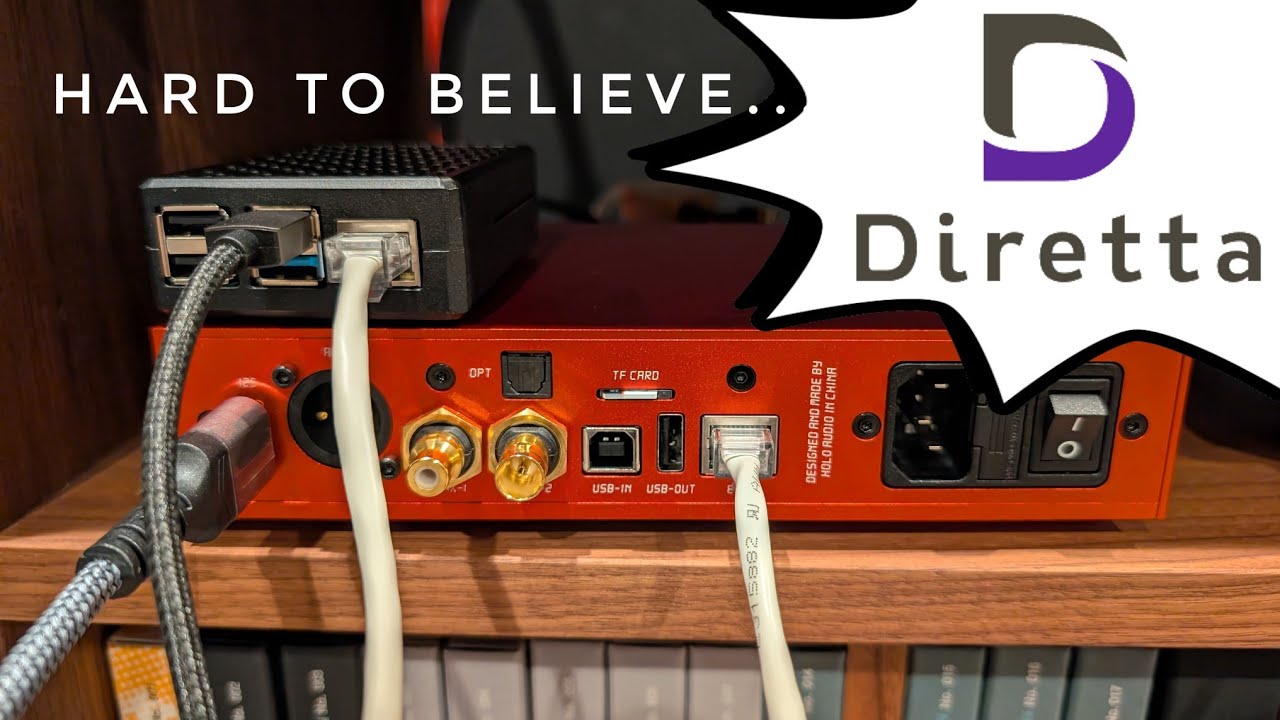
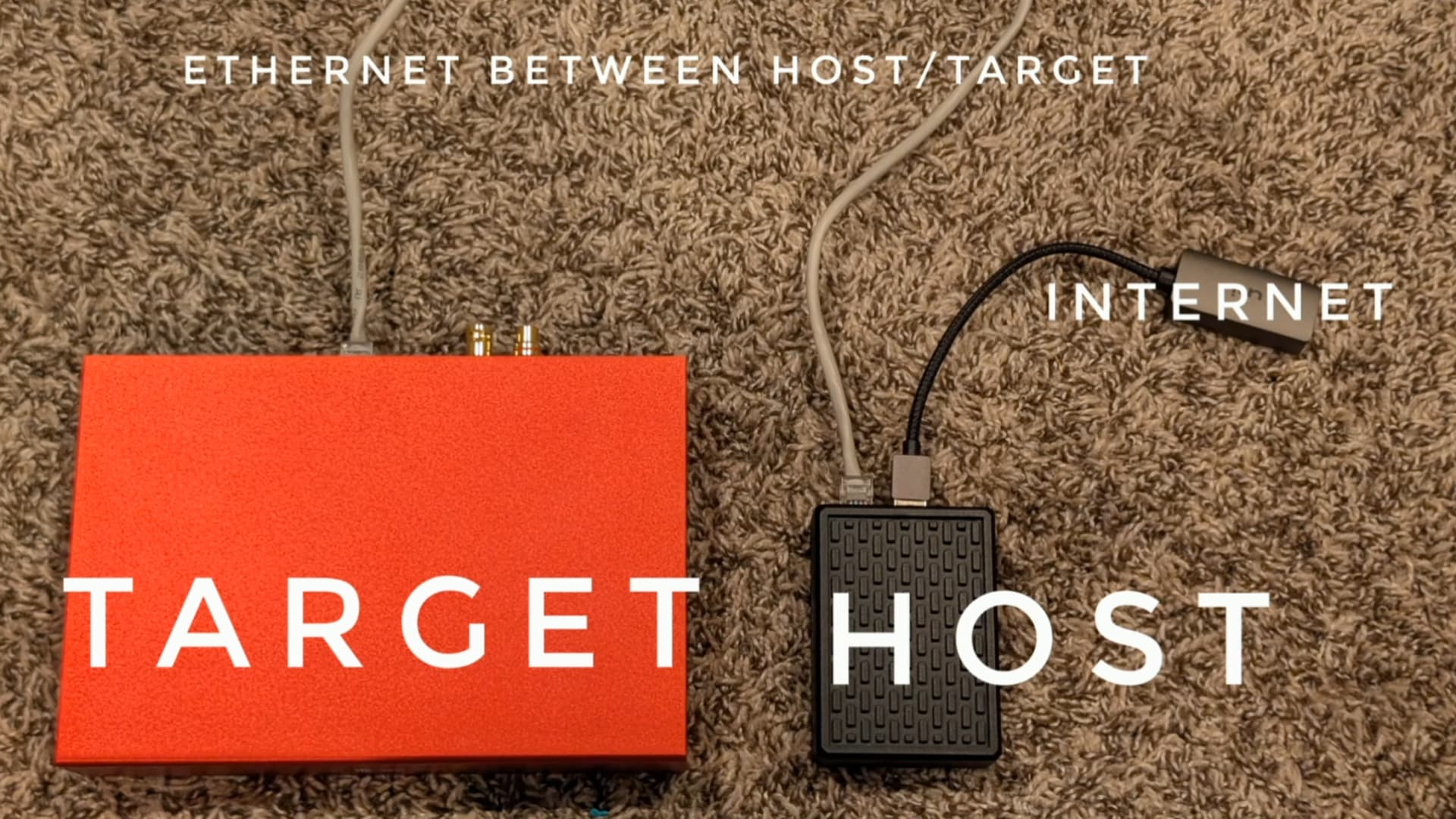
Yes, @Michael_Long - that’s the video that sent me down my own path of exploring Diretta! Particularly, this frame:

Here, we have a Roon endpoint made from two separate computers: Target and Host. Their onboard network interfaces are directly connected via an Ethernet cable (this works thanks to Auto-MDIX). The host sports a second network interface, via the USB to Ethernet adapter, which it uses for RAAT communications with Roon Server.

Add Roon Server to this picture, and we have what I call the three-tier Roon architecture:

Roon Server -> Diretta Host -> Diretta Target --(USB)--> DAC or DDC

The moment that I saw that image, I just had to give this design a try. The rest is history. Thanks for sharing a link to the video!

Hi @thumb5 and @mjw,

I appreciate both of you keeping us honest here. You are pushing for objective correlation to these subjective claims, and as an engineer, I respect that deeply and desire it myself, as exemplified in my network traffic analysis plots.

@thumb5, you asked why I suspect these artifacts are “non-traditional.” My hypothesis is that standard audio analyzers (AP, etc.) are optimized to measure signal integrity (THD+N, SINAD) based on steady-state signals. However, the phenomenon we are hearing likely lies in the time domain—transient intermodulation or noise floor modulation caused by the dynamic load of the transport. To use your words, I am indeed “re-stating plausible-sounding beliefs,” because that is what a hypothesis is. We are currently in the observation phase, not the peer-review phase.

The “Banana” Dilemma

Reading through the requests for data, I feel a bit like someone trying to describe the taste of a specific curved yellow fruit to friends who have never eaten it.

I can describe the texture (creamy) and the flavor profile (sweet), but you are asking to see the gas chromatography report on the isoamyl acetate content before you believe me. That is a valid scientific request! But no amount of chemical data will actually tell you what it tastes like.

This thread is a tasting table. It is for those who want to peel the fruit and take a bite and building community around those who have already done so.

@mjw, you mentioned:

I do hope we can move beyond hypotheses.

I agree completely. But the only way to move beyond a hypothesis is to run the experiment. In this context, the experiment is not “reading a whitepaper”; the experiment is “building the kit and listening.”

Until you peel that banana (build the kit), we are just arguing about the color of the peel. I can’t prove to you via a forum post that it tastes good or why, and you can’t prove to me via logic that it doesn’t or can’t. We just have to try it.

I know you mentioned you are currently running Pi 3s, but since you also said you “don’t mind buying a couple of Raspberry Pi 4s,” I’d love for you to run the physical experiment. If you build it and it sounds exactly the same as your current setup, that is a valid data point we want to hear!

2 Likes

Is the delay possibly due to a change in bitrate. I know that in my setup when the DAC needs to adjust to such a change it disengages for a short time before playing. If I don’t introduce in Roon a Resync Delay I lose a second or two at the start of a song. So, as David suggests, a review of config settings might point the way or at least explain what might be happening.

2 Likes

Thanks David, I subsequently thought of a faster way to demo it - take the small PC and one of my SOtM boxes over to his place - I’ve already got Roon Bridge and ASIO on the PC and I can easily switch my current Host to Target, that should help prove the point

Back with RPis, I was reading about the Gentoo Player option, that seemingly will work on a ‘3, but bearing in my new plan it’s moot

Given a successful trial, I think we’d go down your preferred ‘4/5 route

Regards
Andy

2 Likes

Hi Steve, I don’t think so, the audio path in Roon is clean - it’s playing a 96/24 from Tidal now - and with very little if any track to track delay today!

Maybe it was something to do with the wider innernet when I was listening the other night :woman_shrugging:t2:

Anyway, I have some tweaking option to try in the SOtM settings - more nerdy fun to be had

Thanks for your reply though
Regards
Andy

Love your “banana” analogy. Reminds me of the many coffee “cupping” events I attend from time to time, evaluating various roasted coffees. Doing home audio cuppings is what I feel I’ve been at for many decades. What’s more, my personal auditory “aroma” wheel seems to change as I introduce new hardware and tweaks into the listening room. Many come and go while others stick if they maintain benefits that I like. And I’ll admit, once I perceive a positive change, like those reducing noise that I didn’t know was there, I can’t go back. Additionally, I know my brain is plastic and evolves as well. Can’t compartmentalize, only appreciate the experience I get in the listening.

2 Likes

Fair enough, I appreciate that was your original aim. But then you’re trying to have your banana and eat it, in posts like this one. It’s as if you’re saying: “the gas chromatography analysis would look like such and such, which is why the banana tastes creamy and sweet”. Until you actually do it, just saying it doesn’t explain whether or how the banana tastes different.

It’s not a matter of dis-believing how the banana tastes to you; rather, what makes me uncomfortable is the assertion that it tastes that way because of a hypothesis about its chemical content which could be verified but in fact hasn’t been.

Nevertheless, I am enjoying everyone’s contributions to the thread.

7 Likes

I think there will be a ready market for pre-built versions of this setup for sale. You will probably get most of your money back from others wanting to try it out.

3 Likes

… sorry David, I missed your $100 investment point - and a good point it is too

I just bought another SOtM box for some hundred pounds; I liked what I heard and wanted more ASAP :grinning_face:

My (moot) low cost option was more about quick and dirty - get the PoC running ASAP

And, let’s be honest, <$300 in the HiFi game is worth a punt IMO. That it’s a sound per pound (€$¥) bargain too is a bonus

1 Like

My thought exactly! :+1:

We accept that this banana tastes different, and we simply want to know why.

2 Likes

I was thinking along the same lines. The experiment focuses solely on subjective experiences (at least so far - it seems it takes a while until David finally uses the scope on the power rails), but volunteers technical explanations, with formulas. Before we even try to offer explanations, shouldn’t we establish there’s something to explain in the first place? Blind ABX tests work very well for subjective experiences, whether it’s ears or taste buds. If blind tests don’t reveal any difference in taste for example, do we even need to look for chemical differences? What would we even look for? And if we do look and find no differences, isn’t that easily dismissed as “irrelevant”? You can’t start with a wrong premise and expect a correct conclusion.

5 Likes

It’s hard to understand how cables, networks, software, and endpoints can contribute so much to sound differences in the digital realm. Galvanic isolation to remove noise, and re-clockers to clean up jitter can be even more important. And then there’s the synergy of it all. I started out with my Roon Server running on a stripped down Mac Mini with a USB cable straight to my DAC. I then purchased a Allo USB Signature with Allo linear power supply as a Roon network bridge. I did notice a subtle improvement. After it failed I ended up buying a FiiO SR11 and Small Green Computer linear power supply to become the Roon network bridge. I’m pleased with the sound for the money, Now I’m thinking the Diretta might be my next cost effective solution.

2 Likes

If measurements are demanded by the bab members then why can we not demand they assemble and try it? Sorry (Canadian) but the same crew always kills every party.

4 Likes

Because the burden of proof states that he who makes claims has to prove them, and the rest of the world has no obligation - or time - to prove everybody wrong.

Btw, I did offer to build and measure and specifically asked for the kind of measurements that would be considered relevant. I got radio silence.

5 Likes

Hi,

I haven’t read all 140 prior comments, but can someone explain how this is any different than putting a good USB Isolater i.e. an Intona, in between a streaming endpoint and a DAC? Is there something other than electrical noise that is being “cleaned up” or removed here? And I am not arguing about whether or not USB isolation makes an audible difference, but we do know it makes a measurable difference on the input. Just fuzzy as to how this much more complicated Diretta setup, is better than just sticking in Intona in the chain. Please elucidate. Thanks.