Fair enough. I don’t think we’re going to agree on this, and I’m looking for experiences with dedicated audio endpoints rather than debating the underlying network protocol. Thanks for sharing your experience.
Yes, I’m aware. That’s actually part of what makes the Holo RED interesting to me. I’m not looking for a bare Raspberry Pi running Ropieee, but for a dedicated network endpoint where the RPi Compute Module is part of a purpose-built audio design with dedicated hardware, power supply, clocks and outputs.
The DAC is the ultimate authority in terms of analog audio quality, so the Holo Red, not having an integrated DAC, can’t do more towards that goal than any other streamer, including a bare Pi.
I guess you’re looking for experiences that match your expectations. You’ll get plenty of those, no doubt.
I see the issue here, you are looking for the “special sauce” and about time too, there are far too many mundane non-believers here (and not just on this thread (not just on this forum either!) but across the so called hi-fi community).
Personally, I have an SBC that has been tuned to deliver audio synchronicity by using high end components and cleansed power; there are low noise batteries and capacitors that ensure the bass notes reach a sternum vibration, whilst the highs shimmer with a passion that is only equalled by angels in song.
Most of my components have been created by dedicated audio experts who have recommended the next item based solely on synergy, with price not entering the equation; it really has to be about the signal at all costs. It is easy to dismiss the needs of folk who are willing to create sonic perfection irregardless of financial sacrifice; I had my listening studio designed by specialist audio architects who were under no illusion about what I expected.
I have auditioned most of the streaming services and have found all of them lacking in some regards, sq should be the only deciding factor, ease of use, user interface, curation of folders are all of secondary importance; what I require is perfection or silence, there should be no middle ground.
If you are interested in purely psychological phenomena with no underlying physical difference in sound waves emanating from your headphones, it does not really matter what you do, and there is no practical advice anyone could give you; just pick something that gives you a story that you like and that fits your budget and enjoy the music.
I use both. I too have found a difference in the sound between the two. I find myself using Roon with NAS and Qobuz for most listening and discovery. Audirvana is great for pure 2-channel listening from the sweet spot.
Thanks, this is actually relevant to what I was asking about.
The distinction between the Roon Server, Diretta Host and Diretta Target is interesting, and it’s closer to the kind of endpoint architecture I had in mind.
If Diretta improves on Roon’s quality, I bet it will also do it for Audirvana, so you’ll be back to square one. You’re on a wild goose chase. You’ve been warned.
for what its worth ,I have 2 discrete paths both fed Ethernet . I have Audirvana Studio 3 (on a Windows 11 desktop) and Roon (ROCK/NUC) running on the same local file base
RPi / Allo Digione / Ropiee fed coax to a Sennheiser HDV820 amp (I haven’t tried USB but I could easily)
Naim Uniti Atom HE
I use a range of (high end) headphones , Sennheiser HD800, Meze Elite, HiFiMan HE1000SE
I easily detect differences between the headphones , but not between the amps on the same headphone.
There is a very slight difference (to me) between the 2 players BUT a slight increase in volume in Roon gets them equal (to me). Which I find a bit suspicious for 2 (nominally) identical bit perfect streams.
There are all sorts of settings in both products that can affect , upsampling, volume levelling etc which must be OFF to compare
My comments above about AS sorting mean I could never settle to use AS
Disclaimer: 100% Headphones, 100 % Roon user for 10 yrs !!
It took me ages to like Roon. I did a lot of comparisons, Audirvana, JPlay, and what not. Till I came to the conclusion that Roon is THE reliable system. Whatever you throw at it, it just works. It’s library management is spot on and rich in information. Sondwise, for me, at least, it’s hard to spot differences. I’m now set on Roon running on a MacBook Air M5 and having Roonbridge installed on a Raspberry Pi 4 with DietPi. It’s a most stable system.
I made my mind up after actually doing the testing, which a lot of people don’t do. There are multiple ways to make Roon sound better, running on a Mac isn’t 1 of them.
Audirvana does sound better but it’s GUI sucks. The best sounding is Qobuz connect, but again, the gui sucks. When I’m hosting my audio group, I use QC and Roon.
I will be testing Maestro soon because I heard some promising things. I use Roon all the time, hours a day, in the house, in the golf cart and in the car.
@RustNever From someone running Roon on Mac Mini M4 Pro and a former Audirvana user…
Yes, using a Roon-Ready endpoint can provide you better results with Roon than you’re getting with Audirvana now, but IMHE, the most dramatic improvement wasn’t from just the endpoint alone. The ah-ha moment was adding upsampling to DSD256 via HQ Player desktop installed on the same Mac that runs Roon core. A Sonore Rendu series endpoint set to Network Audio Adapter mode(NAA) connects to the DAC.
You maintain full Roon interface as usual, keeping all the joy of Roon UX but with sonic improvements that can be optimized for your DAC and leveraging additional computational power whenever you upgrade your Mac. You simply select HQ Player as the audio output selection in Roon.
As an aside, I also found further noise reduction by adding a layer of optical isolation between the Mac server and the DAC, but that’s a whole discussion in itself.
I suggest researching on the audiophilestyle Software & Sonore forums for knowledgeable user posts and everyday support responses from the designer’s of both Sonore and HQ Player. Faster than Roon team too
I’m sure some who haven’t tried this will call out that it’s not apples-to-apples suggesting upsampling via HQP+Roon vs. Audirvana without upsampling. But I would argue that isn’t the point. Getting the best SQ using Roon is! All upsampling isn’t created equal and HQP has its fans for a reason, and 20+yrs of continuous improvements and growing user base demonstrate formidable capability. I don’t use the HQP DSP convolution functionality, but if DSP is for you, that’s another rich capability you get with adding HQP to your Roon setup, hardware constraints notwithstanding.
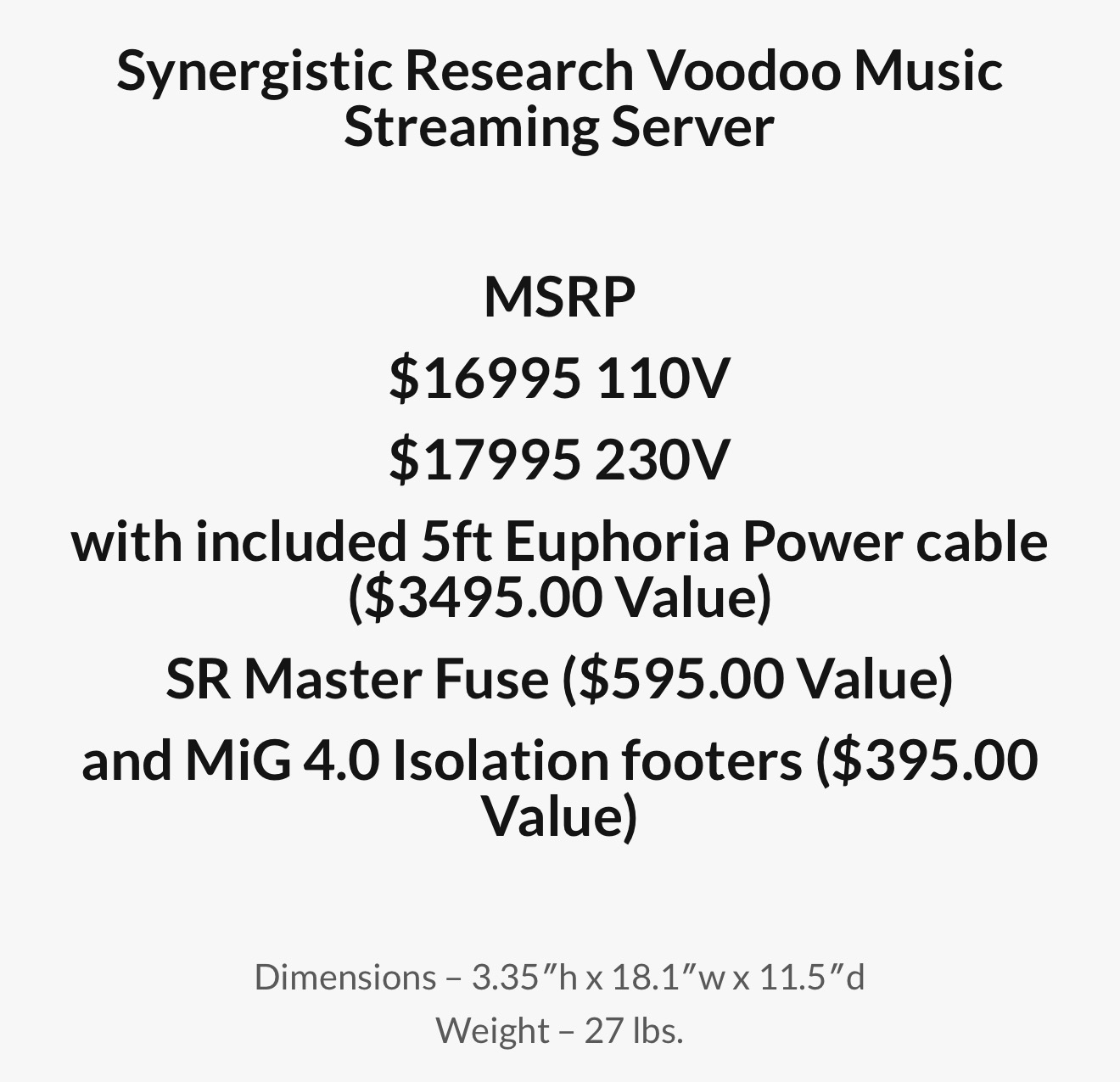
Just by contributing, I have been using Roon for several years, for a few months now in a Voodoo from Synergistic Research, so I consider that I can know the potential that this application has both in terms of cataloging your music library and in terms of playback quality.
Well, recently I have discovered the new SERENTO app, a UPnP-based player, compatible with Apple environment devices, and I must say that it is worth trying, the surprise has been very nice for me.
So we developed the world’s most musically robust server architecture, where we listened to dozens of motherboards, CPU processors, and RAM options in double-blind testing, picking only the most resolved and musical options. We then paired our new computer with our latest LPS technology, refined over the past decade, to power your new Voodoo Streamer/Server.