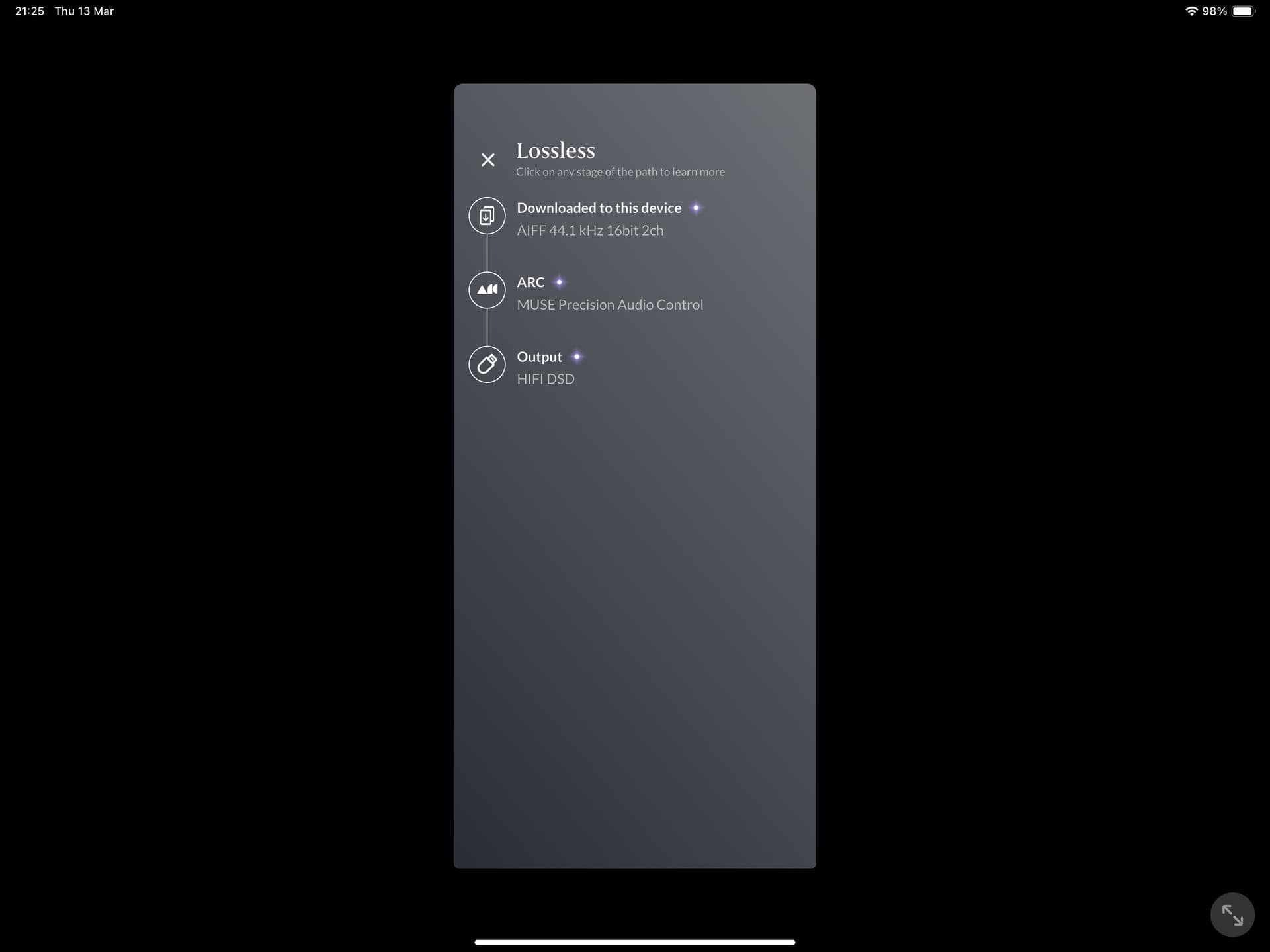
You need to post an image of your Roon Signal path.
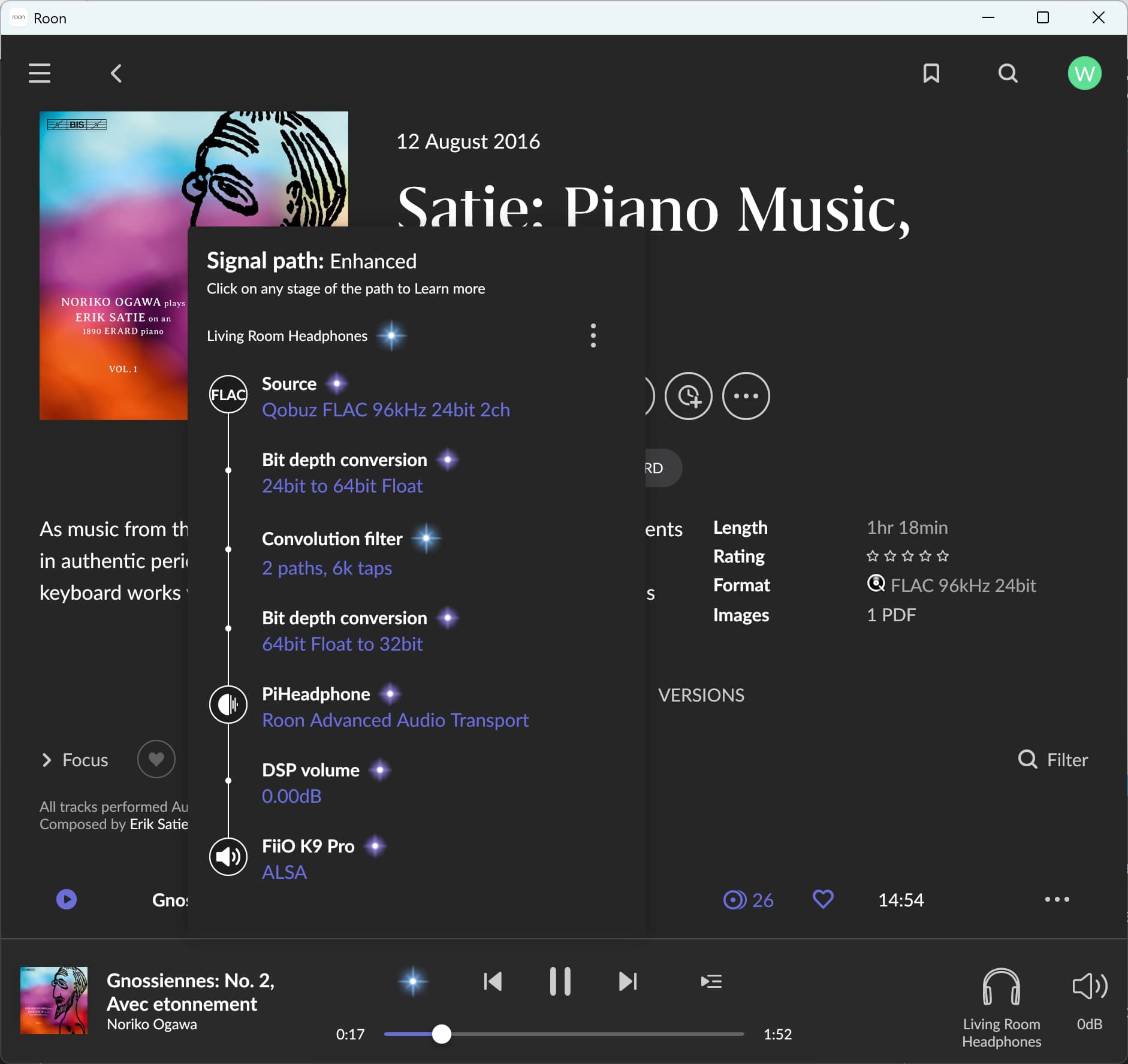
My signal path (using a Raspberry Pi - not a phone) clearly shows the DSP volume control applied within the Raspberry Pi (albeit set to 0dB attenuation so not actually doing anything which is why that particular operation is reported as bit perfect):
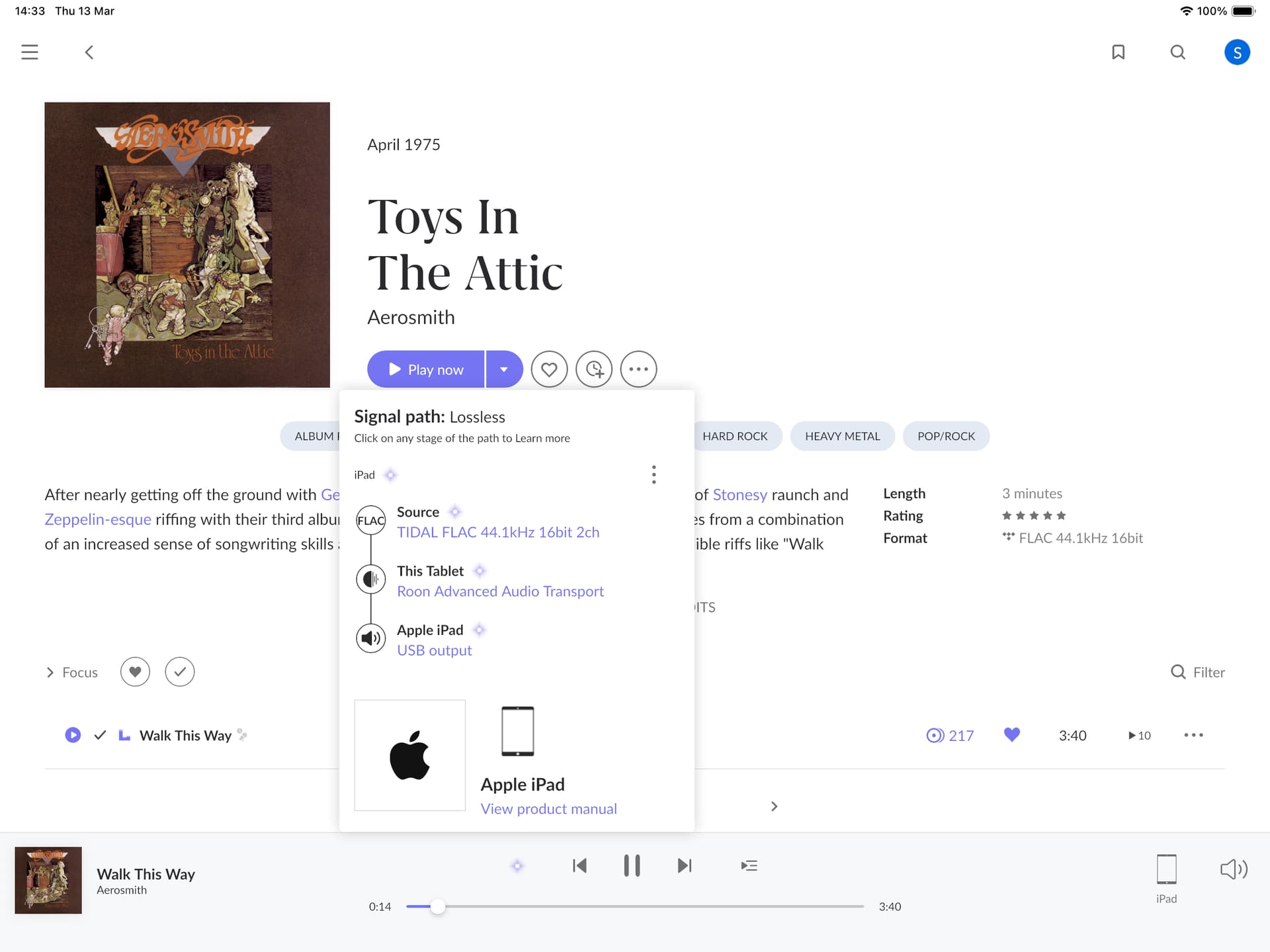
Thanks for the replies so far. Here are screenshots of the chain - it doesn’t look like there’s anything happening in between the core and the USB endpoint. But I am able to change the volume independently through the iPad, which doesn’t show up in the chain.
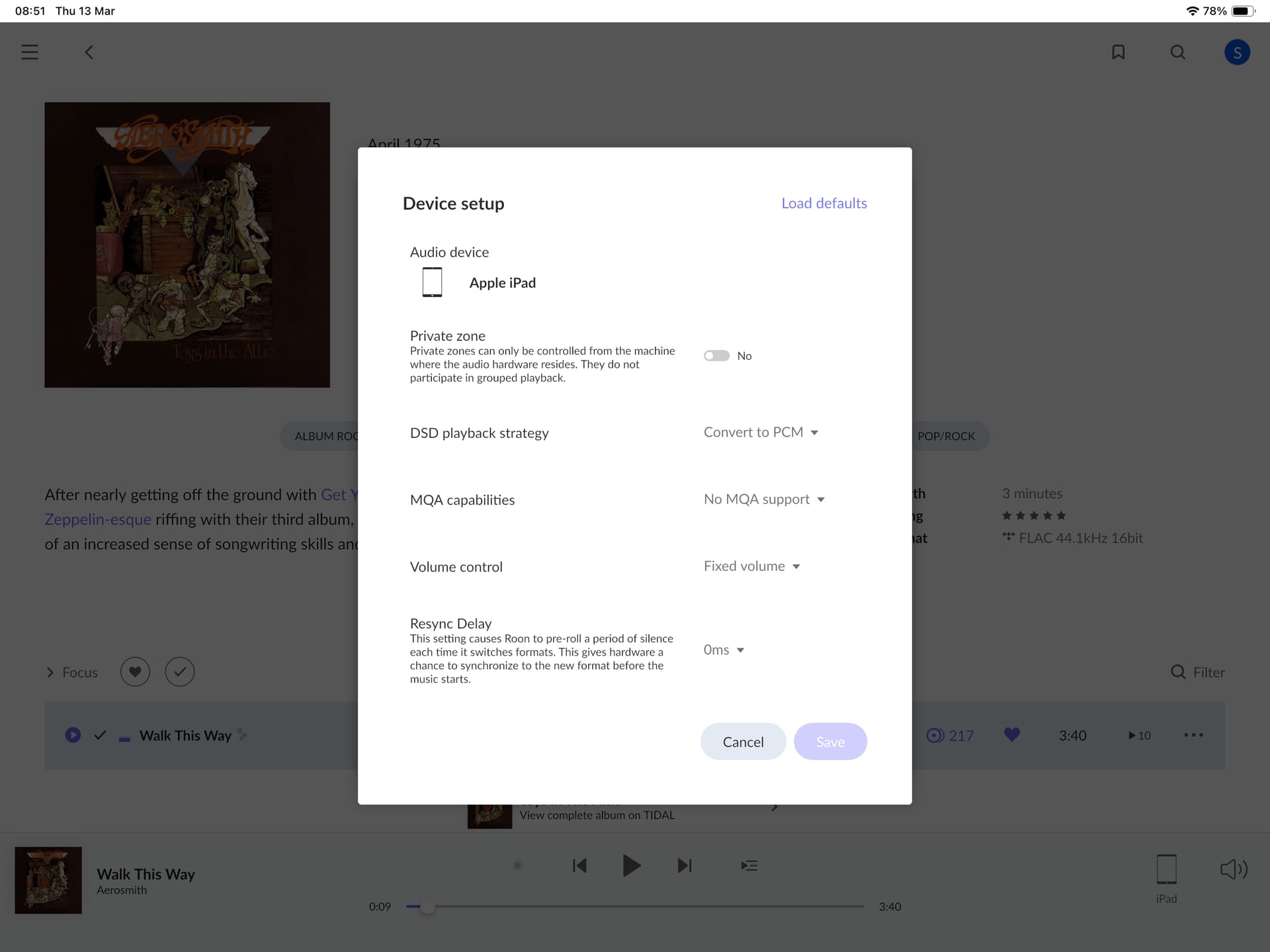
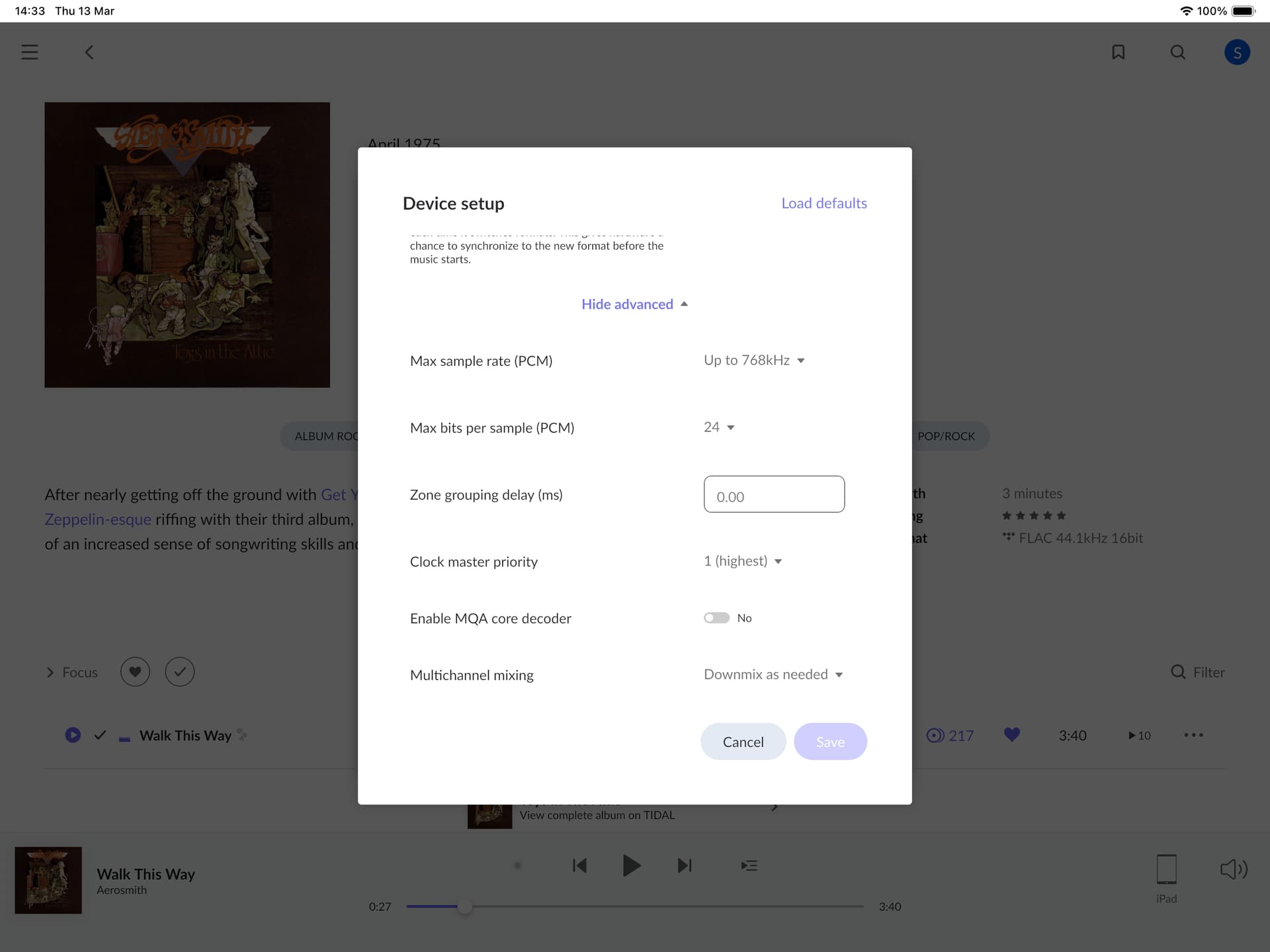
Thanks also for the suggestion of ‘Exclusive mode’, but that doesn’t appear as an option for the iPad.
I have a M4 iPad Pro and a Hidisz Martha USB-C DAC/HP Amp that I rarely use. It has the benefit of changing LED colors based on the sample rate arriving at it. I tested it just now using a range of DSD, FLAQ, and MQA (the Martha handles them all) and it shows the correct bit rate passing to the DAC while still retaining volume control from the iPad OR the buttons on the Martha. I assume that the volume control on the iPad is directly controlling the DAC given this.
So you may get volume control of the DAC but it may still be bit-perfect like in my setup. Does your DAC report on the sample rate? And does it match the original file?
Your signal path is reporting for the iPad, not the DAC. When the DAC is connected to the iPad, it should be listed under Roon Settings → Audio. Enable this, and then select it as the zone.
However, note that the signal path is showing bit-perfect. It can’t get better than this. If the iPad is indeed controlling device volume, then this is likely acting as a hardware volume control.
@mjw One clarification from testing: an external DAC doesn’t appear as a separate device under Settings → Audio for iPad at least for the three DACs that I just tested (Hidisz Martha, Matrix Audio mini-i Pro 4 using USB-C to USB-B input, and Topping D50s). Interestingly, with the Matrix Streamer/DAC and D50s Fixed Volume did appear as a setup option, so it clearly varies based on the device capabilities but remains under the iPad as the Audio device, not as a separate device.
Hi, that’s right, the external DAC does not appear as is the case with yours @ExUnoPlura. The iPad’s USB port is the end device as far as Roon’s signal path is concerned.
It would appear that at max volume on the iPad, the DAC sounds normal. The bitrate is coming through perfectly.
It would just be nice if Fixed Volume in this case prevented me from lowering the volume accidentally.
To be clear, you previously successfully used the iPad Pro via USB directly to the device but were confused about whether the lack of Fixed Volume meant that the device was not bit perfect, but now you are putting a USB to optical adapter in the chain and are unable to get audio from the Chord Hugo 2 except when using Arc on the local network?
The iPad Pro is connected to the Douk U2 USB-SPDIF (then the Hugo 2 downstream), which I thought would be treated as a DAC.
The iPadOS Roon app does not recognise the U2 specifically, so the end of the chain is the iPad USB. The ‘Fixed Volume’ option in this case does not work as intended.
The iPadOS Roon Arc app does recognise the U2, but there is no Fixed Volume option in the Arc app.
Yes, I was concerned about bit-perfectness if volume can be changed by the iPad Pro in either case.
By design, S/PDIF is fixed volume, so the signal is probably going through the iOS mixer (do your hear message notifications?), or the U2 implements software volume.
What happens if you remove the U2? Nonethess, with a Hugo2 there is absolutely no reason to prefer S/PDIF over USB.
Yes, I would imagine you’re right about this. I turn notifications off while I listen to Roon, but it may make an interesting test.
In any case, I thought the ‘fixed volume’ option would bypass the iOS mixer (or bypass CoreAudio altogether?) and send a PCM stream ‘as is’ through USB, no matter what’s attached to it.
As for having the U2 in the chain, it’s just my preference. Even the designer of the Hugo 2 (Rob Watts) prefers optical into the Hugo 2.
I believe only ASIO entirely bypasses the OS mixer. Fixed volume doesn’t affect this either, and is essentially about DAC capability. For instance, Chord DACs are fixed volume since there is no signaling available to control volume used with the hardware volume setting. Alternatively, DSP volume may be used.
With iOS, you can achieve bit-perfect playback, but now that I think about it, notifications would be heard–so Core Audio still uses the mixer. I use Android now, which has its own issues albeit Android 15 may improve this.
Thanks! I tried Roon on an Android device as a source instead of the iPad Pro, just out curiosity. It was a Hiby R4 running Android 12 - I got Fixed Volume, but on the downside, everything was resampled to 48Khz. So, I decided to stick with the iPad Pro.
Yes, that’s a problem with Android, although Roon ARC avoids this with a beta driver. However, by letting Roon handle resampling there is no loss in fidelity for 44.1 kHz, and, arguably, higher sample rates, too.
Thanks for reaching out. Reviewing this thread, it seems the main unresolved questions is this:
The most likely culprit here is the RAATServer implementation in Roon vs. ARC, which relies on a lightweight variant without Zone-level control. We can escalate to development for a precise answer if you’d like to keep this thread open a little longer.
We should have more information after we discuss this case with our development team this week @Stephen_Buzdugan, thank you for your continued patience until then!