Noise generated by computers, routers, NAS, local networks

They don‘t have to be, anyways.

With the amount of money you are willing to spend for good sound, you could find out for yourself rather cheaply if using a true galvanic USB isolation device can help exploit all the slumbering potential of your DAC, eventually surpassing the technically less elegant I2S connection.

1 Like

According to whom? Paul has many patents, several best-selling books, and daily advice for free. Please educate us with your sources and kniwledge. I had no idea that USB was designed for Audio, must have missed that.

More ad hominem attacks on Paul. Sigh. Why did you buy his power conditioner? Which one do you have? You believe what Amir had to say in his limited SINAD test or did you not get any improvement? What does this have to do with the question from the OP? I’ll buy your power conditioner if you don’t want it…

1 Like

I would think, according to people who understand how it works.

USB stands for “Universal Serial Bus.” The whole idea is that it wasn’t designed for anything in particular, so it works with pretty much everything: printers, scanners, webcams, mice and keyboards, DACs, ADCs, you name it. Same with Ethernet; same with Internet. If it can transport data fast and reliably, it can transport digital audio.

I don’t personally know Paul, but everything I heard him say was marketing fluff with no scientific base. As far as I’m concerned, that’s not ad hominem, and as @Bill_Janssen said, we’ve talked enough about him already.

4 Likes

You do realize that you can get pretty much anything “novel” patended?

So does Danielle Steel. Her books aren’t great literature either.

This is called advertising, and hid “advice” changes depending on whether PS Audio doesn’t have a product to do X (“X is bad”) or when they finally manage to knock one together (“X is greatest thing since sliced bread”).

I’ve actually studied both physics and computer science… USB is designed for transferring data. USB is very good at transferring data, over random cables (as long as they are reasonably to spec) with no errors and without having to care for the source clock.It supports high bit rates, and has an actual connection standard. Looks superior to S/PDIF or I2S by all measures.

2 Likes

Paul’s LinkedIn page also used to state that rather than all the engineering stuff, personally, marketing is really where it’s at for him.

I do note, however, that he has changed his profile recently.

Some of Paul’s claims are no loftier than those made by other manufacturers, however, his “style” does seem to generate quite a following. Unfortunately most of his claims have no more basis in science or engineering than many of his contemporaries in the game of selling “Schlangenöl”.

I fear this thread will end up going the way of many others of the same ilk. A downwardly circular debate in a downward spiral that will ultimately be shut down by the moderation team.

1 Like

Discussing McGowan’s pros and cons seems wildly off-topic for this thread, and I’m sorry I opened my mouth. Now, of course, I can’t even delete my comment. Slow mode is not all it’s cracked up to be.

1 Like

We’re in slow mode already. The death knell is tolling…

Bill, I cordially disagree - the very first post was about PS Audio’s AirLens. As the “P” in PS Audio, I fail to see how Mr McGowan can be off-topic.

Henry, we need to bear in mind that until it’s come out of the analogue side of a DAC, there’s no such thing as audio. Prior to that, it’s just a stream of data, and transferring data, quickly and efficiently with infinitessimally small bit error rates is exactly what USB was designed to do.

Performance-wise USB is on a similar par to SATA, the protocol used to save and retrieve data from drives. Lots of datacentres run on it:

Also

In audio equipment, I²S is sometimes used as an external link between a CD player and an external digital-to-analog converter, as opposed to a purely internal connection within one player box. This may form an alternative to the commonly used AES/EBU, Toslink or S/PDIF standards.
The I²S connection was not intended to be used via cables, and most integrated circuits will not have the correct impedance for coaxial cables. As the impedance adaptation error associated with the different line lengths can cause differences in propagation delay between the clock line and data line, this can result in synchronization problems between the SCK, WS and data signals, mainly at high sampling frequencies and bitrates. As the I²S bus doesn’t have any error detection mechanism, this can cause significant decoding errors.
There is no standard interconnecting cable for this application. Some manufacturers simply provide three BNC connectors, an 8P8C (“RJ45”) socket or a DE-9 connector. Others like Audio Alchemy (now defunct) used DIN connectors. PS Audio, Musica Pristina and Wyred4Sound use an HDMI connector.[7] Dutch manufacturer Van Medevoort has implemented Q-link in some of its equipment, which transfers I²S over 4 RCA connectors (data, MCK, LRCK, BCK).

Full article:

On the face of it, I really fail to see how anyone can argue for I²S being superior to USB as a data transmission protocol between devices. It was never designed for that. It’s designated function was to transmit data between ICs within a device. Additionally, I²S has no error detection mechanism which makes it even more inferior to USB.

4 Likes

I know I’m replying to some posts backwards…

Something we have to bear in mind when listening to source equipment is that we need to ensure precise level-matching of the output. Different digital protocols between source device and DAC will not necessarily produce the same output level depending on how the source and DAC process that protocol.

Measured level-matching has a habit of taking perceived audible differences out of the equation. Just a fraction of a dB increase in loudness can make one thing sound better than another, when in fact, there is no audible difference other than amplitude.

In science, rigorous experimental controls are put in place for very good reasons.

3 Likes

You should check out “the hifi podcast” with Darren Myers now VP of R&D at Parasound designer of award-winning devices like the PS Stellar Phono stage. Linked previously.

I don’t have a device with I2S… but I trust his perspective and I like to hear other views that don’t always align with my own preconceived notions. As a 50-something CTO and lifelong audiophile, I trust my ears above SINAD scores and I have a good BS detector for sites like ASR. Which I find informative with a pound of salt, certainly not the final say for me… In my experience, USB is noisy and has a lesser SQ to my streamer over COAX. If you disagree, great, but the OP was about the AirLens which uses COAX and I2S not USB.

Has ANYONE had some experience with I2S or AirLens? [moderated]

I use REW and a UMIK-1 for measurements and match inputs and LR to within ~0.4 dB when measuring. I’m pretty OCD about my system levels and in-room measured responses. Yet, I am still learning… In addition to my 3 DACs (RME, Pro-Ject, and Topping) my “system” includes my room and speakers/amp (KEF LS 50 Meta/NAD C268) room and speakers have much higher distortion figures than any DAC. Not sure about the “systems” overall SINAD but it’s not the SINAD of the best measuring DAC.

Like you Graeme, I also have some Dan Clark headphones (Ether2 in my case) to take the room out of the equation and for critical A/B DAC and input comparisons and listening. The fact that a company like PS chose not to have a USB connection on their streamer speaks volumes (to me). Schitt just designed their own USB implementation for their CD player for similar reasons (noise). You can listen to Jason explain it here → Podcast: Schiit Urd (& Syn) w/ Jason Stoddard | Darko.Audio

You can disagree, but the idea of “noise” in USB used for audio is not a new one. As a tech guy, I have a really hard time accepting this, but I trust my ears and my system.

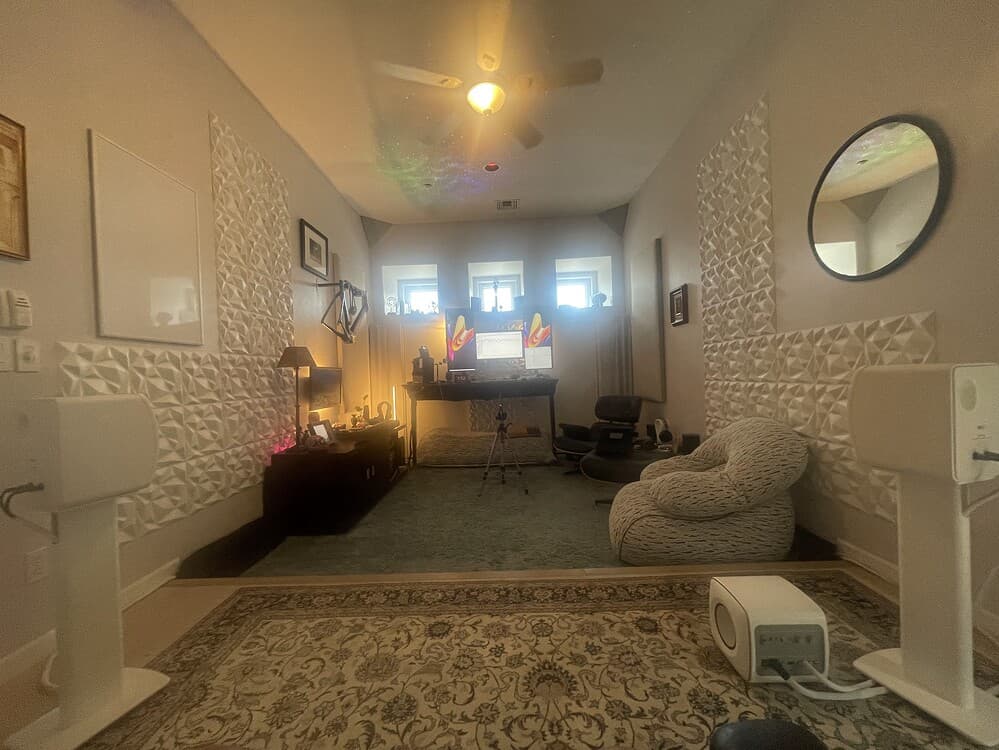
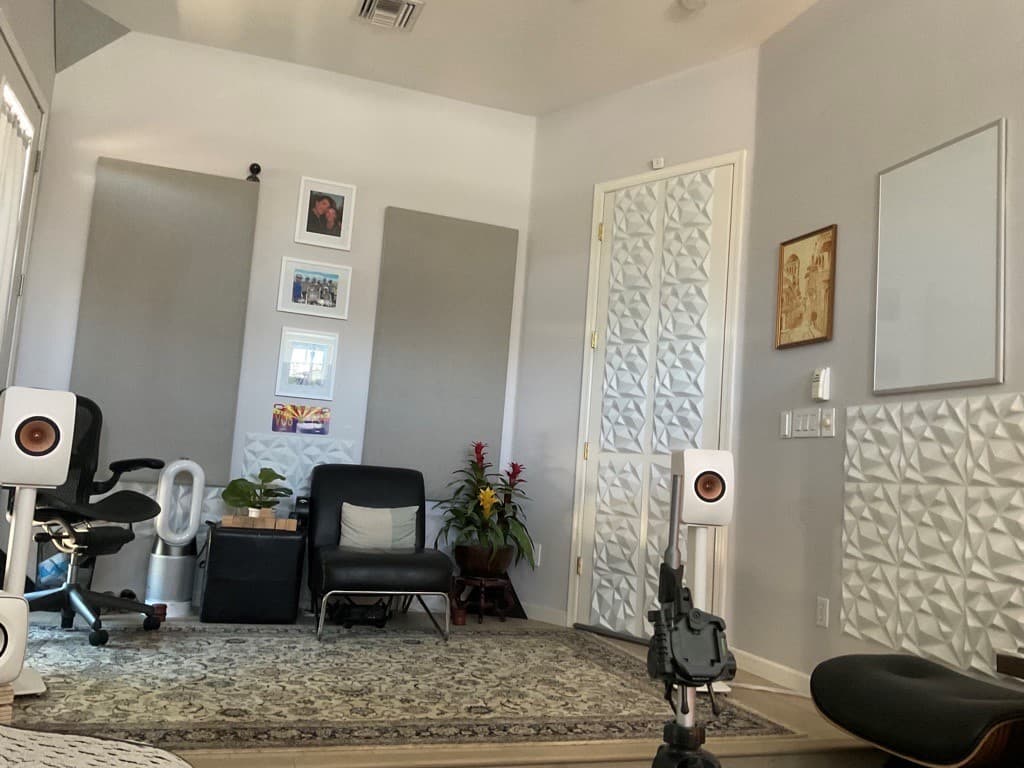
My “system”


I can absolutely guarantee that PS audio chose I²S over USB for purely marketing/sales purposes. There’s a lot of misinformed and misplaced criticism of USB as an audio data transport protocol. “After all, how can a humble data transfer protocol like USB be good enough for audio? Audio is special and bits aren’t just bits” Manufacturers exploit this in their marketing and sales blurb and choose protocols other than USB to capitalise on the FUD.

USB is a solved problem. If a DAC has a half-way decent implemetation of USB, it’s performance is way beyond the capabilities of human hearing. A recent test of a very high-end streamer/DAC combo with I²S vs USB turned in a difference of 4 dB SINAD in favour of I²S. Noise and distortion were at -164 dB, though. So far below the threshold of audibility as to be completely and utterly inaudible, even at ear-drum rupturing listening levels.

Other than a RPi streaming data from a Synology Rackstation and my latest DIY speakers, my audio gear is all made by Benchmark Media. Besides the superb technical and audio performance, Benchmark Media has its origins in pro audio.

There’s no marketing hype. Just straight talking from an engineering-driven electronics company. Lots of proper technical application notes to demistify some of the oft-misunderstood concepts in audio, no ■■ and not an I²S input in sight.

My DAC is connected to a humble PoE-powered RPi ia USB. Even with the convolution filters in place to level out the sub-bass on my new speakers, a -120 dBFS test tone is stil audible. Noise? Are you kidding? I can’t test an AirLens because I don’t have an I²S input and using S/PDIF is inferior to USB (at least measurably). Audibly though, I challenge anyone to differentiate them in a properly controlled blind listening test.

If someone wants to lend me an AirLens and an I²S capable DAC, I’ll happily test, listen and measure compared to my current setup and provide honest, unbiased feedback.

Maybe, when I retire in 2025, I’ll use some of my hard-earned to do just some of this sort of stuff. But then again, will I be villified by the hardcore subjectivists in just the same way as ASR, Archimago and anyone else who takes a measured, objective approach to evaluation of audio reproduction?
3 Likes

To me, as well. As a CTO, you must understand UMC factors and how much is saved by not adding another port. As well as promoting PS Audio’s bizarre chosen product differentiator, I2S connectivity.

Perhaps you should consider re-calibrating that ■■ detector you were boasting of. I’d think McGowan’s decades of indefatigable self-promotion and his company’s raft’s of high-priced unnecessary audio paraphernalia would keep such an instrument signalling continually. While the blunt and expert discussions of various equipment on ASR (it’s not all Amir) would seem to me more reasonably trustworthy.

2 Likes

More ad hominem attacks for Paul and now me. :frowning: My initial ■■ detector due to comments like yours and “reviews” by Amir, was HIGH for PS Audio and Paul. As I have grown and learned and read both of Paul’s books… I now disagree with the attacks you are all leveling at him, especially without even listening to the AirLens. I don’t own any PS Audio products but I have friends that do and I trust them and my ears. As my HiFi knowledge and system(s) have improved and evolved I have learned to be skeptical of both the objectivists like Amir and subjectivists like Paul. Find your own way…

RE: Amir/ASR, does nobody else find it odd that Topping/SMSL is always the best or nearly the best testing equipment? I bought a DX3 Pro SINAD of 117 only to be very disappointed in its sound, I use it as my PC DAC. SINAD does not equal excellent sound, in my experience. My RME which Amir also recommended only scored at 112 in SINAD. Schiit even makes a product where you can choose the one that sounds better or the one with the best measurements. Could it be that Topping tunes their products to measure better? There sure seems to be an endless stream of suckers for so-called “science”.

SINAD is important if you apply a little intelligence and look at which dominates in a piece of equipment. The argument presented in the linked article is a straw man. In the example quoted of a headphone outputting at 132 dBSPL and claiming noise at 58 dBSPL as being audible - seriously? 132 dBSPL is well into the threshold of pain. You’ll be too busy screaming and trying to control the bleeding from your ear drums to be even remotely concerned about what’s happening at 58 dBSPL. This is another attempt by the scientifically uninitiated to discredit measurements based on BS and FUD.

3 Likes

I inherited it. No, it does not improve any sound. Doesn’t make it worse either, with well-designed equipment, but you’d expect a bit more for something that does costs like a real PowerPlant.

If you want it, you can pick it up, the thing weighs a ton, is huge, and shipping it will cost far more than anything I would be comfortable asking for a product that is broken by design. For the price of it, one could just get a lab-grade power supply that would actually do what it is supposed to do. But if you want it, I’ll keep it boxed up here.

Yes. Both are absolutely useless bits of marketing.

Indeed, it does. When you can not compete on competent engineering, you invent a new “standard” that is, by all measures, inferior to what everyone else uses, but can be sold to the unaware with lots of ■■ and requires purchase of many various boxes of auxiliary equipment.

Indeed. So is the idea of $50,000 speaker cables, or sound-improving fuses. While USB (just like any connector) can pass through noise, its audibility means that at least one of the devices is badly made. Probably both.

Nobody, not even on ASR is claiming that every person will always prefer more accurate sound to a less accurate one, let alone different flavors of sound that is similarly (in)accurate. Some people even pay good money for tube equipment. General preference though is statistically shown to be for more accurate sound… Does not mean that any specific person would prefer it.

1 Like

Send me a PM with the details (model number and state/location). If it works I will gladly take it and pay the shipping. Thanks!

I2S was used already for internal connections as @Graeme_Finlayson pointed out. What many don’t know is that PS defined/standardized the pin configuration to use this with a standard high bandwidth HDMI cable and then made the specs open source and many have adopted the standard thanks to their work.

Strawman argument. Nobody is recommending or promoting 50K cables. I buy mine on Amazon and yes there is a small difference between crap and good enough for me in some cases. IDK if 50K makes a better sounding cable, even if I had all the money in the world I would not throw it away on cables. Are you saying I need to spend 20K on a good DAC that removes USB sound? My RME does a good job but COAX is clearly better fed by my streamer. Your taste may be different. Enjoy!

@moderators It’s totally up to you guys, but based on previous experience, I think this thread has become a downwardly spiralling circular discussion which should be halted before we get into the 24+ hour slow mode and the personal and ad-hominem attacks that ensue which result in you guys ultimately drawing the line.

I feel that everything that can be said has already been said and we’re just circling the plughole…

I’m all for freedom of speech, but any thread which starts with the title “cables”, “ethernet”, “noise” or any similarly contentious subect is going to end up in the same subjectivist vs objectivist standoff.

Can’t we just enjoy the music?

3 Likes

Good Lord, I hope so! Would that all manufacturers did!

2 Likes

Well actually sad to see very little in this mess of comments about the product the thread-owner has asked for. Many comments that discredit the company in general when not having experienced a single product at all.
Seems this is more and more common - and of course mentioning any ultimate priced cable etc. which hasn’t anything to do with this thread.

So overall it’s a pitty when an intended exchange of concrete experiences gets diluted always.

1 Like

It all depends on what that company sells. I would have no problems discrediting a company specializing in tin foil hats without owning any of their products.

1 Like