Some fundamentals of USB and USB audio can be found here
Thanks @Bill_Janssen. So, errors would be audible as artefacts, e.g., clicks, pops etc.?
Possibly. The frame rate is pretty short, on the order of a eighth of a millisecond or less. Burst errors would probably be audible, though. But it’s up to the DAC to decide what to do. It could, for instance, interpolate between the previous sample and the next one. Not sure what that would sound like.
Yes I agree you’d probably hear ticks and pops, but not sure actually - if one sample got corrupted maybe you would not. For hard drive communication, there’s error checking. And indeed you can have errors with a bad USB cable or one that is not speced for the speed - hard drives transfer data much faster.
I am not sure about this. it is a serial protocol so you could have cases where there is corrupted signals but no pop. Unless there is some sort of verification followed by a mute signal, there could be no tick or pop.
PS: Just read the link above from XMOS. I would say an error must create a gap. What happens is the error-verification (which does exist in USB Audio) verifies that a bulk of bytes transferred is correct or not. So even though the DAC cannot tell the host “there’s an error, resend” it can know that the samples it received are somehow messed up and it’s probably a rule that this should result in a MUTE to the DAC creating a gap.
Yes, it depends on what the DAC does with a corrupted frame of samples.
However, I have experienced different sound qualities over USB while using either a USB repeater (eg USB Regen of Wyred4Sound’s USB regenerator or whatever it’s called). And also when switching to a microRendu from using the computer itself. I chuck this to ground plane noise and stuff like that, I don’t know, but you can hear it.
USB is capable of transmitting data rates orders of magnitude greater than that required by audio. Let’s ignore USB 1.0 as it’s very much legacy. Here’s the data transfer rates for USB 2.0 and onwards:
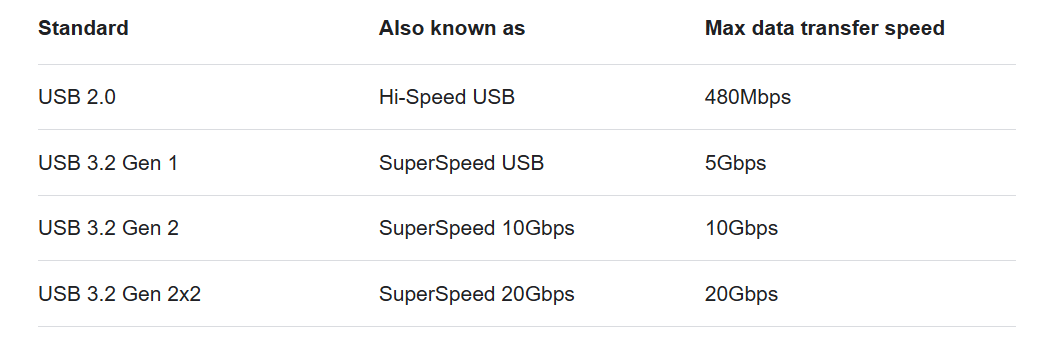
Stereo DSD512 is only 45.16 Mb/s which is less than one tenth of the bandwidth capability of USB 2.0. If USB is dropping data, then something in your system is BROKEN!
Seriously, digital data transfer has been a solved problem for years. Audio data doesn’t even begin to tax the capabilities of modern digital data transport systems.
People need to stop worrying about stuff like this and focus on speakers, their placement, room interaction, room treatments and DSP. Everything else is small fry. Once you’ve sorted that stuff, if you’re of a mind to tinker and squander cash, then knock yourself out. BUT, until you do sort out your speaker and room interaction, anything else is wasted effort compared to the miniscule returns.
Have you any idea how much electrical noise is needed to compromise USB data integrity? Even the harshest of industrial environments manage fine with data integrity over USB. Seriously, I work in environments where very large variable frequency drives are used, electrical motors of > 1MW on HV (>= 3.3 kV) supplies are in service and I’ve never experienced USB data corruption. A typical home on a 220/230/240 V supply with a 100 Amp incomer can max at 22 - 24 kW, and you’d never be switching that sort of load. Industrially, motors of hundreds of kW are switched in an out with start-up currents of >10x running current, even with Star-Delta starters. The level of mains interference and EMI generated is huge, yet all of our instrumetation, PLCs, Devicenet, Modbus, Profibus, DH+, ethernet communication protocols work just fine. Data saved and backed up over USB is faultless.
We have instrumentation which is far more sensitive than audio equipment working just fine in these environments.
Engineers take care of this stuff. As I said before, worry about your listening room and how it interacts with your speakers first and foremost.
To put it another way, the specified bit error rate for USB 2.0 is 10^-12. That means that if you streamed Redbook 24 hours a day over USB, you’d get maybe two bit errors, max, per month.
Yep. Using standard cables, decent Amazon stuff if you will. Nothing fancy. Just matching the requirements of the standard. There are no such things as audiophile USB cables - but this is for another war 
What a hilarious circle jerk goes on, over and over again.
We don’t listen to -120dBFS 1 kHz 50% square wave test tracks, I mean someone here does, but I don’t. It’s not about data dropping on USB or SPDIF or AES, it’s about the time domain and smearing that happens when noise is introduced via whatever means noise is being introduced and about the harmonics introduced throughout the spectrum by that time smeared signal. You don’t hear it, I’m perfectly fine with hat.
I’ve connected $700 dollar LPS to a $200 reclocker (crazy I know right?) and I’ve heard significant improvements. I’ve swapped $20 dollar USB cables for $100 USB cables and I’ve heard significant differences. It doesn’t take expensive cables to notice changes. In the real world we don’t listen in A/B tests we listen with imprinted long term memory, it’s why we can instantly tell when someone we talk to often has a cold. Make a change, buy a $100 Wireworld Starlight USB cable. It doesn’t have to be expensive, hell you can sell it when you’re done… You can’t hear it, that’s fine an move on.
There’s a embarrassingly pathetic johnson swinging cadre here that’s seemingly always going out their way to tell others they’re not hearing what they’re hearing and can’t let someone’s opinion go unanswered with a said johnson swing.
EVERYTHING matters, room treatment, speaker placement, a/c current quality, DC power supply noise, cables of all sorts, vibration/isolation damping. EVERYTHING makes a different.
Enjoy listening to your -120dBFS 1 kHz 50% square wave test track. I’m happy getting the exact sound from my system I want and you’re apparently triggered by that.
No more posting on the subject for me it’s gotten old.
Swinging johnson circle jerks? Wow, have we gotten off topic! 
It would be more convincing if you could say what this means in the actual technical things that happen on USB
That’s true. At the same time, eye witnesses are notoriously unreliable because they can’t say what actually happened 5 minutes after the fact. And Anne-Sophie Mutter can’t distinguish a Stradivarius from a run-of-the-mill violin in blind tests. (True thing). The human mind is a funny thing, so it shouldn’t be treated like an objective measurement instrument.
But we’re not general population, if you’re spending the amount of money that you could buy a nice entry level German engineered sedan, I’d seriously hope that you were more than the average listener. Why bother otherwise? I’m confident in my listening skills (yes it’s a skill), and I can pick out a lot. Every now and then I downgrade a piece of equipment or cable or power supply to make sure I’m actually hearing what I claim to. If you’re in the not reliable listener camp then save yourself a lot of money and buy a Bose system and call it a day right? Or unless we’re buying gear just to impress the neighbors. Which are you? I don’t know, but I’ll stand by my claim that anyone in the hobby that isn’t in it to impress their neighbors should be able to tell. It doesn’t take a lot of investment either, these are differences that even a modest $5K (used market) all in well put together chain would easily resolve.
If you’re genuinely interested in understanding the why, this guy does a pretty good job, no affiliation but it’s shared in a technical enough way where those who care, can follow along and shared in easy digestible and science based. Enjoy, or don’t. I honestly don’t care. I’m simply posting for the sake of those that have an open enough mind to actually listen for themselves. And I don’t mean listen to a -120dBFS 1 kHz 50% square wave test track, because that’s not listening to music.


And Ms Mutter is a representative of the general population?
I looked into your videos and as far as I can see they are all about analog cables. That’s a whole 'nother can of worms (hey, I use Chord Sarum T - look at my system info in my profile and you will realize that I am not a stranger to some things that are difficult to explain) but it has nothing to do with this thread, which was originally about power supplies on computers and has turned to digital cables, and you talked about USB
And spare me the sermon about your actually listening to music and not test tones. I am always the odd one out among the Diana Krall aficionados on every hifi forum because I grew up on punk and noise rock.
Electrons flowing through a cable don’t know know or care what they’re carrying. As I said, I’m not posting the information for you or the cadre. It’s for those with an open mind and the ability to say I don’t know, so let me research.
Ms. Mutter, one anecdote does not a theory make, science and all, I mean you either support it or you’re just looking for details to support your half arguments. Grow a little.
You have no clue about how digital works, which is the common theme among the people who go on about switches and digital cables
Research is a big word for dabbling, but nobody is preventing you. However, your right to it, and to say what you think, does not mean that others can’t challenge your statements on a public forum.
Ms Mutter and several other experienced orchestra people went on German TV in a blind test and failed to make the distinction. This was a few years ago after the many widely publicized articles like
Now, personally I don’t think this proves that they sound the same. But it puts another big question mark on your mysterious powers of sound memory
Ad hominems are the best way to support hypotheses
Provide some evidence that “noise” 120dB below the signal level introduces “time domain smearing” and “harmonics” which are audible. Go do some research and see just how much harmonic distortion is required before it becomes audible. The harmonics you claim to be present would be measureable, if they existed. They aren’t measureable, so they don’t exist.
This guy has a degree? Where’d he get it? In a Christmas cracker Pseudo-scientific testiculating* to the max.
*for the non-Brits; testiculating - waving your arms around and talking bollocks.