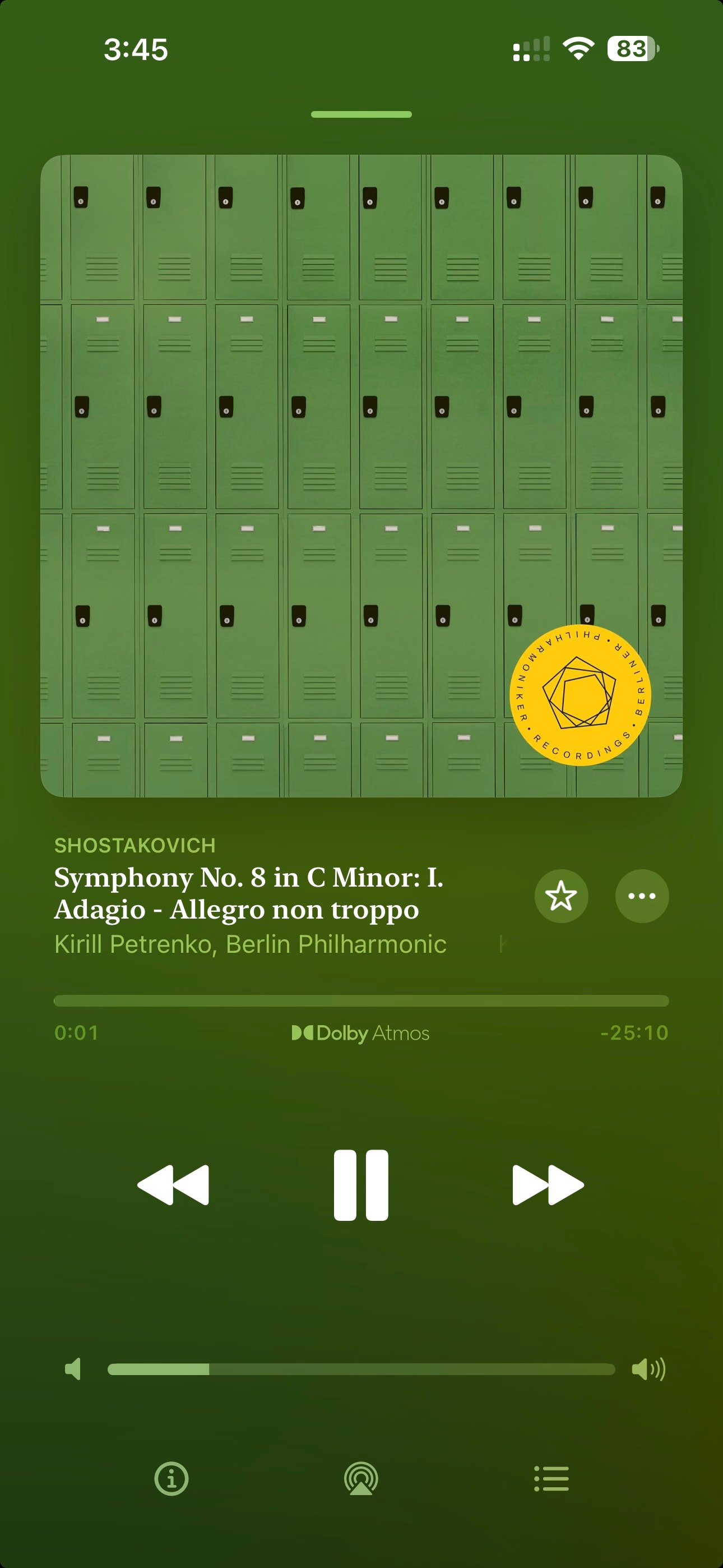
Apple Music streams and decodes Dolby Atmos music and uses official Dolby Atmos trademarks. It’s fully licensed. Apple products can use the official Dolby Atmos renderer or the Apple renderer. The Apple renderer has supported head tracking for a long time.
The term Spatial Audio is Apple’s branding in front of Dolby Atmos, or in the future any immersive technology the company wants to use. It could enable Auro, Sony 360, or open source immersive decoding, yet keep the same Spatial Audio branding, so consumers aren’t confused.
As you can see in the photo below, it says Dolby Atmos and it’s fully licensed.
If all Roon is doing is integrating the Atmos tracks that exist on Tidal, are they subject to these fees and requirements? That would seem unfortunate and unreasonable if so.
That said, I’d happily pay a few extra dollars for a Roon tier that supported Atmos streams. Moreover, both Roon AND Tidal would get me back as a subscriber.
Eventually Roon 7.1 and 5.0/5.1 users will hear atmos music (even 5.1.2) and want it - and be willing to pay extra for it. What about this compromise: Let Roon at least recognize mkv files in order to store and play them. - And since Roon hardware probably can’t do it with a software-only update at this time, at least let it send the stream via HDMI so that something like an Arvus HD1D, or any atmos capable endpoint can take it to 5.1.2 and up. Steven Wilson’s Headphone Dust site, for example, is selling them, and for those not satisfied with the lower-res atmos from Apple, Tidal and Quobuz - I think it will catch on. [nucleus->Merging+NADAC]
Agreed - I actively seek out Atmos and other multichannel formats. For Roon not to support it in 2026 is just perverse.
As you note, all they’d have to do is pass the bitstream unmolested to the endpoint (obviously, that supports Atmos). I’m assuming it has something to do with their strategy of ONLY sending decoded PCM across RAAT (if I understand correctly), but IN MY OPINION, they should rethink this.
I wish Dolby would release a container file that Roon could get behind and implement. MKV as a container works but it is open source and unlike FLAC, it by-passes the license fee to Dolby and so I do not believe Roon will support this.
For Dolby getting it’s start in audio recordings, I do not understand that they would be missing out on this hugh opportunity. It is a matter of money and I wish that Dolby would recognize how big of a market awaits its container to be released.
Hi Mike D, Thanks for directing the conversation to licensing. But isn’t MKV is only a container for delivery? I think that those creating the Dolby content and the manufacturers of atmos playback products will have already paid that important obligation. They already advertise its use in music-only products on their public facing webpage. I think it falls back to Roon for figuring out how to send the data - and keep that option clean from being a point of confusion.
Hi John, MKV is a “general purpose” container, just like .wav and .mov - which can carry video, timecode, subtitles, chapters, etc - even non-Dolby obj oriented immersive music like Sony 360 - so that is probably not the issue. As an atmos producer, I pay for Dolby directly or through the purchase of DAWs I use. Atmos-able endpoint manufacturers pay a license to use it and advertise the Dolby logo.
RAAT is based upon fixed speaker-to-channel decoding and so is a completely different beast. I’m hoping that if it could identify and bypass all MKV (or ADM) and send the stream straight to HDMI. Doesn’t seem that complicated.
But, maybe the issue is too much variation in the endpoints’ decoding, and,. I can imagine the giant support headache Roon would face with home theater problems! That is not its audience. Nor do I want it to be. (there is no screen in my listening environment)
Maybe for personal or home use but not for retail. This would be the same as someone burning copies of CDs and selling those copies. That is illegal. A MKV file is a copy.
The Dolby container would be the same as a MQA container file where when it is produced, a fee is paid for the copy and a fee is paid for the hardware to decode, but you cannot duplicate these copies and then sell them. When a MQA file was purchased online thru an authorized distributor, a fee was paid to the MQA organization.
Dolby is not a container. In the studio, atmos mixes are created as ADM/BWF format files, which are not playable in consumer gear - so need to be converted. The only lossless file type (lossy is not worth the bother here for us audiophiles) is Dolby TrueHD/Atmos, which is made for Blu-Ray discs using the Dolby Media Encoder, bought directly from Dolby Professional. These can live in an MKV container. I don’t know of any, but if a media server could simply stream the data (HDMI out) to an Atmos Ready endpoint, it could replace a BluRay. Replacing a disc is a familiar concept for Roon users, but RAAT will not read raw data from its drive without processing it, nor will it read an MKV (or ADM/BWF) file. I’m hoping to learn if doing so is a possibility for the future.
There lies the problem. Dolby does not have a container file which would be needed to work and be distributed. MKV is a container and it works, but is it licensed by Dolby for distribution?
Steven Wilson is a well known and also a great producer of music. He has also done a lot of Atmos music production over the years. I have several of his works and they are very well produced.
I’m sure he can distribute his own music. I am curious though how he is able to distribute Atmos thru a container that could be or not be authorized by Dolby. Again this is a Atmos copy. Lots of unknowns here.
When Roon implemented MQA there was no price increase because I think that the MQA fee was obtained when recorded, sold and played on the hardware and Roon was just like a passthru piece of software. It would seem that the same would apply to Atmos. Like MQA, Atmos is a proprietary format and if Dolby would introduce a container then Roon and hardware vendors would get on board like it was done with MQA.
Danny stated that Roon had to pay a fee for MQA. Presumably this would be the same for Atmos. The question would be if it would bring in enough new subscribers to be worth the fee as well as time and development.
I’m curious… is the solution to Roon supporting local Atmos files (I.e. MKV files on my NAS) different than supporting streaming Atmos (Tidal)? Are the potential licensing costs that were being discussed above different for each? Is one more complicated than the other? Would Roon implement one without the other?
For what it’s worth, if Roon implemented Tidal Atmos, that would be sufficient for me. The number of local Atmos files that I have is minimal. Both Roon and Tidal will regain a subscriber if they make this happen.
Yes, this could be another angle for Roon to approach this using the Tidal container. The Atmos library on Tidal seems to be impressive and is growing every week with new releases.
Have you notice how many DACs that have been released in the last year or so that have HDMI? If a Nvidia Shield can pass Atmos playback from Tidal, it seems that the rest of this puzzle should not be that hard to implement.
Even if it is just the Tidal library for now, that would be a start.
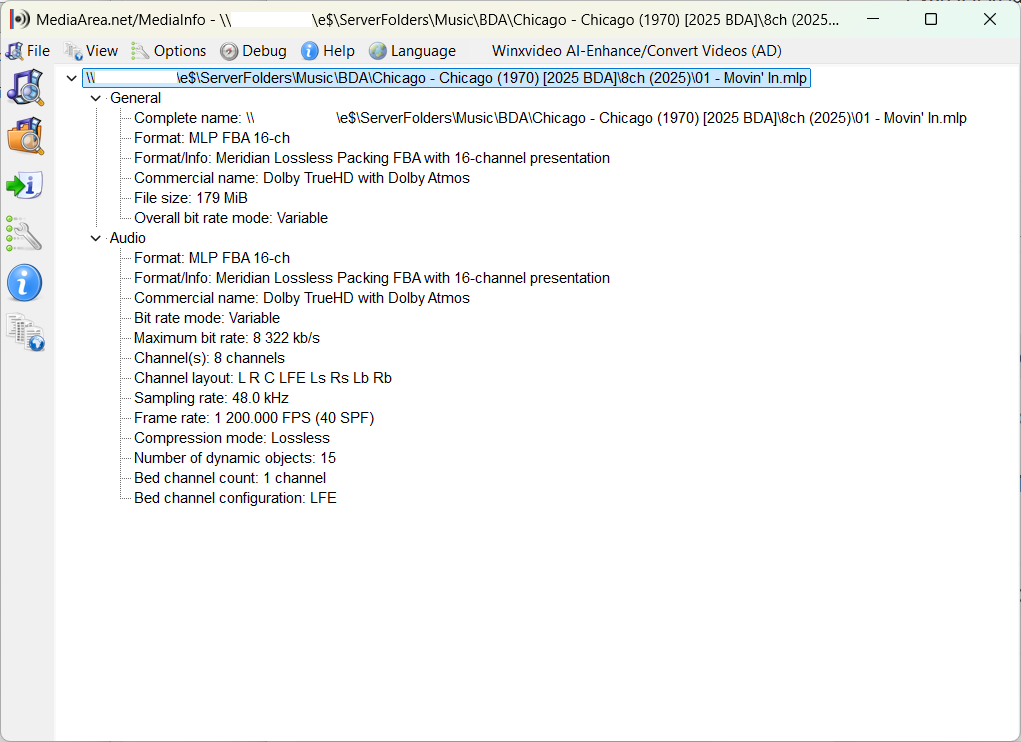
In my journey to play Atmos music files from a server, I found that I can rip the file from a Blu-Ray disc, but it had to stay in native Median Lossless Packaging (MLP) format to preserve the Atmos spacial encoding. An Atmos encoded track is not simply 7.1, it contains up to 16 channels (dynamic objects) of sound placement. Saving to FLAC will lose the dimensional dynamic.
As with 5.1 surround tracks, I use DVD Audio Extractor to provide that freedom from putting in a disc every time I want to hear a song in multichannel splendor. Like SACDs (DSF format), I have to use the Direct Stream Demux option to extract the file unmolested.
This allowed me to save each song and format individually, where MKV would have saved the entire album and all formats in one file. While it is a personal preference, it’s also the difference between Roon reading a container (MKV) and an individual sound file.
Since I use a Windows-based Roon Bridge connected to my AVR, the trick to playing uncompressed Atmos tracks is to install both a player (MPC-HC or VLC) and the Dolby Access decoder from the Windows Store.
Now, I’m probably wrong about this, but I think for Roon to play MLP files, they would have to build another transport, like DSD. Only, you can’t have an option to convert to PCM because it would lose the dynamic objects. Then, whatever (Roon endpoint) you connect to your AVR would need to support the Atmos decoding. That’s probably where the Dolby licensing would live. In the case of my Roon Bridge, it’s a Windows app.
Lastly, the difference between this method and somehow leveraging Tidal or Apple libraries is that these files are uncompressed. They do sound better (I’ve compared Blu-ray Atmos to Apple Spacial Audio), but many will find a subscription to Tidal or Apple more manageable than buying and ripping discs. Either way, I think the decoding would need to live on the endpoint to preserve the dynamic objects.