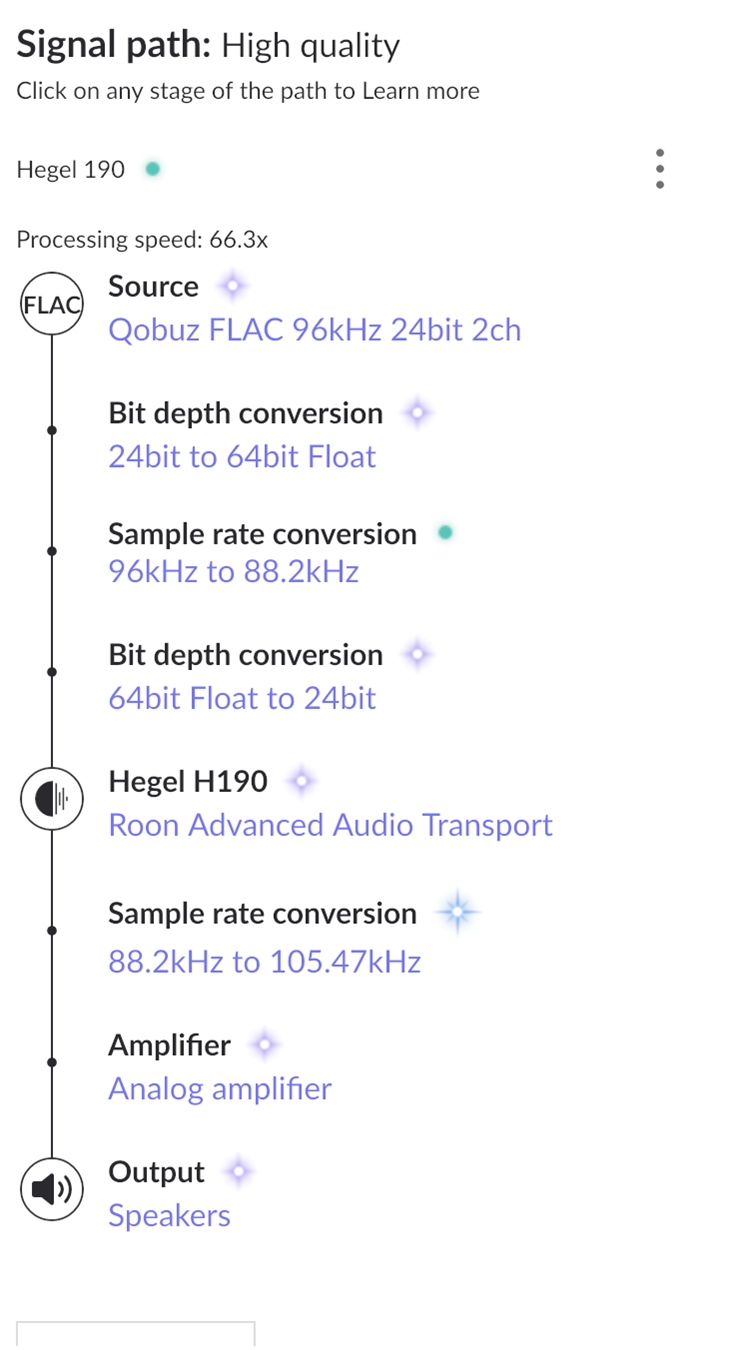
· **Title:** Unexpected sample rate conversion (96→88.2 / 192→176.4) to Hegel H190 via RAAT
**System:**
* Roon running on Mac (single-app setup) * Output: Hegel H190 (Roon Ready, RAAT) * Network: standard home WiFi (no bridges/repeaters in path) * Sub: SVS (not relevant to digital path)
**Issue:** Roon is consistently converting sample rates before reaching the Hegel:
* 96 kHz → 88.2 kHz * 192 kHz → 176.4 kHz
Then the Hegel shows an additional internal conversion (e.g., 88.2 → ~105 kHz), which I understand is normal for the DAC.
The concern is the **pre-Hegel conversion**, which I believe should not be happening.
* All modules disabled (EQ, headroom, etc.) * Sample Rate Conversion toggled OFF * Tried both “Max PCM rate” and “Max PCM (power of 2)” * Reset to defaults * Device Setup (Hegel):
* Max sample rate = 192 kHz * No unusual settings enabled * Disabled and re-enabled Hegel zone * Full reboot of Mac + Hegel * Verified playback is to Hegel (RAAT), not System Output
Despite all of this, the conversion persists.
**Question:** Is there a reason Roon would force conversion from 48-family rates (96/192) to 44.1-family (88.2/176.4) for the Hegel H190?
Or is this indicative of a stuck DSP state or device compatibility behavior?
Happy to provide logs if helpful.
Thanks in advance.
Tell us about your home network
· Using a bridge tp 3001; Comcast wifi. router Asus
The Hegel H190 (along with the H95 and H120) is designed with a specific digital architecture. When these devices talk to Roon via RAAT, they explicitly report that they natively accept the following sample rates:
44.1kHz
88.2kHz
176.4kHz
They do not report native support for the 48kHz family (48, 96, 192) over the RAAT protocol. Because Roon’s goal is to be “bit-perfect” to the device’s capabilities, it sees that the Hegel can’t handle a native 96kHz stream and performs the conversion to the highest supported rate (88.2kHz) to ensure you still get the highest possible quality without the device failing to play.
Why does UPnP or Qobuz Connect look different?
As Hegel developers have noted here, some other protocols (like UPnP) might allow the 96kHz file to be sent directly, but the conversion then happens inside the amplifier’s internal hardware.
Hegel’s design philosophy for this specific range of amps was to focus engineering costs on the analog output and their proprietary “SynchroDAC” technology rather than a “catch-all” digital input board. Roon performing the conversion on your Mac (which has significantly more processing power than the chip inside the amp) generally results in a cleaner, higher-quality signal than letting the amp struggle with it internally.
The “105.47kHz” Mystery
That final conversion you see on the Hegel screen (e.g., 88.2 → ~105kHz) is Hegel’s SynchroDAC at work. This is their proprietary “golden” upsampling that they believe provides the best sonic performance for their DAC stage. It is perfectly normal and a signature feature of their sound.
Summary
Is it a bug? No, it’s Roon respecting the Hegel’s hardware limits.
Can you prevent it? Not without changing the hardware. The H190 simply doesn’t accept native 96/192kHz via RAAT.
Is quality being lost? Technically, a conversion is happening, but because Roon is doing it with high-precision math before sending it to the Hegel’s optimized 44.1-family clock, you are hearing the amp exactly as Hegel intended.
Does this help clarify why your signal path looks a bit “busy”?