Trying it at the moment, I was using ASDM5EC-super for the last few days with iir really like it’s analog and warm sound so much. I feel the difference when I switch to the 7th order modulator with it’s “hifi” sound. I may be extreme but I always look for that warm analog sound in mastering, filters etc. and try to avoid that hifi sound if I can. I thought IIR is the most analog filter correct? the only issue I ran with it is upsampling 48 or 192khz pcm files that’s why I switched to xla as 1x and iir on nx. I read DSD5 is even more analog than ASDM5EC modulators.
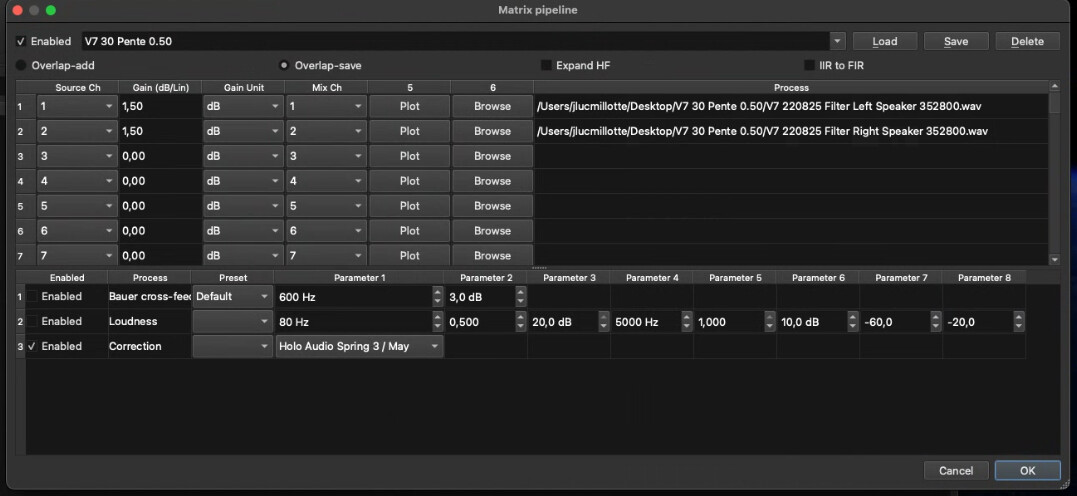
One last question I have even though my DAC is SMSL Raw MDA1 when I select enable correction in pipeline setup I see SMSL D-6 as the default DAC is this still fine to use? also was wondering what actually correction is doing to the DAC and if it’s recommended to enable it. Thanks for the help!
Yes, and IIR2 as newer and better alternative as well.
Although minimum-phase FIR filters are quite analog style as well. One of my personal favorites for old prog-rock being poly-sinc-short-mp(-2s).
For me personally, I tend to pay attention to leading impact of percussions and such. So that the attack is snappy, sharp, clean, and by no means harsh (distorted). So no artificial “digital glare”.
No, the corrections are very very much specific to a DAC model. So the D-6 correction is only applicable to D-6 (in DSD Direct mode) and nothing else.
If you are looking to try alternative DAC’s, I’m fairly certain you would like sonic character of Holo Audio offerings, like Cyan 2, Spring 3 or May.
I think I found a new favorite poly-sinc-short-mp(-2s! thank you for mentioning it!
I thought xla is great and still feel that way but that sinc filter is more analog sounding in my system. I just disabled the DAC correction, hopefully I’ll upgrade to a Holo in the future. Only thing remaining is found a solution for 192 pcm files, I couldn’t play them at all with IIR in 1x or nx had to switch to xla or sinc for both. I’ll try iir2 now to see if it will be better analog sound-wise.
By activating “Overlap-save” instead of “Overlap-add,” I think the result is better.
What are the main differences between these two methods?
Some articles online suggest that the “save” option is generally preferable.
This is an interesting question. Manual says very little of these two, only recommending overlap-add as it should use less cpu power. I’ve never even tried the overlap-save option but now I tried. I notice no difference in cpu usage between these two.
Then I asked ChatGPT about these two and it gave quite a detailed answer but recommended overlap-save as default and for room correction/bass management, as it should use less power… go figure. Waiting for Jussi’s answer
Okay, let’s wait for Jussi’s response. ChatGPT must have based its response on the HQP doc content, I suppose.
For CPU or RAM consumption, I don’t see any difference between these two methods either.
Just discovered an amazing filter: poly-sinc-hb-l
Detail retrieval is the best of all filters. Impuls is perfect. Open sound with timing and drive. All this without a digital glare. I’m surprised because it sounds really different than other filters.
Tested at 768khz, pcm.
Sinc-m and hb-l have almost opposite sound signatures, and I like both. Sinc-m is still my favorite for classical music. But sinc-m can make percussion and electronic music sound a bit thick and slow. Since 90% of the music I listen is classical, sinc-m is my default.
I’m into weirdos at the moment. Won’t try to persuade anybody ; just for the record, I have Red/May + high end active speakers and care much for energy radiating from its source and things like coherence of a piano image
I dared try Direct SDM for DSD sources (99% 64) and was happily surprised I still have convo working (FIR transformed in Pipeline). Should I still care for a hidden modulator under the hood even though it reads Direct SDM and Direct SDM for shaper and filter ? I have 7EC super
I much prefer PCM with the May (again I dig the hifi seduction and apparent perfection from SDM route but I just connect less, make less sense of the music ) and gravitate around hb m (interesting to make the music too thick and slow (most of the time) with hb l and xs with hi res live can be very vivid). The weirdo thing is that I prefer 16 x (7xx) over max and am puzzled that top expensive offer from say dCs doesn’t go over 384. Am I the only one not preferring to max ? (for texture, coherence, focused energy…)
If you have matrix enabled, Direct SDM doesn’t really do anything. If convolution is working, then you of course don’t have Direct SDM. Only thing that works with Direct SDM are channel delays (speaker distance).
May’s screen says it’s fed 64 (128 with 128 source files) and in Client I have no rate option but Auto. So at least it gives a NO OS order while still applying the modulator picked in Preferences ? It’s strict equivalent to picking 2.8224M Rate for 64 source for a given modulator ?
Is your recommendation for modulator and rates the same for 64 sources (sdm to sdm) than it is for PCM to SDM upsampling ? does the EC have the same importance ? how about the DSD modulators family (DSD 5 7 etc)? are they for 64 DSD sources while AdaptativeSDM family would be for upsampling PCM ?
I came to the Direct SDM experiment after trying to play Pharoah Sanders Karma SACD, my Mint original LP being ridiculously better, in that Sanders’sax has body, giving it consistence while with any upsampling I tried it does not stand out of a mess of sound, being a mere different tone in the canvas, not an instrument originating its energy. Plus upsampled agitated bells sound hollow, mere trebly sounds.
It was much better in (pseudo) Direct mode. I suppose you disapprove (noise closer to audio band, not so pretty signal etc) ?