Interesting to hear your thoughts on the change. I am just running in a new pair of speakers at the moment and awaiting some acoustic panels. I will then re-measure and send off to Theirry, I have not yet used his services, although I have had a go after using Magnuses guide. I do have a tricky listening position with one speaker close to a wall and in a bay window (and actually slightly forward of where it should be). My new PMC speakers suggest aiming the speaker triangle to meet behind the listening position, but I am finding it tricky to get right. Oh well, it keeps us entertained.
1 Like
Yep in a normal home and general purpose room, finding the perfect position is not that simple at all.
No its not. I make liberal use of blue masking tape on the floor to guide the setup. Then I mark out the speaker setup with the same tape (around two of the four speaker foot posts) when things are dialed in. Then I can always get things back to normal.
FWIW, I don’t do the whole LPSU or audiophile ethernet cable stuff. But I do get nuts about setup.
It is if your constrained for space, which a lot of us are. Things in the room for living get in the way of perfect placement, this is what I mean. I can’t get my speakers perfectly placed or I would not be using DSP to reduce the bass. I would need them so far in to the room it’s not practical or safe and these speakers are not known for being overly bass heavy.
I meant, ‘no it’s not easy’. Even under the best of circumstances its a challenge. Then you add in all the constraints we have to live with, it’s even tougher.
Arh sorry misread you. Apologies
1 Like
Forgive me if I’m speaking a little out of turn here, and I realise this comment is said lightheartedly, but it does seem a bit un-sporting if Thierry ends up having to redo everything because of a change in the room environment? I agree with it being really difficult to find the right speaker position in a general purpose room though - given how poorly my speakers have had to be positioned I’m amazed at what Thierry has managed to achieve.
No your not wrong. I offered to pay upfront as I don’t expect it for nothing and apologised prefusly. He’s being very patient with me. He does offer redoing the filters if you change amp,speakers etc at a lower cost than the initial price so this is part of his service although unexpected in a week I guess. I really cant praise him enough though, excellent service all round.
1 Like
Apologies, that wasn’t very clear from the first post. Glad it’s all working out for you 

And all done new filers in da house.
Very happy with new filters. Job done. No more tweaking now, leaving it alone to just listen now.
Give it a week 
2 Likes
Nope I have told him I am done now, not that he would refuse more money for any other tweaks, Hope the kids dont knock the speakers. I will have an issue come Christmas as my hifi usually has to move to make way for the Tree. I will have to push back this year.
Mark the positions with some tape or better yet a light line with a permanent marker. If painters tape is not allowed use some invisible sellotape perhaps.
1 Like
Yep i would likely do that if I have to move them temporarily
Hello Folks.
I am looking at this nice guide and have as yet not read all 435 comments.
I’ve got the freshest REW 5.20 Beta 13 and this guide was written in 2017; I hope there’s nothing important different to do with this current version compared to back in 2017.
I have just taken my first RTA measurements as described (not adjusted a thing yet, just took measurements), and compared to the graphs I’ve seen, I seem to have a really horrible response curves.
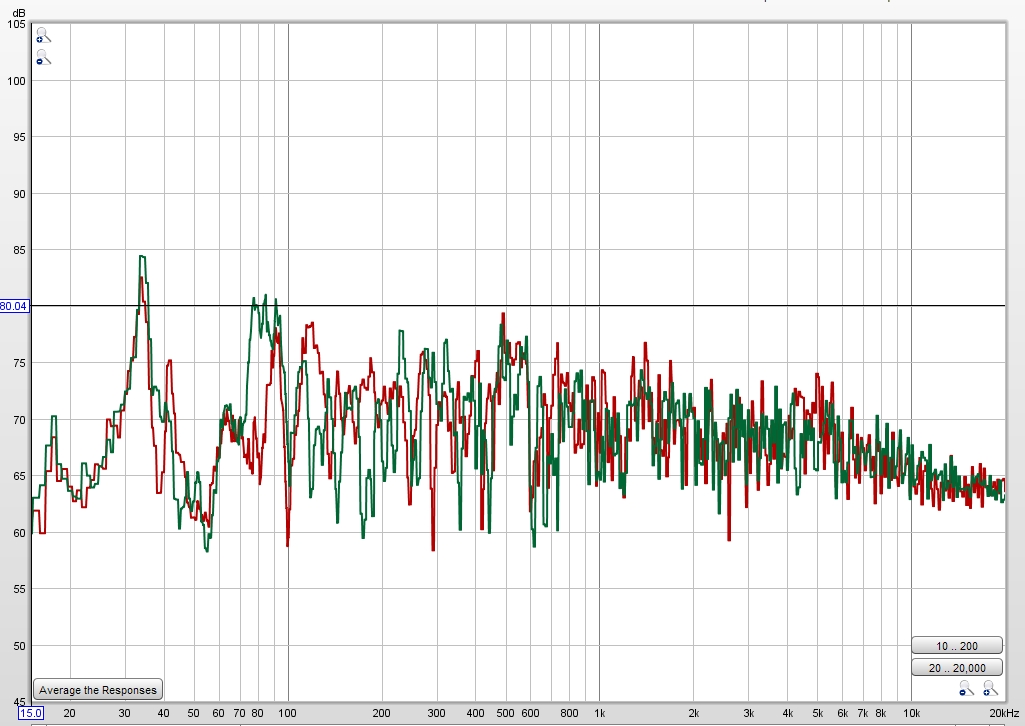
Before I try correcting stuff that’s uncorrectable because I am making some terrible procedural mistake, I wanted to ask, does that look like I am making a mistake making the measurements?
Thnx.
The guide is getting old, it has been kept alive a long time. But apart from some smaller GUI changes in REW that becomes apparent from the screenshots, its still valid as far as I know.
Those measurements looks good, maybe raise the volume so you get around 75-80 dB in average, and then use “Var smoothing”. It looks like you have a fairly symmetrical setup so I think I would do a simple mono correction (one measurements on both sides of head, and then correct and export it as mono). But feel free to follow the guide if you prefer.
The dip at 100Hz is speaker boundary interference, but its so sharp its nothing to worry about. If REW corrects it by adding a sharp +dB filter at 100Hz you can (and should) disable it. The big dip at 50-60Hz is probably ok to correct, buy you might want to experiment with and without corrections.
Well, I guess every room is different, and many are “horrible”, so perhaps the raw RTA is simple as it is.
Getting past that, I do have a less nebulous question. The current REW interface has the following options that are not shown in the screenshots from 2017:
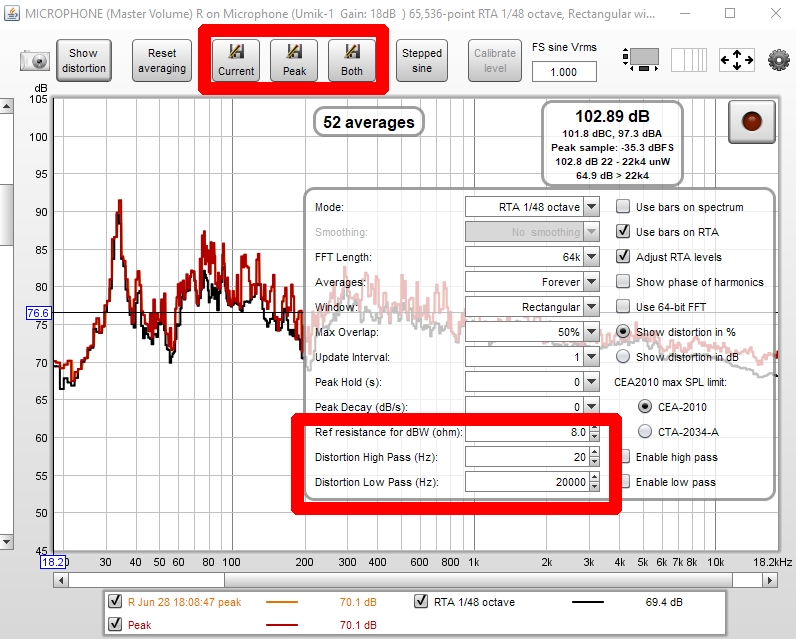
So, when saving the RTA data, do we want “current” or “peak”? And can the “Ref Decay”, “Ref resistance” "Distortion high pass"and “Distortion low pass” options be left as they are set by default?
Thanks!
1 Like
Save with “Current”, and those option looks good. I also use “Use 64-bit FFT” but I doubt it matters for analoge input.
2 Likes
Great! Now we’re cooking with gas!
How about this option?
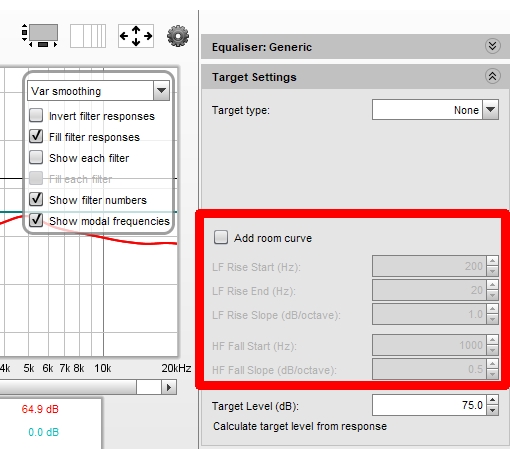
In your guide, it seems the room curve settings were not de-selectable, and these days REW lets you turn that off entirely. I ofcourse have no idea what my room curve would be - should we turn it on and select the values as in your screen shot?
Thnx. =)
Added: When exporting “filters impulse response” 32-bit FLOAT is selected by default… however there is also the option of 32bit PCM. Which should it be?