Denafrips DAC users

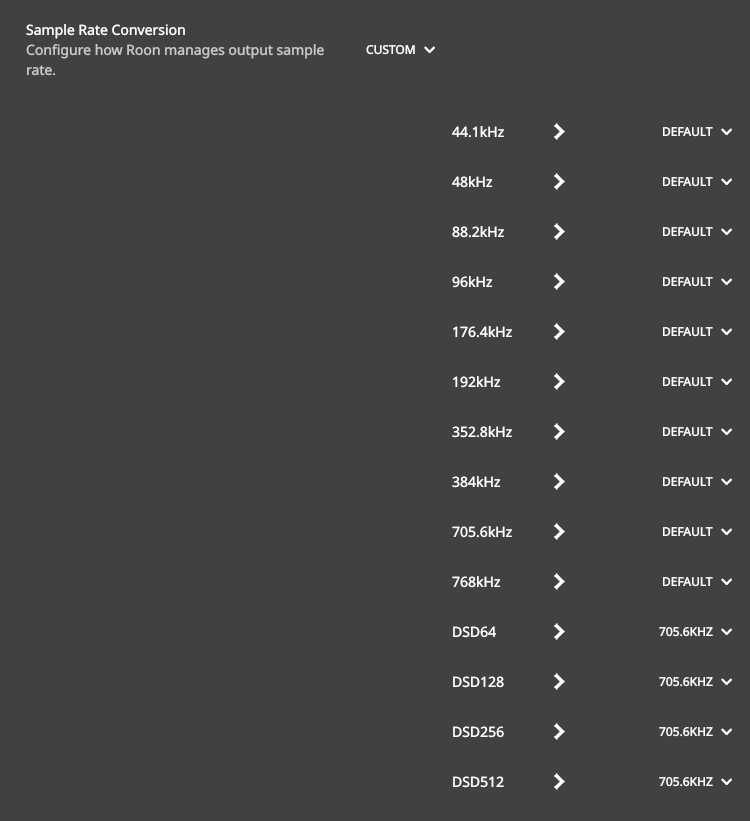
Since the Lumin features what we believe to be a better algorithm of digital volume control, please try enabling Volume Control and Leedh Processing Volume in the Lumin app settings for Lumin U1. Set Roon to convert DSD to 705.6kHz if you use U1 USB output (352.8kHz for U1 MINI USB output) to Terminator Plus, or 176.4kHz if you use U1 AES output.

Turn down the volume before you play it back.

You may also set the Max Volume % to protect the speakers. Example Max Volume % set to 80% with main volume set to 70 equals actual volume 70 * 80% = 56.

Both the Leedh Processing Volume and the Max Volume % features are active even when using Roon.

If you use the Lumin digital volume, you don’t need a preamp.

2 Likes

HI @wklie

Did I get your recommendations correct? What will happen if I select 765 KHz?

That’s a mathematical preference. If I’m not mistaken some Chord products also convert DSD to 705.6kHz in some modes.

DSD64 2822400Hz / 705600Hz = 4 (integer)
DSD64 2822400Hz / 768000Hz = 3.675

1 Like

Thank You, @wklie. :slight_smile: What would be you recommendation for the best & efficient way to handle MQA files as T+ does not handle MQA natively?

You may set Roon MQA Capabilities of Lumin U1 to No MQA Support or Renderer Only, for connection to Denafrips DAC.

1 Like

And set the MQA core decoding… Thank you @wklie .

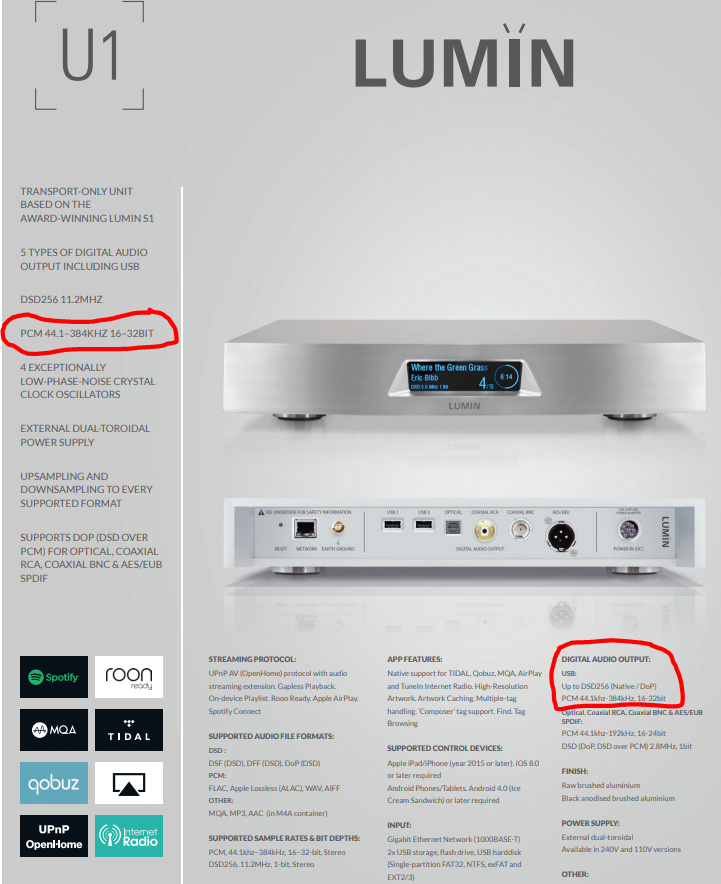
Also I noticed the LUMIN U1 Brochure at LUMIN U1
downloads the PDF file which has incorrect data, I guess.

The brochure is really old. Please refer to the web specs.

1 Like

Received the T+… The delivery was amazingly fast… I’m continuously playing the T+ with speakers off for like 12 hours now. The contact from Denafrips said it will take 10 days to settle down for all practical reasons, though it has 100 hrs pre-burn-in… :slight_smile: Waiting for XLR cables from straight wire, [Jerry@straightwire.com] recommendation from @David_Snyder (thank you) , Got a discount too.

2 Likes

My Ares II is a week old today. Already ordered a Venus II, it’s that good. Can’t wait to hear your impression.

I ran mine continuously for the week. No difference to my ears. Probably because I’m not much of a burn in believer. Don’t wait give it a go.

How could you ever design anything if you had to wait weeks for things to sound the way they “should”?

1 Like

I definitely agree… I want the T+ to loose it’s virginity :slight_smile: over XLR cables, Hopefully, next week Thursday will be the Day…

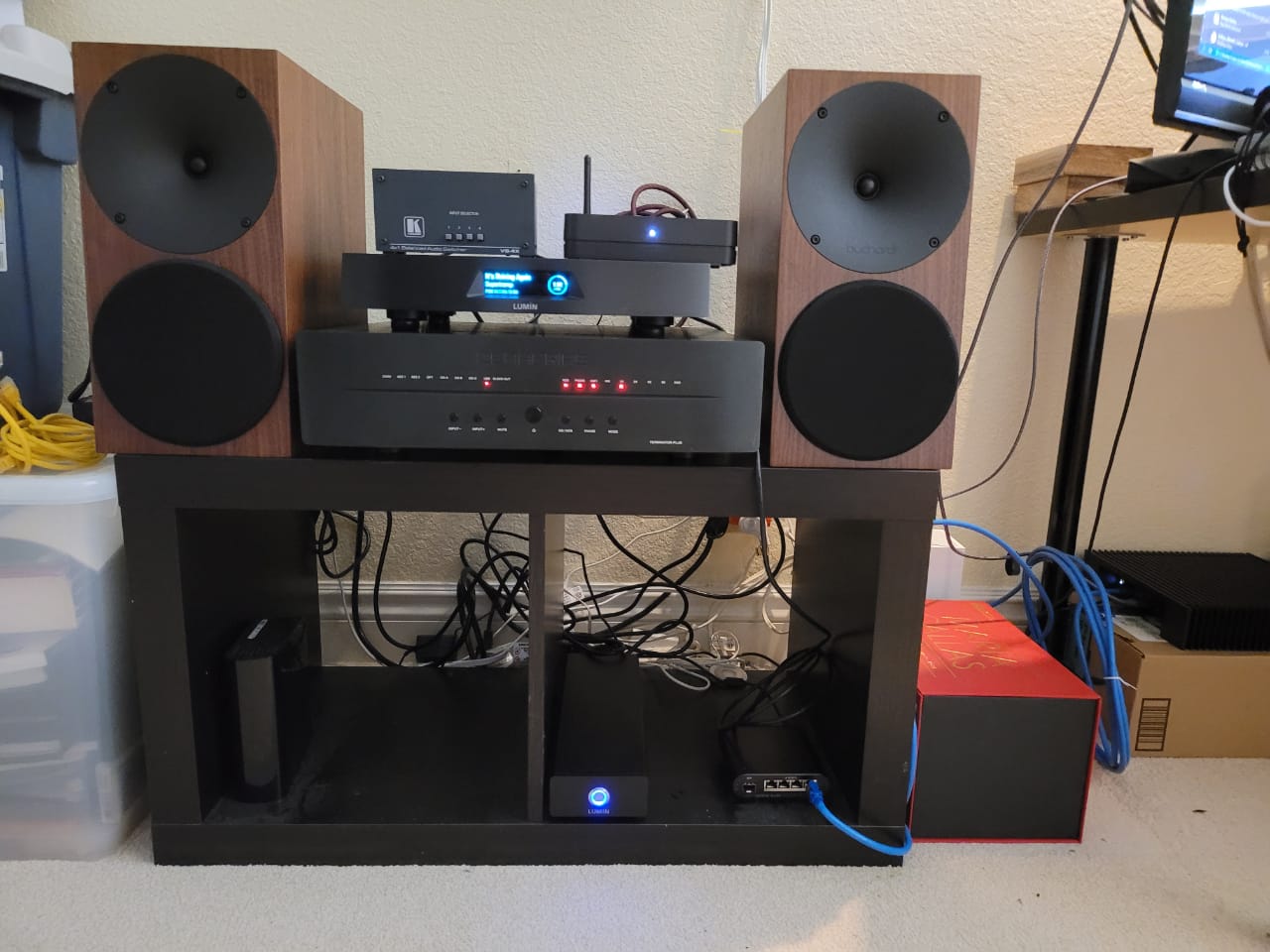
The temporary resting place of T+, U1 & A500’s…

1 Like

I like the idea, but my engineering mind just says no. A big honking mechanical subwoofer cone, yes perhaps… maybe. Electronics no. V8 engine yes, but quickly.

I think burn-in is a way for companies with 15-30 day trial periods to get you to keep it past that mark. And it has become a thing in the fast moving info-age. Repeat anything enough and the uninformed masses start to believe it.

Better or not I’m sure you will like the Terminator. I wish I could have justified the extra $$$, enjoy in good health!

3 Likes

Bought an Ares II recently for my second rig. :smiley:

1 Like

My nigh on 50 year experience with hifi says there is a thing we could call ‘burn in’, but it’s complicated. :blush:

This Ares had the strangest sound when I first plugged it in, interesting, enticing, but plain weird, all over the place really, disjointed maybe? But I’ve been around audiophilia long enough to know people don’t make components to sound like that - this is a a case of warm up required - mine and the DAC.

Now I reckon there are several reasons for the ‘burn-in’ phenomenon and which is topmost depends on the item - digital, analogue, bog standard op amps, chipsets, or more esoteric discrete components - and the individual involved.

The first is system acclimatisation, I often feel a new component needs time to shake hands with the rest of the signal path for a while, shift some electrons around the place, align structures - say hello! Don’t laugh, I introduce my components gently, system synergy is all, I know it works! :laughing:

The second is simply heat, atoms vibrating, components alter after warm up. Digital much less so, analogue elements more so. Even a few minutes after switch on makes a difference, my Mojo came on song about half an hour after receiving a signal, my little Topping L30 about a few minutes, my Topping E30 instantly. This Ares was ice cold on arrival, weeks in storage and transport probably, never switched on since manufacture - poor thing! I gave it some Woodward electricity (albeit not conditioned and probably terribly noisy - my speakers pop when I turn a light on!) and left it to warm up for a few hours.

The third is the most important - the personal and uniquely individual human physical and mental perception mechanism. If you listen to a component in your system whilst you are ‘burning it in’ you are actually burning in your ear/brain perception mechanism as well!! There is no way to avoid this on first listen, I found the Ares so weird because I have had several months of my existing system burning in my perception mechanism - and this now sounded very, very different.

You see, we don’t hear music, we interpret sound waves moving in the air and hitting our ears via a sophisticated ear/brain interaction. There is no music coming out of these speakers, or running down the speaker wire, or whizzing around inside the DAC or amplifier - we turn sound waves back into music via perception. We do in fact turn all reality (which is nothing more than a wave) into what we perceive it to be via the same mechanism - but that’s another story.

So if we allow the ear/brain perception mechanism loose on our new pet too early we will be simultaneously hoping the physics does it’s job, whilst also seriously interfering with the mechanism we will be later using to measure the results! And is that mechanism foolproof, absolutely not, it’s all down to perception and perception is all down to our very own learned personal filters - it’s a miracle we actually agree on anything! :sunglasses:

3 Likes

I also say…but whatever if you think it gets better then good…why does it never get worse…ever…is there never any such thing as burn out?

2 Likes

Your poetic explanation might make sense for letting equipment ‘warm up’ before playing music, but for a 100+ hour burn in, not so much.

Can’t remember the last turn I turned off my DAC.

As a prospective T+ buyer, I asked @VinshineAudio why a burn in was needed, but never got an answer.

2 Likes

Leaving it on and powered up all the time I can attest to being a good thing, stability of clocks at steady temps is something I can understand being preferred.

1 Like

Ah! Well I beg to offer up even more…:blush: after 24 hours I listened to the Ares for around an hour or so, lovely, bit bright, but very analogue as they all say. Around 40 odd hours I had another listen, ouch, harsh, bright, nasty… I was seriously thinking of packing it up!

Now two things, second time I just listened to whatever was playing, all my own rips, nothing audiophile, just my warm up playlist of local files (I found Roon often just stopped after hours of streaming Qobuz so local files are safer). These are not well recorded jazz or blues but the usual alt pop or whatever - Feist, Gomez, even some PJ Harvey and I actually always think my rips sound bright compared to Qobuz versions? Anyway I lasted about half an hour and turned it down again.

I listened for an hour or so again last night, probably 50 hours or so and much better, but again this was nice stuff, nicely recorded acoustic jazz etc. So… who knows?

I’m listening now after 75 plus hours and I’m ok with it, I’m still getting a bit of ringing in my ears with this vibraphone playing, turned it down a notch… maybe my ears are messing with me today? The actual music is lovely, sounds very real, not digital at all so the Ares is definitely a keeper - but I think I have a bright system anyway and now I’m moving up the ranks with source components it’s telling?

I did measure with REW when I upgraded from the Mojo to the RME DAC and this confirmed a hump in frequency volume from around 800Hz to 2Khz, but I’ve taken this off altogether for auditioning the Ares, I don’t really want to buy a great bit of kit and then adjust it out!

This hobby is all about balancing the ‘foo foo’ with the hard physics isn’t it, that’s what makes it so fascinating for me. I would have to concur that 300 plus hours some companies are asking you to burn in their stuff is crazy! I bought a cable a while ago and likewise the recommended burn in time was hundreds of hours - but it did come with a refund or replace if it still wasn’t right warranty.

I usually find if a cable sounds awful then it’s going to sound a little bit different but still awful after 300 hours - actually tried it once! If it sounds good it may get better… maybe it’s all perception, backed up by just a little believable science? :blush:

Using the Roon DSP gain control?

On another issue all together, since bringing the Ares into the mix I’m having trouble getting my Heed Obelisk SI amp to go past one notch on the volume control without the volume being way too loud. I suppose with the Mojo and the RME I simply adjusted the output to suit, (down to .75mv I think with the RME) but obviously the Denafrips doesn’t have a preamp section.

Also I had some DSP on and that had a -3db reduction in gain to stop the little red light coming on. Would it be a problem if I used the headroom gain control to dial in say -6db to give me a little more room on the Heed volume knob?

I do have some in line attenuators, but last time i tried them they sucked the life out of the music.

I am running a 220w Musical Fidelity M6si amp to Klipsch Heresy IV speakers that are highly efficient. Ten a clock is really loud, so I adjusted the Roon headroom to -6db. It actually sounds better as I can run the amp volume control higher.

The Roon headroom adjustment is done in 64 bit mode, so there almost no affect on SQ.

2 Likes