Failed Roon Server 2.71 update and OS reinstall on Nucleus (ref#4TOM0Q)

Select your Nucleus model from the list below

· Nucleus Rev A

I'm having trouble with my Roon server software

· Other

Select the option that fits best

· The Nucleus does not boot up and I can not connect to it in the Roon app.

Describe the issue

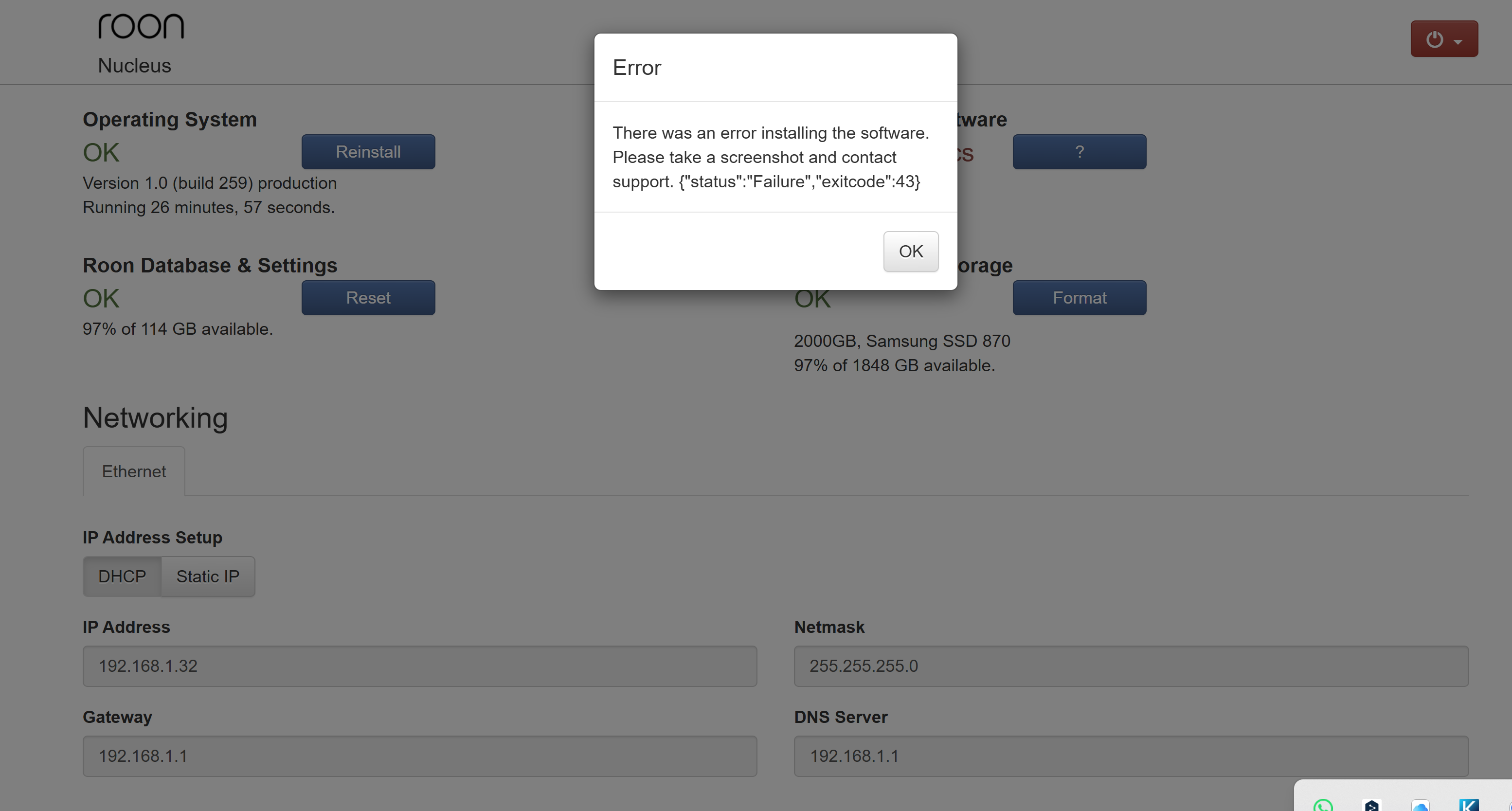
After an unsuccessful update of my Nucleus to Roon Server 2.71, I tried to reinstall the operating system via the administration web page. That attempt also failed.
The error message was: Status: failure, exit code: 43.

Since then, the administration web page for the server software has been reporting “missing codecs.”

Hello @Martin_Furrer

Exit code 43 means the step that extracts and installs Roon Server failed. Before we look at anything deeper, it is worth knowing that this error has cleared on its own for other people, sometimes simply on the next attempt and sometimes after leaving the unit alone for a day. So the first thing to do is repeat what you already tried, in a slightly different order:

  1. Please shut the Nucleus down properly, then unplug it from power for a full minute. A restart from the web page is not the same thing.
  2. Plug it back in and let it come up completely.
  3. Open the administration page and run Reinstall Operating System again.
  4. If it fails a second time, please leave it powered on and try once more a few hours later.

Please tell us the exact status text after each attempt, whether it is 43 again or something different. The reinstall does not touch your database, playlists or history, so there is no risk to your library in retrying it.

One thing to avoid. Because your administration page now says “missing codecs”, you will find articles explaining how to download ffmpeg and copy it onto the device. Those are written for Roon Optimized Core Kit, which is the do-it-yourself version. Your Nucleus already includes its codecs, so please do not install any. That message is a symptom of the interrupted installation, not a separate problem, and it should clear by itself once the install completes properly.

If the reinstall keeps failing after those attempts, tell us and we will move on to checking the internal drive, since a drive that has stopped accepting writes would produce exactly this. But please try the above first, because for several people that has been the whole fix.

Dear Vadim,

Thank you for your reply.

I followed your instructions and tried to install the server software twice. Both times, I received the error message

“There was an error installing the software. Please take a screenshot and contact support. {“status”:“Failure”,‘exitcode’:43}”.

How should we proceed from here?

Hello @Martin_Furrer

Thank you for trying it twice. Two identical failures with the unit fully power-cycled in between means this will not clear on its own, so we stop retrying the web page and move to a proper repair.

Exit code 43 means the step that writes Roon Server onto the internal drive failed. Everything below is safe for your library, and you can work through it without waiting on us again between steps.

First, before you touch anything: your backup

Please tell us whether you have a Roon backup, how recent it is, and where it is stored. If your only backups are on the Nucleus itself, please say so straight away, because getting a copy off the unit comes before anything else.

A five minute test of the internal drive

Your Nucleus still serves its administration page, so it should still be reachable as a network drive. This tells us whether the internal drive is still accepting writes, and it may save you the trouble of the later steps.

  1. On your computer, connect to the Nucleus as a network drive. On a Mac, in Finder choose Go, then Connect to Server, and enter smb:// followed by your Nucleus name or its IP address. On Windows, type \ followed by the same into a File Explorer window.
  2. Open Data, then RoonServer, then Logs.
  3. While you are in there, please copy that whole Logs folder to your computer and upload it to us using the link below. Those logs will tell us what happened during the failed update, and if the drive is on its way out we may not be able to get them later.
  4. Now copy any small file from your computer into that same Logs folder. A photo or a text document, anything at all. It will do no harm.
  5. Restart the Nucleus from its administration page.
  6. Reconnect and check whether your file is still there and still opens.

https://workdrive.zohoexternal.com/collection/nocvrfc5b2ddab55140af8640f1d7ce13291e/external

Please tell us what happened at each step.

If the copy is refused, or the folder is not reachable at all, or your file has vanished after the restart, then the drive is the problem, and you can stop there.

If the file survives, that tells us the drive is still writable, which is good news but not a clean bill of health. The part of the drive that the installer writes to is separate from the part you have just tested, so it narrows things down rather than settling them. We would go on to the USB installer.

Dear @Vadim,

The Nucleus backups are stored in the Dropbox cloud and should be reasonably up to date.

Due to error messages during the upload, I was only able to upload the last 10 log files to the address you provided.

I was able to successfully copy a small photo file into the Nucleus log folder. After restarting the Nucleus, it was still there, and I was able to open it.

Hey @Martin_Furrer,

Thanks for your patience, and for doing that extra testing, the log set you sent was exactly what we needed.

Your logs show the update failing at the same point every time. The Nucleus downloads the 2.71 package without any trouble, and then can’t unpack it. It made eight attempts between the 5th and 14th of August, and all eight failed in exactly the same way, across two different 2.71 builds.

The reassuring part is that this is not a failing drive. Your internal storage mounted normally on every startup, your database opened cleanly each time, and there are no read or write errors anywhere in the logs. Your test with the photo file was a good instinct, and it agrees with what we’re seeing.

What has happened since is why nothing starts now: the reinstall cleared out the Roon Server application files and then ran into that same unpacking problem, so it was left half-finished. That is what the “missing codecs” message is reporting. It also means pressing Reinstall again can’t get you out of it, the Nucleus no longer has a complete copy of the software to repair itself with.

How to get it running again

The fix is a RoonOS Recovery from a USB stick. Despite the name, this is the gentle option, it rewrites the operating system only and leaves your database, your settings and your music where they are.

You’ll need a spare USB stick (1 GB or larger), plus a monitor and keyboard you can connect to the Nucleus.

  1. First, check your backup. Open Dropbox and confirm your RoonBackups folder is there. Your last successful backup ran on 8 August, so you’re covered, this is purely insurance before we touch anything.
  2. On another computer, download the recovery image. You can download the image from here. After the download, this file has an extension of “.img.gz” – you do not need to decompress/unzip it.
  3. Write it to the USB stick using Etcher (Windows, Mac or Linux) or Rufus on Windows. Select the .img.gz file as the image and your USB stick as the destination.
  4. Shut the Nucleus down completely and unplug any external USB drives.
  5. Put the stick into the USB port on the Nucleus, and connect your monitor and keyboard.
  6. Power it on and immediately press F10 repeatedly until a boot menu appears. Select the USB stick from the list.
  7. In the menu that follows, choose Recover RoonOS. Please don’t pick the install or reinstall option, that one does erase your database and settings.
  8. When it completes, safely remove the stick and restart the Nucleus. Give it a few minutes to come up.

Then let us know how you got on. One small request: if it comes back and offers you the 2.71 update again, please hold off and check in with us first. We’d rather go through it with you than have it retry the same step on its own.

And if the recovery itself doesn’t complete, tell us what appears on the monitor, that would be genuinely useful, and it would change what we suggest next.

Thank you!
Hi Benjamin,

Thank you for your reply. I’m currently having trouble downloading the recovery image:

"The website is unavailable.

The response from download.roonlabs.net took too long.

Try the following:

Check your connection

Check your proxy and firewall settings

Run Windows Network Diagnostics

ERR_CONNECTION_TIMED_OUT"

Hi Benjamin,

The download problem was caused by my internet service provider. It’s been resolved now. I’m going to download and install the recovery image as you recommended.

Hi Benjamin,

In Step 7, the “Recover RoonOS” menu doesn’t appear.

All I see are a few messages that disappear right away, and then:

Manufactuer: Roon Labs

Model: Nucleus

OS: RoonOS 1.0 (build 259) production

Serial: …

Hostname: Nucleus

Roon can be accessed by opening any Roon Remote product. If you don’t see this device there, check “Roon OS devices on your network”.

The Roon OS Web UI can be accessed directly at: http://192.168.1.32.

I have the Nucleus connected via an Ethernet cable to the LAN. Do I need to disconnect it?

Hey @Martin_Furrer,

Thanks for the update!

This is big, and thinking about this a bit more, lets take a quick step back. Now that your ISP has fixed some upstream network-related issues, I’d be curious for you to try the original RoonOS reinstall via the webUI again.

See if you’re able to get things up and running normally, which this network issue solved first.

If you hit the same failures, let’s get the USB boot working:

  • Confirm the stick was written with Etcher or Rufus using the .img.gz file directly (don’t unzip it, don’t copy it across). After writing, the stick will look empty in Windows and may prompt you to format it, say no.
  • Plug a wired keyboard straight into the Nucleus, no hub or KVM.
  • Press power and immediately start tapping F10 repeatedly, before anything shows on screen. Monitors often sync too late to catch the menu.
  • If no menu appears, try a different USB port

Also, please confirm you can download and open your August 8 Dropbox backup before we go further, just so we know it’s solid.

Thank you!

Hi Benjamin,

I installed the operating system through the web administration page. According to the message, the installation was successful. However, the website still shows “Missing Codecs” for the Roon Server software.

I can now access the Nucleus Roon Server through the Roon Remote app on my iPad, and—lo and behold—I can stream music!

The album library and the track queue are also fully available.

In the Remote app, I can find backups from August 4, 9, and 13, and earlier.

I’m not too happy about the “Missing codecs” message on the web administration page. Also, the album information and cover art for the currently playing track are not displayed.

Hey @Martin_Furrer,

That’s excellent news overall! Sorry the missing codecs is still lingering. There’s a pretty easy fix for this as well, I’ll share the KB and needed steps below:

Here’s a simplied step by step for you:

1. Download the codec file

2. Unpack it (twice)

  • Windows: install 7-Zip, extract the .tar.xz, then extract the .tar that appears
  • Mac: double-click the file, macOS handles it
  • Inside the folder, find the file named ffmpeg (no extension). That’s the only file you need. Don’t rename it, don’t zip it back up.

3. Open your Nucleus over the network

  • Windows: open File Explorer → type \nucleus\Data in the address bar → Enter
  • Mac: Finder → Go → Connect to Server → smb://nucleus
  • If asked to log in: username guest, password guest

(If the name doesn’t work, use your Nucleus’s IP address instead, e.g. \192.168.1.50\Data.)

4. Drop the file in

  • After you connect, you’ll land in the data directory, and in that, you’ll see a Codecs folder
  • Copy the ffmpeg file into it

5. Restart Roon Server

  • Access your webUI, and safely reboot Roon Server

That’s it, the codec warning goes away and MP3/AAC files will play.

We’ll be on standby for your reply and if you have any issues along the way! :raising_hands:

Hi Benjamin,

Great, everything’s working again! The album that’s currently playing is now showing up, too.

Apparently, the whole problem arose because my internet service provider had blocked your download domain.

Thank you so much. Now I’m completely happy!

Hello @Martin_Furrer

Glad it is all working, Martin.

Your conclusion looks right. Eight attempts failed at the same step, and the first attempt after your provider stopped blocking our download domain succeeded.

Nothing further needed from you. Enjoy your music.