Is Tidal now innundated with fake AI music? Have a look (and listen) at this Joe Pass album list. The first 4 ones don’t sound anything like Joe Pass. “Smoky” Joe Pass? come on…
Or I don’t recognize Joe Pass anymore…
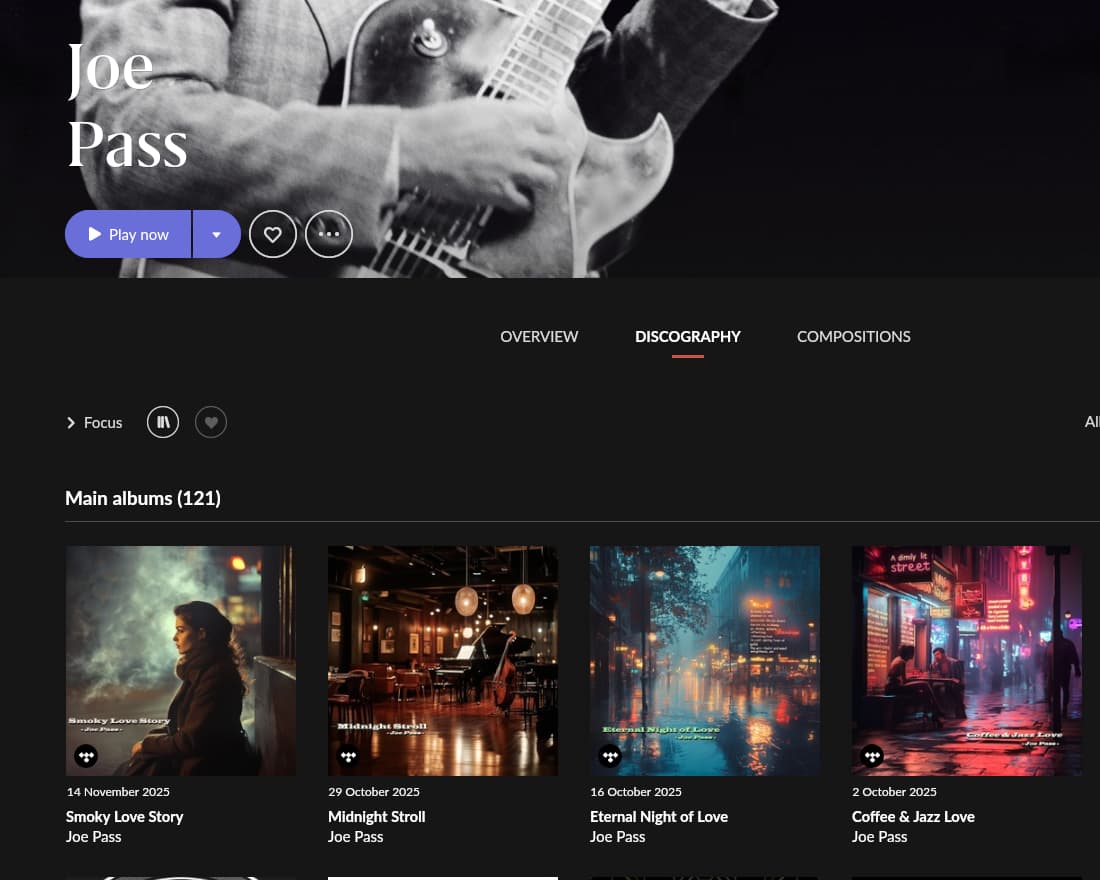
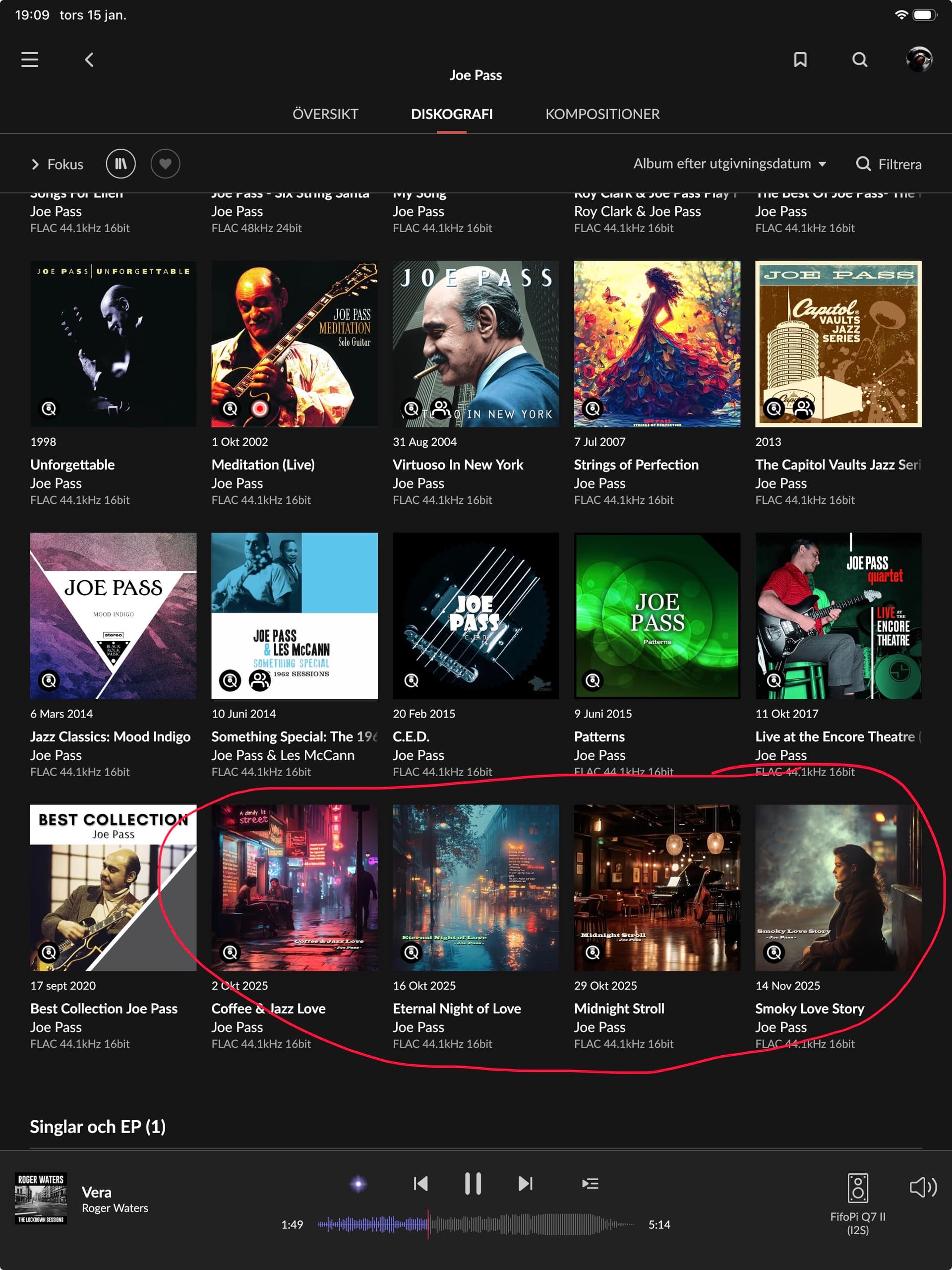
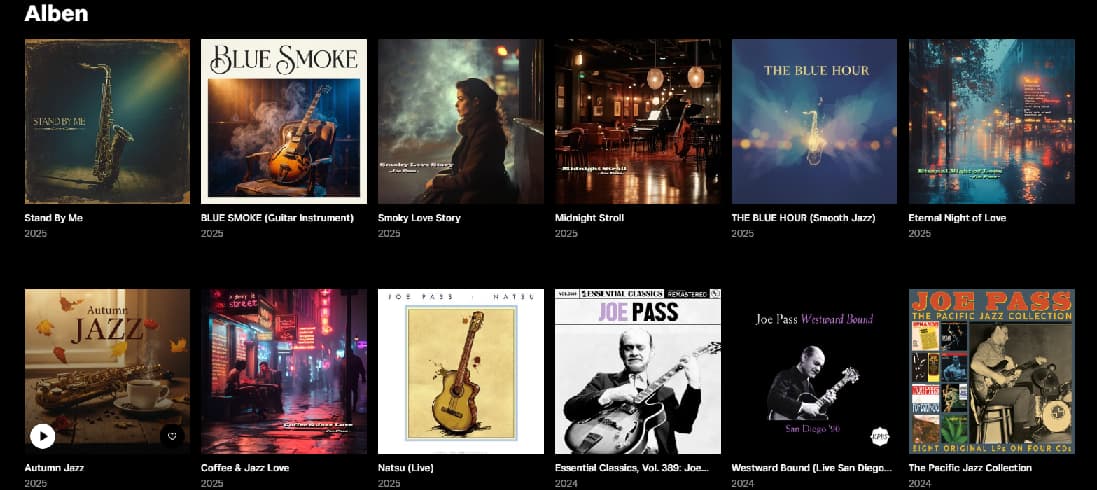
How does this stuff end up in Tidal or Qobuz?
They do not collect random stuff from the internet. Somebody needs to actively add this to their catalog, right?
Yup, streaming services ingest more than a million (!) new tracks per week and there are a lot of low-budget distributors out there, with non-existent quality control, so large amounts of this stuff slip through. I think Deezer recently removed something like 7 million fraudulent tracks, and they receive 30,000 fully AI-generated tracks daily.
Edit: check this article from late last year: Nearly a third of all tracks uploaded to Deezer are now fully AI-generated
I wonder how can the scammers make money out of this? I suppose anything under Joe Pass must send revenue to the labels that own the Joe Pass catalog? can anyone upload anything and get revenue?
As they are uploading it, they must get payouts or they wouldn’t bother…
This is of course all fully automated - except for spot checks, I suppose - as nobody can do accounting for 100 million tracks manually.
And of course streaming services try to make it reasonably easy for artists to publish their music, which is in principle a good thing.
As I said in the parallel thread about the same problem on Qobuz:
And:
Isn’t Spotify just allowing AI slop on its own, without even having to pretend to be a real recording?
Same horror as McLoughin and Hiromi, it is really shameful.. Do we contact Tidal?
Diego
I believe yes, in part. But it’s more difficult, I think:
- like synthesizers, generative Ai can be an artist’s tool, and there is not necessarily anything wrong with it.
- a recent Morgan Stanley study found that people do listen to Ai music on purpose more than one would expect, which at first upset me, but then I thought about it and I guess I can understand that someone might, want, e.g., a steady beat when working out, which should explicitly be mediocre and not make them want to look up what track this is.
- at the same time, there are probably incentives for streaming services to eliminate artist payouts (and the Spotify CEO was a bit vocal about this) and this can be a bad thing, too. Though if they make clear that it’s not a human recording, then at least they are not lying.
However, they also seem to try and ban deceptive Ai slop that pretends to be what it is not:
Digital distribution is automatic. Anyone can pay, you can go do it right now, to have your music uploaded into almost all the DSPs. They don’t filter. This includes all the credits submitted which is how they return royalties owed. Just because you wrote, recorded, and own a song that has nothing to do with where the royalties go. Royalty administration, well away from the artists, has almost always been part of the music industry.
These examples show how easy it is to spoof an artist, to get the album to show-up in their discography, but I’m sure none of the royalties are going anywhere near that artist or their label. It’s about visibility and the chance for played seconds. No different than your spam e-mails from the prince trying to send you millions for a small fee. It’s just visibility, mostly from playlist injection, but visibility and as long as some hit play they make money.
Spotify is a whole other mess. They are actively loading AI garbage because when it’s played they don’t owe royalties to anyone. They are actively participating to take streaming seconds away from real artists in favor of Spotify owned artists. (this statement is more speculation than fact but they have been doing similar things, even before AI, so AI is just the next extension of that)
This is a bit of a different situation. Artists, human artists, using AI is one thing but what you’re seeing in this post is actual scammers creating AI artists, that is no real human behind the music at all, to seed garbage tracks in places that generate plays. These are scammers taking advantage of a system without any protections. Either the DSPs need to slowdown how they approve tracks into their catalog or the distributors need to set some rules before allowing individuals on their platforms.
I know, this is why I split it into a separate bullet point under the overarching topic of “allowing Ai music”, separate to the other bullets that are about other aspects like slop. The difference in practice will often be clear and obvious, but there may be grey areas too (like there were when sampling became a thing)
I would think in this case it has more to do with not paying for it and less with giving people what they did not even know they wanted…
Sure but nevertheless there are two sides to it. If they work on preventing misrepresentation that’s the problem here in this thread, that’s an ok side.
Bandcamp are taking steps.
I’m referring here only to the discography of the artist Joe Pass on Spotify. I myself left Spotify a short time ago because more and more AI-generated music is appearing in the playlists.
Thanks to all for the infos how digital distribution works and how vulnerable this system is to AI slop.
I don’t think they have to ban it as long as they label it as fully generated by AI.
AI generated music can be nice to listen to and thats what music is all about, isn’t it?
I think Bandcamp are trying to preserve the role of human artistry in the creation of music. I, for one, am very pleased about that.