That’s pretty close call when it comes to GPU RAM! If there would be some desktop graphics too, the GPU would run out of RAM. So having the desktop graphics (if involved) on integrated graphics or some other GPU can help.
And of course if you have two Nvidia GPUs to spare, the RAM pressure gets spread a little. Although it is designed to be “big operations” and “small operations” split. So the second GPU may be with less RAM and generally a smaller one (maybe 5060Ti or similar).
yep, probably with desktop graphics it will choke, one may be can leverage CPU graphics as well. In my case, is by a “playbook” - headless input output server via NAA, so max capacity is saved for whatever HQPlayer needs…
Interestingly quite recently I was contemplating 2 GPU use case. Here is some of my conclusions, I predominantly stay in @1024 domain and I am 2ch listening. This means CPU with “Top 1” core performance. At present it seems 14900KS is the only “Top 1” core performer for HQP use case. This means Z790 chipset. This means special sub-class of motherboards. This means… for a really good MB’s you less likely can instal 4090(5090) + another small but decent GPU in the same MB directly, as they will either not fit, or kill 4090(5090) airflow, so the answer is PCI extension, this brings the PC case questions, and if finally I install two GPU’s which is possible with extension and ridiculously wide PC case - z790 chipset can only get one GPU bus at maximum performance , second one will be capped on speed. There are CPU+MB combinations made for multiple GPU’s, but this would not be 14900KS, voila.
But current performance of HQPlayer Embedded, acoustically and in terms of hardware efficiency is so amazing, that I don’t think second GPU for 2ch is needed.
If I ever would make sophisticated correction filter and would need to run convolution, I’m sure I could leave with @512, since room correction effect would certainly overweight @512/@1024 difference…
If you invest in a such box, spending few more hundreds for watercooling is obvious. My ASUS Z790 Apex Encore is doing fine with rtx5090+rtx5080 with alphacool waterblocks. And for 14900KS direct die watercooling is must. I get about 50C temperature with stress test 100% load on all cores. Without direct die waterblock, the temperature will skyrocket to 80+
that’s a power setup! truly impressive, and I get it for your quest of 8ch + convolution. In my 2ch quest I did not hit a brick wall yet. Only IIRx filters, may be, but they are not offloaded. However with new 1024 modulator simple IIR works OK. My hands were itching for “direct die” tinkering when I just got 14900KS, but I gave it a try without deleading and at “stock” it performs within reasonable limits with AIO.
I’d say it boils down to the use case.
What is interesting, would 14900KS be as good for multichannel comparing to AMD’s…
An AMD with 24+ cores at 4.5ghz+ will cost craploads. As I mentioned before, the E-cores of 14900 cpu can do DSD1024 just fine with most modulators, except for AMSDM7EC, this is though one, even P-core at 6.2ghz is not delivering.
No, I checked, this was shortly after I started listening, and all cores were actually below 40°C. And directly afterwards it worked without problems for more than five minutes.
EDIT: More or less the same happened with sinc-Lh and GPU support now, too. Stopping and starting the music helped (pause was long enough that the engine was stopped and started).
Actually, with my 2060, this already works without problems, too (at DSD512 with correction for Cyan 2). I had hoped to make do without the GPU to be more flexible, like being able to directly compare to sinc-MGa which isn’t possible due to not enough VRAM, but TBH, that’s more a theoretical use case than strictly necessary. I’m happy that I can use DAC correction now!
At the moment my development machine is 14900K on this mobo: https://pg.asrock.com/mb/Intel/Z790%20PG-ITXTB4
Plus RTX A4500. Seasonic 1kW hybrid PSU. And it performs very nicely with 64GB of DDR5-6400 CL32 (G.Skill, XMP Profile 1).
My experience was, if multichannel layout is greater than 8ch, better go with AMD’s >=16 physical cores CPU or >=16 physical cores Intel Xeon. Intel Core series are not suitable for >8ch DSD upsampling.
Hi there, I remember you mentioning that dsd1024 is not possible on 14900k with more that 2 channels, while it does 8x1024 without any issues. I received couple up boards, Jussi recommends, and some more Xing core interfaces. Will try today to test 16 channels on 14900ks.
Thanks for your dummy load / dry run experiments. And hopefully you really can produce an ultimate 12~16ch (from 7.1.4 to 9.1.6) multichannel DSD1024 system. Maybe I’ll follow your footsteps to build one.
Due to AMD x7950 has 16 cores my system is still 7.1.4 / 12ch DSD256
I have a plan to acquire an Intel Xeon workstation (W5 or W7, >= 20 physical cores) to replace my current AMD x7950 for 9.1.4 But you know, budget always insufficient…
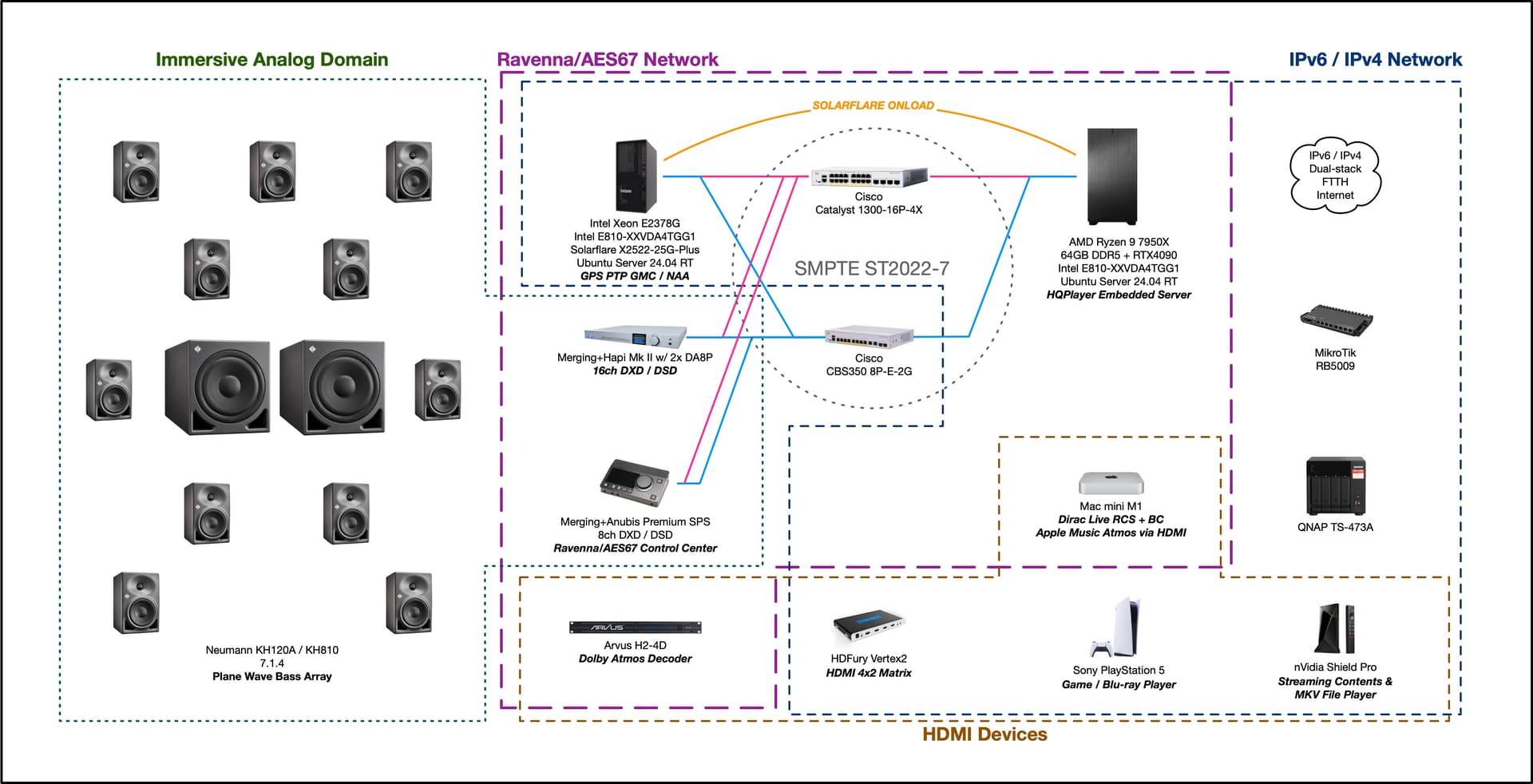
Picture is my current system. I’m using Solarflare Onload technology to minimize the latency between HQPe - NAA communications. A/V sync is within acceptable range especially streaming services (Atmos contents from TV+, Disney+, HBO Max, Netflix…). Very satisfied with the sound qualities. HQPlayer is the best DSP on the planet!
Since Neumann speakers has built-in EQ (very basic but powerful) and also use KH810’s analog crossover circuit, in HQPlayer I only use PEQ to fix problematic bands. ALXO’s FIR is only for comparison / reference now.
Well, my tests may be with dummy load on the usb audio interfaces, since to D/A output is not connected, but surely the load on CPU is not dummy I always do connect one real DAC together with the stack of amaneros, so i can be sure there are no artifacts and delays during playback.
I’ve just tried 16ch on 14900ks, it delivers smooth at DSD256 only, with any modulator. With DSD512+ there are hiccups and im positive it is not because of the CPU but because of intel memory architecture, so yeah… a server grade mobo with multichannel memory management is needed. for 8xDSD1024 the 14900k is fine. Also im not building 7.1.4 or 9.1.6, my aim is professional and not home use audiophile. While engineering the last piece of the device, the clock delivery unit, the best solution i came up with, its the same for either 8 or 16 channels, its just the matter of the clock buffer IC, so its just adding 4 more DSC2 boards and 4 more USB interfaces.
I am also interested, the question is about AVX optimisations. Since 14900k has AVX512 disabled, because of the E-cores, will Xeon need the same clock frequency like 14900k to perform on the same level ? Or higher amounts of cache memory and 512bit AVX will deliver on lower clocks ?
It depends on the algorithm. Some of the modulator calculations just need bare clock speed. But I’ve managed to optimize the newer modulators quite well, so for example Apple silicon can do up to DSD512 despite the relatively low clock frequencies.
But if you want something like DSD1024 with for example ASDM7EC-fast, then you need higher clock frequency than Apple silicon offers at the moment.
Hi.
This is loosely related to HQP, but I wonder which memory test was useful for testing RAMs.
I secured a set for quite a high price, and I’ll need to test it when it arrives.
I plan to use it for the roon core machine’s upgrade as it is getting a bit old and the motherboard’s functionality is a bit unsatisfying.
I already have a spare motherboard, but the CPU will be next month.


 What’s your current set up? Always 200 channels, as usual, with cosmic convolution and whats not ? Hahaha !

 I always do connect one real DAC together with the stack of amaneros, so i can be sure there are no artifacts and delays during playback.