Looks like the service doesn’t start / fails. Did you remember to reset the web interface credentials after installing the package?
Isn’t it simply running:
sudo hqplayerd -s username password
and then
sudo systemctl enable hqplayerd
?
PS. I see error messages in the log file.
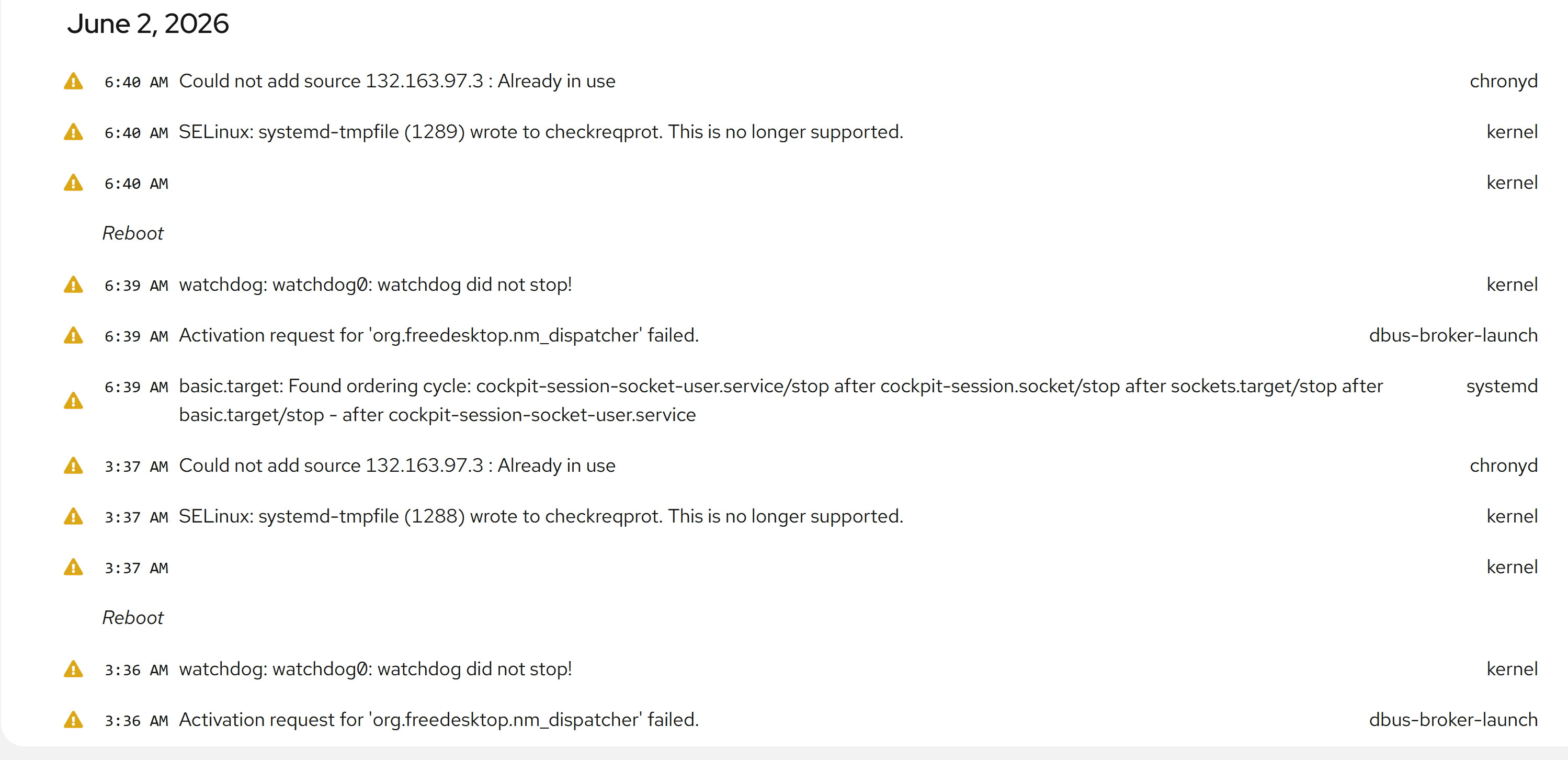
Yes, and reboot after that.
You could switch to root with “sudo su -” and then “systemctl stop hqplayerd” and then just start “hqplayerd” and see if it tells what the problem is.
None of these are related to HQPlayer…
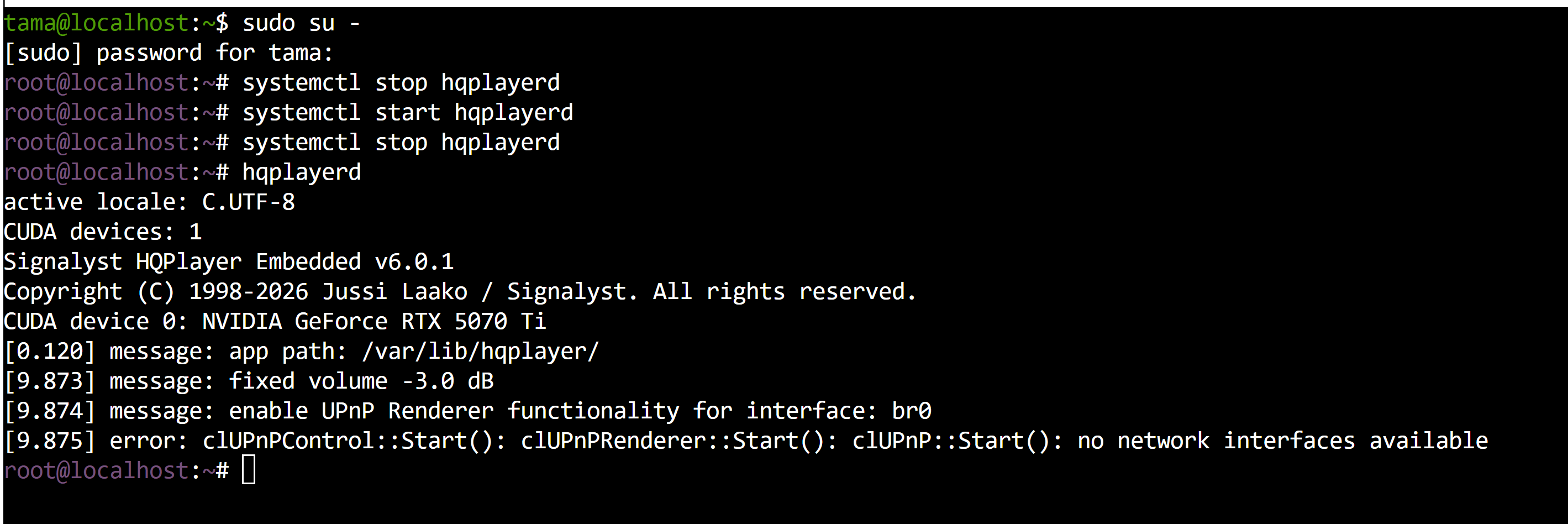
In your /etc/hqplayer/hqplayerd.xml, the UPnP stack is configured to use network interface “br0” which doesn’t exist. I recommend to set this to “auto” instead.
hey man! long time no talk. I have been dealing with some health issue and we are largely on same page, but can I post a bit of my own findings and comment on my measurements with the EIDA/APU platform?
At times I think the “transformer output = colored DAC” argument around the DSC2/DSC3 is being overstated, and in some cases badly misunderstood.
I am not claiming the transformer-output DSC2 is a surgical modern ESS/Topping-style SINAD machine. It is not. If the only metric someone cares about is 1 kHz THD+N at high output voltage, there are plenty of modern chip DACs and pro converters that will measure cleaner. I own and have measured gear like the RME ADI-2 Pro FS R Black Edition, and I know what that level of conventional cleanliness looks like.
But that is not the same as proving that the DSC2 transformer-output version is “colored,” “soft,” “rolled off,” or “far from neutral.” Those are much stronger claims, and the measurements I have do not support really.
The biggest mistake in this discussion is that some people look at the topology and then jump straight to the conclusion. They see output transformers and assume warmth, softness, rolled-off highs, weak bass, and euphonic distortion. That is not engineering. That is topology stereotyping.
A transformer can be colored if it is badly chosen, badly loaded, driven too hard, or used outside its proper operating range. But a transformer is not automatically colored simply because it is a transformer. Like op-amps, DAC chips, capacitors, resistors, power supplies, and output stages, implementation matters.
The real technical challenge with the DSC2 is not “the transformer makes it syrupy.” The real challenge is that this is a low-output, direct physical-FIR/DSD-style DAC. Mine outputs only about 1.2 volts. That is much lower than a typical modern DAC, where 2 Vrms RCA and 4 Vrms balanced are common. That low voltage heavily affects conventional measurements, especially SNR and THD+N, because the signal level is low relative to the analyzer/noise floor.
So if people are comparing it against modern DACs with much higher output levels, they need to understand that the DSC2 is being measured at a disadvantage. That does not excuse every measurement result, but it changes the interpretation. The limitation is largely gain structure and interface behavior, not necessarily “coloration.”
The power supply also matters enormously with these units. They do not necessarily come with a fully standardized supply chain like a mass-market DAC. When I used a generic off-the-shelf switch-mode power supply, I could see noise-floor artifacts, hum, and general messiness. When I moved to a better iFi supply, those artifacts flattened out dramatically. That alone should make people very careful before making universal claims about “the sound of the DSC2.” Two DSC2 systems may not be equivalent if one is running from a poor supply and the other is properly powered.
The same applies to loading. My DSC2 output impedance is around 4 kΩ. (if if recall correctly). If someone runs that into the wrong load, or uses long cables, or a downstream device with unsuitable input impedance, they may get interaction. But that is a system-matching issue, not proof that the transformer itself is inherently bad. In my chain, I am using the DAC into an iFi stage as a gain/preamp device, then into a very low-coloration THX AAA SMSL SP400 headphone amplifier. This is not a warm tube chain hiding flaws. If the DSC2 were obviously soft, rolled off, or syrupy, I would hear it.
Now, look at the actual low-frequency measurement evidence. At 50 Hz, my DSC2 measurement showed THD around -90.5 dB, noise around -123.7 dBFS, and THD+N around -89.6 dB. The individual harmonic readouts were especially important: H2 was around -130.2 dBFS, H3 around -113.3 dBFS, and H4 around -150.7 dBFS. The fundamental was roughly -22.7 dBFS, so referenced to the signal, H2 was about -107.5 dBc, H3 about -90.6 dBc, and H4 about -128 dBc.
That does not look like warm, soft, even-order transformer coloration. The second harmonic is extremely low. The fourth is basically buried. The THD is mostly dominated by the third harmonic. You can criticize the amount of third harmonic if you want, which is still ‘consonant’ as the fifth above the octave, but that is a very different argument from “the transformer is making soft, colored bass.”
The claim that “bass below 50 Hz is distorted and soft” also needs to be handled carefully. At 20 Hz, yes, the transformer/output stage can be stressed more. That is where transformer physics becomes harder, because low-frequency flux demand rises sharply. A 20 Hz full-scale or high-level sine wave is a torture test. It is useful, but it is not representative of most real acoustic music. I listen primarily to jazz, classical, choral, piano, orchestral music, and other real instruments. For that kind of material, clean behavior around 40–50 Hz and up matters far more than obsessing over full-scale 20 Hz torture tones.
If someone wants to say, “The transformer output may have limitations with very high-level 20–30 Hz material,” fine. That is a reasonable technical caution. But that is not the same as saying the DAC is broadly colored, soft, rolled off, or unclean. My 50 Hz data does not support that.
At 1 kHz, the DSC2 tells the same basic story. It is not a THD champion. In REW at DSD512, I measured a 1 kHz fundamental around -21.6 dBFS, with noise around -124 dBFS, N+D around -118 dBFS, THD around the low/mid -90 dB range, and THD+N around the low -90s. Again, the story is not “this is the lowest distortion DAC ever made.” The story is that the noise floor is extremely low and clean, while the distortion profile is dominated by a visible harmonic structure, especially third harmonic.
That distinction matters. A DAC can have higher THD than a modern ESS implementation and still be very quiet, linear, temporally clean, and musically convincing. THD is one measurement. It is not the entire behavior of a DAC.
The metrics that make the DSC2 sound so good in my system are not primarily its THD number. They are SNR, noise-floor cleanliness, jitter behavior, and low-level linearity. Those are the areas where this architecture becomes special. My measurements of other devices, including the RME, show that my measurement setup can absolutely resolve very clean performance when it is there. I am not confusing measurement limitations for DAC performance.
The DSC2’s strength is that it preserves low-level information extremely well. Reverb tails, hall decay, imaging, center stability, quiet instrumental texture, and spatial relationships survive in a way that many conventionally excellent DACs do not reproduce as convincingly in my system. That lines up with what I measure: strong noise behavior, excellent low-level linearity, and very clean timing/jitter behavior.
Fake spaciousness can come from distortion, yes. But spatial clarity can also come from lower noise, less ground contamination, better common-mode behavior, cleaner power, less RF/ultrasonic garbage, better low-level linearity, and better reconstruction. A transformer output can contribute to isolation and common-mode cleanup. That can make a system sound cleaner, not more colored.
This is especially relevant in a DAC like the DSC2, because the output transformer is not being used in a generic vintage tone-control context. It is part of a direct physical reconstruction architecture being fed by HQPlayer. The upstream reconstruction filter and modulator matter enormously. With HQPlayer doing serious reconstruction before the DAC, the physical output network is operating in a very different context from a typical chip DAC output stage.
That is also why the “active output stage is automatically better” argument is incomplete. I understand why Miska might prefer the original active/op-amp output stage. An active stage can provide higher output voltage, lower output impedance, stronger drive, better conventional THD/SINAD, and less load sensitivity. Those are real advantages. But that does not prove the transformer version is colored. It proves the active version may be easier to measure well and easier to interface universally.
The transformer version has different tradeoffs: lower output voltage, higher output impedance, more loading sensitivity, and possible low-frequency stress at the extreme bottom. But it also has galvanic isolation, a floating/balanced interface, possible RF/ultrasonic cleanup, and potentially lower system-level contamination. In a properly matched chain, those advantages can matter.
So the honest position is not “transformers are always better.” It is also not “transformers are always colored.” The honest position is this:
The transformer-output DSC2 is a low-output, interface-sensitive, direct physical-FIR/DSD DAC that requires proper power, proper loading, and proper gain staging. If those conditions are met, the blanket claim that it is soft, rolled off, colored, or unclean is not supported by the measurements I have taken or by my listening experience.
If someone wants to criticize the DSC2, criticize the actual weaknesses: low output voltage, higher output impedance, need for careful power supply choice, and measurable harmonic distortion that is not state-of-the-art by modern DAC-chip standards. Those are fair criticisms.
But saying “it has transformers, therefore it is colored” is not a serious argument. It ignores the actual measurements, the actual harmonic structure, the actual power-supply sensitivity, the actual loading conditions, and the actual strengths of the architecture.
My conclusion is simple: the DSC2 is not a modern SINAD trophy DAC. It is something more unusual. It is a very low-noise, highly linear, timing-clean, direct physical reconstruction DAC whose limitations are mostly output/interface related. Calling that “colored” because it uses transformers is an oversimplification at best and misleading at worst.
3 Likes
Andrew!! Great to hear from you. It truly has been a long long time. You mentioned about health condition so I hope this is no longer an issue.
Ever since I got my hands on a dsc2 and dsc3 about 2 years ago, and have since gone on to sell all my other commercial DACs and never looked back. The only other unit I have is a topping E2x2 that I use as a mic preamp for room measurement and as a ADC for vinyl ripping.(that’s another rabbit hole I would say)
So in terms of DACs, I am done, settled and have not bothered to look at what’s out there anymore for 2 years
Thank you!
I changed the value, and now it works!
I wonder how it became “br0”, because I haven’t done anything with the xml file when installing HQPe 6. :?
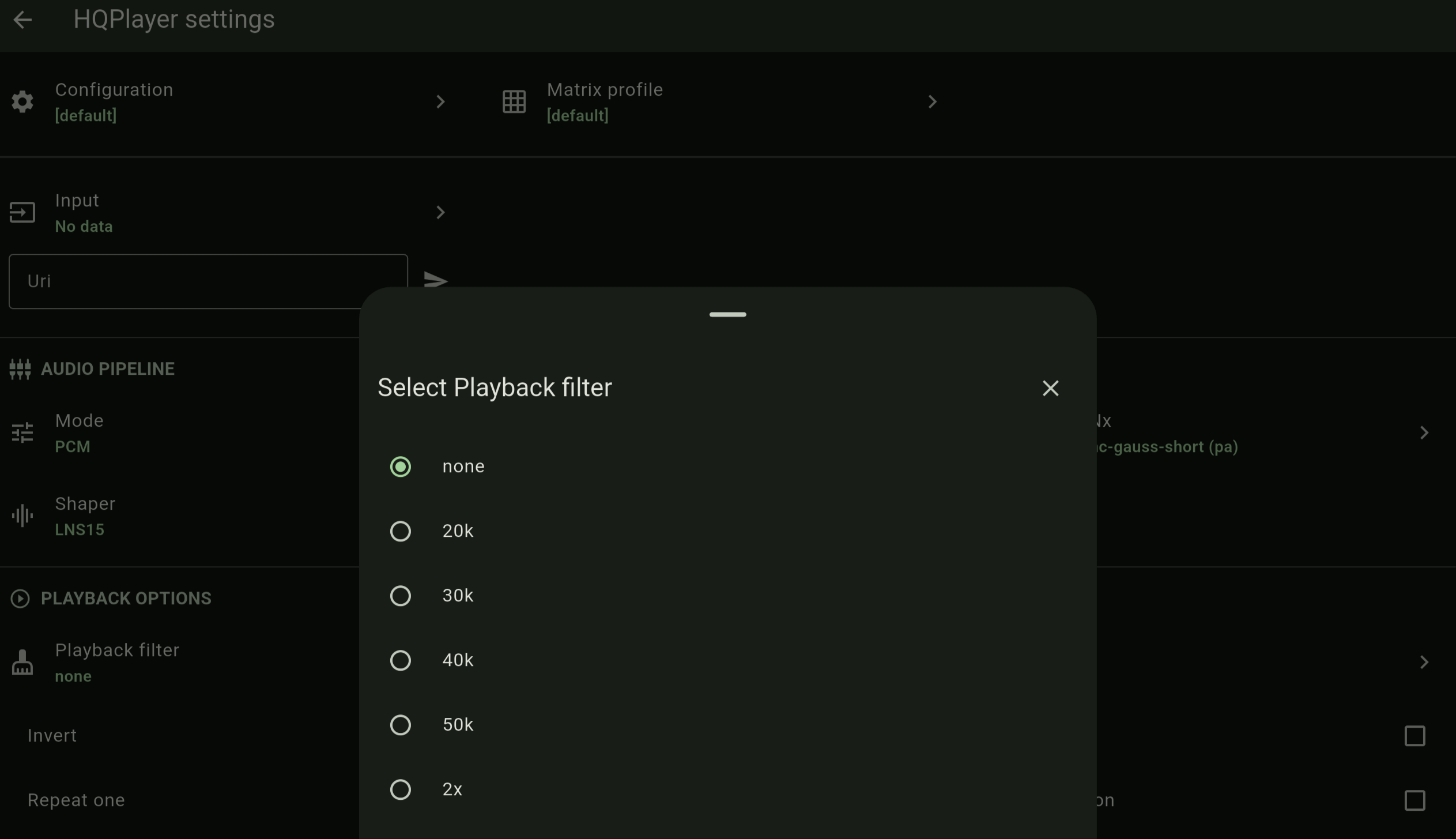
The new version of HQPControl has arrived, and it’s now possible to change the Playback Filter. Thanks, Jussi!
I don’t know, but it sounds like the configuration file originates from HQPlayer OS. Installing hqplayerd package doesn’t overwrite existing configuration files, if there were any existing. Those are only installed if it’s a fresh system without earlier configuration files.
1 Like
I don’t think Signalyst is part of the development of hqpdcontrol. It’s 3rd party. Too bad it’s subscription based now. 
1 Like
Thanks for correcting me! I’d use HQPClient if I had an iPad, but I’m actually on Android.
HQPClient for iPad is exactly like the hqplayer client app on PC. A necessity for switching filters on the fly if you use hqplayer desktop and aren’t near the computer running desktop as there is no iPhone app or web interface with desktop.
Hqpdcontrol is the only phone based app that works with hqplayer desktop to switch settings on the fly. It is a very well put together and thought out, full featured controller for hqplayer. I kinda miss it a little, it was a sweet app… I used it more than the hqplayer client app but then it went subscription. I can’t stand subscriptions.
If I didn’t have an iPad, I would probably buy one to use hqplayer client before I would get a subscription to use the an app on the phone, even if the phone app was better!
1 Like
JPlay for iOS can be used
Subscription based.
Not true. One can buy a lifetime for 199$.
Doh! Point taken, but this is really about settings for hqplayer.
The JPlay is a sharp turn that is completely off course. But it does have hqplayer control options.
I did just notice HQPPorter listed on the Signalyst page. May look into that. 
Dealing with app stores like Apple’s App Store is such an enormous pain and suffering. Anything you do needs to be explained to a 100 year old grandmother who knows absolutely nothing about the stuff and has absolutely zero interest about your stuff, but is passive-aggressive against anything new.
4 Likes
I know this has nothing to do with HQP (I couldn’t find a general chat channel on the roon forum), but I renovated the floor in the listening room this week (tatamis, if you know what they are), and I had to move all the equipment to another room and move it back.
No music for another while, as all the machines are unwired, and I would like to clean the dust off of them as I re-wire…
Hello,
I have a question regarding two functions that have been missing since version 5.0:
“SHUTDOWN” and “REBOOT.”
I asked about this shortly after version 5.0 was released, but Jussi gave a rather brief answer.
I am not a software expert, but I still cannot understand the reason why these functions were removed.
If my PC running HQP Embedded is located in a separate room (due to noise), I always have to start it manually.
It can be shut down via SSH, but that isn’t exactly convenient.
Best regards,
Wojciech Jaminski