I have listened to a mates Mojo2 , I have the original mojo poly combo. I could not really hear a difference when not messing with any of the additional features. I am at the wrong side of 50 so there is that to consider.
Obviously when messing with the additional eq features etc I could hear a difference, but I never really use any sort of eq so not a reason for me to upgrade.
The cross feed feature was, in my opinion fantastic, but again, I do this in Roon so not a reason for me to upgrade.
For someone new coming to Chord, it really is fantastic value, and if you can save up for one, don’t hesitate.
For me, I’ll put a couple of quid aside each month for when the battery on my mojo gives up the ghost and upgrade then. Avoiding the, albeit small, hassle of changing the battery out.
The intelligent desktop mode would be a reason for me to upgrade, but I have other hifi priorities at the mo.
Late to this thread but my 2 cents….
Firstly the UHD DSP is simply brilliant. EQ without lifelessness.
Second, it is a pocket mscaler. 1tb card loaded with PGGB 16fs files, playlisted using Cantata and playback with bluetooth mode from gofigure. Plugin your favorite iem, add a little UHD DSP if needed, go outside… marvel
Me and you both. My Mojo one is now running sans battery so desktop only. Have downgraded to Bluetooth headphones and phone when out and about. If I have USB power I can have Mojo sound with poly, or a USB battery.
Yeah, I’m at that point but I’m not that prudent. Figure running the Mojo 1 in permanent battery less desktop mode and use the money as 45 off the Mojo 2. I’m talking myself into this…
Have a Chord Hugo 2 for quite few years and bought a Chord Etude amplifier last december, after a (very) long search. I really don’t see me buying stuff from another brand soon when it comes to DAC / Amps.
Started with the mojo, pair of hifiman, added poly, then Tin Hifi P1 iems for on the go.
Then started saving like a madman and got myself a used pair of Harbeth P3ESR. Good friend of mine leant me a Rega Brio (what a fantastic little amp). Saved for a raspberry pi and a hat and what wonderful music with that little mojo.
Next saved for a used Qutest, and found a denon 1600 at a thrift shop.
After 4 years,
Home built NAS > Roon > Ropieee > Qutest > Denon > Harbeth P3ESR
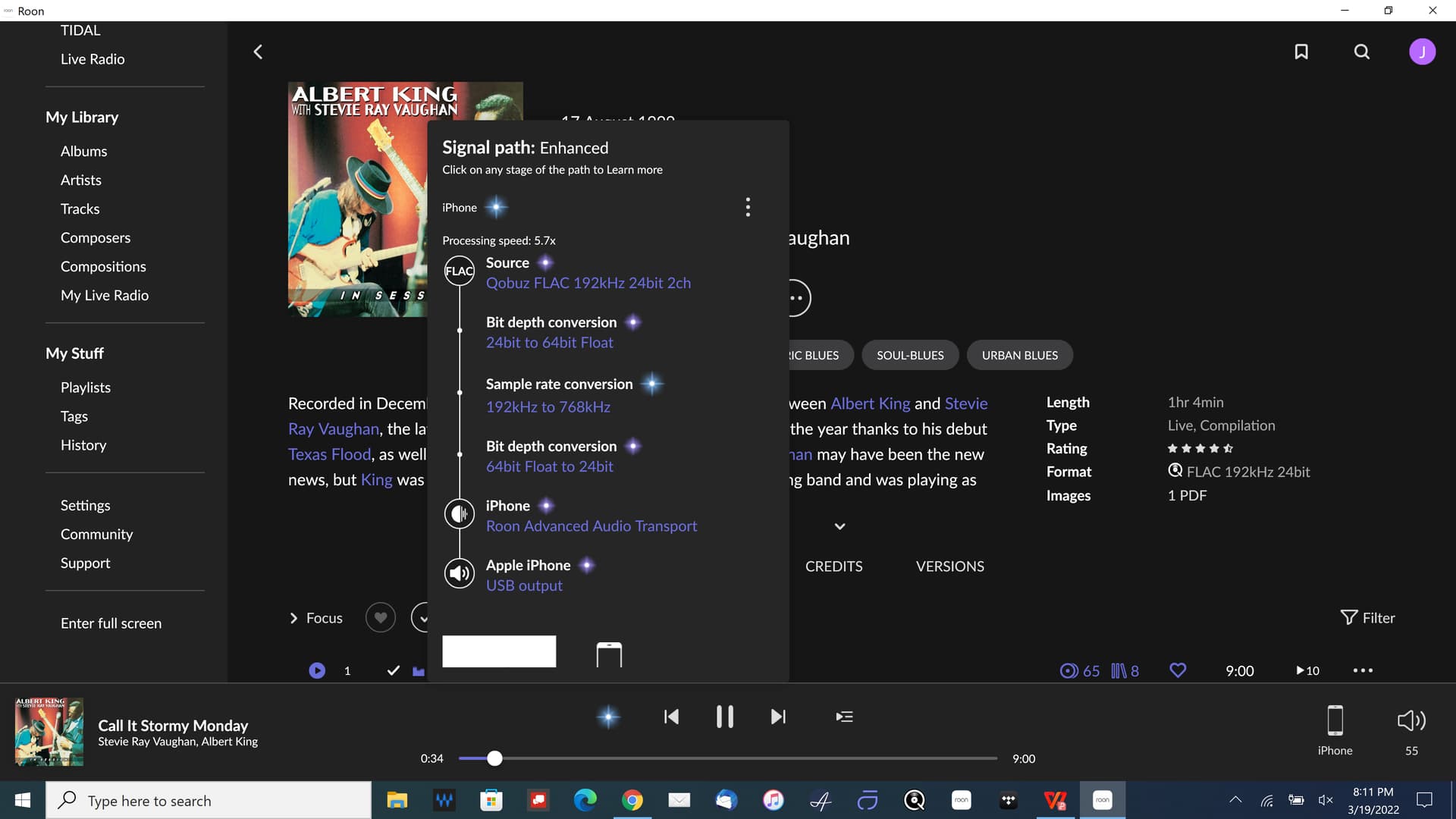
Here’s a question for anyone who knows the answer. I was playing around with Roon core on my laptop with Mojo 2 plugged into the laptop USB port and all seemed OK. Then, I wondered if I could plug the Mojo into my cell phone (using the camera adapter) and send audio from the Dell to iPhone to avoid using the Dell USB port. So, I switched the iPhone to the Dell Roon core and everything worked just fine.
Then, I noticed the Mojo was indicating 24/192 coming from the iPhone. Could this be? So, I went into Roon on the laptop and turned on DSP Max Power of 2 and the Mojo and Roon are indicating 768. Is that possible coming through the iPhone? It must be.
So, when we visit the mother-in-law next week, I’ll plan to use my iPhone or one iPad for Verizon hotspot data and use the other as a Roon end-point for the Mojo. I won’t have to use the Dell USB port.
The Mojo is 768 KHz capable over USB and Coax digital, so yes, it’s possible. The limiting factor at high speeds might be your WiFi connection. The signal path looks clear and the Mojo’s bit-rate indicator agrees, looks good to me . Enjoy, though that doesn’t sound a problem for you ATM
Thanks for that. I was just a little surprised that an iPhone could transmit the 768 signal from Roon to the Mojo. I guess it’s just acting as a Roon end-point and not processing anything. IDK.
In Roon, I generally use Max Power of 2 to upsample everything to 176.4 or 192 with my other DAC’s. I’m not sure I can hear any difference, but it certainly doesn’t hurt. With this Mojo 2, that results in everything going to 705.6 or 768. I was concerned that might overtax my little i3 Roon Nucleus, so in Roon, I made a custom DSP sample rate conversion to convert 44.1 and 88.2 to 176.4 and 48 and 96 to 192. That seems to work well with the Mojo, keeps the blue sample rate light on, and doesn’t stress out my Nucleus.
A little late to the party but here’s my impressions of the Mojo 2 from last month’s CanJam NYC.
The Mojo 2 kind of just blew me away with its incredible sound quality. First I listened to it using the new Meze Liric closed back headphones and the sound was just so damn smooth. Really stunning. The next day I went back and tried the Mojo 2 with the new Dan Clark Audio Stealth closed back headphones and this was truly a match made in heaven. Really, really impressive.
So now I am faced with the best kind of dilemma, which is how do I justify buying a $4K pair of headphones when I already own over 2 dozen sets of headphones, including several really good closed backed cans, like the Sennheiser HD 820s, and justify buying yet another portable (or desktop) headphone DAC/amplifier when I already own at least a half a dozen very good headphone DAC/amplifiers?
Of course I can only ask this kind of question here on the Roon Community, which is filled with other people suffering with the same dementia as me.
By the way if you are still undecided as to whether or not you should get the new Mojo 2 don’t be. This little wonder is surely one of the best bargains in all of audio.
Transducers >> DACS (unless upgrading from a truly atrocious DAC). Nothing against the Mojo 2… I’ve got the original and like it. But the DCA Stealth gets rave reviews and tracks the Harman Curve nicely so you might not need EQ
Then again, the Mojo 2 is pocket change cf. DCA Stealth… so just get both!
The Mojo 2 EQ is much simpler than it appears. Just press the menu button 2 to 5 times to get to the frequency range you want (there are four), then press the + or - buttons from 1 to 9 times to raise or lower the relative volume of that frequency.
I just started messing with it late last night. I turned up the bass a little and turned down the treble. This is using Focal Clear headphones. I would probably need to do the opposite with my Sony headphones. I sold my AEON.
EDIT: I’m using the EQ settings shown in the manual example and they work well with Focal Clear headphones. Also using one notch of crossfeed.
 . Enjoy, though that doesn’t sound a problem for you ATM