A completely new protocol designed for high-end audio
Its philosophy is totally different from that of existing protocols.
Many factors affect the sound quality of audio players.
Power-supply noises generated by digital blocks on circuits significantly affect the sound quality. Usually, capacitors and inductors are placed at power sources to reduce the noises.
In this way, we can configure low-pass filters and reduce spike-like digital-specific noises.
However, as you can see from the fact that low-pass filters are used, any low-frequency fluctuation passes through.
It isn’ t necessary to filter it out because it isn’ t a noise, and you can’ t see it even if you observe it by focusing on voltage.
But, if you observe it by focusing on electrical current, you can detect noises that affect the audio frequency band of a constant cycle.
It is absolutely difficult to electrically eliminate the noises.
1 Like
Bill_Janssen
(Wigwam wool socks now on asymmetrical isolation feet!)
2
Wouldn’t “absolutely difficult” mean “impossible”?
I wonder how this would improve over something like Euphony that can run as a RAAT endpoint (Target in Diretta terms) and will load everything into onboard RAM before it begins playback? In this case, there is no need to coordinate anything with the Host, Euphony gets all the packets it needs before playback, so it seems there would be no spikes in the Euphony processor during playback. I haven’t run any CPU traces on the NUC where I run Euphony but this gives me an idea of something to try.
Not really, because nothing about Diretta makes any sense. That it’s been 5 years since the original post and still, no reputable manufacturer anywhere had ever bothered to implement it seems to be a hint…
I’ve been looking at Diretta on and off over the past half dozen years or so. It has always seemed interesting, in spite of my objectivist leanings. We all know that Roon is bit-perfect. Once the endpoint delivers the data to the DAC, it’s job done. The rest is up to the DAC.
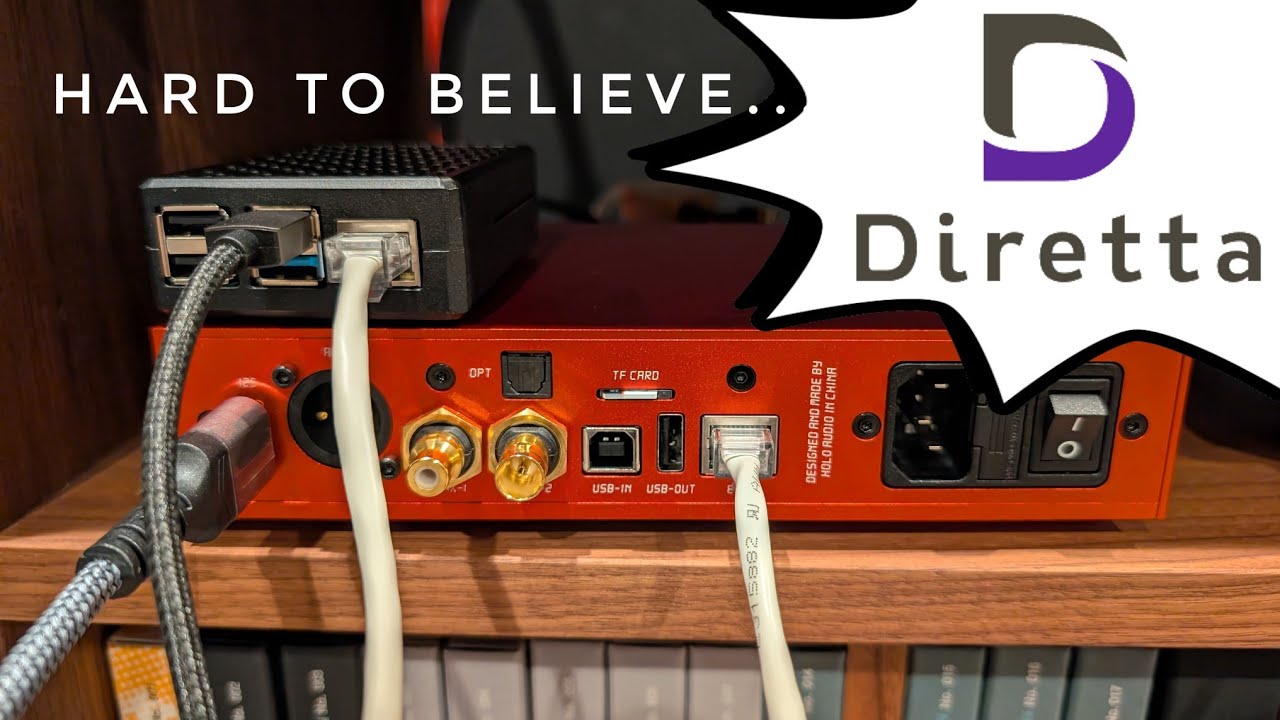
But then a friend shared this video with me:
His particular implementation got me thinking. Instead of competing with R.A.A.T., Diretta could add a third tier to Roon’s architecture, further offloading processing from endpoints.
But why should anyone care about that? While I agree that it makes no objective sense, I’ve found a rough correlation between reduced CPU usage on the endpoint and sound quality. I don’t know what’s behind this, but perhaps the following description of Diretta contains a hint:
Diretta, a specialized protocol from Japan, operates on a different, more granular principle. It does not concern itself with user interface or library management; instead, it focuses exclusively on the method of data transport. Diretta’s central hypothesis is that the “bursty,” intermittent processing load typical of standard network protocols causes fluctuations in the current draw of the endpoint’s digital circuitry. These fluctuations, in turn, generate low-frequency electrical noise that can evade a Digital-to-Analog Converter’s (DAC’s) internal filtering (as defined by its Power Supply Rejection Ratio, or PSRR) and subtly degrade its analog performance. To combat this, Diretta employs a “Host-Target” model where data is sent in a continuous, synchronized stream of small, evenly spaced packets. This “averages” the processing load on the Target device, stabilizing its current draw and, theoretically, minimizing the generation of this pernicious electrical noise.
First time I’ve run across “PSRR”, but when I mentioned this to a friend who is a retired RF engineer, he agreed that low-frequency noise is very difficult to filter out.
So, the problem with using a computer as the transport for a DAC has nothing to do with jitter. That’s a solved problem in 2025. Instead, it may be low-frequency noise generated by bursty demands on the transport’s power supply. The idea goes that bursty network traffic is behind these brief spikes in processing demand.
Okay, so plausible pseudoscience explanation accepted for now. For something like this that has only a small chance of making an audible difference in a positive direction, two things need to be true (at least for me):
The solution has to be inexpensive
The effort required to try it has to be relatively minimal
In most threads I’ve read, Diretta users talk about migrating Roon Server to a custom operating system, like AudioLinux. Or installing 3rd party ASIO drivers. Patching or recompiling the Linux kernel, and configuring IPv6. I can do all of that, but none of it sounds like fun. The results would likely be fragile and a mess to maintain. Crucially, I use my system and music to relax after work. I don’t want a brittle mess that needs troubleshooting every third time I power it on. Hard pass!
On the other hand, I’ve yet to encounter anyone who went to the trouble of implementing Diretta and was not rapturous about the sound quality gains. Could be recency or confirmation bias, but reactions and descriptions are highly consistent. So I’ve not completely ruled out the possibility that adding Diretta to a resolving system might be beneficial.
This still leaves my objections to the “tuition fee”, in terms of cost and effort, for learning for myself what Diretta can do. I’m unwilling to migrate Roon Server to another computer or OS. A trial solution needs to just drop into my existing Roon environment, sitting between my network and USB DAC.
Piero, author of AudioLinux, has been very helpful as I’ve been working on a solution. Although the approach is my own design, I’ve leveraged technology from a number of sources. I’m certainly not the first person to work this out, but I may be among the first to write it all down:
My solution involves two Raspberry Pi’s. An Ethernet cable connects them by their onboard network interfaces. One, the “Diretta Host”, runs Roon Bridge and is connected to your home network via a USB3 to Ethernet adapter. The other, the “Diretta Target”, is connected via USB to your DAC or DDC. Very similar to what you saw in the video. Think of the Diretta Host as a protocol converter between Roon RAAT and Diretta.
If you imagine the two strapped together, the assembly is Ethernet in, USB out. It fits into any Roon environment exactly the same way as a typical RPi running RoPieee or any Roon Ready endpoint with a USB output. No need to change anything or install anything on the server.
The hardware amounts to a couple of Raspberry Pi builds plus a USB to Ethernet adapter and a short CAT6 patch cable. Pretty minimal…a little more than twice the cost of building a single RoPieee endpoint with no display.
For software, I highly recommend AudioLinux for both computers. In fact, my build process depends on it. Although the price may increase, a one year subscription is currently only $69. And only one subscription is needed for as many installations as you like at the same location.
The other required commercial software is a Diretta Target license. This costs 100 Euros and it’s locked to the hardware on which it is activated; not transferable. However, I’ve heard that you can test it as much as you want before activating as long as you limit the audio to 16-bits, 44.1 kHz. If you play anything higher than that, Diretta Target will permanently stop working after six minutes. I’ve confirmed the latter behavior already. I’ll test the former later this week and update this thread with my findings. If that works, you could evaluate for longer by configuring Roon to resample everything to Redbook format.
I’ve only been using it for a few days, so I don’t have anything authoritative to say about sound quality. Of course, it sounds fantastic, but more time will tell if I’m just being affected by the aforementioned recency bias! Regardless, it’s been fun having a new toy to play with.
Oh, this Diretta thing looks rather like “feeding expectations” than delivering factual results.
1st, they don’t say their idea is better than others but different.
2nd, they repeat this never ending myth of electronic activity would inject (audible?) noise to (exactly) what?
3rd, they don’t explain at all what they actually measured where when showing the graphs.
4th, they clearly suggest their devices would be a cure, but don’t explain or even guarantee anything.
Conclusion, for my taste the story is too much “you give me your money and we will give you a feeling” voodoo. Better forget about it.
Let’s say a file is 50 MegaBytes FLAC. This equals 0.4 GigaBits. With a LAN bandwidth of a conservative 0.5 gigabits per second, the bursts would be very short. Has anyone ever reported that SQ is fine most of the time, interrupted by very short poor SQ bursts?
Even ignoring that the load of receiving PCM from the Roon Server, and FLAC decoding therefore not happening on the endpoint, is minimal. If this is relevant, who is to say that having very short burst loads between extended periods of essentially no load isn’t preferable to a constant very low load?
The whole story is more or less nonsense. In case there is a factually audible difference in some analogue signal between using Diretta (better?) or not some or more devices in the chain are utterly badly designed or manufactured. Since even regular devices are not sensitive to some or more electronic load, esp. not in the audible range.
Ideally, we should be able to measure the analog outputs on the DAC and make that determination. However, to be thorough, we’d want to measure all combinations of DACs and transports since some pairings may do better with one strategy vs the other.
Unlike Amir, I don’t have an Audio Precision APx555B lying around, so I just decided to put this thing together and give it a listen for a few weeks. If I like it, I’ll keep it. If I like it a lot, I may tell a few more folks about it and encourage them to give it a try too…based on no evidence at all except that I’ve had fun with it. For most of us, this is a hobby, after all.
Since no more than a pseudoscience explanation has been offered for how Diretta might be beneficial, I make no claims that it will do anything other than consume time, money, and electricity. But the amount of each is small, in the grand scheme of things. For folks like me who enjoy tinkering, a Diretta endpoint build for Roon will likely be an enjoyable diversion.
By the same logic, these devices (and the many others like them) should make no audible difference either.
A Diretta Target license is a little over a hundred bucks. As far as we know, it performs as well or better than those extravagant solutions. That’s what inspired me to give it a try. Well, and because I find stuff like this fun to play with.
Even if it makes one’s audiophile heart bleed, that’s absolutely true.
And everybody with a solid knowledge of how digital data transmission works, knows this.
I can’t understand why audiophiles always believe that audio data behaves differently from other data. If digital data transmission worked the way audiophiles imagine it, the Internet would be completely useless. Nobody would send bank data, control data for medical devices or critical infrastructure as digital data. Or do they all use such voodoo devices to ensure that the data arrives cleanly at its destination?
Not even this forum would be usable, because electronic noise would constantly change the letters.
The Diretta case is not about digital data integrity, though, but supposed EMI introduction due to processing load. Just making sure that we criticize the right thing
1 Like
mjw
(You want nice, supportive? Call a damn helpline.)
18
As far as we know, all of these devices perform exactly the same. IOW, without measurement we cannot make any reliable claim.
And, the comment about low frequency noise seems to come from the same school of thought promoting exotic cables where the effects are only relevant in the high MHz. It sounds good, but it is irrelevant. Moreover, such noise is measurable and often correlates to component failure.
If Diretta was a serious proposition, they would have backed their claims with science and engineering facts. They have not, and it would appear that the audio industry (marketing) isn’t prepared to have the wool pulled over their eyes either. I suspect Diretta was an attempt at getting licensed code into products along the lines of MQA, Dolby etc.
If, as you say, you are hearing something different, the logical conclusion is that their software is adding rather than subtracting something.
There is such a simple test we can all perform. Disconnect the network cable and let the music play from the buffer, as controlled by the DAC. Do we hear any change? A resounding, no!
I’ll have to think about that. This is actually the test I propose when folks claim that an “audiophile switch” or optical networking is required to make Roon sound good.
However; pretend that we live in a parallel universe where the pseudoscience put forth by Diretta is widely accepted. I would not presume to know if the “low-frequency noise” signature produced by playing music from the buffer is better or worse than small, evenly timed packets sent over a point-to-point network connection. Perhaps it depends on the transport or the DAC?
Back in our universe, the distinction is immaterial because 99% of audiophiles don’t believe Diretta could possibly have a positive effect on their listening experiences. Of the 1% who are open to the idea, 99% will never try it. Of the remaining 1% who do, 99% will be fooled by placebo effect, power of suggestion, or some other bias into actually believing that they are experiencing better sound. That, or perhaps they are right.
If forced to choose which group I want to hang out with…well, it sounds like the last group is having the most fun.
The problem with Diretta, for me, is that even if the protocol performs as any other, in moving bit-perfect data from source to destination (which it likely does), it does not offer any real benefit, while their description of why it is supposedly better is so meaninglessly laughable as to make it impossible to take them seriously.

 .
.


